
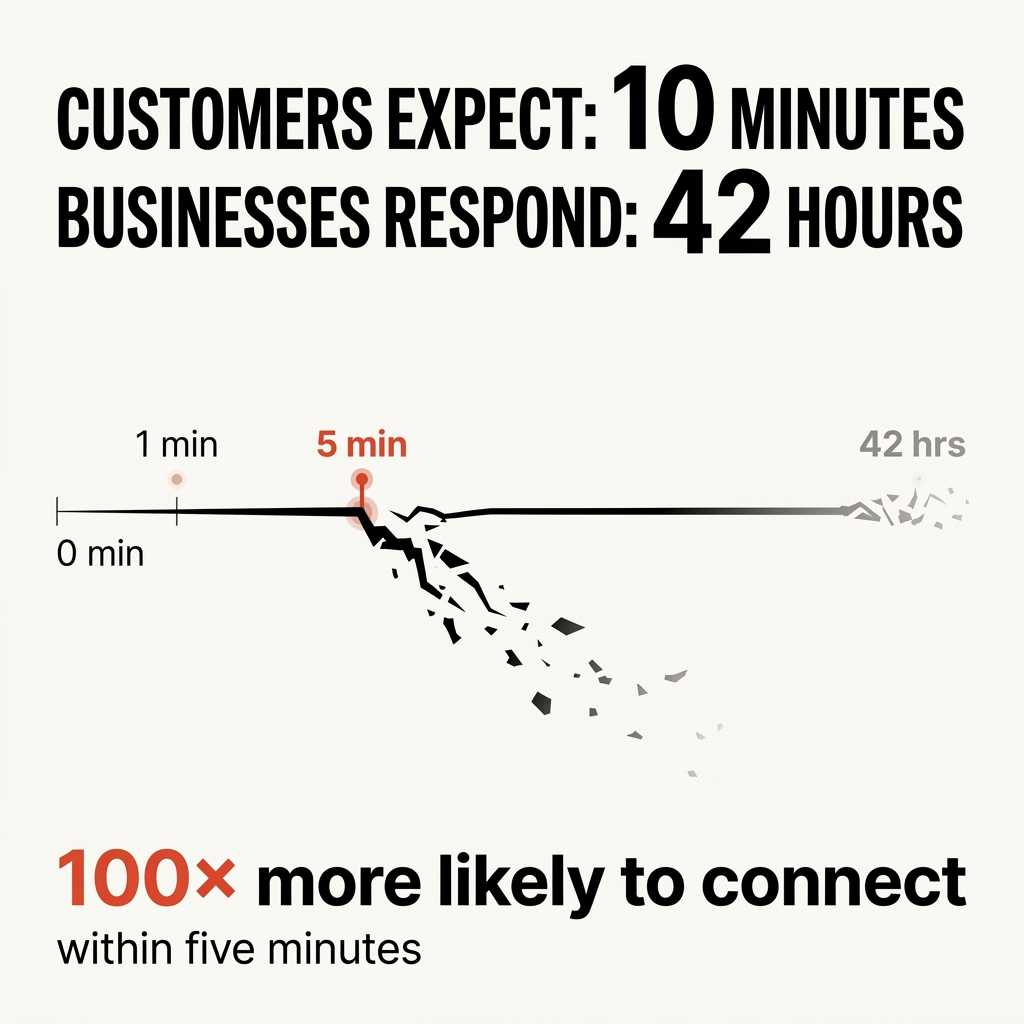
TL;DR: You’re losing customers between enquiry and response, not because your funnel is broken, but because you’re too slow. Responding within five minutes makes you 100x more likely to make contact. Most businesses take 42 hours. Fix that, and your conversion rate climbs without touching a single landing page.
Responding within 5 minutes makes you 100x more likely to reach a lead and 21x more likely to qualify them.
Calling within 1 minute of an enquiry boosts conversions by 391%.
78% of customers buy from the first company that responds.
The average business response time is 42 hours. Customers expect a reply in under 10 minutes.
Clients who fix their response time close 8-24% more customers, with zero changes to their offer or pitch.
You’ve spent months perfecting your marketing funnel.
The landing pages are optimised. The copy is sharp. The lead magnets are compelling. You’re driving traffic, generating enquiries, and watching the numbers tick up in your CRM.
Then you check your conversion rate and wonder what went wrong.
Here’s what most founders miss: the gap between enquiry and response is where your revenue disappears.
Whilst you’re obsessing over funnel architecture, your competitors are winning customers simply by responding faster. The data proves it, and the gap between what businesses know and what they actually do is staggering.
Research from Harvard Business Review and MIT reveals something that should stop you in your tracks: responding to a new lead within five minutes makes you 100 times more likely to make contact and 21 times more likely to qualify the lead.
Read that again.
100 times more likely to make contact.
The original research, conducted by Dr James Oldroyd at MIT, analysed over 15,000 leads. The findings weren’t subtle. After just five minutes, the odds of qualifying a lead plummet by 80%. Conversion rates drop by eight times when follow-up is delayed by a mere five minutes.
This isn’t about being slightly better. The deterioration of prospect interest is exponential. Every minute that passes after initial contact has a disproportionate impact on your probability of conversion.
Bottom line: The five-minute window isn’t a nice-to-have. It’s the difference between a paying customer and a lead that goes cold before you’ve finished your coffee.
Research from Velocify found that calling a lead within one minute of their enquiry boosts conversion rates by 391%. That’s not a typo.
There’s a 391% increase in actual sales conversions, not just bookings, when inbound leads are contacted within the same minute they submit a demo request.
The principle is blunt: 78% of customers buy from the first company that responds. Being first often matters more than being best.
Your funnel design doesn’t matter if someone else answers the phone first.
Bottom line: Speed isn’t a sales tactic. It’s the sales tactic.
The average response time across industries is 42 hours. Meanwhile, 82% of consumers consider an “immediate response” to their marketing, sales, and customer service concerns to be important or very important. Most define immediate as within 10 minutes.
Let that sink in.
Customers expect a response in 10 minutes. Businesses respond in 42 hours.
Only 0.1% of inbound leads are engaged in under five minutes.
Only 23% of companies responded within five minutes.
42% took more than 24 hours.
If you respond quickly, you’re already ahead of 99.9% of your competition. That’s not a small edge. That’s a chasm.
Bottom line: The execution gap is enormous. Closing it doesn’t require genius. It requires urgency.
Moving a lead from the 24-hour bucket into the under-five-minute bucket roughly 2.6x’s the close rate, from 12% to 32%. No change to the offer. No change to the rep. No change to the pitch.
The lever is purely operational.
You’re not redesigning your entire marketing strategy. You’re not rebuilding your product. You’re not hiring a new sales team.
You’re fixing a process problem that’s costing you customers right now.
Real-world result: clients closing between 8% and 24% more customers simply by getting back to leads faster. That’s it. Nothing fancy.
Bottom line: This is the most unsexy, high-return fix in your entire business. You’re welcome.
Last year, B2B marketers spent over $4.6 billion on advertising. Nearly $2.7 billion of that investment was wasted due to slow or no follow-up.
More than 30% of leads are never contacted.
You’re paying to generate leads, then ignoring them. It’s like filling a bucket with a hole in the bottom and wondering why it’s empty.
The problem isn’t your funnel. The problem is what happens after someone enters it.
Bottom line: Slow follow-up doesn’t just lose customers. It sets fire to your ad spend.
Most trade businesses are messy behind the scenes. Inconsistent pricing. Unclear processes. Weak follow-up.
AI tools respond instantly, but they often expose bigger problems underneath: poor sales skills, lack of structure, missed opportunities. The hardest part isn’t the technology. It’s the business you’re plugging it into.
Response time isn’t just about speed. It’s about having systems that work when a lead comes in. Knowing what to say. How to qualify. What happens next.
Businesses that excel at response time have done the unglamorous work: mapping processes, training teams, eliminating bottlenecks.
If you can’t respond quickly, it usually means your operations are broken. Response time is one of the best diagnostics in the business.
Bottom line: Speed is a symptom of operational health. If you’re slow, something deeper needs fixing.
83% of customers expect to interact with someone immediately upon contact, according to Salesforce. Almost 66% of buyers expect a response within 10 minutes to any marketing, sales, or customer service enquiry.
More than half of your customers say slow responses are their biggest frustration.
Not product issues. Not pricing. Response speed.
Customer expectations are rising. The companies that meet them win. The companies that don’t lose to someone who will.
Bottom line: Your customers have already set the bar. The question is whether you’re clearing it.
Start by tracking how long it takes from enquiry to first contact. Most businesses don’t know this number, which is exactly why they can’t improve it.
Five minutes is the gold standard. Even getting to 30 minutes puts you ahead of most competitors.
AI receptionists that respond within 60 seconds.
Alerts that notify your team the moment a lead comes in.
Restructured sales processes that remove delay at every step.
The specific solution matters less than the commitment to speed.
The goal isn’t to close the deal immediately. It’s to make contact, qualify the lead, and lock in the next step.
Every step between enquiry and response is a chance for delay. Simplify until it hurts.
Bottom line: Speed to lead isn’t a culture shift. It’s a process shift. Map it, build it, stick to it.
Response time is one of the few competitive advantages that’s both high-impact and widely available.
You don’t need a bigger budget. You don’t need better technology. You don’t need a revolutionary product.
You need to answer faster than your competitors.
The data is clear. The opportunity is massive. The execution gap is real.
Whilst everyone else is redesigning their funnels, you can win by simply picking up the phone.
Bottom line: The competitive advantage hiding in plain sight isn’t a secret. It’s just a phone call you haven’t made fast enough yet.
Five minutes or under. Research shows that responding within five minutes makes you 100x more likely to reach a lead and 21x more likely to qualify them. Even hitting 30 minutes puts you ahead of most businesses.
Because buyer intent is at its peak the moment someone enquires. The longer you wait, the more that intent fades. Interest drops off exponentially, not gradually.
In most cases, response time has a bigger impact. Moving a lead from a 24-hour response to under five minutes roughly 2.6x’s your close rate, with no changes to your offer or pitch.
Only 23%. And just 0.1% of inbound leads are engaged in under five minutes. Most businesses take over 24 hours.
The majority define it as within 10 minutes. Yet the average business response time is 42 hours. That gap is your opportunity.
AI can respond instantly, but it often exposes deeper issues like weak sales processes and poor qualification. Technology speeds up the response. You still need a solid system behind it.
In B2B alone, nearly $2.7 billion in ad spend was wasted last year due to slow or no follow-up. More than 30% of leads are never contacted at all.
Measure it. Most businesses have no idea how long their current response time is. You can’t fix what you don’t track.
Responding within five minutes makes you 100x more likely to reach a lead and 21x more likely to qualify them.
78% of customers buy from the first company that responds. Speed beats quality in the race to conversion.
The average business takes 42 hours to respond. Customers expect a reply in 10 minutes. That gap is your opportunity.
Moving from 24-hour to five-minute responses roughly 2.6x’s your close rate, with zero changes to your offer.
Poor response time is usually a symptom of broken operations, not just a scheduling problem.
$2.7 billion in B2B ad spend is wasted annually on leads that never get followed up. Don’t add to that number.
You don’t need a fancier funnel. You need to answer faster than the person next to you.
Reading is good. A roadmap is better.