TL;DR: Founders keep throwing money at ads wondering why nothing converts. The problem isn’t the creative. It’s that you’re asking strangers to buy from a brand they have no reason to believe in. Build the trust infrastructure first. Then advertise.
Why your ads aren’t converting despite decent traffic
What “trust infrastructure” actually means in practice
What the real financial cost of a trust gap looks like
Why founders keep repeating this expensive mistake
How a Fractional CMO builds the credibility layer that makes advertising work
You’ve spent thousands on Facebook ads. Google ads. LinkedIn campaigns. The clicks are coming in. The traffic looks decent on paper.
But the conversions? Crickets.
Here’s the uncomfortable truth most founders miss: pouring money into advertising whilst skipping the trust infrastructure is like building a shop with no floor. People walk in, look around, and fall straight through.
The problem isn’t your ad creative. The problem is you’re asking strangers to buy from a brand they have zero reason to believe in.
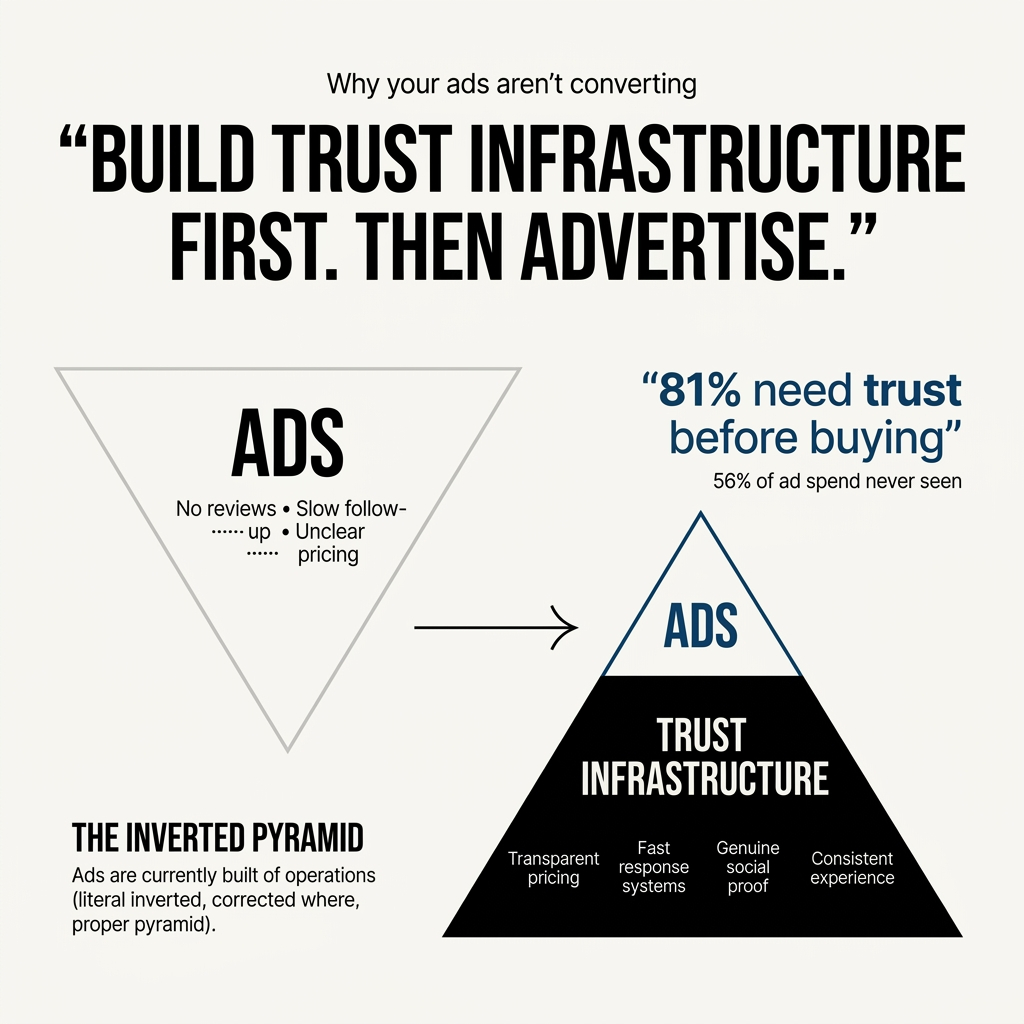
Let’s talk numbers. 81% of consumers need to trust a brand before they’ll even consider buying. Not “might consider” or “could be persuaded.” Trust is the baseline requirement.
Meanwhile, trust in companies sits at just 47%, whilst trust in reviews from other users has rocketed to 64%. Translation: your customers trust complete strangers talking about your business more than they trust your own marketing.
That’s the credibility gap your ads are trying to bridge. And they’re failing.
When you don’t have trust infrastructure in place, every pound you spend on advertising is working twice as hard for half the result. You’re not just competing on price or features. You’re fighting an uphill battle against scepticism, doubt, and the lingering question: “Can I actually believe what this company is telling me?”
Key Point: Trust isn’t a nice-to-have. It’s the baseline your advertising needs to function at all.
Trust infrastructure isn’t a buzzword. It’s the foundational layer that makes your marketing credible before you ever ask someone to click “buy now.”
It includes:
Transparent pricing and policies. No hidden fees. No fine print surprises. 75% of consumers won’t buy from organisations they don’t trust with their data. Unclear pricing and buried policy shifts do outsized damage to trust.
Consistent customer experience. Speed matters. You can have the best product in the world, but if your follow-up is slow or your processes are messy, you’ve lost the sale. The hardest part isn’t the campaign. It’s the business you’re plugging it into.
Social proof that’s real. Customer reviews can increase conversion rates by 270% because they address buyer uncertainty. Reviews are 12 times more trusted than traditional advertising. If you’re not actively collecting and displaying genuine customer feedback, you’re leaving money on the table.
Brand credibility signals. Your website, your content, your response times, your customer service. Every touchpoint either builds trust or erodes it. There’s no neutral ground.
Most businesses skip this layer entirely. They build a website, launch some ads, and wonder why the leads aren’t converting. The answer is simple: you’re asking people to trust you before you’ve given them any reason to.
Key Point: Trust infrastructure is the system of signals, processes, and proof points that make a first-time visitor feel safe enough to become a customer.
Wasted ad spend isn’t just about bad creative or poor targeting. It’s about operating in a black hole where you can’t connect marketing activity to actual business outcomes. When you don’t know which touchpoints drive real customers, you’re destined to repeat expensive mistakes.
Google found more than 56% of ad impressions are never seen by consumers. Proxima estimates $37 billion of worldwide marketing budgets are being wasted on poor digital performance. That’s not a rounding error. That’s a systemic failure.
And here’s the part that really stings: even when your ads do get seen, they’re fighting an uphill battle. Ad-blocking software adoption reached 42% amongst desktop users globally, costing the digital advertising industry an estimated $54 billion in lost impressions annually. People are actively avoiding your ads because they don’t trust them.
The biggest financial costs aren’t the fines for false advertising or the wasted impressions. They’re the indirect costs: lost trust, wasted marketing spend, and delayed growth. A 10% decline in repeat customers from broken trust reduces lifetime value by 20 to 30%.
You can’t advertise your way out of a trust problem. You have to build your way out.
Key Point: The real cost of a trust gap isn’t just wasted impressions. It’s the compounding damage to lifetime value and growth that follows.
Advertising is tangible. You can see the campaign. You can track the clicks. You can show the board a shiny new ad creative and feel like you’re doing something.
Trust infrastructure is invisible. It’s the systems, the processes, the follow-up, the consistency. It doesn’t photograph well for investor updates. It’s not sexy.
But it’s what actually drives conversion.
Most trade businesses are messy behind the scenes. Inconsistent pricing, unclear processes, weak follow-up. You can have the best ad in the world, but if your business operations are chaotic, the ad will fail.
Once a website is built, it just sits there. It doesn’t really do much to bring in leads. The same goes for campaigns launched without infrastructure. They sit there, burning budget, generating clicks that go nowhere because there’s no system to capture, nurture, and convert them.
Key Point: Founders default to advertising because it’s visible. Trust infrastructure is invisible, but it’s what actually decides whether the advertising works.
This is where the role of a Fractional CMO shifts from “campaign manager” to “infrastructure architect.”
A Fractional CMO worth their salt doesn’t just launch ads. They build the credibility layer that makes those ads convert. They ask the uncomfortable questions:
Do you have a system to respond to leads within minutes, or are they sitting in an inbox for days?
Are your pricing and policies transparent, or are customers discovering hidden costs at checkout?
Do you have genuine customer reviews and testimonials, or is your social proof non-existent?
Is your brand messaging consistent across every touchpoint, or does it change depending on who’s writing the copy that week?
These aren’t marketing questions. They’re business questions. And they determine whether your advertising budget is an investment or a bonfire.
Brands with credibility convert more leads into customers, enhancing overall sales performance. Brand credibility is closely tied to marketing effectiveness. Brands that successfully establish credibility find it easier to implement marketing strategies, from social media campaigns to email marketing.
The Fractional CMO builds that credibility. They don’t just run campaigns. They build the whole system to get more leads and the tools to nurture them to close. You’re getting a website, yes, but you’re also getting the marketing engine to back it up.
Key Point: A Fractional CMO’s real job isn’t running campaigns. It’s building the credibility infrastructure that makes campaigns worth running.
Consumer trust in advertising climbed to 47% in 2026, an 8-percentage-point jump from 2025’s 39%. That sounds encouraging until you realise it’s still less than half. Only 40% of UK consumers trust advertising overall.
Trust is the defining metric of this moment because it’s multidimensional, harder to fake, and directly tied to the outcomes that matter most: customer lifetime value, employee retention, brand resilience in a crisis, and sustained growth rather than viral spikes.
Consumers spend 51% more with retailers they trust.
Trusted brands command 15 to 20% price advantages over competitors.
68% of shoppers will pay more for products from brands they trust.
67% cite product quality and value as defining factors.
63% cite brand reputation.
54% highlight customer service.
Trust converts into pricing power and margin. It’s the ultimate competitive advantage.
But you can’t buy it with ad spend. You have to build it with infrastructure.
Key Point: In 2026, trust isn’t just a feel-good metric. It’s the engine behind pricing power, retention, and sustainable growth.
Your advertising isn’t failing because your creative is bad or your targeting is off. It’s failing because you’re asking people to trust you before you’ve built the infrastructure that earns trust.
A Fractional CMO who understands this doesn’t just manage campaigns. They build the credibility layer. They fix the messy processes, establish transparent pricing, implement fast follow-up systems, and create consistent customer experiences. They turn your marketing from a cost centre into a growth engine.
Because here’s the reality: you can have the best ads in the world, but if nobody trusts you, they won’t convert.
Build the trust infrastructure first. Then advertise.
That’s the difference between burning budget and building a business.
81% of consumers need to trust a brand before they’ll consider buying. Trust isn’t optional. It’s the entry ticket.
Customers trust peer reviews 12 times more than brand advertising. Your marketing is fighting itself if you don’t have social proof.
56% of ad impressions are never seen. $37 billion in marketing budgets is wasted annually on poor digital performance.
A 10% drop in repeat customers from broken trust reduces lifetime value by 20 to 30%.
A Fractional CMO’s real value isn’t in running campaigns. It’s in building the credibility infrastructure that makes campaigns convert.
Trusted brands command 15 to 20% price premiums and retain customers who spend 51% more.
Stop advertising into a trust vacuum. Build the foundation, then spend on ads.
Trust infrastructure is the system of signals, processes, and proof points that make a first-time visitor feel safe enough to become a customer. It includes transparent pricing, genuine reviews, consistent messaging, fast follow-up, and reliable customer service.
Clicks without conversions usually point to a trust gap. You’re attracting attention, but visitors don’t have enough reason to believe in your brand. The fix isn’t better creative. It’s building the credibility layer before you spend on ads.
A Fractional CMO acts as your part-time chief marketing officer. Beyond running campaigns, they build the full marketing infrastructure: lead capture systems, follow-up processes, brand consistency, and the credibility signals that make advertising work.
Customer reviews increase conversion rates by up to 270% because they address buyer uncertainty at the point of decision. Reviews are 12 times more trusted than traditional advertising, making them one of the highest-leverage trust signals available.
Not at all. Smaller businesses are often more exposed to the trust gap because they lack the brand recognition that larger companies rely on. For founders and small business owners, trust infrastructure is the difference between a campaign that works and one that drains budget.
Google found that 56% of ad impressions are never seen. Proxima estimates $37 billion in marketing budgets is wasted on poor digital performance annually. A 10% decline in repeat customers from broken trust reduces customer lifetime value by 20 to 30%.
The foundations, transparent pricing, a review collection process, consistent brand messaging, and a lead follow-up system, can be put in place within weeks. Genuine trust compounds over time as the consistency of your customer experience builds a track record.
You can start on your own, but most founders lack the strategic oversight to identify where the gaps are. A Fractional CMO brings the outside perspective and systematic approach to spot the issues quickly and fix them in the right order.
Reading is good. A roadmap is better.