
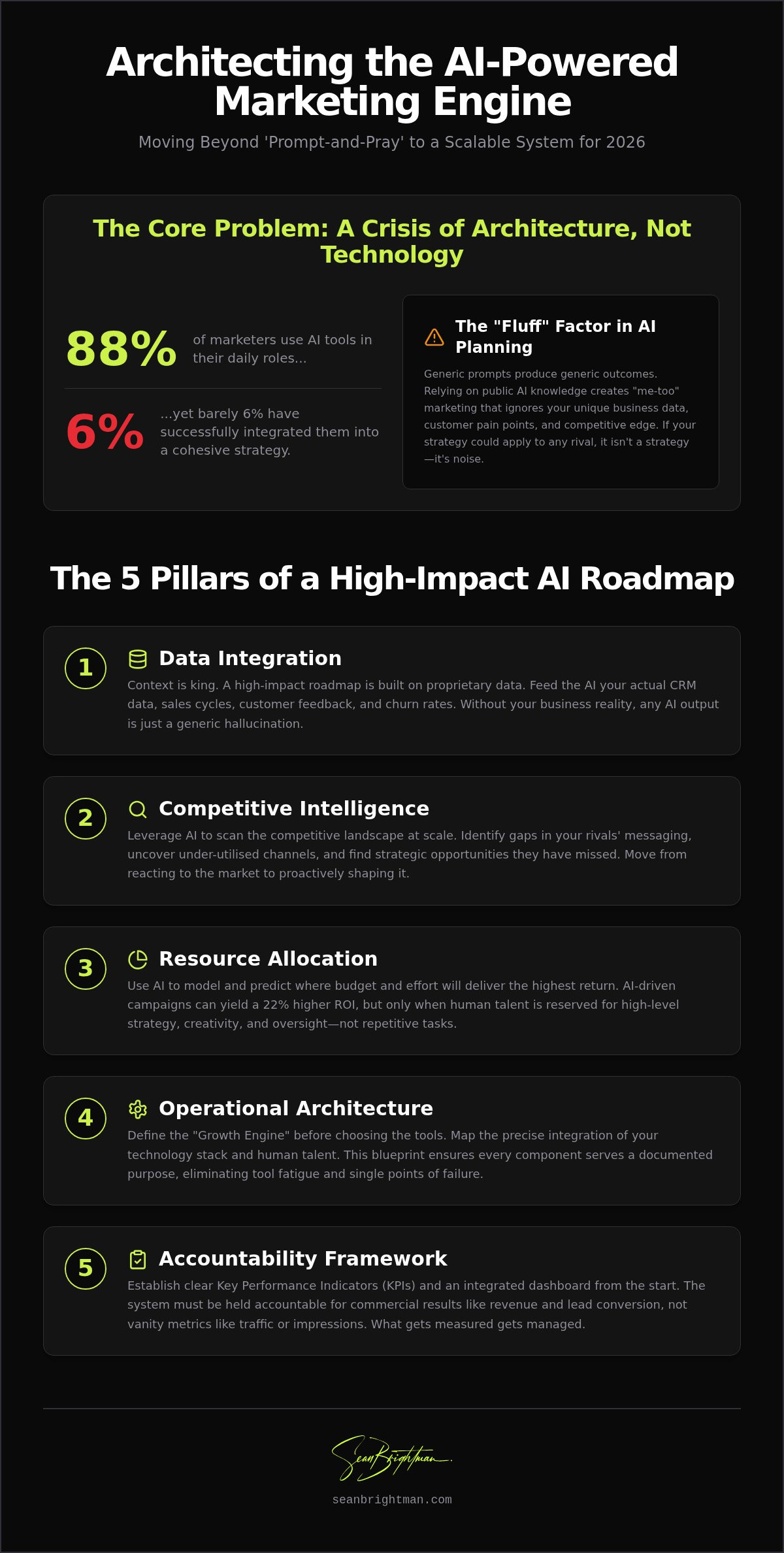
88% of marketers are now using AI tools in their daily roles, yet barely 6% have successfully integrated them into a cohesive strategy. Most businesses are trapped in a cycle of generating fluffy, generic content that lacks any real commercial edge. You don’t have a technology problem; you have an architecture problem. Using ai to create a marketing roadmap shouldn’t mean asking a chatbot for a 12-month plan and crossing your fingers. It means building a high-velocity growth engine that provides clarity, accountability, and a measurable return on investment.
It’s exhausting to manage a bloated tech stack whilst receiving output that feels like a corporate hallucination. You need a roadmap that investors will actually respect, not a collection of disjointed prompts. This guide strips away the noise to show you how to architect a scalable system for 2026. We will move beyond basic automation to define where AI adds genuine value and where it is just an expensive distraction. You’re about to learn how to turn fragmented tools into a functional, battle-hardened marketing machine that drives actual business growth.
Speed is the enemy of strategy if you don’t know where you’re going. Some platforms promise a complete plan in under five minutes. They’re selling you a five-minute mistake. Using ai to create a marketing roadmap requires more than a clever prompt; it requires an architect who understands that a roadmap is a dynamic system, not a static PDF gathering dust in a folder.
Most UK businesses are stuck in the “Prompt-and-Pray” cycle. They feed basic instructions into a chatbot and expect a growth miracle. It doesn’t happen. Generic prompts produce generic outcomes. In a market as cynical and competitive as the UK, “me-too” marketing is a death sentence. You need strategic velocity, not just content volume.
Effective implementation starts with a foundational understanding of Artificial Intelligence in Marketing as a strategic lever. It isn’t an add-on; it’s the core infrastructure. In 2026, the differentiator isn’t who has the best tools. It’s who has the best strategy driving them.
Basic AI models are echo chambers. They draw from public knowledge, which means they suggest exactly what your competitors are already doing whilst ignoring your unique edge. This creates a “fluff” factor that dilutes your unique positioning. When using ai to create a marketing roadmap, you must prioritise proprietary data: your specific customer pain points, your internal sales cycles, and your actual business reality.
Relying on public LLM knowledge alone is dangerous. It ignores the nuance of your brand. If your strategy could apply to any other business in your sector, it isn’t a strategy. It’s noise. True strategic depth comes from feeding the machine your reality, not just asking it for its opinion. Avoid the trap of the AI echo chamber by ensuring your roadmap is built on facts, not hallucinations.
You cannot automate chaos. A flawed underlying business logic ensures that AI simply helps you fail faster and at a larger scale. You must define your “Growth Engine” before you even look at a software subscription. This is about building the machine first, then choosing the fuel that makes it run.
Focus on the mechanics of your lead generation and conversion. Every tool in your stack must serve a specific, documented purpose within the broader system. A marketing roadmap is a functional component of business machinery, designed to convert strategic intent into predictable revenue through precise mechanical integration.
A roadmap isn’t a wish list. It’s a blueprint for a high-velocity machine. Using ai to create a marketing roadmap requires five foundational pillars to ensure your strategy doesn’t collapse under the weight of generic automation. You’re building a system for exit-readiness and strategic velocity, not just a collection of clever prompts.
Move from “what should we do” to “how do we scale”. Use AI to model different growth scenarios based on your current metrics. This involves integrating strategic brand roadmapping into your workflow to ensure your brand identity isn’t lost in the automation. You’re building for long-term value, not just next month’s lead count. If you need a partner to help architect this, a roadmapping session is the logical starting point.
Identify the “Critical Human Junctions”. AI is the fuel, but humans are the drivers. Your roadmap must include training for the team to manage these tools effectively. Build a “Human-in-the-loop” system to protect your brand tone and creative direction. AI can draft, but senior leaders must refine. This ensures your strategic velocity doesn’t lead you off a cliff. You cannot automate brand soul; you can only automate the delivery of it.
Stop adding. Start auditing. Most marketing departments are currently a graveyard of half-baked AI subscriptions. Tool fatigue is real, and it’s expensive. In 2026, using ai to create a marketing roadmap requires you to treat technology as core infrastructure, not a series of shiny add-ons. If your tools don’t talk to each other, you don’t have a system. You have a mess.
Building this machinery is complex. It requires more than just a login; it requires an architect. This is why a marketing operations consultant is vital for this stage. They don’t just add tools; they architect the flow of data. They ensure your stack is a cohesive engine rather than a collection of isolated parts.
You must categorise your stack into four functional zones: Collection, Analysis, Execution, and Governance. If a tool doesn’t fit into these buckets or refuses to integrate via API, kill it. Choose integration over novelty. Choose unified data over fragmented silos. Your roadmap must include a clear decommissioning plan for redundant legacy tools that slow down your strategic velocity.
Governance is no longer optional. With the FTC now levying penalties of up to $53,088 per violation for non-disclosure of AI content in 2026, your infrastructure must track every output. You need a system that ensures compliance whilst maintaining speed. Don’t let a “cool” tool become a legal liability because it lacks an audit trail.
Public tools are for the masses. Custom agents are for the winners. Whilst 88% of marketers use AI daily, only a fraction are building proprietary systems. You should be training custom GPTs and agents on your specific brand voice, sales data, and customer behaviour. This creates a Single Source of Truth that no competitor can replicate using generic prompts.
Protecting your IP is paramount. When using ai to create a marketing roadmap, ensure you’re using enterprise-grade platforms that don’t train their public models on your data. You’re building a growth engine, not donating your strategy to the public domain. Build your own “intelligence layer” that lives on top of third-party platforms. This ensures that if you switch vendors, your strategic brain stays with you.
A roadmap is not an execution engine. It’s a blueprint. Many leaders fall for the “Done-for-you” delusion, believing that once the strategy is set, the machine runs itself. It doesn’t. Using ai to create a marketing roadmap gives you the direction, but your team provides the friction or the fuel. Without senior oversight, your high-velocity engine will quickly become a high-velocity mess.
You must bridge the gap between high-level strategic thinking and weekly tactical execution. AI can draft the plan, but it cannot ensure your team hits their deadlines or maintains the quality of the output. Accountability is the missing component in most AI implementations. With the median monthly AI tool spend for mid-market teams tripling to $3,400 in early 2026, the cost of unaccountable experimentation is simply too high.
Don’t get blinded by technical jargon. If your marketing lead cannot explain how the roadmap drives revenue, the roadmap is useless. Every CEO must ask three critical questions: How does this specific AI application shorten the sales cycle? Where is the human-in-the-loop for brand governance? What happens to our data if we switch vendors? Use AI to provide real-time reporting on these progress points. Never mistake high activity for high impact. Drafting fifty blog posts is activity; closing ten deals is a result.
One-off strategy sessions are great for clarity, but they’re terrible for consistency. Directional drift is the silent killer of growth. This is why ongoing strategic marketing direction beats a static document every time. You need a navigator who understands how to maintain the machinery of the roadmap through monthly accountability sessions.
The AI landscape moves too fast for a “set and forget” mentality. Your roadmap must evolve as new capabilities emerge throughout 2026. An advisory retainer ensures you’re always using the most efficient tools without losing sight of your commercial objectives. If you’re ready to stop guessing and start growing, book a roadmapping session to lock in your strategy and accountability framework.
Hiring a full-time CMO to manage an automated stack is the “£120k mistake”. In 2026, you don’t need a permanent fixture in the boardroom to oversee your growth engine. You need a navigator. Using ai to create a marketing roadmap allows for extreme operational efficiency, which means the traditional heavy-weight marketing hire is often redundant. You need the brain, not the desk space.
A fractional CMO brings the battle-hardened perspective that AI simply cannot simulate. AI knows the data; a veteran knows the stakes. This is about senior-level authority without the corporate overhead. It’s about plug-and-play advisory that fixes the machinery and then ensures it stays fixed. You’re buying strategic velocity, not just another salary on the balance sheet.
Stop hiring for capacity. Start hiring for clarity. The debate between fractional and full-time leadership has been settled by AI efficiency. If your marketing systems are architected correctly, the day-to-day execution is handled by your team and your tools. Your requirement is high-value strategic consulting, not administrative management.
You need someone to get their hands dirty fixing the department’s architecture, then step back to provide oversight whilst your strategic velocity increases. Focus your budget on the machinery, not the management. A senior advisor doesn’t care about internal politics or recruitment cycles. They care about results. They ensure that using ai to create a marketing roadmap leads to commercial wins, not just a busier Slack channel.
Build for the exit, even if you aren’t selling today. A business with a documented, AI-powered growth engine is worth significantly more than one reliant on “Key Person Dependency”. Buyers covet scalable systems. They want to see that your marketing doesn’t collapse if a specific manager leaves. Your roadmap is the proof that your growth is predictable and your systems are scalable.
Documented processes and AI-driven intelligence layers turn your marketing from a cost centre into a transferable asset. This is how you increase business valuation in 2026. You remove the friction and replace it with a functional component of business machinery. If you’re ready to stop the drift and start building a high-velocity engine, it’s time to act. Book an AI Roadmapping Session with Sean Brightman today and get the senior oversight your strategy deserves.
Stop playing with prompts. Start building systems. You’ve seen why generators aren’t strategies and why your stack requires a unified architecture. Using ai to create a marketing roadmap isn’t about saving time on content; it’s about building a scalable growth engine that investors respect. It’s the difference between disjointed activity and tactical precision.
You need the right machinery and a battle-hardened AI strategist. As a Fractional CMO for UK scale-ups and author of “The Strategic Marketing Methodology”, I know that senior-level clarity fixes messy departments. Don’t let your direction drift into the “messy middle” of disconnected tools and generic output. You have the blueprint. Now you need the execution.
It’s time to stop the guesswork and start driving commercial results. Book your AI Marketing Roadmap session today and lock in the senior oversight your business demands. Let’s build a growth engine that actually moves the needle.
Audit your data foundations first. Don’t start with tools. You cannot build a functional system on top of internal chaos. The process begins with a deep dive into your CRM, sales cycles, and customer pain points. Once your business reality is clear, you can begin using ai to create a marketing roadmap that focuses on mechanical integration rather than just generating generic content ideas. Building a machine requires a blueprint, not just a subscription.
No, AI cannot replace the battle-hardened perspective of a senior consultant. Tools are excellent at processing data, but they lack the strategic intuition required to navigate complex UK market shifts or internal politics. A consultant acts as the architect who designs the growth engine, ensuring every AI output aligns with commercial goals. You need a human driver to maintain accountability and prevent the machine from drifting off course into generic fluff.
The best tools in 2026 are those that offer deep API integration rather than isolated chat interfaces. Choose platforms that connect directly to your CRM and business intelligence layers to create a single source of truth. Custom-built agents trained on your proprietary data are far more valuable than public LLMs. Focus on infrastructure that allows your systems to talk to each other without manual intervention or constant human hand-holding.
Review your strategic direction quarterly and adjust your tactical execution monthly. The AI landscape in 2026 moves at a high velocity, with new capabilities emerging constantly. A static document is useless in this environment. Your roadmap must be a dynamic system that evolves alongside technological shifts. This ensures your growth engine remains efficient whilst preventing your team from falling behind more agile competitors who are updating their machinery in real-time.
An AI-generated plan will only be unique if you feed it unique data. If you use basic, public prompts, you’ll receive me-too marketing that ignores your specific positioning. To build a roadmap buyers actually respect, you must integrate your proprietary sales data and brand voice. Using ai to create a marketing roadmap requires you to provide the context that makes the machine’s output commercially viable and distinct from your rivals.
Costs vary based on the complexity of your stack and the level of senior oversight required. In 2026, a mid-market marketing team typically spends around $3,400 per month on AI tools alone. However, the real investment is in strategic architecture. Avoid the £120k mistake of a full-time hire by opting for fractional leadership. This provides the senior expertise needed to build your engine without the bloated corporate overhead or recruitment fees.
Accountability is the only way to ensure execution doesn’t drift. You need a structured framework, such as an advisory retainer, to provide monthly oversight and direction. Use AI-powered dashboards to monitor output and efficiency in real-time. If your team isn’t held accountable to specific KPIs, your roadmap remains a theoretical exercise. Senior leadership must bridge the gap between strategic intent and weekly tactical delivery to ensure the machine actually runs.
A tactical plan focuses on what to post, whilst a strategic roadmap defines how you win. Tactics are isolated actions like drafting emails or social posts. A strategic AI roadmap is the mechanical architecture of your entire growth engine. It defines how data flows, how tools integrate, and how your team scales what works. It’s the difference between running a single campaign and building a permanent, high-value business asset.
Reading is good. A roadmap is better.