
A long list of marketing services won’t fix a startup’s growth problem. Choosing a marketing consultant for tech startups uk means looking beyond the menu to the decisions they can help you make: what to prioritise, how marketing supports business goals and who will keep the plan accountable.
If your activity feels fragmented, you’re right to want more than another batch of tactics. But you may not need a full-time marketing executive either. The right support depends on your stage, your team and whether you need a clear strategy, senior leadership or help maintaining momentum.
This guide will help you identify the support that fits, assess a consultant’s approach and scope an engagement around real business priorities. You’ll also see how strategic roadmapping can turn competing ideas into a focused plan, and how Fractional CMO leadership or an advisory retainer can provide senior direction without a full-time hire. The test isn’t how many services someone lists. It’s whether they can bring focus and accountability to your growth.
Marketing is happening, but it isn’t adding up. Product launches, content and channel activity run in parallel, priorities shift every few weeks, and nobody senior owns the decisions behind them. That’s a reason to diagnose the problem before adding more activity.
A marketing consultant examines what the business needs and brings focused expertise to address it. That might mean sharpening positioning, setting priorities or improving how the marketing team works. The role should connect Marketing strategy to commercial objectives, not simply produce a list of tactics.
Be clear about the type of help involved. Some consultants provide strategic advice; others may also work hands-on in particular channels. A startup with a clear plan but limited delivery capacity may need execution support, whilst a team unsure which audience or market to prioritise needs direction first.
Start with the business constraint, not the channel. Is the challenge that the product’s value is hard to explain, the target audience is unclear, the team lacks relevant expertise, or marketing operations are too fragmented to support a consistent plan? Each points to a different gap.
For example, if a SaaS team publishes regularly but can’t explain how that work supports its commercial goals, more content may not be the answer. The priority could be clearer positioning, audience focus or a better way to choose and review marketing activity.
The answers help define whether you need specialist advice, channel execution or an experienced person to guide the overall direction.
External senior direction can make sense when marketing decisions carry real weight, but the business isn’t ready to create a permanent executive role. Perhaps the founder is still setting priorities, a small team needs a clearer framework, or several activities need to come under one accountable plan. The right moment depends on the business’s objectives and capabilities, not a fixed funding stage, headcount or revenue figure.
A Fractional CMO provides part-time senior marketing leadership. It brings strategic direction and accountability without a full-time CMO. Sean’s Fractional CMO work can help establish priorities and marketing systems. Strategic roadmapping offers a structured plan when the immediate need is clarity. Choose the support that matches the gap, not the most impressive-sounding title.
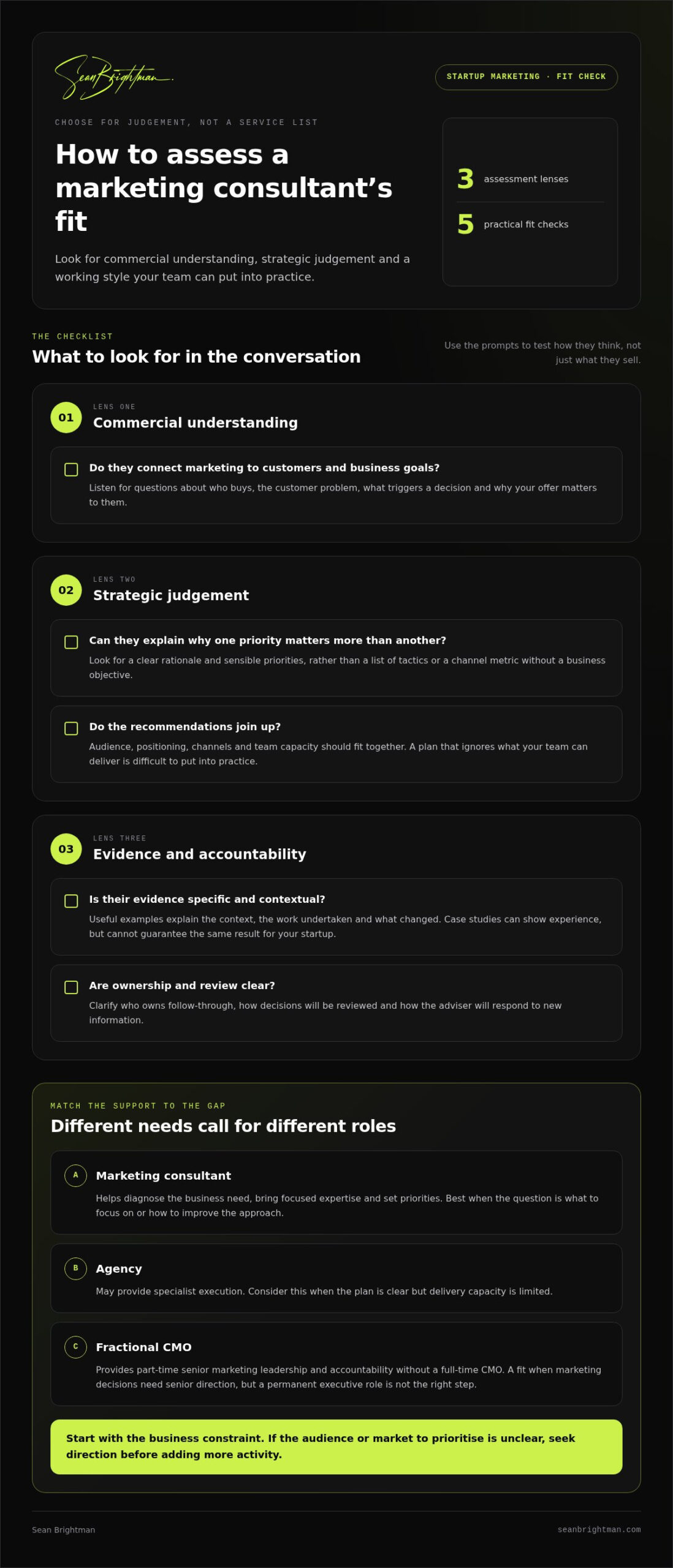
A polished service page tells you what a consultant sells, not how they think. To assess a marketing consultant for tech startups uk, look for three things: commercial understanding, strategic judgement and a working style your team can put into practice.
Technology can be complex, but buyers still need a clear reason to care. A strong adviser should look beyond product features, understand the customer problem and connect that insight to positioning and marketing priorities. Listen for questions about who buys, what triggers a decision and what makes your offer relevant, not just which channels you want to use.
Then test whether the recommendations join up. If they propose a new audience, can they explain how the positioning should speak to it, which channels could reach it and what the team needs to deliver? A strategy that ignores internal capacity is a plan on paper, not a workable direction.
Ask for relevant examples and the thinking behind them. Useful evidence explains the context, the work undertaken and what changed. A channel metric without a business objective or starting point proves little. Case studies can show experience, but they can’t guarantee the same result for your startup.
Look for recommendations with a clear rationale, sensible priorities and measures tied to business objectives. Clarify how decisions will be reviewed, who owns follow-through and how the adviser will respond to new information. For more prompts to shape an assessment, see how to hire a marketing consultant.
Use this checklist to compare advisers:
If you’re looking for senior direction grounded in strategy, positioning and accountability, explore Sean Brightman’s marketing approach to see how that support could fit your startup.
These roles can overlap, but they solve different problems. A consultant helps diagnose and prioritise. An agency may provide specialist execution. A Fractional CMO takes on senior marketing leadership part-time. The right choice depends on whether your gap is direction, delivery or ongoing ownership.
| Role | Primary responsibility | Best-fit need | Typical working relationship |
|---|---|---|---|
| Independent consultant | Diagnose needs, challenge assumptions and recommend priorities | A defined strategic question or need for specialist advice | Project-based or ongoing advice, depending on the brief |
| Specialist agency | Deliver agreed work within its area of expertise | Internal direction is clear, but the team needs specialist delivery capacity | Scoped work or a continuing delivery relationship |
| Fractional CMO | Provide part-time senior leadership and guide marketing direction | Decisions, priorities and accountability need ongoing senior ownership | Part-time leadership, often supported by continued advisory |
These are working models, not rigid rules. Some consultants also support implementation; some agencies contribute strategic thinking. Get specific about responsibilities: who sets priorities, who makes decisions and who carries out the work? A marketing consultant for tech startups uk may sharpen the plan, but that doesn’t automatically mean they’ll deliver every channel activity.
A consultant-led engagement often starts with diagnosis: understand the business problem, identify what’s getting in the way and decide what deserves attention first. An agency engagement may instead centre on specialist delivery, such as a defined channel programme. There’s no universal model, so compare the actual scope, not the label.
For a technology startup, recommendations should fit the product, buyers and operating capacity. Academic research on tech startup marketing can add useful context, but a research finding or marketing system is not a strategy by itself. It must serve the startup’s objectives.
A roadmapping engagement can suit a defined need: align priorities and leave with a structured plan. But if the business needs senior input as decisions unfold, a one-off document may not be enough. A Fractional CMO provides ongoing, part-time leadership; an advisory retainer can add continued direction and accountability. Choose the model based on how much ownership the work needs after the initial recommendations.
Sean Brightman’s Fractional CMO and roadmapping support offers distinct routes to strategic direction, from a structured plan to ongoing senior guidance.
A useful engagement starts with a business problem, not a shopping list of tactics. Before you bring in a marketing consultant for tech startups uk, get clear on what needs to change, which decisions are stuck and what your team can realistically take forward. This gives the work a solid brief and keeps it tied to business priorities.
Share enough context to make the advice specific: your business objective, target customers, product and current positioning. Add a concise picture of current marketing activity, who is responsible for it and the constraints that matter, such as limited team capacity or competing priorities. Keep the brief centred on the questions leadership needs answered. Don’t prescribe a channel or solution before understanding the underlying problem.
Then scope the work in four steps:
A useful roadmap turns decisions into an ordered plan. It should show which actions matter most, what needs to happen first, who owns each next step and where the team must make a decision. Priorities should reflect available capacity. A plan that assumes work your team can’t deliver won’t help. Agree how you’ll review progress without treating any commercial outcome as guaranteed.
That’s the difference between a strategic deliverable and a document full of recommendations. A long list can look thorough whilst leaving the founder to work out what comes first. A practical roadmap makes choices visible, highlights dependencies and gives the team a basis for review. If you need guidance after the initial plan, clarify how ongoing advice and accountability will work.
For structured direction tailored to your priorities, Explore strategic marketing support with Sean.
Don’t choose by the length of the service list. Choose by the decisions your startup needs someone to own. If the problem is unclear positioning, scattered priorities or no senior marketing lead, another channel tactic may only add activity. You need direction that connects the work to business goals and gives your team a clear way forward.
That’s the test for a marketing consultant for tech startups uk: can they help you decide what matters, why it matters and how the business will act on it? The right engagement depends on the gap. A defined need for clarity may call for a roadmap. A need for continued senior input calls for ongoing leadership and accountability.
Sean Brightman offers several ways to bring senior strategic direction into a business. Fractional CMO support provides part-time leadership focused on marketing strategy and direction. Strategic roadmapping turns competing priorities into a structured plan. An advisory retainer provides continued guidance as decisions and priorities evolve.
AI consulting can also help when the question is how to make marketing more efficient. The aim is a practical application tied to the business’s needs, not adopting another tool without a clear purpose. Each form of support addresses a different requirement; the value lies in matching the work to the decision in front of you.
Name the constraint. Is your team struggling to explain the product’s value, choose a priority audience, focus its marketing activity or make effective use of its capacity? Write down the decision you need to make and what’s preventing progress. That gives a strategic conversation or roadmap a concrete starting point.
If you’re comparing models of senior marketing leadership, read about the Fractional CMO approach. Then decide whether you need a defined plan or a senior partner to provide direction over time. A strategy document can clarify priorities, while ongoing leadership helps keep decisions connected as the business moves forward.
Ready to focus your next marketing decision? Talk to Sean about the right marketing direction for your startup.
The right marketing consultant for tech startups uk isn’t simply the one with the longest list of services. Choose based on the decisions you need help making, whether that means sharpening your strategy, building a practical roadmap or securing ongoing senior leadership.
Be clear about the gap before you commit. A defined strategic challenge may call for roadmapping; continued direction and accountability may suit an advisory retainer or Fractional CMO support. A useful plan connects business priorities to what your team can actually deliver.
Sean Brightman provides part-time senior marketing leadership through his Fractional CMO service, alongside strategic roadmapping and advisory retainers. He’s also the author of a published book on strategic marketing methodology. Each offers a different way to bring focus to marketing decisions.
Start by naming the decision or growth constraint holding your marketing back. Then use it to shape a focused conversation about the support that fits. Talk to Sean about the right marketing direction for your startup.
A marketing consultant diagnoses where marketing needs focus and provides expertise to address it. For a tech startup, that might mean clarifying the product’s value, identifying priority customers, setting strategic priorities or improving marketing systems. The scope varies: some consultants advise on strategy, whilst others also deliver specific work. Agree which decisions and deliverables the engagement covers, and who will put recommendations into action.
Choose a marketing consultant for tech startups UK based on their ability to connect commercial goals, customer needs and practical priorities. Look for clear reasoning, relevant evidence and recommendations that match your team’s capacity. Ask how they’d approach your specific challenge and how progress would be reviewed. Be wary of broad promises without context. The strongest fit is someone who can explain what matters first and why.
No. A consultant typically diagnoses a problem, advises on priorities or provides strategic guidance. An agency often focuses on delivering specialist marketing work, although its scope can vary. Neither label guarantees a particular way of working. Clarify who will set direction, make decisions and carry out each task. A startup may need one type of support or a combination, depending on whether its main gap is strategy, leadership or execution.
Consider a Fractional CMO when the business needs experienced marketing leadership and ongoing direction, but a full-time CMO isn’t the right fit. A Fractional CMO provides senior leadership on a part-time basis, helping guide strategy, positioning, priorities and accountability. It can suit a team facing important marketing decisions without a senior owner. The trigger is the leadership gap, not a particular funding stage, headcount or revenue level.
A useful roadmap should connect business objectives to marketing priorities and show what happens next. It can set out the audience and positioning to focus on, the main strategic priorities, dependencies, owners and decision points. It should reflect the team’s capacity, so the plan is workable rather than a wish list. Agree how progress will be reviewed and how priorities can be adjusted as the business learns.
Yes. AI consulting can help a startup identify practical ways to apply AI to marketing efficiency and output. Start with a business need, such as reducing repetitive work or improving a marketing process, then assess whether AI is appropriate. Tool adoption alone isn’t a strategy. The work should connect the proposed use to clear objectives, suitable inputs and the team’s ability to integrate it into existing marketing systems.
The cost depends on the consultant’s experience, the work required and the engagement model. A defined roadmapping project, occasional strategic advice and ongoing senior leadership involve different scopes, so there isn’t one figure that applies to every startup. Set out the decisions you need help with, the expected deliverables and the level of continuing support. That gives you a clearer basis for understanding and comparing proposals.
Separate the responsibilities, then make sure they connect. A consultant or Fractional CMO can help set strategic direction, whilst execution may sit with your internal team or a specialist agency, depending on your needs. Agree who owns priorities, delivery and review so recommendations don’t stall between teams. Sean Brightman’s strategic leadership focuses on direction and accountability, not advertising or campaign execution.
Reading is good. A roadmap is better.