
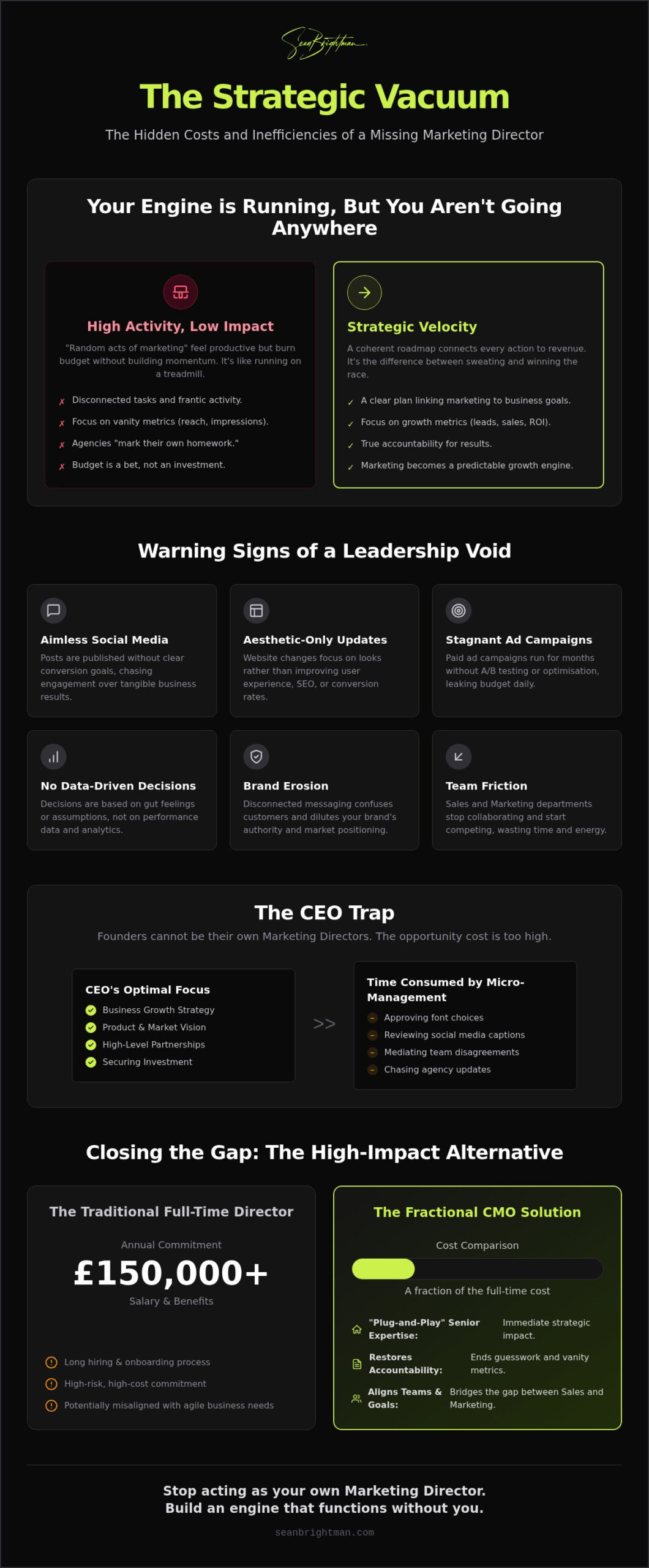
Your marketing engine isn’t broken because the parts are faulty; it’s failing because there’s no one at the controls. Without leadership, marketing spend isn’t an investment. It’s a bet on a horse that hasn’t left the gate. You’re likely feeling the weight of the challenges of a missing marketing director every time you’re dragged into a meeting to approve a font choice or a social media caption. It’s exhausting. It’s inefficient. Most importantly, it’s expensive. When strategy disappears, frantic activity takes its place. Your team is busy, but they aren’t moving the needle.
We agree that this strategic vacuum is unsustainable. You need high-level authority, not more micro-management. This guide identifies the hidden costs of your leadership void and demonstrates how to restore strategic velocity without a £150k salary commitment. We’ll strip away the corporate fluff to look at why your budget is leaking and how to install a plug-and-play solution that brings order to the chaos. Stop acting as your own Marketing Director. It’s time to build a growth engine that actually functions without you.
Marketing activity is not Marketing strategy. One is a series of disconnected tasks; the other is a coherent roadmap to revenue. When you lose your director, you lose the map. You are left with “random acts of marketing” that burn through your budget without building long term equity. It’s the difference between running on a treadmill and running a race. You’re sweating, but you aren’t actually going anywhere. The engine is running, but the gears aren’t engaged.
Without a senior leader, accountability evaporates almost overnight. Agencies begin to mark their own homework. They report on vanity metrics like reach and impressions whilst ignoring the fact that your sales have plateaued. This is one of the most critical challenges of a missing marketing director. Without that senior filter, you’re essentially writing blank cheques to partners who have no skin in the game. You need a strategist who knows how to call out a report that looks pretty but says absolutely nothing about growth.
Internal teams suffer too. Without direction, junior staff focus on what is easy rather than what is effective. They default to “keeping the lights on” because they lack the authority or the expertise to pivot. Common symptoms of this vacuum include:
A Strategic Vacuum is the gap between business goals and tactical execution. Indecision is a silent profit killer. Without a director, product launches stall. Market opportunities vanish whilst your team waits for a “green light” that never comes. Your ad spend becomes a gamble. Without senior oversight, you are likely paying for unoptimised campaigns that target the wrong audience with the wrong message. It’s a leak you cannot afford to ignore in a competitive market.
Your brand is your most valuable asset, but it’s fragile. Disconnected messaging confuses your favourite customers. It dilutes your authority. Whilst you are busy managing the day-to-day chaos, your competitors are busy stealing your market positioning. They are organised; you are reactive. A brand without a leader isn’t a brand at all. It’s just a collection of logos and fonts with no soul and no direction. Consistency is the first thing to go when the seat is empty.
Your team is busy. They are likely exhausted. But are they actually effective? Activity is not an achievement. When the leadership seat is empty, your marketing department defaults to volume over value. They churn out social posts, send more emails, and tweak ad copy without a clear “why” behind the effort. This is the “Busy-ness Trap” in action. It feels like progress because everyone is working late, but your revenue remains stagnant.
One of the primary challenges of a missing marketing director is the total breakdown of strategic filters. Without a senior leader to say “no” to distractions, every new idea becomes a priority. Your team starts chasing shiny objects. They focus on what is easy to execute rather than what is necessary to grow. You end up with a high-speed engine that isn’t connected to the wheels. You’re burning fuel, but you aren’t moving.
Friction between Sales and Marketing becomes inevitable. Sales demands leads for today; Marketing wants to talk about “brand” for tomorrow. Without a director to mediate and align these goals, these departments stop collaborating and start competing. It is a waste of mental energy. You might even find yourself buying more software to fix the friction. Tool fatigue is a real risk. You don’t need a new CRM feature; you need a strategy that tells you how to use the tools you already have.
Your marketing manager might be a tactical wizard, but they aren’t a director. Expecting a specialist to set a 2026 growth roadmap is unfair. It is also dangerous. They lack the senior experience to navigate complex market shifts or manage high-level budgets. This leadership gap kills morale. People want to be led, not just managed. Without a captain, your best talent will eventually look for a ship that has a destination. A dedicated leader brings a unique and valuable perspective that turns tactical specialists into a unified commercial force.
Data silos are the natural byproduct of a leadership void. When no one owns the big picture, information gets trapped in individual tools. Your email data doesn’t talk to your sales team. Your ad spend doesn’t align with your customer lifetime value. You need a central architect to build a scalable growth engine. If your systems feel broken, it might be time to speak with a Marketing operations consultant to audit the mess. Before you commit to another expensive hire, a Fractional CMO can help reset your operational standards and restore focus.
You are the CEO. You have the vision. You built the brand from nothing. That does not make you a Marketing Director. One of the most expensive challenges of a missing marketing director is the founder stepping into the breach. It feels like a solution. It is actually a bottleneck. When you take over marketing, you stop being a leader and start being an obstacle. Growth stalls whilst the team waits for your approval on a font choice or a social media caption.
Your “gut feeling” is a powerful tool for starting a business. It is a liability for scaling one in 2026. Data-driven strategy requires a clinical, analytical approach that founders rarely possess for their own “baby”. You are too close to the product. You make emotional decisions instead of strategic ones. Strategy is a spreadsheet. Vision is a dream. Don’t confuse the two. Without a senior leader to translate your vision into a mechanical system, you are simply gambling with your marketing budget.
The opportunity cost is staggering. Every hour you spend micro-managing a marketing campaign is an hour you aren’t spent on fundraising, high-level operations, or strategic partnerships. You are trading your high-value time for low-value tactical tinkering. It is a poor trade. Your business needs a CEO, not a part-time marketing manager with a founder’s title.
Vision is the destination. Execution systems are the engine. You might know where the brand needs to go, but you likely lack the technical expertise to build the machinery that gets it there. Founders often suffer from “shiny object syndrome” in the absence of a director. You see a competitor doing something and demand your team copies it. It’s reactive, not proactive. This lack of focus makes you easy prey for agencies. Without a senior filter, you cannot hold them accountable for results. They will tell you what you want to hear whilst your budget evaporates.
You need to get back to the work that only you can do. Professional advisory restores your mental bandwidth and removes you from the tactical weeds. It allows you to shift from being a “doer” to a leader who oversees a self-sufficient growth engine. Implementing The Marketing Advisory Retainer provides the senior oversight your team craves. It stops the micro-management and restores speed to your execution. Stop being the bottleneck. Start being the CEO again.
AI in 2026 is not a novelty. It is the engine. If your seat is empty, your team is likely playing with toys rather than building machinery. One of the most dangerous challenges of a missing marketing director is the total absence of an AI roadmap. Without senior guidance, your staff will use ChatGPT to produce more noise, not more value. They are using technology to do the wrong things faster. Speed without direction is just a quicker way to reach a dead end.
The risk is not just about efficiency; it is about governance. Unguided AI adoption leads to data leaks, brand hallucinations, and inconsistent messaging. You don’t need a subscription to a new tool. You need a strategy that defines how AI integrates into your specific commercial goals. Competitors are using AI to automate the boring stuff so they can focus on high-level strategy. You are likely still manually churning out content that nobody wants to read. The gap between the leaders and the laggards is widening every day.
Buying software does not solve a leadership problem. You might have a dozen AI tools in your stack, but if they don’t talk to each other, you have a mess, not a system. A missing director means you are playing with AI rather than profiting from it. You need an AI consulting approach that builds scalable growth engines. This means creating systems that don’t rely on a single person’s prompts. It means building an institutional memory that survives staff turnover. Without this, your AI “strategy” is just a collection of bookmarks in a browser.
Market leaders in 2026 are using AI to slash their Customer Acquisition Cost (CAC) by automating lead qualification and personalising outreach at scale. They are moving at a velocity you cannot match with a fragmented team. AI is the ultimate force multiplier, but it requires a skilled operator to ensure it multiplies your results rather than your mistakes. If you are still waiting for a full-time hire to figure this out, you’ve already lost. You need to book a Fractional CMO now to bridge the technology gap before your competitors become untouchable. Stop guessing with your tech stack. Start building a system that actually converts.
Stop waiting for a unicorn. The traditional six-month recruitment cycle is a slow-motion car crash for your business momentum. You don’t need a full-time hire to sit in an office; you need a strategic architect to fix the foundation. A Fractional CMO is the definitive plug-and-play solution. You gain senior-level authority and battle-hardened expertise without the £150k+ salary commitment. It is about outcome, not attendance. You pay for the results, not the overhead.
An external leader brings a level of objectivity your internal team lacks. They aren’t bogged down by office politics or “the way we’ve always done it.” They see the rot in your systems and have the guts to cut it out. This objective perspective allows you to establish a strategic brand roadmap in weeks, not months. You move from a reactive state to a proactive offensive. This is how you solve the challenges of a missing marketing director whilst avoiding the risk of a bad full-time hire. You get the brains without the baggage.
An advisory retainer acts as the strategic glue for your marketing department. It restores the chain of command. Your team stops guessing and starts executing against KPIs that actually align with your exit goals or growth targets. This is a shift from a “missing director” problem to a “smarter leadership model.” You aren’t just filling a gap. You are upgrading the engine. Accountability returns because there is finally someone qualified to mark the homework of your agencies and internal staff. No more fluff. Just performance.
Assess your reality. Do you truly need a full-time executive to manage the day-to-day, or do you need a strategist to build the system? For most scaling firms in 2026, the latter is more valuable. You can start the recovery process immediately with a Strategic Brand Roadmapping session. This is the diagnostic phase that identifies exactly where your budget is leaking and how to organise your efforts for maximum impact. Stop the drift. Reclaim your strategy. The vacuum only exists because you haven’t decided to fill it yet.
A vacancy in your marketing leadership is a budget leak you cannot afford to ignore. We’ve established that the challenges of a missing marketing director go far beyond an empty seat. It is a strategic vacuum that forces CEOs into micro-management and turns tactical teams into reactive ones. You don’t need a six-month recruitment cycle to fix this. You need a plug-and-play solution that restores accountability and builds a functional growth engine today.
Sean Brightman brings Fractional CMO expertise to UK scale-ups, acting as a battle-hardened expert who builds AI-powered growth engines. As the author of a published marketing strategy book, he specialises in stripping away corporate fluff to deliver pragmatic, high-impact results. Stop acting as your own marketing manager and get back to being a CEO. Your vision deserves a roadmap that actually works, not just a series of disconnected tactics.
Stop the strategic drift and book a Roadmapping Session with Sean Brightman
Your business has the potential for massive growth. It just needs the right architect to engage the gears. Let’s get to work.
The most obvious sign is a marketing team that produces high volume with zero strategic impact. You’ll notice the CEO is pulled into minor tactical decisions like email copy or social media graphics. Strategy is replaced by “random acts of marketing” that don’t move the revenue needle. One of the primary challenges of a missing marketing director is this total loss of direction, where activity is high but commercial results are non-existent.
No, an agency cannot lead your marketing strategy. Agencies are tactical partners; they are built to execute, not to own your commercial outcomes. Expecting an agency to fill a leadership void is like asking a builder to be the architect. They will often mark their own homework and focus on vanity metrics that make them look good, rather than the hard data that makes you money. You need internal leadership.
The cost is measured in wasted budget and missed opportunities. Without senior oversight, businesses often leak thousands in unoptimised ad spend and ineffective campaigns. There is also the “CEO tax,” where the founder’s time is diverted from high-value tasks to marketing micro-management. When you factor in brand erosion and lost market share to more organised competitors, the financial drain is far higher than the cost of professional leadership.
It is a scalable leadership model that fits both scenarios. Many firms use a Fractional CMO to navigate the challenges of a missing marketing director during a recruitment gap. Others realise they don’t actually need a £150k full-time hire and keep the fractional model as a permanent, lean leadership layer. It provides the senior authority you need without the long-term overhead and complex benefits packages of a full-time executive hire.
They provide the “glue” and the “filter” for your department. A Fractional CMO sets clear KPIs, removes operational bottlenecks, and restores a functional chain of command. They coach junior staff to focus on high-impact work rather than busy-ness. By taking ownership of the roadmap, they free the CEO from the tactical weeds. The team gains a mentor who understands the mechanics of growth, which improves morale and productivity.
Ownership is the differentiator. A consultant delivers a report or a set of recommendations and then leaves you to figure out the execution. A Fractional CMO joins your leadership team and takes responsibility for the results. They don’t just tell you what is wrong; they install the systems to fix it. It is the difference between a mechanic giving you a manual and a mechanic actually fixing the engine.
Yes, high-level AI Consulting is a core part of a modern fractional engagement. It isn’t about buying a ChatGPT subscription. It is about building an AI-powered growth engine that automates lead qualification and personalises outreach at scale. They ensure your team uses AI to produce more value, not just more noise. They also handle the governance and security risks that come with unguided or experimental technology adoption.
You will see strategic clarity within the first few weeks. A roadmapping session identifies immediate leaks and low-hanging fruit for quick wins. Structural changes to team performance and system integration typically take three to six months to fully mature. This isn’t a “magic wand” solution; it is a clinical process of stripping away what doesn’t work and building a scalable growth engine that delivers predictable, long-term revenue.
Reading is good. A roadmap is better.