

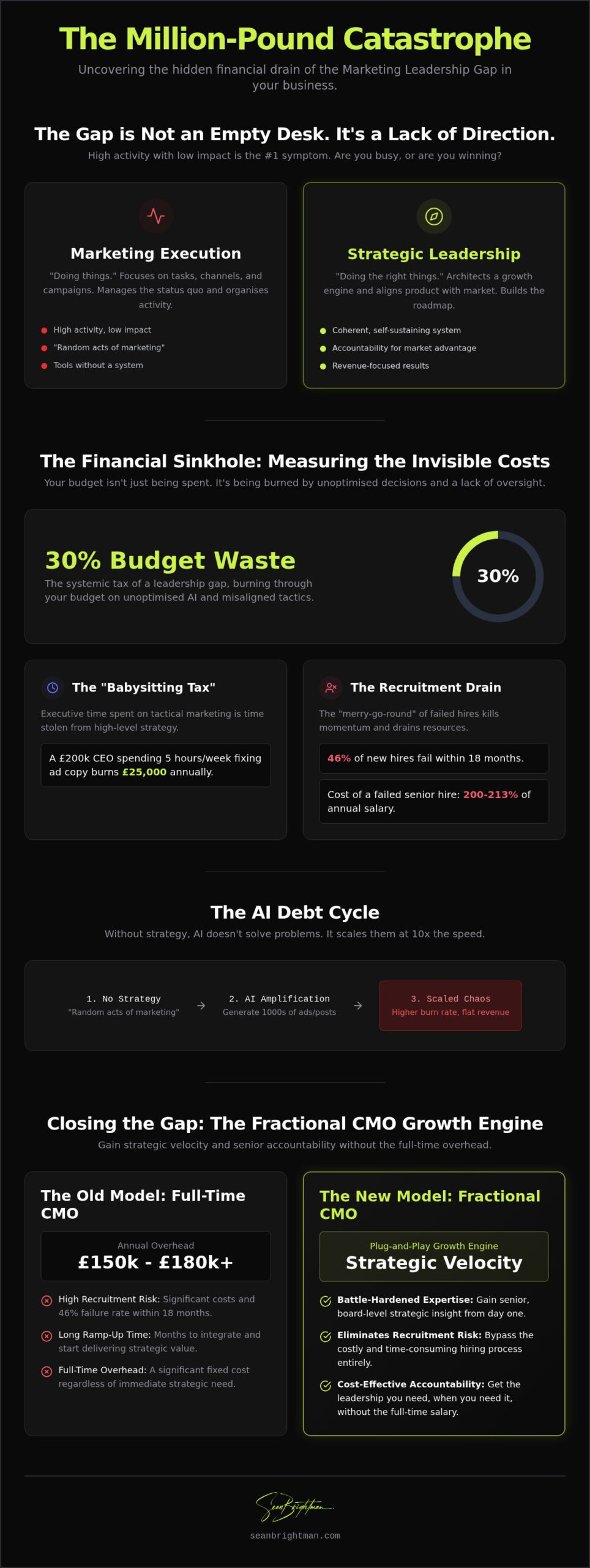
Hiring the wrong person isn’t just a mistake. It’s a million-pound catastrophe. In 2026, the actual cost of marketing leadership gap issues is no longer a missed target or a messy spreadsheet. It’s a systemic tax. It burns through 30% of your budget on unoptimised AI and misaligned tactics while you’re left holding the bill.
You see the symptoms daily. Your team is busy, the tools are expensive, and your burn rate is climbing. Revenue stays flat. You’re likely exhausted from founder-led marketing and tired of guessing which half of your budget is actually working. This is about systems, not just tools. You need a growth engine, not a collection of expensive subscriptions.
I’ll show you how to plug these invisible financial leaks. You’ll discover how to build a marketing department that functions as a self-sustaining growth engine without the £150k overhead of a full-time hire. We will examine the mechanics of fractional leadership, the reality of AI-disrupted roles, and the exact roadmap to strategic clarity.
The gap isn’t an empty desk. It’s an absence of accountability for your market advantage. You have people. You have tools. You probably have a dozen active campaigns. But you don’t have a growth engine. You have a collection of parts that don’t fit together. This is the difference between marketing execution and marketing leadership.
Execution is about doing things. Leadership is about doing the right things. Mid-market UK firms often fall into the “Tactical Trap” whilst scaling. They hire for skills but lack the vision to integrate those skills into a coherent system. The cost of marketing leadership gap issues shows up as high activity with low impact. You’re busy, but you aren’t winning.
In 2026, the complexity of AI and fragmented channels has turned this gap into a canyon. AI allows you to generate a thousand ads in a minute. Without leadership, those thousand ads are just noise. You’re scaling chaos. You’re paying for speed when you should be paying for direction.
Managers organise tasks. Leaders architect growth engines. If your Marketing Manager is spending their day debating font sizes or scheduling LinkedIn posts, they aren’t leading. They are managing the status quo. They cannot solve your positioning problem because they are too close to the machinery.
True leadership requires an understanding of the core principles of marketing management to align your product with a shifting market. A manager follows the roadmap. A leader builds it. Relying on “bottom-up” strategy from junior staff is a recipe for expensive failure in a competitive market.
Founder-led marketing works until you hit £5M. At that stage, your intuition is enough. But as you push toward £20M, that intuition fails. You can’t be in every meeting. You can’t approve every headline. You hit the “Squeezed Middle”.
This is where the cost of marketing leadership gap becomes a drag on your valuation. You are too big for a freelancer but too small for a full-time £180k CMO. The result is “random acts of marketing”. You try a bit of SEO. You dabble in PPC. You hire a content agency. None of it talks to each other. You have a team that needs babysitting instead of a department that generates revenue.
Your marketing budget is leaking. It isn’t a drip; it’s a flood. The cost of marketing leadership gap issues isn’t just a line item on a P&L; it’s the cumulative weight of unoptimised decisions. When you lack senior oversight, you pay a “Babysitting Tax”. If you are a CEO earning £200,000 and you spend five hours a week fixing LinkedIn posts or debating ad copy, you are burning £25,000 a year in executive time. That is time stolen from high-level strategy to do a job you’ve already paid someone else to perform.
The drain extends to your ad spend. Running campaigns on a broken brand foundation is like pouring water into a sieve. Without a leader to enforce message market fit, your cost per acquisition climbs whilst your conversion rate stagnates. You aren’t building an asset. You are just renting expensive, low-quality attention. Mastering the challenge of measuring marketing ROI becomes impossible because the data is polluted by tactical noise. You can’t measure what you haven’t defined.
Busy marketing teams are often your most expensive ones. High activity does not equal high impact. Spending £10,000 a month on SEO without a strategic brand roadmap is a vanity exercise. You might win the traffic game, but you’ll lose the revenue race. This misalignment compounds over 12 to 24 months. By the time you realise the direction was wrong, your competitors have already out-positioned you and captured the market’s trust. If you want to stop the bleed, you need to audit your marketing machinery before adding more fuel.
The recruitment merry-go-round is a silent killer of growth. Research shows that 46% of new hires fail within 18 months. For a senior marketing role, the fully loaded cost of a failed hire can be between 200% and 213% of their annual salary. This includes recruitment fees, ramp-up time, and the devastating loss of momentum. Junior staff churn because they have no one to learn from; senior hires fail because they lack the systems to succeed. Choosing a Fractional CMO eliminates this risk. You get the battle-hardened expertise without the £180,000 overhead or the long-term recruitment gamble. It’s about buying results, not just filling a seat.
AI isn’t a silver bullet. It’s an accelerant. If your strategy is flawed, AI just makes you fail faster. Many UK firms are currently drowning in “AI Tool Fatigue”. They have 50 different subscriptions for copy, images, and video, but no integrated workflow. They are buying tools, not solutions. This is where the cost of marketing leadership gap issues become visible in your software budget. You are paying for capacity you don’t know how to use.
The real danger is the “Garbage In, Garbage Out” problem. AI allows you to scale bad strategy at ten times the speed. Without senior oversight, your team is simply generating more noise. They are using ChatGPT to churn out generic blogs whilst your competitors are building automated, data-driven growth engines. This misalignment is often rooted in the structural failure of the marketing role itself. As noted in The Trouble with CMOs, when a role is poorly designed, it cannot possibly manage the complexity of modern technology. You don’t need more prompts. You need a framework.
To move beyond this, your team requires a comprehensive AI consulting framework. This isn’t about learning how to write better emails. It’s about re-engineering your entire marketing machinery to function in a post-AI world. If you are still manually writing every piece of content whilst your rivals use AI-powered operations, you aren’t just falling behind. You are becoming obsolete.
Most marketing teams use AI as a tool for “content”. They use it to save ten minutes on a social post. True leadership treats AI as a system for “operations”. Research from Boston Consulting Group indicates that 90% of a marketing manager’s tasks are disrupted by AI from a skills perspective. If your leadership doesn’t understand this, they cannot re-engineer your processes. This creates an “Efficiency Gap”. You have a 2026 budget supporting a 2019 workflow. It’s expensive, slow, and strategically toothless.
Moving from “playing with AI” to a scalable growth engine requires an owner. Senior leadership must own the AI implementation roadmap. It’s not a task to delegate to a junior executive. A strategic roadmap defines how AI integrates with your CRM, your lead scoring, and your customer journey. The ROI of automated marketing operations is found in the machinery, not the copy. Under expert guidance, you stop buying subscriptions and start building an integrated growth engine that runs itself. This is how you close the cost of marketing leadership gap and turn your marketing department into a profit centre.
Stop pretending your marketing department is an autonomous engine if you’re the one still turning the key every morning. If you’re correcting ad copy or debating the colour of a CTA button, you aren’t a CEO. You’re a high-priced editor. Whilst you might feel that staying involved ensures quality, you’re actually capping your company’s growth. You’ve hired a team, but you’re still doing the heavy lifting.
Founder-led marketing is a stage, not a permanent state. If you are still the final word on every LinkedIn post and ad headline, your team hasn’t been empowered. Or worse, they aren’t capable. Either way, you’re the bottleneck. This isn’t leadership; it’s a lack of trust in your own systems. When you can’t step away from the tactical details, the cost of marketing leadership gap issues starts to paralyse your executive focus.
Look at your last report. If it’s full of “vanity metrics” like follower growth or website traffic, you’re being fed fluff. Real leadership focuses on “revenue velocity.” It’s about how fast a lead turns into cash, not how many people liked a post. When your team reports on activities instead of outcomes, you’re witnessing the cost of marketing leadership gap in real-time. You’re paying for a list of chores, not a strategy.
You likely have a marketing operations disaster hidden in your tech stack. If no one can tell you exactly which tool manages which part of the customer journey, you’re paying for a mess. Tools should talk to each other; your team shouldn’t be the manual bridge between them. Review your calendar for the last fortnight. If 20% of your time was spent on marketing “how-to” rather than “what’s next,” you have a leadership void that needs plugging.
Can your team explain the CAC (Customer Acquisition Cost) to LTV (Lifetime Value) ratio? If they can’t, they aren’t managing a budget; they’re spending it. Your marketing reports should read like a financial statement, not a list of activity logs. Ask for a strategy pivot tomorrow. If it takes three months to change direction, your machinery is rusted and your leadership is missing.
What happens if you don’t attend the marketing meeting for a month? If the answer is “everything stops,” you don’t have a business. You have a job. The brand voice must be a documented system, not an extension of your personality. Founder-led marketing is a massive bottleneck to a business exit. No one wants to buy a company that breaks the moment the founder goes on holiday. You need to build a system that outlasts your daily involvement.
If your marketing team needs a leader instead of a babysitter, book a strategic audit to find your growth engine.
You don’t need a full-time executive. You need an outcome. In 2026, the cost of marketing leadership gap issues is solved by buying results, not paying for presence. A Fractional CMO is the “Plug-and-Play” solution for UK scale-ups. It gives you senior-level authority to fix the machinery without the £180,000 overhead or the recruitment risk. You get the brain without the baggage.
Think of it as senior brainpower at roughly 25% of the cost of a traditional hire. You aren’t paying for corporate politics or 40 hours of “busy work”. You’re paying for a growth engine that runs itself. This shift from a “Leadership Gap” to a Marketing Advisory Retainer moves the needle from tactical chaos to strategic velocity. It’s about high-impact intervention in a concentrated timeframe.
Don’t hire a single executioner until you have a map. Most firms hire a “Social Media Manager” or an “SEO Specialist” before they even know what they are selling or to whom. That is a waste of capital. A Fractional CMO starts with a 90-day Roadmap. We define the positioning, the systems, and the AI integration points first. We build the foundation before we hire the executioners.
This roadmap sets the accountability framework for your existing team. It turns them from a group of people doing tasks into a department delivering revenue. We fix the brand foundation so your ad spend actually converts. We integrate AI into the workflow to bridge the efficiency gap. You get a blueprint. Then, and only then, do you build the team to run it. This sequence ensures you aren’t scaling chaos.
Strategic direction shouldn’t come with corporate baggage. An advisory model provides an external force of order. It brings a battle-hardened perspective that internal teams lack. You get a partner who isn’t afraid to be blunt or challenge the status quo. This is about providing the high-level thinking that keeps the engine running at peak efficiency whilst your internal team handles the daily output.
This isn’t just about next month’s leads. It’s about building a marketing department that buyers covet. If you’re preparing for an exit, a system-led marketing engine adds significant value to your business. It proves that the brand isn’t dependent on the founder. It proves the growth is repeatable and scalable. Stop babysitting your marketing and start leading your business. It’s time to turn your marketing department into a profit centre.
Your marketing should be a self-sustaining growth engine, not a series of fires you have to put out. We’ve seen that the cost of marketing leadership gap issues is measured in wasted ad spend, CEO burnout, and stagnant revenue. You don’t need a full-time £180k hire to fix it; you need a system that works. Strategy must lead your tools, especially when integrating AI into your operations.
I provide no-fluff, senior-level advisory for founders who are ready to step out of the tactical weeds. As an expert in AI-powered growth engines and the author of the definitive book on marketing strategy, I help you build the machinery that outlasts your daily involvement. It’s about clarity, accountability, and results.
Ready to bridge the gap? Book a Strategic AI Roadmapping Session with Sean Brightman today. Let’s turn your marketing department into a high-impact profit centre. You’ve built the business; now build the engine to scale it.
The true cost is the sum of wasted ad spend, CEO time, and failed recruitment. Research indicates a bad senior hire can cost over 200% of their annual salary. The cost of marketing leadership gap issues also includes the “Babysitting Tax,” where founders lose hours to tactical management. This isn’t just money out of the bank. It’s the compounding loss of market position whilst competitors out-manoeuvre you.
Managers execute; CMOs architect. If you need someone to schedule posts and run basic campaigns, hire a manager. If you need a scalable growth engine, a positioning overhaul, or an integrated AI strategy, you need a Fractional CMO. You don’t hire a manager to solve a strategy problem. You hire a leader to build the system that the manager eventually operates.
Rarely. Agencies are built to sell services, not to own your business outcomes. They focus on their specific channel, whether that’s SEO or PPC, often ignoring the broader brand foundation. A Fractional CMO acts as an internal force, providing senior leadership that holds agencies accountable. You need an architect on your side of the table to ensure the builders are actually following a plan.
For a seasoned professional at a scale-up, you’re looking at £150,000 to £200,000 plus benefits and equity. This high overhead is why many mid-market firms hit a growth wall. They need the expertise but can’t justify the six-figure commitment. A Fractional CMO provides the same level of strategic velocity at a fraction of the cost, focusing on high-impact outcomes rather than full-time presence.
By building an operational system, not just writing prompts. We look at the entire customer journey to identify where AI can automate lead scoring, content distribution, or data analysis. The goal is to re-engineer your marketing machinery to be faster and leaner. It’s about moving from “playing with tools” to owning a data-driven growth engine that scales without adding headcount.
It is almost universal between £5M and £20M turnover. Founders often reach the limit of their own marketing intuition but haven’t yet built a departmental system. This creates a vacuum where tactics become disconnected from revenue. Identifying the cost of marketing leadership gap early allows scale-ups to professionalise their marketing operations before the “Founder Bottleneck” causes a permanent stall in growth.
You’ll burn another 30% of your budget on misaligned tactics and unoptimised tech subscriptions. Your competitors will gain a 12-month head start on AI-powered operations that you’ll struggle to match. Ignoring the gap doesn’t just stall growth; it builds “strategic debt.” The longer you wait to fix the foundation, the more expensive and painful the eventual reconstruction becomes.
The initial “plug-and-play” intervention usually takes 90 days. Within the first month, we audit the existing machinery and identify the leaks. By day 60, we’ve defined the strategic roadmap and AI integration points. By day 90, the accountability framework is in place and the team is running a documented system. You move from chaos to clarity in one fiscal quarter.
Reading is good. A roadmap is better.