
Most AI implementations in 2026 are nothing more than expensive paperweights. You’ve likely seen the cycle: a hefty invoice from a flashy agency, a library of “toy box” tools nobody uses, and a marketing department that’s more disorganised than when you started. Finding a competent ai marketing consultant uk isn’t about hiring someone who can recite the latest LLM specs. It’s about finding a partner who understands that AI is a strategy problem, not a technical one.
You want systems that run without constant hand-holding and a roadmap that actually scales. We agree that the corporate noise is deafening. This guide identifies the firms that build functional growth engines instead of abstract theories. We’ll show you how to vet for accountability, navigate the 2026 UK regulatory shifts, and bridge the 45% skills gap that’s currently stalling your competitors. It’s time to stop buying software and start building a machine that delivers results.
AI consulting in 2026 is a minefield of shiny objects. Most firms arrive with a suitcase full of “toy box” tools, ChatGPT wrappers, and flashy dashboards. They sell you the sizzle of automation whilst ignoring the steak of your underlying marketing system. It’s an expensive trap. You end up with shelfware; costly, sophisticated software that your team doesn’t use and your customers don’t care about. If you are looking for an ai marketing consultant uk, you must distinguish between those who sell software and those who build systems.
The difference is binary. You are either “doing AI” or you are building an AI-powered growth engine. One is a hobby; the other is a competitive advantage. If your marketing department is currently a mess of fragmented data and manual workarounds, an algorithm won’t fix it. It will simply accelerate the chaos. You need a strategist to lead the machine, not just an integrator to plug it in. This is a business-critical decision, not a procurement checkbox.
Tools are tactical. Growth is strategic. Many businesses rush to implement the latest generative models without asking if those models solve a specific revenue bottleneck. This tool-first approach creates a fragmented tech stack. Your SEO team uses one tool, your email team uses another, and your data remains siloed. It’s a recipe for inefficiency.
The hidden cost of this fragmentation is staggering. It isn’t just the subscription fees. It’s the cognitive load on your staff and the dilution of your brand voice. When you prioritise the tool over the system, you lose accountability. You cannot fix a broken marketing department with a prompt. You fix it by re-engineering the workflow and then using AI to lubricate the gears. This is the mechanical reality that most agencies ignore. If you’re experiencing tool fatigue and need a clear path to scalable ai consulting, the answer lies in systems architecture, not more subscriptions.
Strategy defines the “why” before the “how”. Traditional Management consulting often focuses on high-level theory, but in the AI era, strategy must be visceral. Are you aiming for a 2026 exit? Are you looking to scale lead volume by 300% without increasing headcount? These goals dictate the technology, not the other way around.
Brainpool.ai claims that 95% of enterprise AI projects fail to reach production. From a marketing perspective, these failures happen because the projects aren’t aligned with commercial goals. They are tech experiments, not growth initiatives. A strategic AI marketing roadmap ensures every automation serves your long-term vision. It creates a culture of accountability amongst your team. They stop fearing the technology and start using it to drive the engine. You don’t need more tools. You need a better machine. Understanding the hard architecture behind effective AI implementation for marketing is what separates businesses that scale from those that stall.
Size is a distraction. A firm’s prestige isn’t a guarantee of your growth. When searching for an ai marketing consultant uk, you’ll encounter three distinct tiers. Most CEOs choose the wrong one because they mistake headcount for impact. You don’t need a small army; you need a surgical strike. The landscape in 2026 is divided between those who manage bureaucracy and those who build machinery.
It is a binary choice. Do you want 50 junior consultants filling slide decks, or one battle-hardened expert who knows where to turn the screw? For high-growth firms, the latter is almost always the more profitable route. High-value fees don’t always equate to high-impact marketing output. You must choose the tier that aligns with your specific commercial bottleneck.
Accenture, BCG, and McKinsey are the “safe” choices for the FTSE 100. They excel at massive, multi-year enterprise transformations and global infrastructure. If you need to overhaul a legacy system across 40 countries, they are the right fit. However, their overhead is immense. For mid-market companies, these firms often swallow the marketing ROI before the first automation goes live. You pay for senior partners but often get recent grads learning on your dime. It’s a safe choice that frequently leads to slow execution.
Firms like Brainpool focus on deep-tech builds. They live in custom code, machine learning models, and proprietary data science. This is the tier you hire to build an internal AI product or unique IP. The risk here is the “technical vacuum”. These firms often lack marketing intuition. They can build a sophisticated algorithm, but they might lose your brand voice in a sea of technical complexity. They are engineers, not growth strategists. Use them to build the engine, but don’t expect them to know how to win the race.
This is the rise of the Fractional AI Strategist. These advisors are best suited for high-growth UK businesses needing senior marketing leadership without the £200k+ overhead of a full-time hire. They focus on marketing systems, brand positioning, and rapid execution. When vetting this tier, look for frameworks like the AI Guide for Government, which provides a no-nonsense approach to auditing AI initiatives. This tier is about accountability and results. If you need a Fractional CMO to turn your messy marketing department into an AI-powered growth engine, this is your target. It’s high-impact leadership without the agency bloat.
High fees are a comfort blanket, not a performance metric. Many CEOs believe that a six-figure invoice from a global firm guarantees a six-figure return. It doesn’t. In the world of AI, you are often paying for the firm’s real estate and partner retreats rather than actual code or strategy. This is the efficiency gap. When you hire an ai marketing consultant uk, you need to know if you are buying their overhead or your growth. It is a binary reality: you either pay for the name or you pay for the result.
The Junior Consultant trap is the industry’s open secret. You are sold the vision by a senior partner with twenty years of experience. Two weeks later, your account is being managed by a recent graduate who is learning how to use your tech stack on your time. You pay senior rates for junior mistakes. You get the brand name, but you lose the expertise. This isn’t just a waste of budget; it’s a risk to your market position.
In 2026, speed is the only moat left. Bloated firms are structurally incapable of moving fast. They have layers of approval, internal meetings about meetings, and a process-first mentality that kills momentum. By the time they deliver a formal report, the market has already pivoted. Worse, they rarely own the numbers. If the growth engine stalls, they blame the execution or your internal team. You need a partner who stays in the room until the engine hums, not one who vanishes when the slide deck is finished.
Firms sell hours. Advisors sell outcomes. If a consultancy suggests a massive, multi-tool implementation without a clear ROI path, they are padding the project. They want more billable hours, not a leaner operation. This is why an AI marketing roadmap is vital. It defines the leanest path to profit. It identifies the toy box tools that exist only to inflate the invoice. You want a machine that works, not a tech stack that looks impressive on a slide deck.
Strategy is your business’s soul. Never outsource it entirely. A third party should guide you, but your internal team must own the controls. The goal of a high-impact advisory is to build your internal capability, not to create a permanent dependency. This is where a marketing operations consultant comes in. They architect the systems and train your people to run them. You get the expertise of a senior leader without the permanent bloat of an agency. It’s about building a scalable engine that functions whilst your competitors are still waiting for their consultant’s next monthly check-in.
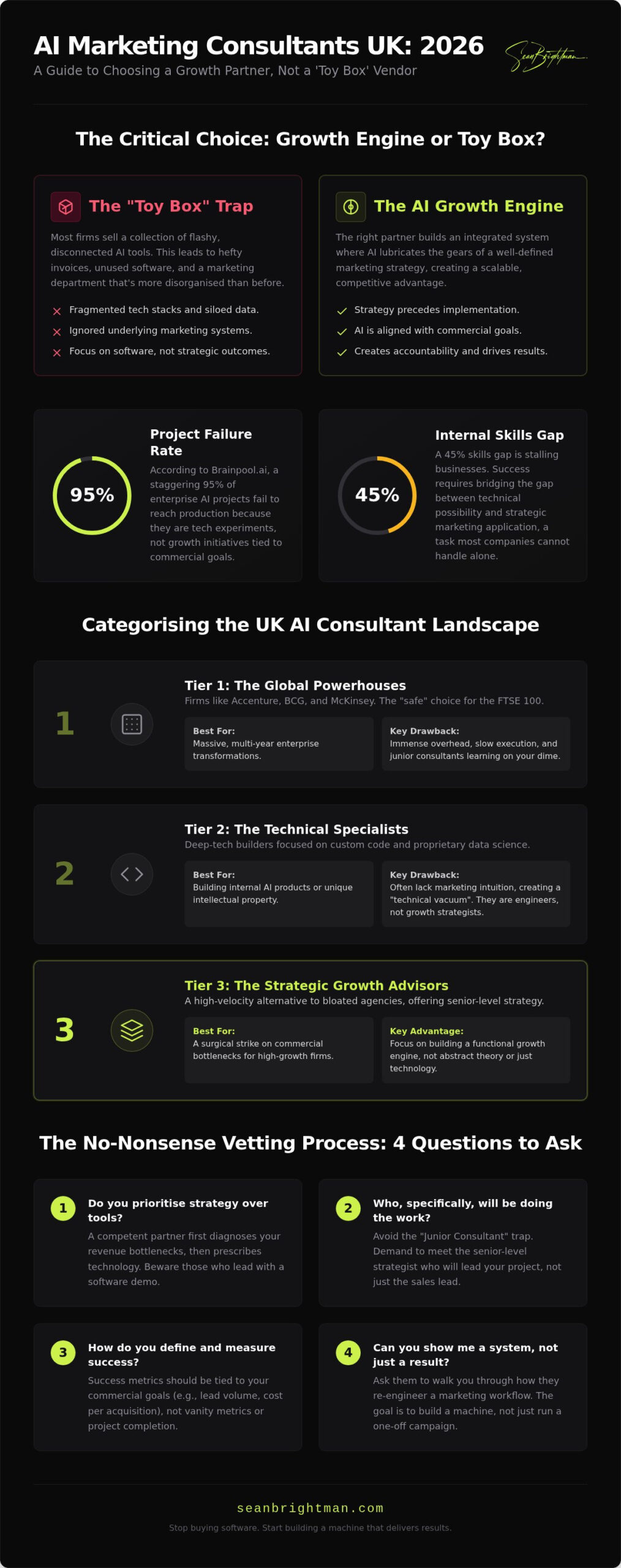
Most CEOs get blinded by technical theatre. You see a flashy dashboard and a smooth interface; you assume the strategy is sound. It rarely is. Vetting an ai marketing consultant uk requires looking past the code and into the commercial engine. If you can’t understand their value without a glossary of jargon, they don’t have a strategy; they have a sales pitch. Use this five-step BS detector to ensure you aren’t buying polished shelfware.
If you’re tired of technical fluff and want to see a functional blueprint for your business, book an AI strategy audit here.
Watch out for vague promises about “efficiency” or “synergy” that lack concrete marketing metrics. If a firm refuses to discuss the fractional cmo alternative, they are likely protecting a bloated agency model that thrives on your overhead. Another warning sign is an over-reliance on generic, off-the-shelf AI tools. In 2026, differentiation is the only moat. If they are giving you the same prompts as your competitors, they aren’t giving you an edge; they’re giving you a commodity.
Don’t let the partner sell you and then vanish. Ask who the specific person is leading your strategy day-to-day. You need to know if your growth engine is being built by an expert or a trainee. Ask how the implementation improves customer behaviour insights. AI should make your customers’ next moves more predictable, not just your data more complex. Finally, ask about ownership. What happens to the systems and the custom models if you stop the retainer? You should own the machinery, not rent it.
Big firms sell you a project. Advisors sell you a partnership. In 2026, the market moves too fast for static reports and quarterly reviews. You need a surgical alternative that prioritises speed and precision. This is where an ai marketing consultant uk provides the highest value. It isn’t about a one-off implementation; it’s about embedding AI into your brand DNA. You don’t need a bloated agency. You need senior expertise that plugs directly into your leadership team and stays there until the machinery hums.
A marketing advisory retainer is the antidote to the “one-and-done” model. It provides ongoing accountability and ensures that the systems built during the roadmapping phase actually deliver on their promise. You get maximum impact with zero bureaucracy. It’s about movement and machinery, not abstract theory. An advisory retainer offers several distinct advantages for the modern CEO:
Scaling a business in the UK requires senior CMO-level thinking. But hiring a full-time heavyweight is an expensive, slow process that adds unnecessary overhead. The fractional model gives you that same level of strategic depth at a fraction of the cost. We focus on brand positioning and marketing systems that actually scale. We apply AI practically to improve output and marketing efficiency. It’s about building a machine that works without constant hand-holding. You get the strategy; you lose the bureaucracy.
You can move from messy to methodical in 90 days. Most marketing departments are currently a patchwork of manual tasks and disconnected tools. Sean Brightman’s roadmapping sessions strip away the fluff to provide a functional blueprint. We identify the bottlenecks and build the AI-powered solutions to clear them. This isn’t a suggestion; it’s a systems architecture designed for 2026. It turns your marketing from a cost centre into a predictable growth engine.
Your competitors are likely wasting budget on tools they don’t understand and systems they can’t manage. Don’t join them. The next step is a strategy session to audit your current trajectory and identify the gaps in your AI implementation. Let’s find the growth engine in your business and turn it on. It’s time to stop buying toy boxes and start building for the future.
AI in 2026 is either a distraction or a force multiplier. It depends entirely on who is holding the map. You can continue sinking budget into disconnected tools that your team ignores, or you can build a methodical, AI-powered growth engine. The choice is binary. High-impact results require senior-level strategy that connects your brand DNA to your technical architecture. You don’t need more software; you need better systems.
Finding the right ai marketing consultant uk means looking for accountability, not just a flashy pitch. We’ve seen the cost of bloated agencies and junior-led implementations. It’s time to choose the surgical alternative. With fractional CMO expertise and a focus on strategic AI roadmapping, we strip away the noise to deliver systems that actually scale. As the author of ‘The Book’ on marketing strategy, I focus on outcomes, not billable hours.
Stop guessing and start executing. Your competitors are likely still stuck in the “toy box” phase. This is your window to lead. Build your AI-powered growth engine with Sean Brightman today. Let’s get to work.
AI consulting firms re-engineer your marketing machinery to drive revenue. They don’t just hand you a list of prompts. They audit your existing workflows, identify where manual labour is stalling growth, and build automated systems that scale. It’s about building a functional growth engine, not playing with technical toy boxes.
Investment levels depend on the complexity of the systems you need to build. A high-impact strategy often starts with a surgical audit to identify the biggest revenue leaks. Avoid firms that focus on billable hours. You should invest in the outcome of a scalable system, not the time it takes a consultant to install it.
The difference is binary: strategy versus execution. An AI firm focuses on building technical components and machine learning models. A Fractional CMO, acting as an ai marketing consultant uk, focuses on the commercial outcome. One builds the engine; the other ensures that engine is pointed at your revenue targets.
Readiness depends on your data and your pain points. If your marketing department is drowning in manual work and you have accessible customer data, you’re ready. If your data is non-existent, your first step is an audit. You cannot automate a void; you need a foundation to build upon.
Technical firms often fail at brand positioning. They treat AI as a content mill, which dilutes your brand voice into generic mush. A strategic advisor uses AI to sharpen your position. They use technology to gain deeper customer insights and amplify your unique value, not to replace human intuition.
Most projects fail because they prioritised the tool over the system. Industry data suggests that 95% of enterprise AI projects never reach production. They fail because they lack a commercial roadmap. They are technical experiments that ignore the reality of marketing operations and human change management. Understanding how to move from tool fatigue to a cohesive ai consulting strategy is the critical first step toward closing this gap.
Choose based on your required velocity. Big Four firms are built for massive, multi-year transformations within global corporations. Specialist advisors are built for speed and high-impact execution. If you need senior-level marketing leadership without the corporate bureaucracy and junior-staff padding, the specialist advisor is the superior choice.
Reading is good. A roadmap is better.