

Your next winning channel won’t fix a broken acquisition model. Building a sustainable customer acquisition model means making growth repeatable, rather than betting the month’s target on whichever platform looks promising.
If customer numbers swing from month to month, marketing activity is hard to connect to profitable customers, or channel choices rely more on assumptions than comparable evidence, the problem may not be a lack of tactics. It may be a lack of joined-up measurement and learning.
This guide shows you how to connect the right audience, channels and commercial economics, then use what you learn to improve the system. You’ll see how to compare channel performance on consistent terms, assess whether customer value supports acquisition costs, and set review habits that lead to better decisions.
No channel wins forever. A resilient model gives you a clear way to test, invest and adjust without confusing activity with profitable growth. The steps below cover the measures that matter and common traps that make acquisition unpredictable.
A campaign can flood your inbox with leads one month, then leave sales chasing poor-fit prospects the next. A dependable acquisition model does something harder: it attracts suitable customers through a process the business can afford, deliver and improve.
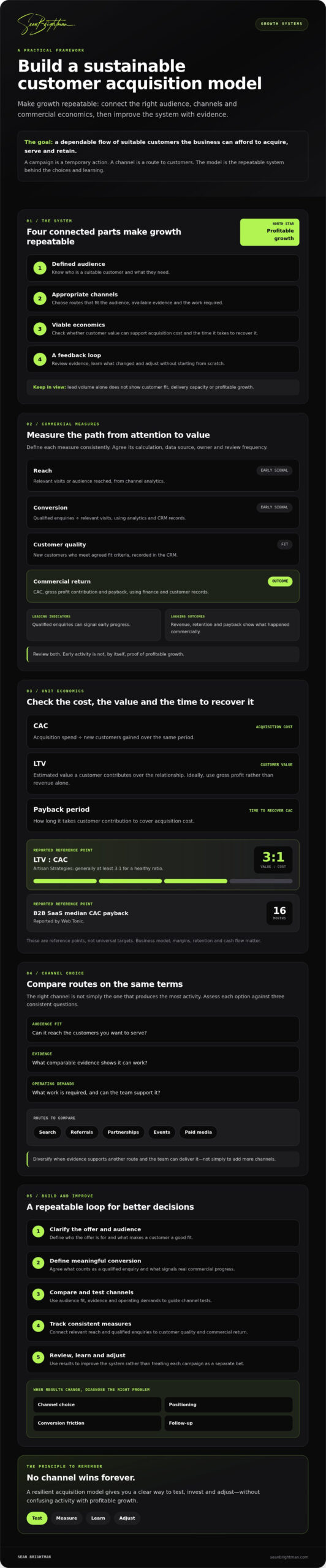
A sustainable customer acquisition model is a repeatable system that connects a defined audience, appropriate channels, viable economics and a feedback loop that improves decisions over time. It isn’t a campaign, a channel, a funnel diagram or a pile of disconnected tactics. Campaigns are temporary actions within the system. Channels are routes to customers. Neither replaces the choices and learning that make growth repeatable.
The system needs to account for customer quality and the organisation’s capacity to serve them, not just lead volume. A surge in demand can create problems if the offer attracts the wrong buyers or the team can’t deliver well. The fundamentals sit within broader core marketing concepts: understand the market, shape an offer and decide deliberately how it reaches customers.
A marketing plan often sets out activities and timing. A model sets the strategic choices behind those activities, then uses evidence to adjust them. For example, assumption only: a small software firm might test search content for buyers already looking for a solution, then track which enquiries become suitable customers. The campaign delivers the test. The model determines what to measure and what to change based on the result.
Repeatable doesn’t mean identical results every month. Markets shift, competitors respond and customer needs change. Sustainability means you can see what drives suitable demand, learn when performance changes and adapt without starting from scratch. It also means checking whether customers stay, whether the business can deliver the promised value and whether the economics make sense over time.
Don’t diversify channels just to tick a box. A second or third route can reduce reliance on one source, but only when evidence shows it can reach the right audience and the team can support it. The goal is a resilient mix that fits your customers and capabilities, not more activity for its own sake.
Start with the commercial outcome, not the dashboard. Decide what the business needs to gain, then define a qualified customer and the conversion that signals real progress. A form submission may be a useful early indicator. A customer who buys, stays and can be served profitably is the outcome that matters.
Keep the core economics clear. Customer acquisition cost (CAC) is the acquisition spend divided by the number of new customers gained over the same period. Customer lifetime value (LTV) estimates the value a customer contributes over the relationship, ideally using gross profit rather than revenue alone. Payback period measures how long it takes for that contribution to cover CAC. In plain terms, acquisition cost must be supported by the value customers generate, and the business must be able to wait for that value to arrive.
For context, Artisan Strategies reported in April 2026 that a healthy LTV:CAC ratio is generally at least 3:1. Web Tonic reported a 16-month median CAC payback period for B2B SaaS in 2026. These are reference points, not universal targets. Business model, margins, retention and cash flow all matter.
Choose a small set of metrics that follows the path from attention to commercial return. For each one, agree on its calculation, data source, owner and review frequency. This prevents teams from comparing figures built on different definitions.
Qualified enquiries are leading indicators. Revenue, retention and payback are lagging outcomes. Review both, but don’t mistake early activity for proof of profitable growth. Cohort analysis can help: group customers by when or how they were acquired, then compare retention and contribution over the same period.
Compare acquisition investment with realised customer value over consistent time windows. Include gross margin, retention and delivery costs where the data is reliable, and label estimates rather than presenting them as facts. Attribution will never be perfect, especially when buyers encounter several touchpoints. Consistent definitions and directional evidence are more useful than false precision. To understand what customers are trying to achieve, the Jobs to Be Done framework can sharpen how you define fit and value.
For wider systems context, explore the Marketing operations growth engine. If measurement exposes gaps in ownership or strategic alignment, marketing roadmapping support may help turn the diagnosis into prioritised next steps.
There’s no universally best acquisition channel. Search may reach people actively looking for an answer, while referrals can bring trust from the first conversation. The right choice depends on your audience, offer, sales cycle and ability to run the channel well. Building a sustainable customer acquisition model means comparing those factors, not copying a competitor’s channel mix.
Consider where your audience pays attention, how much buying intent they show, how quickly you can learn and what your team can realistically manage. Check audience concentration, control over the message and how each channel fits your sales cycle. Separate what you know from customer or sales evidence from assumptions that still need testing.
Use the same definition of a qualified customer and comparable review periods across channels. Otherwise, one route may look stronger simply because you counted an early enquiry while another was judged on a completed sale.
| Channel | Evidence to collect | Common trade-offs |
|---|---|---|
| Search | Relevant search demand, qualified enquiries and eventual customer fit | Captures existing intent, but learning and visibility may take time |
| Referrals | Source of introductions, conversion quality and repeatability | Can bring warm prospects, but relies on relationships and may be hard to scale predictably |
| Partnerships | Audience overlap, partner contribution and follow-through | Can extend reach, but needs alignment and ongoing coordination |
| Events | Suitable conversations, follow-up completion and sales progression | Creates direct engagement, but demands preparation and timely follow-up |
| Paid media | Qualified conversions, customer outcomes and total acquisition investment | Offers control over testing, but spend alone doesn’t prove customer quality |
First, make sure your current route can produce suitable customers and that follow-up works. Adding channels before you understand the core process creates more moving parts, not resilience. Consider diversification when reliance on one source creates a material business risk and you have the capacity to test another route without weakening delivery.
Positioning shapes channel choice. It clarifies who the offer is for and where that audience is likely to respond. A strategic brand roadmapping process can help connect those choices to a coherent growth direction. Add a channel when evidence and operating capacity support it, not to make the plan look balanced.
Don’t launch five channels at once and call the noise learning. Building a sustainable customer acquisition model starts with a focused test that the team can deliver, measure and interpret. Use this sequence:
A useful acquisition experiment tests one clear hypothesis with a defined audience, measure, time boundary and decision rule. That structure won’t guarantee a result. It will make the result easier to interpret.
Start with the biggest evidence-backed uncertainty affecting conversion or customer quality. For instance, if sales conversations suggest prospects don’t understand the offer, test a clearer message with a defined audience before adding another channel. Check that the team can run the test without disrupting essential work. Set the decision rule beforehand: continue if the agreed evidence supports it, change direction if it exposes a fixable issue, or stop if the core assumption doesn’t hold.
Record the audience, message, channel, conversion definition, time boundary, result and limitations. Note what changed during the test, too. A result shaped by delayed follow-up or incomplete tracking shouldn’t be treated as a clean verdict on the channel.
Repeat and refine promising approaches across relevant customer situations before standardising them. Use marketing strategy roadmap guidance to prioritise what to test next and keep actions tied to strategic direction. If you need help turning acquisition questions into a prioritised plan, explore marketing roadmapping support.
A customer acquisition model only improves when evidence changes what the team does next. Set a review cadence that fits your sales cycle and allows enough time for meaningful results to emerge. Each review should end with a decision, a named owner and a clear next action, not another list of marketing activity.
Look at customer quality, channel evidence, conversion friction and delivery capacity together. If a channel brings relevant enquiries but few become customers, the channel may not be the problem. The positioning could be unclear, the buying journey may create friction, or follow-up may be inconsistent. Diagnose the weak point before switching tactics.
Keep the meeting focused. For each issue, record whether to:
Assign an owner and next step to every decision. A short written record of the evidence, interpretation and action makes the next review more useful. It also stops teams celebrating clicks or enquiries without asking whether they lead to suitable customers.
A focused roadmap can help when priorities are unclear or acquisition activity lacks a coherent direction. It turns the diagnosis into a sequence of strategic actions. Ongoing senior oversight may be more useful when decisions span channels, measurement and internal execution, and the business needs continued direction and accountability.
Fractional CMO and advisory support provide strategic leadership, not a promise of execution or results. The right level depends on the gap: a defined planning need may call for roadmapping; a continuing need for senior direction may suit an advisory retainer. For a closer look at ongoing support, read the Marketing advisory retainer guide.
AI may help organise information or support repeatable workflow tasks, but it can’t replace customer understanding, reliable measurement or sound judgement. Treat its output as something to check, not as evidence in itself.
Before adding another channel or campaign, identify the biggest constraint in your acquisition model and decide what evidence would help resolve it. If you want strategic input on that diagnosis, discuss your acquisition model with Sean.
Sustainable growth doesn’t come from chasing a channel that worked last month. It comes from a clear view of who you want to reach, what makes an acquired customer commercially valuable and how the team will learn from each test.
Start small. Compare channels using consistent definitions, measure customer quality as well as early interest, and review what happens after conversion. When results disappoint, check the whole system before blaming the channel. Positioning, follow-up and delivery capacity can all shape the outcome.
That’s the practical work of building a sustainable customer acquisition model. If your priorities are unclear or channel decisions lack strategic ownership, fractional CMO support can provide senior marketing leadership. Roadmapping can turn the diagnosis into a prioritised plan, while an advisory retainer can provide ongoing direction and accountability.
Discuss your customer acquisition model with Sean to identify the constraint to tackle first. A more dependable approach starts with one informed decision, then improves through disciplined learning.
A sustainable customer acquisition model is a repeatable way to attract suitable customers while keeping acquisition commercially viable and manageable for the business. It connects a defined audience and relevant channels with clear measures and regular learning. It doesn’t promise identical results every month. Instead, it helps the team understand what’s working, spot changes and make informed adjustments without relying on a single campaign or a constant rise in activity.
Start by defining the customer you want to reach and the business outcome you need. Clarify the offer, choose a channel that fits your audience and team, then set up tracking before launching a focused test. State the hypothesis, measure, time boundary and decision rule in advance. Review the findings, including limitations, then adjust or repeat. Building a sustainable customer acquisition model is a process of structured learning, not a one-off campaign.
There’s no single best channel for every small business. Search may suit an offer people actively look for; referrals may work where trusted relationships influence buying decisions. Consider audience access, intent, sales-cycle fit, time to learn and the team’s capacity to manage the channel. Test a suitable option and assess qualified customers, not just clicks or enquiries. Compare results using the same conversion definitions and review periods.
Compare acquisition cost with the value customers contribute over a consistent period. Include gross margin and, where reliable data exists, retention and delivery costs. Customer acquisition cost is acquisition spend divided by the number of new customers gained; customer lifetime value estimates their contribution over time. Payback period shows how long it takes to recover acquisition cost. Treat estimates carefully, and don’t confuse early indicators such as enquiries with realised commercial returns.
Use the number of channels your team can operate and measure properly, rather than aiming for a set total. Begin with a focused route that can generate useful evidence. Consider adding another when the existing process is understood, reliance on one source creates a genuine risk and you have the capacity to manage additional demand. More channels can spread risk, but they also add work and can make results harder to interpret.
Review it regularly, with the cadence guided by your sales cycle and how quickly reliable evidence becomes available. Each review should consider customer quality, channel results, conversion friction and delivery capacity, then record a decision, an owner and a next action. Avoid reacting to short-term fluctuations before enough evidence has accumulated. Review test progress sooner if needed, but judge commercial outcomes over a period that fits the buying journey.
Yes, AI can support parts of the workflow, such as organising information or helping teams work more efficiently. It can’t replace direct customer understanding, sound measurement or strategic judgement. Check outputs against dependable data and the needs of your audience before acting on them. For example, AI may help summarise enquiry themes, but the team still needs to confirm whether those themes reflect suitable customers and lead to meaningful commercial outcomes.
Reading is good. A roadmap is better.