
Your marketing budget is leaking; you just don’t know where the holes are. Most CEOs are tired of funding a messy department that delivers plenty of activity but zero clarity on ROI. You don’t need more tactics. You need a strategic marketing direction that actually moves the needle. It’s the difference between throwing paint at a wall and building a precision-engineered growth engine.
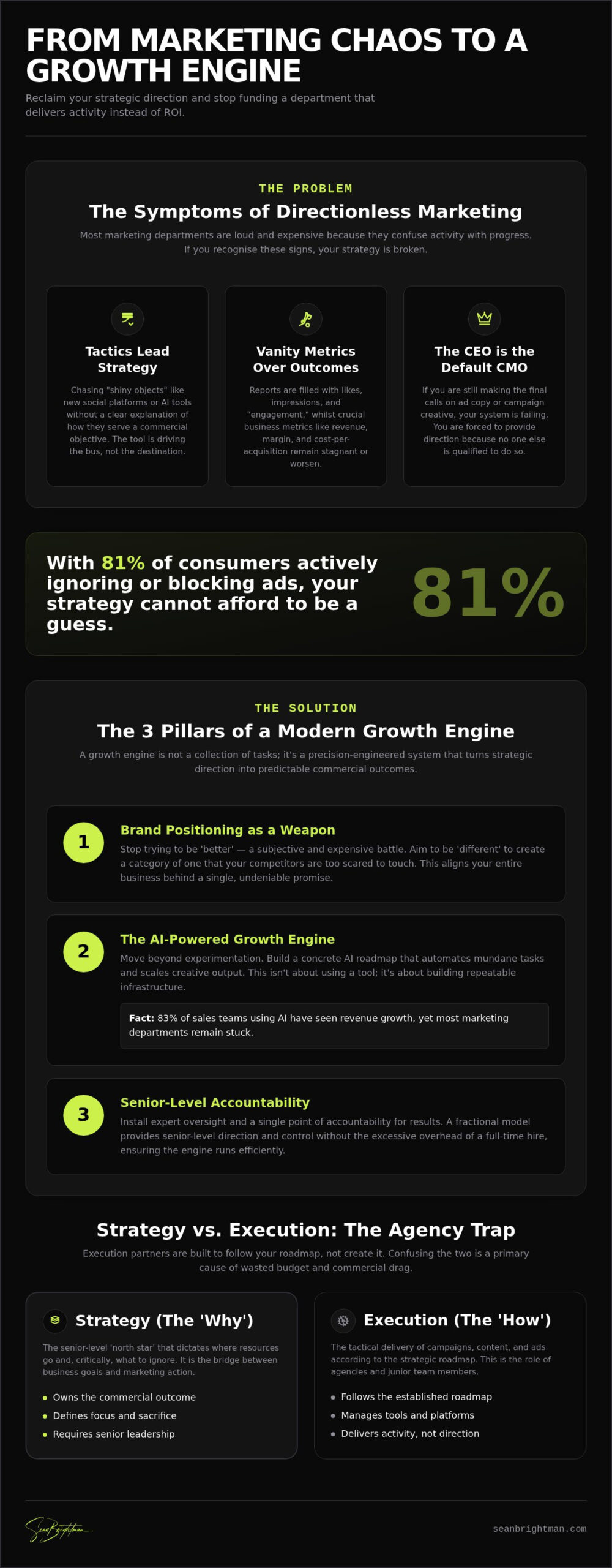
You likely feel the weight of high spend paired with low visibility. It’s a common frustration. You want a system that runs like a machine, not a series of fires you have to put out. With research showing that 81% of consumers now actively ignore or block ads, your strategy can’t afford to be a guess. We’re going to fix that. You’ll learn how to transition from chaotic execution to a high-impact roadmap that drives measurable business value.
We’ll explore the mechanics of building a scalable system. This includes how to organise your AI integration and secure expert oversight without the overhead of a full-time salary. It’s time to stop the noise and start the engine.
Most marketing departments are loud, expensive, and fundamentally lost. They produce a mountain of content and run dozens of campaigns, yet the needle barely moves. This happens because they lack a strategic marketing direction. It is not a 50-page document gathering dust on a server; it is the senior-level ‘north star’ that dictates exactly where your resources go and, more importantly, where they don’t. Strategic marketing direction is the bridge between business goals and tactical execution.
True direction is the art of sacrifice. Whilst most businesses try to do everything at once, a real strategist understands that focus is your only leverage. If you don’t have the discipline to choose what not to do, you are just gambling with your budget. Without this filter, your marketing team is merely busy. They are not productive. They are generating noise instead of building a growth engine. Whilst a foundational Marketing strategy provides the theory, direction provides the command and control necessary to win in a crowded market.
CEOs often confuse motion with momentum. Buying more ads or producing more blog posts is not a strategy; it is just increased spending. This is the ‘messy’ marketing trap. When your department lacks senior leadership, you end up with wasted budgets and missed market windows. You see the activity, but you don’t see the commercial velocity. This environment is toxic for talent. A lack of clear direction leads to team burnout and high turnover because high performers hate running on a treadmill that leads nowhere. They want to see results, not just checklists.
If you aren’t sure if your direction is broken, look for these three red flags. They are the hallmarks of a system that has lost its way.
You don’t need more hands on deck. You need a sharper mind at the helm to turn that tactical chaos into a repeatable machine.
A growth engine is the mechanical reality of your strategic marketing direction. It is not a collection of loosely related tasks; it is a precision-engineered system designed to produce a predictable commercial outcome. In 2026, the distance between a market leader and a struggling also-ran is defined by three structural pillars. These pillars turn your vision from an abstract theory into a functional, revenue-generating machine.
Don’t aim to be better. Aim to be different. ‘Better’ is subjective, fragile, and incredibly expensive to prove. ‘Different’ creates a category of one. By engaging a marketing leadership consultant UK, you can identify the unique commercial angle that your competitors are too scared to touch. This level of clarity does more than just attract customers; it can support a business transformation by aligning every internal department behind a single, undeniable promise. When your culture matches your brand, you stop selling and start dominating.
Stop playing with tools and start building infrastructure. Research from 2026 shows that 83% of sales teams using AI have seen revenue growth, yet most marketing departments are still stuck in the ‘experimentation’ phase. You need an AI roadmap that automates the mundane whilst scaling your creative output. This requires a marketing operations consultant mindset. You aren’t just using ChatGPT to write emails; you are building repeatable, automated processes that run without your constant supervision. With 63% of marketers already using generative AI, the competitive advantage is no longer the tool itself. It’s the integration of that tool into a strategic marketing direction that prioritises speed and precision.
A plan that isn’t measured is just a wish list. You need mechanisms that ensure every pound spent serves a commercial goal. This means moving beyond vanity metrics and focusing on the numbers that actually impact your balance sheet. Accountability is the ‘get-your-hands-dirty’ part of leadership. It’s about setting hard KPIs and having the guts to kill projects that aren’t performing. You need a department that values results over ego. If your current systems feel like they are held together with tape and spreadsheets, it might be time to look at an Advisory Retainer to install the necessary discipline and oversight.
These pillars provide the stability your business needs to scale. When positioning, AI integration, and accountability work in harmony, marketing stops being a cost centre and becomes a predictable engine for growth.
You cannot outsource your soul. Most CEOs make the mistake of hiring an agency and expecting them to provide a strategic marketing direction. It won’t happen. Agencies are built to execute. They are designed to scale their own billable hours by delivering assets, running campaigns, and managing platforms. They are vendors; they are not your business partners. If you don’t give them a roadmap, they will invent one that serves their bottom line, not yours.
This is the ‘Agency Trap’. You pay for activity whilst the underlying strategy remains broken. An agency’s incentive is to sell you more services, more content, and more ad spend. They want to expand the scope. A B2B marketing advisor, however, is incentivised by your efficiency. One wants to sell you more machinery; the other wants to ensure the machine you have is actually pointing at the right target.
Advisors provide the ‘What’ and the ‘Why’. Agencies provide the ‘How’. An advisor owns the ROI and the commercial outcome; the agency owns the deliverables and the deadlines. You wouldn’t hire a builder to architect your house, and you shouldn’t hire a social media agency to architect your market positioning. You need a battle-hardened strategist to manage your external partners. Without that oversight, you are just a client with a chequebook and no leverage. A strategist ensures that every tactical penny spent by your agency aligns with the broader business objectives.
Hiring a junior team and expecting senior-level results is a recipe for expensive failure. When you lack direction, you suffer from ‘tactical drift’. This is the slow erosion of your brand value as your marketing team tries every new trend without a cohesive plan. Over a year, between wasted ad spend and unproductive salaries, this drift easily becomes a £120k hole in your budget. It’s a high price to pay for ‘staying busy’. Agencies need a roadmap to follow, not a blank cheque to experiment with your capital. If you aren’t providing the strategic marketing direction, you are effectively letting your vendors decide your company’s future. That is a risk no CEO should be willing to take.
Stop tweaking the edges. If your marketing is a mess, you need a hard reset, not a new colour palette. Reclaiming your strategic marketing direction requires a clinical approach to your current activity. You have to be willing to kill what isn’t working to make room for what will. This is a five-step process designed to move you from tactical chaos to commercial velocity in 90 days.
Start with Step 1: The Audit. This is about brutal honesty. Identify the ‘zombie’ campaigns that eat your budget whilst delivering nothing but vanity metrics. If a channel isn’t contributing to a commercial outcome, cut it. Don’t let sentimentality protect a failing ad account. Once the noise is gone, move to Step 2: The Roadmap. Set a ‘North Star’ metric that the entire business understands. This isn’t about clicks or impressions; it’s about revenue, margin, or market share. Your roadmap should be a 90-day sprint. Focus on high-impact, low-friction wins that prove the model and build immediate momentum for the team.
Strategy is useless without a system to execute it. Step 3 is Systems Architecture. You need to define roles and responsibilities with surgical precision. Who owns the lead flow? Who owns the CRM data? By organising your tools and team around the roadmap, you move from a collection of individuals to a functional growth engine. This leads directly to Step 4: AI Implementation. Plug in automation to improve efficiency and output without increasing your full-time headcount. Use AI to handle the mundane, repetitive tasks, allowing your team to focus on high-level creative work. A machine-like system doesn’t just drive growth; it makes your business scalable and significantly more attractive for a potential exit.
Finally, Step 5 is Ongoing Advisory. Direction is easily lost in the day-to-day grind. You need an external force to provide the accountability that keeps the engine on track. If you are ready to stop the guessing and start the building, it is time to secure a Marketing Advisory Retainer to define your path forward and ensure you stay the course.
Scaling a business is a high-stakes game. You don’t win by hiring more juniors or buying more software. You win by installing senior leadership that understands the machinery of growth. For most scale-ups, a full-time CMO is a luxury they don’t need. Instead, senior marketing leadership on demand provides the heavy-hitting strategy required to scale without the £150k overhead. It is about commercial results, not internal headcount.
The Marketing Advisory Retainer is the mechanism for long-term consistency. It provides the ongoing strategic marketing direction that ensures your team stays focused on commercial outcomes rather than vanity metrics. Stop playing with tools. Start building a growth engine. A Fractional CMO doesn’t just give advice; they provide the leadership and accountability necessary to turn a roadmap into a revenue-generating reality.
You can’t see the label when you’re inside the jar. Every CEO needs a second opinion from someone who isn’t buried in the daily grind of the business. An advisor provides that clinical, external perspective that internal teams often lack. Through monthly accountability sessions, your strategic marketing direction stays on track. You get the benefits of a seasoned pro without the recruitment risk or the equity demands of a full-time hire. It’s a plug-and-play solution for strategic velocity. You get the expertise you need, exactly when you need it.
Clarity is your most valuable commercial asset. A single Roadmap Session can provide more direction than a year of agency status meetings. This isn’t a casual chat; it’s a high-impact strategic reset. You’ll exit the session with a clear understanding of your positioning, your AI integration plan, and your tactical priorities. You’ll know exactly what to do and, more importantly, what to stop doing. It’s time to stop the noise and start the engine. Get the strategic direction your business deserves.
Activity is not growth. You don’t need more content or more ads; you need a system that delivers predictable commercial outcomes. True strategic marketing direction is about sacrifice. It is about choosing the high-impact paths and ignoring the tactical noise that drains your budget and burns out your team. You have the vision for your business, but without the right machinery, that vision stays stuck in the mud.
I help CEOs move from chaos to clarity. As the author of ‘The Book’ on marketing strategy and a Fractional CMO for high-growth UK scale-ups, I’ve built these engines before. I specialise in AI integration that turns abstract theory into functional velocity. You don’t have to navigate the complexity of 2026 alone. You just need a battle-hardened strategist to point the way.
Build your growth engine with a Strategic Marketing Roadmap. It’s time to stop guessing and start scaling. Your business is ready for the next level; let’s build the engine that takes it there.
Marketing strategy is your theoretical plan. Strategic marketing direction is the active leadership that dictates where every pound and hour is spent. Think of it as the difference between a map and a driver. A strategy tells you where you could go; direction ensures you actually get there by making hard choices about what to ignore.
You don’t need a full-time hire to secure senior-level results. Most UK scale-ups are better served by a fractional model that avoids the £150k+ overhead of a permanent CMO. You get the same battle-hardened expertise and strategic oversight on a part-time basis. This allows you to invest the saved salary directly into your growth engine instead.
You should expect to see a shift in commercial velocity within 90 days. Whilst deep structural changes take longer, the noise can be cut instantly. A strategic reset identifies zombie campaigns and inefficient spend in the first few weeks. This immediate cleanup creates the breathing room needed for long-term systems to start producing measurable ROI.
Agencies are built to execute, not to lead. Their business model relies on selling you more services; they have a conflict of interest when it comes to cutting noise. An agency follows a roadmap; they don’t architect your business’s strategic marketing direction. You need an internal or fractional leader to manage those vendors and ensure they stay aligned with your commercial goals.
AI is the fuel for your growth machinery. It fits into a roadmap by automating repetitive operational tasks and scaling your content production without increasing headcount. In 2026, 83% of sales teams using AI report revenue growth. Your roadmap ensures you aren’t just playing with tools but building a precision-engineered system that integrates AI into your core workflows.
It is a secret weapon for CEOs who need senior oversight without the full-time commitment. The retainer provides ongoing access to a strategist who ensures your roadmap stays on track. It involves monthly accountability sessions and strategic adjustments. This keeps your team focused on outcomes and prevents the tactical drift that usually erodes brand value over time.
Small businesses need direction more than anyone else. Large corporations can afford to waste budget on failed experiments; you can’t. Precision is your only advantage. Having a clear roadmap allows you to punch above your weight by ensuring every tactical move serves a specific commercial objective. It’s about efficiency, not just scale.
If you are measuring success by likes rather than revenue, you lack direction. Other red flags include a marketing team that is always busy but never productive, or a CEO who is still making final calls on ad creative. When tactics drive the bus instead of business goals, your system is broken. You are paying for activity, not progress.
Reading is good. A roadmap is better.