

More marketing activity won’t fix unclear priorities. If campaigns are running but their commercial contribution is hard to see, a strategic marketing advisor for hire should help you make sharper choices and agree who will act on them, not simply deliver another polished strategy deck.
You may already know the business needs senior direction. The challenge is finding support that fits without committing to a full-time leadership hire, and making sure recommendations keep moving once the adviser leaves. Before comparing people, identify the decision you need help with and what is currently stopping you from making it.
This guide explains what a strategic marketing adviser should solve, how to assess their experience and working style, and what to agree before you hire. It also compares advisory support with consultants, agencies and fractional marketing leadership, and explains when a one-off roadmap or ongoing advice may be a better fit. You’ll learn how to define a practical scope, working rhythm and measures of progress, so the work connects to business decisions rather than ending as a document gathering dust.
A full calendar can still hide a failure to make the decisions that matter. Campaigns, content and meetings keep moving, while the business remains unsure what it stands for, which customers to prioritise or how marketing supports its commercial goals.
A strategic marketing advisor helps a leadership team clarify its marketing choices, priorities and direction. Strategic marketing advice helps a business decide what to focus on and why; tactical marketing activity carries out the agreed work. The adviser shapes the direction, while internal teams or delivery partners implement it.
Marketing strategy provides a framework for connecting business goals with markets and choices. In practice, an adviser should help turn that broad idea into decisions your team can use, rather than simply adding more activity to the plan.
If you’re looking for a strategic marketing advisor for hire, start with the decision you need help making, not a list of marketing tasks. The right starting point depends on your business context, so agree the problem with the adviser before defining the work.
Look for a specific point of uncertainty that leadership can resolve. For example:
These are decisions, not requests for a longer activity list. A useful adviser will ask about your objectives, customers and current marketing before settling on the problem to address. You can make that conversation more productive by bringing examples of current priorities, open decisions and activity that is proving difficult to connect to business goals.
If the immediate need is hands-on campaign delivery, content production or other execution, you may need delivery capacity rather than strategic advice. An adviser can help set direction, but don’t assume that includes carrying out the work. Clarify who owns implementation before agreeing the scope.
Recruitment is a separate need, too. An external marketing adviser isn’t a placement service or a substitute for hiring someone into a role. If you’re unsure whether you need strategy, execution or a new team member, define the business outcome and the gap preventing it. Then choose support that addresses that gap.
A strategy deck can record the work, but it can’t prove that the business has made a decision or that the team is acting on it. A useful engagement leaves leaders clearer on what to prioritise, why it matters and what the team should do next.
Expect agreed decisions, a focused set of strategic priorities and practical direction the team can apply. That might mean choosing which market to focus on, stopping activity that no longer fits or identifying what evidence would change the plan. The document captures those choices; it is not the outcome itself.
A useful plan connects business aims with what the team knows about its customers, competitors and current position. The adviser should help leaders weigh that information and decide what it means for the business. The result should make the next choices clearer, not simply add pages or recommendations.
Good advice includes challenge and follow-through, not taking over every task. The adviser can test assumptions, check whether agreed priorities are being adopted and help leaders address obstacles. Your team or delivery partners can own implementation, with responsibilities agreed upfront. If you’re considering a strategic marketing advisor for hire, make that boundary explicit before work begins.
Start with the business decision or constraint the engagement must address. Agree who needs to contribute, what information the adviser needs and which decisions leadership expects to make. Then set the boundaries: what the adviser will recommend, what your team will implement and who owns each action. This helps prevent a strategy brief quietly turning into an execution brief.
Agree review points to check whether recommendations have been understood, adopted and acted on. Choose progress measures with the adviser that fit the business challenge; avoid generic targets and don’t assume a particular result. If new evidence undermines the original plan, decide how you’ll revisit priorities rather than pushing ahead by default.
For ongoing direction and review, explore the marketing advisory retainer guide. It can help you consider whether continuing advice fits better than a defined, one-off piece of roadmapping.
These labels can overlap, and a title alone won’t tell you who owns the work. Compare support by its purpose, decision-making role, delivery capacity and likely engagement shape. For an overview of a consultant’s possible responsibilities and specialisms, see What Is a Marketing Consultant, then confirm the actual scope with each provider.
The right option depends on the gap you need to fill: clearer decisions, defined expertise, delivery capacity or sustained senior marketing leadership.
| Support | Main purpose | Leadership ownership | Execution capacity and likely shape |
|---|---|---|---|
| Strategic marketing adviser | Clarify choices, priorities and direction. | Informs decisions; leadership remains with your business. | Doesn’t automatically include implementation. May be a focused piece of work or ongoing advice. |
| Marketing consultant | Bring specialist analysis or recommendations to a defined challenge. | Usually advises rather than taking ongoing leadership ownership. | Scope can range from a discrete project to continuing support. Confirm whether implementation is included. |
| Agency | Deliver agreed marketing work within its contracted remit. | Your business retains strategic ownership unless leadership responsibilities are explicitly agreed. | May provide delivery capacity; channels, tasks and ownership depend on the agreement. |
| Fractional CMO | Provide part-time senior marketing leadership. | Can take sustained responsibility for marketing direction and leadership, as agreed. | Typically an ongoing, part-time arrangement; confirm the remit, authority and responsibilities. |
Don’t assume every consultant or agency works the same way. Ask what they’ll own, what your team must provide and whether the engagement covers recommendations, delivery or both. The distinction matters: an adviser informs decisions, while a fractional CMO can provide part-time senior leadership across teams and priorities.
Choose advisory support when the main gap is diagnosis, prioritisation or an independent view of a difficult choice, rather than a shortage of people to deliver campaigns. An adviser can help define what work should happen and why. Someone still needs to own implementation, whether that’s your internal team or a separately commissioned delivery partner. An agency may be the right fit when delivery itself is the need.
If priorities need a senior owner who can stay involved across teams and decisions, explore fractional leadership rather than assuming an advisory scope will cover it. Advisory and fractional CMO responsibilities can differ, so agree decision rights, accountability and time commitment before starting. Read the Fractional CMO guide for a deeper explanation.
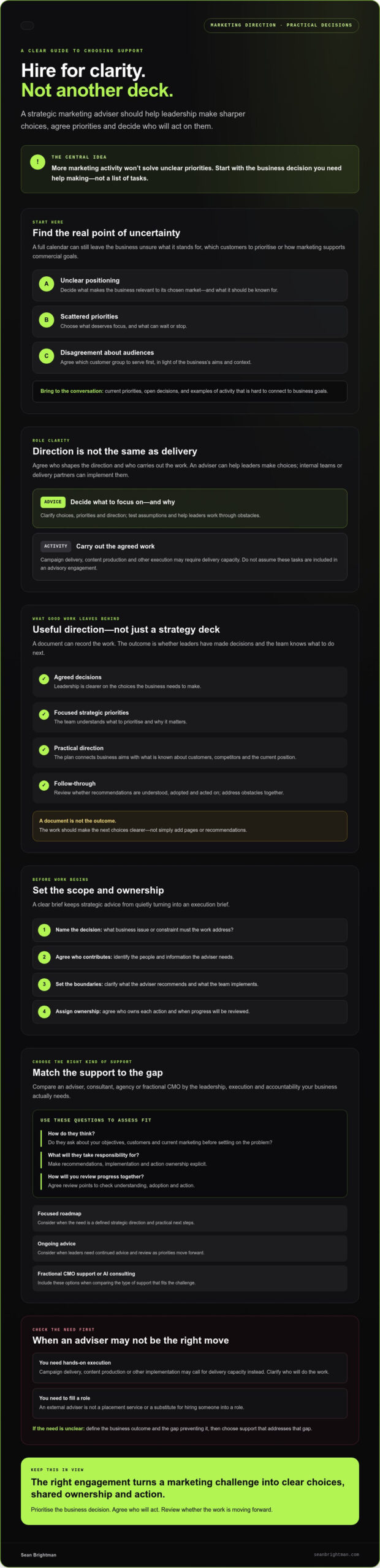
A strong proposal should show how the adviser will move from your business challenge to a decision you can act on. Don’t judge fit on confidence or polished slides alone. Test the thinking, responsibilities and working rhythm before you commit.
Use this process to assess a strategic marketing advisor for hire:
Ask: “What information would you need before recommending priorities?” “Which decisions and outputs would this engagement cover?” “What will you need from our team?” “How will we review progress, and what happens if new evidence challenges the original assumptions?” Clear answers should make the boundaries visible. If success measures or ownership are vague, or promises are made without context, pause and ask for specifics.
Good fit shows up in the conversation. The adviser explains their reasoning, asks questions that sharpen the brief and is willing to challenge your starting assumptions respectfully. They can describe a working rhythm that suits how your leadership team makes decisions. Check that the proposed scope matches your actual need; don’t infer expertise or delivery capacity that hasn’t been confirmed.
If the central need is a structured roadmap, explore this strategic brand roadmapping guide. It may help you decide whether a defined roadmap is the right shape of support before discussing an engagement.
Ready to turn a marketing challenge into a scoped next step? Discuss strategic marketing support with Sean Brightman.
Start with the business challenge, not a preselected service. Be clear about the decision you need to make, the support that could help and how you’ll review progress. That gives you a firmer basis for discussing fit and scope, without assuming every problem needs the same kind of engagement.
Sean Brightman provides strategic marketing support through roadmapping, advisory retainers, Fractional CMO support and AI consulting. These options address different needs. The right place to start depends on the challenge, the leadership involvement required and whether you need a defined piece of guidance or continuing support.
A one-off roadmap may suit a business that needs clearer direction and a practical set of priorities. An advisory retainer may fit when leaders need ongoing strategic input and accountability as they make decisions. Fractional CMO support is worth exploring if the gap is part-time senior marketing leadership. Consider AI consulting when the challenge specifically involves applying AI to marketing. Confirm the available scope and responsibilities before agreeing an engagement.
These are strategic support options, not a recruitment route or outsourced advertising service. Sean doesn’t provide full-time CMO placement, recruitment or advertising execution. If you need someone to deliver campaigns or fill an employee role, clarify that requirement separately rather than expecting an advisory engagement to cover it.
Describe the business challenge in plain terms. Note your current marketing priorities, the decisions still open, what you’ve already tried and where progress stalls. You don’t need a perfect brief, but you do need enough context to explain what’s getting in the way and what leadership needs to resolve.
Use the conversation to test fit, not to chase a promised outcome. Discuss which type of support might match the challenge, what the scope could include, what your team would need to contribute and how accountability would work. A useful next step is clarity on whether the proposed support fits, what remains to be defined and how to proceed.
If you’re looking for a strategic marketing advisor for hire, discuss your strategic marketing challenge with Sean Brightman. Bring the decision you’re trying to make and use the conversation to establish whether roadmapping, ongoing advice, Fractional CMO support or AI consulting is the right fit.
The right support starts with a clear business challenge, not a wish list of marketing activity. Define the decision you need to make, then choose support that fits: a focused roadmap for clearer direction, ongoing advisory for continued guidance, or Fractional CMO support when you need part-time senior leadership. Agree responsibilities and review points before work begins.
A strategy document only matters if your team uses it. Look for clear priorities, practical direction and accountability, with measures that make sense for your business. If AI is central to the challenge, AI consulting may be relevant, but it isn’t the answer by default.
If you’re considering a strategic marketing advisor for hire, Sean Brightman offers roadmapping, advisory retainers, Fractional CMO services and AI consulting. Start by explaining the challenge, what you’ve tried and where progress stalls. Then you can establish whether the support and scope fit, without assuming a particular outcome.
Discuss your strategic marketing challenge and take the next step with greater clarity and confidence.
A strategic marketing advisor helps a business make clearer marketing decisions. They assess the situation, challenge assumptions and help leaders set priorities and direction. For example, they might help clarify which audience to focus on or how marketing should support business objectives. Their role is advisory unless the agreed scope includes leadership responsibilities. Your team or delivery partners may still own implementation, so confirm who is responsible for turning recommendations into action.
Hire an adviser when an important marketing decision is unclear or activity isn’t adding up to a coherent direction. You might be weighing different audiences, struggling to prioritise initiatives or unsure what marketing should contribute to business goals. A strategic marketing advisor for hire can help define the issue and guide decisions, but first clarify what you need: advice, senior leadership, implementation capacity or recruitment. The right support depends on the gap.
The titles can overlap, so compare the proposed work rather than relying on the label. A strategic marketing adviser typically focuses on choices, priorities and direction. A marketing consultant may bring specialist expertise to a defined problem and could provide recommendations or other agreed work. Neither title guarantees implementation or ongoing leadership. Ask what the person will deliver, what decisions they’ll inform and who owns follow-through before agreeing a scope.
Choose an adviser if you mainly need help thinking through marketing choices and setting direction. Consider a fractional CMO if you need part-time senior marketing leadership with sustained ownership across teams and decisions. The distinction depends on the responsibilities you need, not just the job title. Agree decision-making authority, accountability, working rhythm and implementation expectations before engaging either option, as advisory and fractional leadership scopes can differ.
They can help connect strategic decisions to implementation, but that doesn’t mean they’ll personally deliver campaigns or marketing activity. Some scopes may include ongoing guidance, progress reviews or senior leadership; others focus on advice and a roadmap. Ask what support is included, who will carry out the work and who is accountable for delivery. If hands-on execution is your main need, identify that capacity separately rather than assuming advisory support covers it.
Ask how they’ll understand your business before recommending priorities, what decisions and outputs the engagement covers, and what they’ll need from your team. Clarify who owns implementation and how you’ll review progress. Ask what happens if new evidence challenges the original assumptions. Look for clear reasoning and relevant questions, not vague success measures or promises without context. The answers should help you judge both strategic fit and whether the working arrangement is practical.
Involvement varies with the agreed scope. A focused roadmapping engagement may centre on setting direction, while an advisory retainer provides continuing strategic input and accountability. Fractional CMO support can involve broader part-time marketing leadership. Before starting, agree how often you’ll meet, who will take part, what decisions the adviser will support and how progress will be reviewed. Don’t assume a particular level of access or execution is included unless it’s confirmed.
Reading is good. A roadmap is better.