

Your marketing department is a high-speed treadmill that leads nowhere. You are burning through cash on “activity” whilst your revenue remains stubbornly flat. It is a common trap. You hire more agencies. You try new channels. You wait for a breakthrough that never arrives. The reality is blunt: you do not have a marketing problem; you have a leadership vacuum.
It is exhausting to act as the primary decision-maker for every campaign whilst trying to scale a business. You likely see the signs you need a senior marketing leader every time you look at an opaque ROI report or a disjointed tactical plan that lacks a cohesive core. You want a system that works without your constant intervention. You need accountability that goes beyond vanity metrics and actually impacts the bottom line.
This article identifies the critical symptoms of a broken marketing function and explains why senior strategic leadership is the only way to build a scalable growth engine. We will explore how to transition from chaotic execution to a disciplined strategy that aligns with your long-term growth or exit goals. It is time to stop managing tasks and start building an engine.
Most marketing teams are sprinting. They produce blogs, run ads, and post on social media. They are incredibly busy. Yet, the revenue needle remains stubbornly fixed. This is the Activity Trap. It is the hallmark of a team that lacks a strategic rudder. If your revenue is flat whilst your Slack channels are buzzing with “completed tasks”, you are witnessing the first senior marketing leader signs. Activity is easy. Strategy is hard.
In a competitive 2026 landscape, “random acts of marketing” are an expensive luxury you cannot afford. You do not need more “doing”. You need better “thinking”. When a team lacks a leader, they default to tactics because tactics feel like progress. They are not. Progress is measured in commercial movement, not just the volume of output. If you cannot draw a straight line from a marketing task to a revenue outcome, you are just burning cash.
Your current team likely reports on vanity metrics. Likes, reach, and impressions feel good in a monthly report. They do not pay the bills. A senior leader ignores the fluff. They focus on pipeline, Customer Acquisition Cost (CAC), and Lifetime Value (LTV). They reorient the team toward revenue-generating behaviour by asking the difficult questions that agencies often avoid.
This is the difference between an Agency Manager and a Growth Architect. An Agency Manager checks if the work is done. A Growth Architect ensures the work is profitable. It is about commercial outcomes, not creative output. If you are currently managing tasks instead of systems, you have found one of the clear signs you need a senior marketing leader. You need someone to own the P&L of your marketing spend, not just the calendar.
Marketing should be a machine, not a series of one-off projects. It needs to work whilst you sleep. Without a leader, your marketing is a collection of “decorators” painting a house that has no foundation. They make things look pretty, but the structure is weak. Senior leadership builds brand equity that compounds over time. They don’t just fill the funnel; they build the funnel.
A marketing leader is the person who owns the “Why” and the “How”, not just the “What”. They integrate strategic roadmapping and AI consulting to drive efficiency. They ensure every pound spent is an investment in a scalable system rather than a one-time expense. They stop the noise and start the growth engine.
Growth does not just happen. It is engineered. If you feel constant friction in your marketing department, it is usually because your operational complexity has surpassed your internal capability. You are stuck in The Activity Trap because your team is executing without an architect. Recognising the signs you need a senior marketing leader is the first step toward reclaiming your time and your budget. Here are the five unmistakable signals that your current setup is failing:
In the early days, your intuition was an asset. It got you to the first £1m. Now, that same intuition is a liability. You are the biggest blocker in your own growth. A CEO cannot be a part-time marketing leader whilst trying to scale an entire organisation. It is a recipe for half-baked strategies and missed opportunities. If you are still the primary marketing decision-maker, your business is limited by your personal bandwidth, not your market potential. You need a partner who provides strategic accountability so you can focus on the board level, not the ad level.
Buying the tech is easy. Integrating it into a growth engine is where most scale-ups fail. It is a £50k mistake to invest in advanced software without a senior roadmap to run it. Junior teams often use AI for tactical shortcuts, like churning out mediocre content, rather than strategic efficiency. They see the tool, but they miss the system. Senior oversight in AI consulting ensures your tech stack actually drives margin. You don’t need more tools; you need a leader who knows how to wire them into a cohesive, scalable engine that produces results whilst you sleep.
Agencies are tactical partners. They sell services. They do not sell your growth. One of the clearest signs you need a senior marketing leader is when you realise your agencies are marking their own homework. They report on their own success whilst your bank balance tells a different story. An agency is incentivised to keep you spending. If a channel is failing, they will suggest “optimising” rather than “stopping”. They lack the objectivity to fire themselves from a failing project. You need an internal force that prioritises your margin over their retainer.
Ownership of your strategic intelligence is non-negotiable. If your data and insights are locked inside agency dashboards, you do not own your marketing. You are renting it. A leader ensures that every piece of market intelligence remains a permanent asset of your business. They stop the leakage of knowledge and ensure your brand is built on an internal vision, not an outsourced one. You cannot outsource the soul of your company to a team that manages forty other clients.
Agencies are “doers”. They are built to execute specific tasks. To succeed, they need a high-quality brief. If you are the one writing that brief, you are still the marketing leader. This is the briefing gap. A senior leader sits between you and the tactical partners, translating your business goals into precise instructions. They coordinate the specialists. They ensure the SEO agency is not fighting the PPC agency for the same budget. Without this coordination, you are paying for a choir where everyone is singing a different song.
Potential buyers look for stability. An agency-only model is a red flag. It looks like a house of cards that collapses the moment a contract ends or a founder leaves. To build a marketing strategy for business exit, you must prove your growth engine is documented and repeatable. Investors want to see professionalisation. They want a leader who has built a system that functions independently of the CEO. A senior marketing leader transforms your marketing function from a chaotic cost centre into a transferable asset that buyers actually covet.
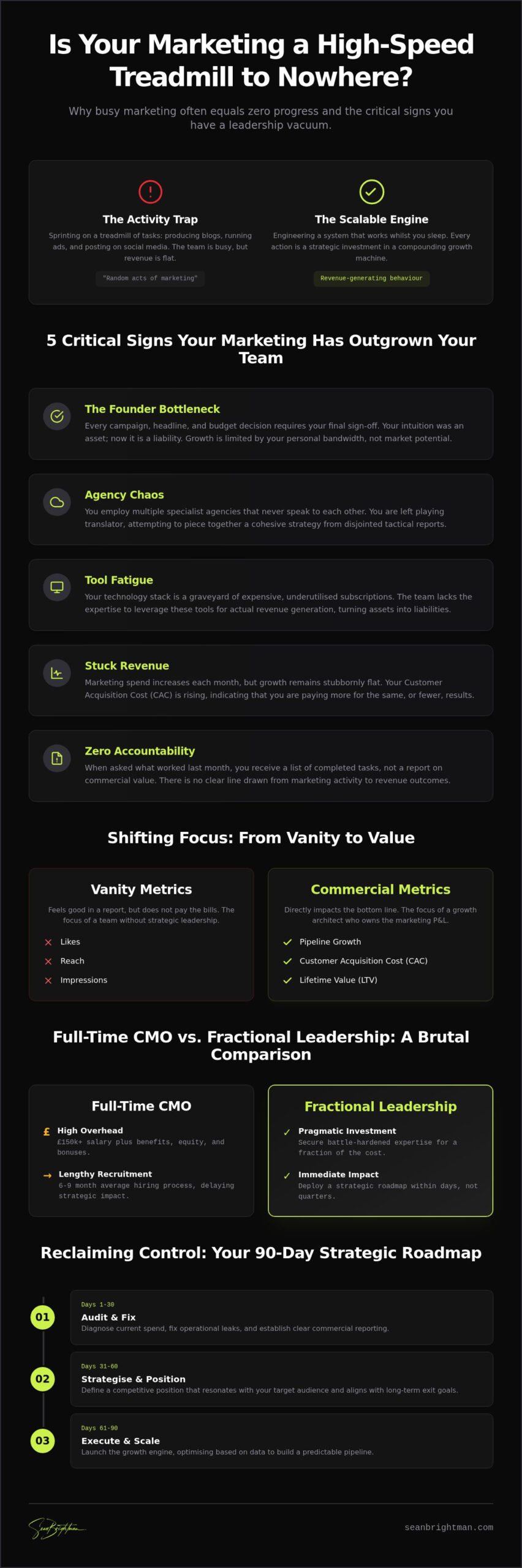
If you see the signs you need a senior marketing leader, your first instinct is likely to call a recruiter. That is often a six-figure mistake. Many scale-ups fall into the “Title Trap”. They hire a Marketing Manager for £60k and expect them to behave like a Chief Marketing Officer. It never works. A manager is an executor. They follow a brief; they do not write one. You end up with a high-salaried employee who still looks to you for every strategic decision.
The math of a full-time executive hire is brutal. A seasoned CMO in 2026 commands a salary of £150k plus benefits, NI, and often equity. Add a 20% recruitment fee, and you have spent £180k before they even sit at their desk. Then comes the “ramp-up” period. Whilst a full-time hire spends their first ninety days navigating internal politics and learning the office layout, a fractional leader is already dismantling your failing campaigns. You pay for impact, not presence.
There is a revenue threshold where a permanent CMO makes sense. Usually, this is when your marketing team exceeds ten people and your annual turnover is north of £15m. Hiring too early leads to high churn. A heavy-hitting strategist will become frustrated doing tactical work, and you will end up wasting equity on a role that hasn’t been properly defined. A “Plug-and-Play” strategist is the smarter move during this transition. They build the engine so that when you finally hire a permanent lead, they inherit a machine that actually works.
Fractional leadership is about results, not career ladders. These are battle-hardened experts who have seen your problems ten times before and know exactly how to fix them. They bring a “No Ego” approach that prioritises your P&L over their office status. By accessing senior marketing leadership on demand, you get the brain of a £200k executive for a fraction of the cost.
You don’t need another expensive seat in the boardroom. You need a growth engine that produces predictable revenue. If you are ready to stop the activity and start the growth, book a strategic roadmap session to see how fractional leadership can fix your marketing function.
If you have identified the signs you need a senior marketing leader, the next ninety days are critical. You cannot fix a broken engine whilst it is still running at redline. You need a structured intervention. This roadmap is not a theoretical exercise. It is a tactical overhaul designed to move you from chaotic activity to predictable growth. We stop the guessing and start the building.
A strategic brand roadmapping session is the fastest way to get unstuck. It provides the “Why” behind every “What”. Most teams live in a state of “we should try this”. A roadmap moves you to “we are doing this because”. It creates a plan that the board can understand, support, and fund. It turns marketing from a black box into a transparent growth lever that delivers strategic velocity.
A strategy is useless if it sits in a PDF on your desktop. Order requires an external force. An advisory retainer provides the ongoing accountability needed to ensure the strategy is executed, not filed away. It is the tactical oversight that keeps your team focused on high-impact work whilst ignoring the shiny distractions that usually derail progress. You get senior-level authority without the full-time overhead.
Stop the mess. It is time to professionalise your marketing function and build an engine that buyers covet. Book a strategic roadmapping session with Sean Brightman today and start the growth.
Busy marketing is a trap. If you are still the primary decision-maker for every campaign whilst your revenue remains flat, you have seen the signs you need a senior marketing leader. You don’t need more agencies or more tools; you need a growth architect. You need a system that functions independently of your personal bandwidth and aligns with your commercial exit goals.
Sean Brightman provides the battle-hardened Fractional CMO expertise that UK scale-ups require to professionalise their marketing function. As the author of the definitive guide on strategic marketing, he offers a no-fluff, results-driven advisory that replaces chaotic activity with mechanical precision. It is time to reclaim your time and build a transferable asset that buyers actually covet.
The next ninety days could define your trajectory for 2026. Stop the noise. Build your growth engine with Sean Brightman and move from the founder bottleneck to scalable velocity. Your growth engine is waiting.
Managers are executors who focus on the “what”. They manage task lists and follow a brief. A senior leader is an architect who owns the “why” and the “how”. They write the brief and align marketing activity with commercial business goals. Whilst a manager ensures the work is done, a leader ensures the work is profitable and builds a scalable system.
Industry rates for fractional leadership are based on impact and strategic velocity rather than hours. It is a high-impact alternative to a full-time hire, which typically costs £120k plus recruitment fees and equity. You secure battle-hardened expertise for a fraction of that overhead. The focus is on delivering a return through strategic efficiency and revenue growth rather than just occupying a seat.
No. Agencies are tactical specialists who need a rudder. Without an internal leader, agencies often mark their own homework and default to activity that protects their retainer. You need a senior strategist to coordinate multiple partners and ensure every pound spent is an investment in a cohesive roadmap, not just a series of disconnected tactical acts.
The right time is when you hit the “Founder Bottleneck”. If every marketing decision still lands on the CEO’s desk, growth will inevitably stall. You should seek leadership when your marketing spend is increasing whilst your ROI becomes opaque. It is the moment you need a repeatable marketing engine that doesn’t rely on your constant intervention to function.
Flat revenue despite high team activity is the primary signal. If your team is busy but your customer acquisition cost is rising, the strategy is broken. Other signs you need a senior marketing leader include disjointed messaging amongst different channels and a lack of clear, revenue-linked data. If you can’t see how a task leads to a sale, you are failing.
AI is a machinery upgrade for your growth engine. A senior leader uses AI consulting to build high-efficiency systems that automate workflows and improve data analysis. It isn’t about using tools for tactical shortcuts. It is about integrating technology into your operations to reduce overhead and increase the speed of your marketing execution whilst maintaining a lean internal team.
Yes. A small team without leadership is just a group of people doing tasks. Leadership is about strategic direction, not headcount. A fractional leader provides the roadmap that ensures your small team is working on the highest-impact initiatives. They stop your staff from getting lost in tactical noise and keep them focused on activities that drive commercial value.
Measure the ROI through commercial metrics rather than vanity stats. Look for a reduction in customer acquisition costs, an increase in pipeline velocity, and the creation of a documented, repeatable system. The value is found in the transition from chaotic activity to a predictable growth engine. If your marketing now functions without the CEO’s input, the ROI is clear.
Reading is good. A roadmap is better.