

Only 2.6% of board directors have an executive marketing background, whilst 100% of boards have designated finance experts. That’s a massive literacy gap. When you walk in with a slide deck full of “brand sentiment” and “social reach,” you aren’t speaking their language. You’re simply confirming their suspicion that marketing is a discretionary cost centre. It’s time to stop the “colouring-in” charade.
Successfully presenting a marketing plan to the board requires a shift from tactical fluff to clinical capital allocation. You’ve likely felt the heat of aggressive questioning on long-term ROI whilst the CFO stares at your budget like it’s a leak in the boat. You know that marketing drives growth, but the board only sees a line item they’d rather cut to protect EBITDA.
This guide will show you how to transform your list of tactics into a risk-mitigated growth engine that commands respect and secures your £ budget. We’ll break down the shift from vanity metrics to commercial alignment, navigate 2026 data privacy risks, and provide a step-by-step framework for a pitch that wins. You’ll move from being a cost to being the engine.
Boards don’t care about your TikTok engagement or the “vibe” of your new creative campaign. They care about risk mitigation and EBITDA growth. Most marketing leaders fail because they fall into the “fluff trap.” They present a shopping list of tactics and call it a strategy. Tactics are just things you do; strategy is how you win. When you’re presenting a marketing plan to the board, you’re usually pitching a cost. You should be pitching an investment.
The board’s primary concern is fiduciary responsibility. They want to know how every pound spent protects the business or scales it. If your plan doesn’t explicitly link to the balance sheet, it’s noise. You need to move from a “Cost Centre” mindset to a “Growth Engine” mindset. One costs money to maintain; the other generates a return that outweighs the input. It’s a binary choice.
The board thinks you’re just spending money. They’re often right. If your narrative is built on “getting our name out there,” you’ve already lost the room. Boards are supply-side thinkers. They understand operations, finance, and legal risk. They don’t understand “brand love.” This disconnect creates a culture where marketing is the first budget to be slashed during a downturn.
Stop obsessing over raw lead volume. High lead counts without a scalable system behind them are just a drain on sales resources. You need to move from activity to outcome. Instead of saying “we’re running ads,” say “we’re building a predictable customer acquisition machine.” Presenting a marketing plan to the board is about proving you have control over the machinery of growth, not just the steering wheel.
You need to translate marketing jargon into financial reality. “Brand awareness” is actually market share protection. It’s defensive. It’s about ensuring competitors don’t eat your lunch. To gain credibility, you must ground your talk in the return on marketing investment (ROMI) framework. This isn’t just about spreadsheets; it’s about showing you understand capital allocation.
Focus on unit economics. If your Customer Acquisition Cost (CAC) is climbing whilst Lifetime Value (LTV) stays flat, you’re a liability. However, if you can demonstrate how Strategic brand roadmapping builds a long-term business asset, you’re an expert. This is where a Fractional CMO adds value. They act as the bridge between the creative engine and the boardroom, stripping away the fluff to focus on what actually moves the needle for the business.
Boards don’t want a narrative; they want a blueprint. When presenting a marketing plan to the board, you must demonstrate that your strategy is built on three unbreakable pillars. These pillars move the conversation from “what are we doing?” to “how are we scaling?”. Without this structure, you’re just another department asking for more cash. It’s about building a machine, not just running a department.
Marketing should be an equity play. If you aren’t showing how your activity increases the company’s valuation, you’re failing. A McKinsey analysis on C-suite marketing alignment confirms that only 3% of board members have a marketing background. They don’t speak your language; you must speak theirs. This means developing a marketing strategy for business exit. You are building a growth engine that a buyer would covet because it’s predictable and documented. Every pound spent should be an investment in the company’s future sale price.
Most marketing teams are a collection of silos and manual workarounds. That’s a recipe for operational drag. You need to show the board the machinery behind the leads. This isn’t about which shiny new tools you use. It’s about how those tools are integrated into a functional, scalable system. Bringing in a Marketing operations consultant is the fastest way to fix the plumbing. They ensure your data flows from the first touchpoint to the final sale without manual intervention. Boards love systems; they hate “heroics” that can’t be replicated.
By 2026, AI is no longer an experiment. It’s a fundamental requirement for operational efficiency. Research from the Gartner 2026 CMO Spend Survey shows that leading organisations are now allocating over 21% of their budgets to AI initiatives. Boards expect you to use these tools to lower your Customer Acquisition Cost (CAC) and increase your speed to market. This isn’t about replacing your team. It’s about augmenting the machine to produce more output with less waste. If you need help building this architecture, a Fractional CMO can provide the high-level oversight needed to integrate these systems into your 12-month roadmap.
If you walk into a boardroom and start talking about “impressions” or “social engagement,” you’ve already lost the CFO. These are vanity metrics. They belong in the graveyard of marketing credibility. They don’t pay the bills. They don’t drive EBITDA. Presenting a marketing plan to the board requires a ruthless focus on commercial unit economics. It’s about showing the board you understand how cash moves through the business.
The board wants the “Holy Trinity” of metrics. This is the only language they respect. Focus on Customer Acquisition Cost (CAC), Customer Lifetime Value (LTV), and the Payback Period. If your CAC is £500 and your LTV is £5,000, you have a business. If the payback period is under six months, you have a growth engine. McKinsey research on proving marketing ROI to the board shows that CMOs face heightened pressure to substantiating these numbers with rigour. Don’t hide behind brand sentiment. Bring the data.
Accountability isn’t a one-off event. It’s a continuous process. Establishing a Marketing advisory retainer provides the ongoing oversight needed to keep these metrics aligned with business goals. It ensures you aren’t just hitting targets, but hitting the right targets that drive valuation.
When you’re presenting a marketing plan to the board, your dashboard should be a one-page summary. CFOs don’t want to dig through 50 slides. They want to see the 80/20 of your performance. What are the 20% of activities driving 80% of the revenue? Focus on your “North Star” metric. This is the single value that indicates the health of your growth engine. It might be net revenue retention or pipeline velocity. If it doesn’t impact EBITDA, it doesn’t belong on the page.
AI isn’t just for making content faster. It’s a margin-improvement tool. When you report on AI, don’t talk about “cool tools.” Talk about operational speed and cost reduction. Professional ai consulting helps you measure the actual hours saved and the reduction in manual overhead. Boards love efficiency. Show them how automated growth engines are lowering your cost per lead whilst increasing your output. AI is about capital efficiency. It’s about doing more with less.
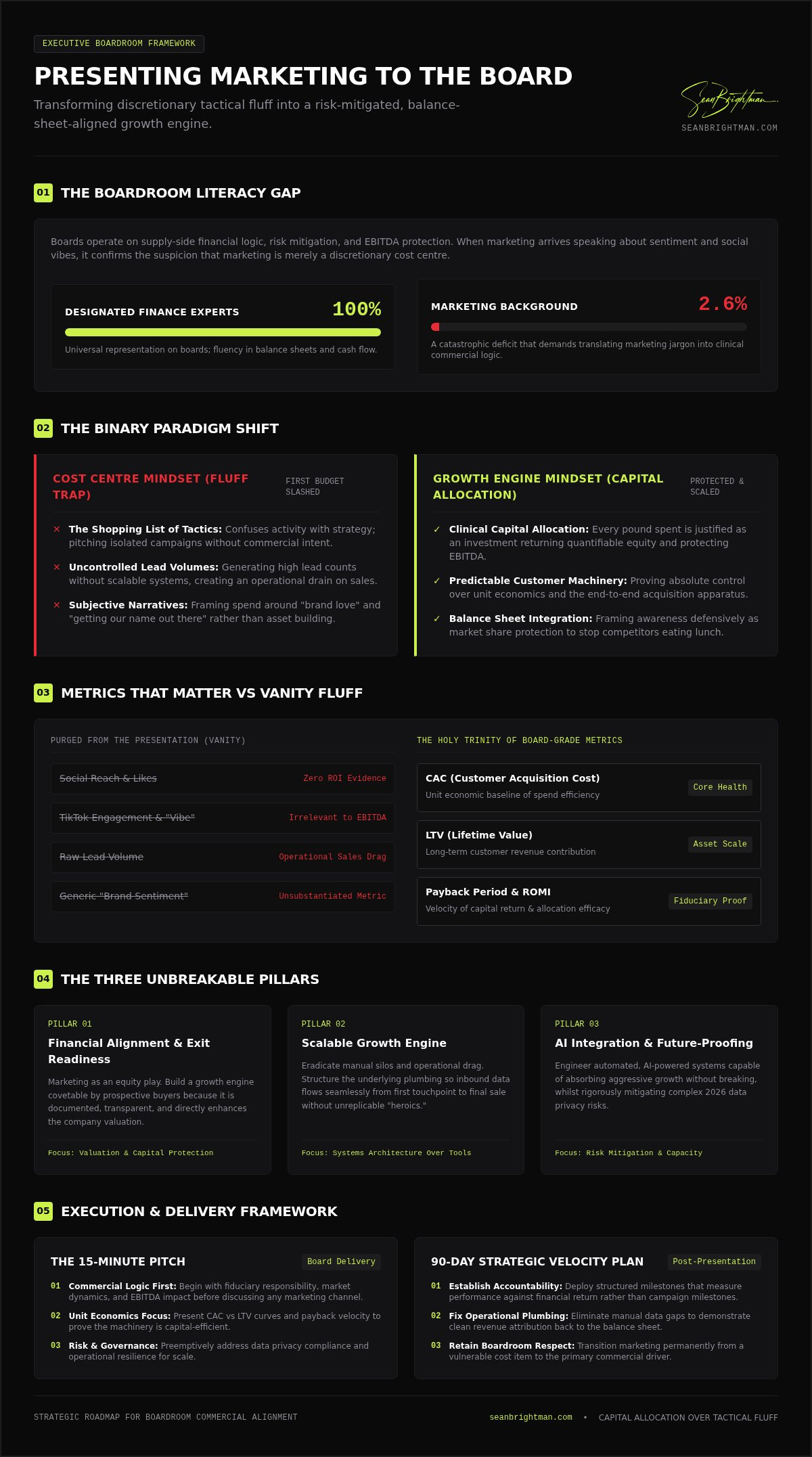
You have 15 minutes. Don’t waste ten of them on creative mood boards or font choices. Boards operate on a high-velocity briefing model. They want the bottom line first. When you’re presenting a marketing plan to the board, you have exactly 15 minutes to prove you aren’t a liability. Mastery is about controlling the narrative through five clinical steps.
Mastering the delivery of presenting a marketing plan to the board is about moving from a supplicant asking for money to a partner offering a solution. If you need a battle-hardened expert to help refine this delivery, consider a Advisory Retainer to ensure your strategy is boardroom-proof.
Expect the “it’s too expensive” objection. Don’t defend the price; reframe it as opportunity cost. Show them what the business loses in market share by doing nothing. When they say “we tried this before,” don’t take it personally. Explain that the previous system failed because the plumbing was broken, not because the strategy was wrong. Use blunt honesty. Boards respect a leader who admits where the old machine leaked and shows exactly how the new one is sealed.
Define value through binary choices. It’s the fastest way to create clarity. Contrast your new plan with the messy status quo. You aren’t just “improving marketing.” You’re moving from manual chaos to automated precision. You’re trading vanity fluff for commercial reality. This structure creates a sense of urgency without the need for corporate fluff. It forces the board to choose between stagnation and velocity. Most will choose velocity every time.
Winning the room is the easy part. Delivering the results is where most CMOs fail. After presenting a marketing plan to the board, you have a brief window of peak confidence. Don’t waste it. The presentation is only 10% of the battle. The remaining 90% is about establishing a rigorous accountability loop. You need to move from the vision phase into the execution phase with clinical precision. This isn’t about hope. It’s about machinery.
Success requires a shift in visibility. The board doesn’t need to know every tactical tweak. They need to know the growth engine is running according to the blueprint. You must maintain board-level visibility without inviting micromanagement. This is achieved through a structured roadmap that prioritises commercial velocity over departmental activity. It’s about results, not busywork.
The first 90 days are critical. Given that the average CMO tenure has dropped to 4.1 years, you don’t have time for a slow build. You need a strategic velocity plan. Set immediate, unarguable milestones that prove the concept. If you promised a reduction in CAC, show a downward trend by day 60. If you promised pipeline velocity, show the movement by day 90.
Reporting back to the board should be rapid and data-heavy. Keep the momentum high by showing how the initial investment is already being deployed into the machine. This builds a culture of accountability within your own team. They need to see that the board isn’t just a hurdle to clear, but a partner to report to. When the team knows the CFO is watching the LTV:CAC ratio, the fluff disappears naturally.
Internal teams often get bogged down in politics and legacy processes. This is why an external voice carries more weight in the boardroom. Bringing in a fractional cmo provides that necessary third-party validation. They aren’t there to play office games. They are there to ensure the growth engine stays on track amongst internal distractions. They provide the blunt honesty that internal leaders sometimes feel they have to soften.
Using an Advisory Retainer ensures that the strategic roadmap remains the North Star. It provides the board with a sense of security. They know a battle-hardened expert is auditing the performance and holding the department to the promised unit economics. This third-party oversight prevents the strategy from diluting over time. It keeps the focus on EBITDA, equity, and scalable growth. You aren’t just running marketing; you’re managing a business asset.
Successful marketing is not a creative exercise. It’s a capital allocation strategy. By purging vanity fluff and focusing on the “Holy Trinity” of unit economics, you transform from a cost centre into a growth engine. You’ve seen the framework: translate your tactics into financial reality, build a scalable machine, and maintain accountability through a 90-day velocity sprint. This is how you win the boardroom.
Successfully presenting a marketing plan to the board requires a shift in mindset. You’re no longer asking for permission to spend money; you’re offering a risk-mitigated path to increased valuation. Boards respect results, systems, and blunt honesty. They have no patience for ambiguity. Give them a blueprint they can actually bank on.
Ready to bridge the gap between creative activity and commercial reality? Build your board-ready growth engine with Sean Brightman. With over 20 years of strategic experience as a Fractional CMO, Sean specialises in building AI-powered growth systems through direct, results-oriented advisory. It’s time to stop the colouring-in and start building a business asset. You’ve got the roadmap. Now, go execute.
A board-ready plan must include a clear link to enterprise goals, unit economics like CAC and LTV, and a risk mitigation strategy. Skip the social media schedule and the font choices. Focus on the machinery of growth and the financial outcomes. You need to show how marketing spend protects market share and drives EBITDA. It’s a capital allocation document, not a creative mood board.
Justify your budget by reframing it as an investment in a growth engine rather than a discretionary cost. When presenting a marketing plan to the board, use “this, not that” logic to show the opportunity cost of inaction. Present a clear mathematical path to ROI and payback periods. If you can’t prove the financial return, the board will treat your budget as a leak that needs plugging.
Boards care about the “Holy Trinity” of metrics: Customer Acquisition Cost (CAC), Lifetime Value (LTV), and the Payback Period. They don’t want to hear about impressions or engagement rates. Focus on Marketing-Sourced Pipeline Value and Contribution Margin by channel. These metrics speak the language of finance and demonstrate that you are managing the marketing department as a value-generating asset rather than a vanity project.
Explain brand building as a defensive asset that protects market share and reduces long-term CAC. CFOs view brand as abstract fluff unless you frame it as “demand insurance.” Show how a strong brand creates pricing power and lowers the cost of future customer acquisition. It’s about building equity in the business, which directly impacts company valuation and exit readiness. Brand is the engine’s durability; performance is the fuel.
Yes, but frame it as a margin-improvement tool rather than a novelty. By 2026, AI integration is a boardroom mandate for operational efficiency. Focus on how AI-powered growth engines reduce manual overhead and increase speed to market. Don’t just list tools; show the architecture of how AI lowers your cost per output. Boards want to see that you are future-proofing the business against rising labour costs and competitive disruption.
Keep your delivery to a 15-minute high-velocity briefing. Boards have no patience for long-winded introductory clauses or tactical deep dives. Spend three minutes on financial context, four minutes on the demand thesis, four minutes on unit economics, and four minutes on the specific “ask” and risk mitigation. This pace respects their time and projects the confidence of a leader who knows exactly how to fix a situation.
A marketing plan is a list of activities; a growth engine is a scalable, predictable system. Plans are often static and tactical, whilst a growth engine is a functional component integrated into the business machinery. When presenting a marketing plan to the board, you should be pitching the engine’s architecture. One relies on heroics and manual effort; the other relies on automated systems and data-driven accountability.
A Fractional CMO acts as the bridge between the board’s financial objectives and the marketing team’s execution. They bring senior-level authority and a “battle-hardened” perspective that internal teams often lack. By using an Advisory Retainer, you gain an external voice that can provide blunt honesty and third-party validation. They ensure your strategy is boardroom-proof and that your growth engine remains aligned with EBITDA targets amongst internal distractions.
Reading is good. A roadmap is better.