

Your marketing department is a graveyard of expensive software and half-finished strategies. It’s a mess of tool fatigue and conflicting reports. You’re right to be frustrated. Most CEOs are drowning in a sea of platforms that add corporate bloat without moving the needle. You need results, not more dashboard logins. Real growth comes from overcoming marketing complexity by stripping your system down to its high-impact core.
Strategy is about focus, not features. Success in 2026 requires a surgical approach to growth, not a scattergun list of tactics. This guide provides a clear roadmap to help you reclaim control. We’ll explore how to replace fragmented tools with a simplified, AI-powered system and establish the accountability your business deserves. It’s time to stop funding the chaos and transform your marketing from a confusing cost centre into a transparent, high-performance machine.
Marketing isn’t just getting harder; it’s getting heavier. Most CEOs are paying a hidden “Marketing Complexity Tax” every single month. This isn’t a line item on your P&L. It’s the friction caused by uncoordinated tactics, fragmented teams, and a lack of senior leadership. It’s the cost of doing more while achieving less. You’re funding a machine that’s designed to idle, not to accelerate.
By 2026, UK scale-ups have reached a breaking point with tool fatigue. We’ve spent a decade believing that another piece of software would solve our growth problems. It didn’t. It just created a louder room. True Complexity management requires the guts to cut the noise and focus on the mechanics of what actually works. Overcoming marketing complexity is about subtraction, not addition. It’s about removing the weights, not adding more engine parts.
There is a massive difference between busy marketing and effective marketing. Busy marketing is a team chasing the latest algorithm update or arguing over colour palettes. Effective marketing is a lean system that predictably generates high-value leads. If your strategy feels like a tangled web, it’s usually because you’re masking a lack of fundamental brand positioning with tactical clutter. Complexity is a convenient shield for a strategy that doesn’t actually exist.
A broken department doesn’t always look lazy. Often, it looks hyperactive but produces zero results. Watch for these red flags:
Strategic drift is a silent killer. It starts with a small compromise and ends with a bloated, ineffective department. The costs are visceral:
Marketing complexity doesn’t happen by accident. It’s built, brick by brick, through specific failures in how you manage your tools, your people, and your actions. These are the three horsemen of marketing overload. They steal your margin, kill your momentum, and hide the path to growth. Overcoming marketing complexity starts by identifying which horseman is currently trampling your department.
Your tech stack should be a force multiplier. Instead, it’s usually a dead weight. Most teams use a fraction of their software’s capabilities, yet you pay for the full suite every month. If you aren’t using the majority of a tool’s features, bin it. Disconnected tools create manual work through data isolation. Adding more data doesn’t lead to better decisions; it leads to paralysis.
Stop hiring “doers” to solve “thinking” problems. A junior specialist cannot fix a broken strategy. They’ll just execute bad ideas faster. Many agencies thrive on your complexity because it keeps them billable. You need a leader who prioritises accountability over activity. If you want to strip away the noise, a Fractional CMO provides the strategic oversight you actually need.
Tactical fragmentation is the final blow. It’s the danger of “channel-first” thinking. You don’t need a “TikTok strategy” or an “AI strategy.” You need a business strategy that uses those channels. In the age of AI, “Shiny Object Syndrome” is at an all-time high. AI should be a complexity killer, not another layer of clutter. Referencing the 10 Modern Marketing Mantras, we see that clarity always beats volume. Focus on the core truth of your brand before you add another tool to the pile. Overcoming marketing complexity requires the discipline to say no to the new until you’ve mastered the essential.
Most CEOs think hiring an agency is the cure for a messy marketing department. It isn’t. Agencies are execution machines. They aren’t designed to own your internal growth strategy, and they certainly won’t simplify it for you. If your foundation is cracked, an agency will just build a prettier, more expensive house on top of the rubble. Overcoming marketing complexity requires an internal architect who prioritises your bottom line over their own billable hours.
The core problem is incentive misalignment. Agencies want to spend your budget, not save it. They thrive on the “more is more” philosophy because it justifies their monthly retainer. You’re often sold the vision by a senior partner, only to be handed off to a junior account manager who is learning on your pound. Use agencies for high-level execution, but never let them dictate the direction. You need to keep the strategy in-house whilst using external partners as tactical muscle.
This is where strategic velocity replaces corporate bloat. A Fractional CMO is a senior leader who steps in to fix the machine, not just run the ads. It’s a plug-and-play solution. You get two decades of experience without the six-month recruitment slog or the massive overhead. In fact, you’re often looking at £120k+ in savings compared to a full-time senior hire. They provide an unbiased, blunt perspective. They aren’t afraid to challenge the CEO because they aren’t interested in playing corporate politics.
Real value lies in advisory and accountability. You need a roadmap, not just a list of tasks. If you’re still debating the merits of a traditional hire versus a more agile model, you should consider the shift and stop hiring full-time CMOs as your default setting. Strategic clarity isn’t about how many bodies you have in the office. It’s about having the right level of leadership at the right time. Overcoming marketing complexity is only possible when someone with senior-level skin in the game is focused on the system, not just the individual tactics. An Advisory Retainer ensures that this focus remains sharp, providing the constant pressure needed to keep your growth engine lean and high-impact.
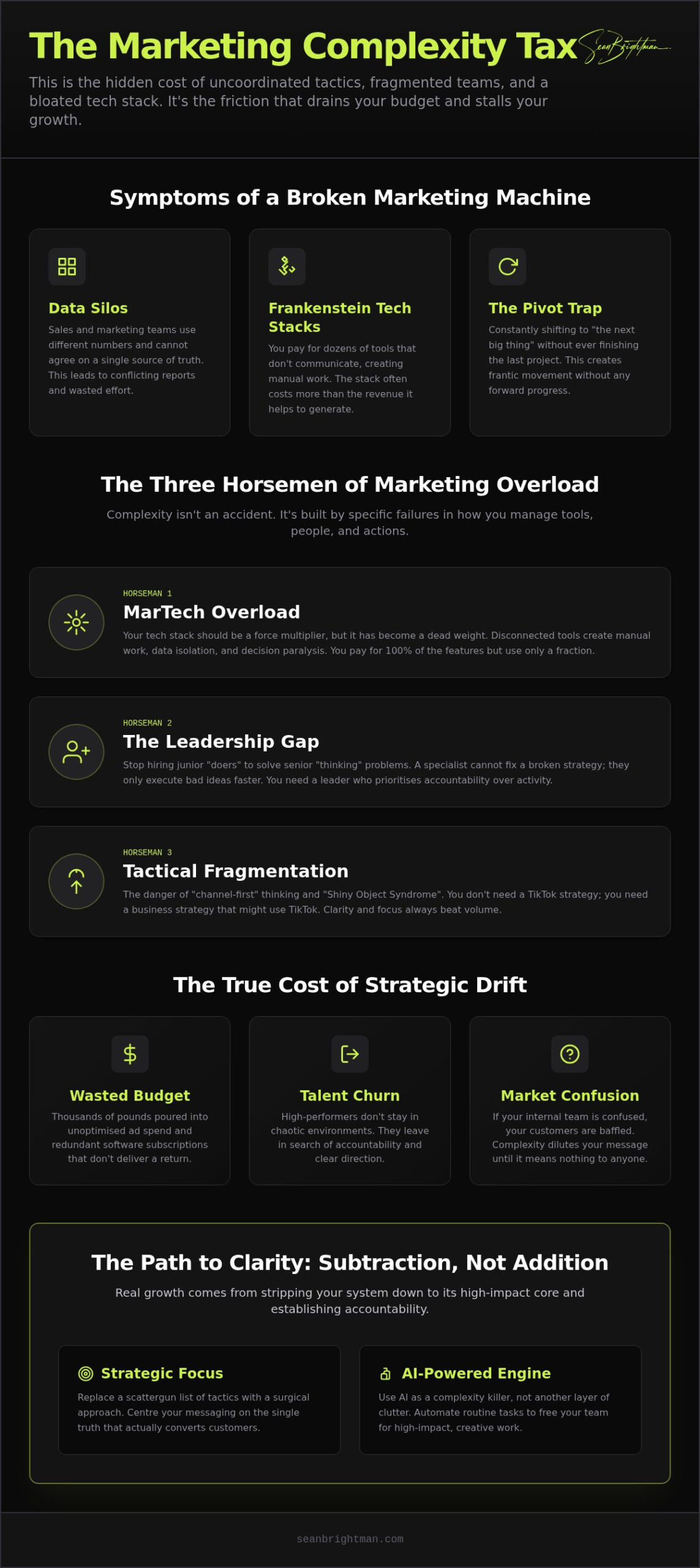
Most marketing advice is additive. It tells you to add more channels, more content, and more tools. This is a mistake. Real growth comes from subtraction. Overcoming marketing complexity requires the discipline to strip your operations down to the bare metal and rebuild only what is essential. You don’t need a longer to-do list; you need a shorter one that actually works. This roadmap is designed to transform your marketing from a bloated cost centre into a high-velocity growth engine.
Start with a “Brutal Audit”. Look at every channel, every tool, and every campaign. If you cannot prove it drives revenue, kill it immediately. You need a “Stop Doing” list more than a new strategy. This isn’t about being lean; it’s about being lethal with your resources. Identify the 20% of activities that generate 80% of your results and discard the rest. The goal is to eliminate the noise that distracts your team from high-impact work.
Next, simplify your positioning. If you can’t explain your value proposition to a 10-year-old, it’s too complex. Complexity in your messaging leads to confusion in your market. Your customers shouldn’t have to work to understand why they need you. Finally, identify your North Star metric. Stop chasing twenty vanity KPIs. Pick the one number that defines success for your business and align every tactical decision with it. If a tactic doesn’t move that specific number, it doesn’t belong in your plan.
Once you’ve cleared the debris, you can begin strategic brand roadmapping to build your 2026 growth engine. This is the architecture of your success. Map the customer journey from the first touchpoint to the final brand advocate. Don’t guess where your customers are; use your data to define the path of least resistance. This architecture ensures that your marketing is a connected system rather than a collection of random acts.
Execute in 90-day sprints. Long-term annual plans are often just corporate fantasies that fail to survive contact with the market. Short-term sprints provide the velocity you need to test, learn, and pivot. To ensure this new system doesn’t slide back into chaos, implement a Marketing Advisory Retainer. This provides the external accountability needed to keep your team focused on the roadmap and prevents “Shiny Object Syndrome” from taking root again. Overcoming marketing complexity is a rigorous, ongoing process of refinement that requires senior-level oversight to maintain.
If you’re ready to stop the rot and rebuild for impact, you can start your roadmapping journey today.
AI is often sold as the ultimate shiny object. In reality, it is the ultimate complexity killer. By 2026, the winners aren’t those with the most tools, but those with the most integrated systems. Overcoming marketing complexity requires you to stop treating AI as a tactical gimmick and start treating it as the core of your growth engine. It automates the boring, repetitive tasks that drain your team’s energy, allowing them to focus on the brilliant strategy that actually moves the needle.
Don’t get distracted by prompt engineering. That’s a technician’s concern, not a CEO’s. You need a high-level AI strategy that focuses on mechanical integration and scalable growth engines. This is about building a system that learns and evolves, not just a series of clever chat prompts. True clarity comes from removing the human friction that slows down your data and your execution.
The first step is fixing your content supply chain. Use AI to scale quality, not just volume. Flooding the market with mediocre, AI-generated noise will only damage your brand. Instead, use AI to research, structure, and optimise high-impact content that resonates with your core truth. This ensures your message remains sharp whilst your output increases.
Next, deploy predictive analytics to remove the guesswork. You should know where your next customer is coming from before they even click an ad. AI can identify patterns in customer behaviour that a human team would miss amongst the noise. Finally, automate your reporting. Human bias and “creative” data interpretation are the enemies of strategic clarity. An AI-powered dashboard provides the blunt, honest truth about your ROI, allowing you to make decisions based on evidence, not ego.
We are moving from guesswork marketing to evidence-based growth. In an AI-driven department, the role of the human leader shifts from manager to architect. You aren’t there to oversee the daily tasks; you’re there to ensure the system remains aligned with your business goals. The machine handles the speed; you handle the direction.
Getting started doesn’t require a total overhaul. It requires a roadmap. You need to identify the bottlenecks in your current system and apply AI as the solution. Overcoming marketing complexity is a permanent shift in how you operate. By building an AI-powered growth engine today, you ensure that your marketing remains lean, high-impact, and transparent for years to come. The era of the bloated, confusing marketing department is over. The era of the automated, strategic engine has begun.
Marketing complexity isn’t a force of nature; it’s a failure of leadership. You’ve seen the roadmap. You know that adding more tools only adds more weight. Success in 2026 depends on your ability to strip away the noise and rebuild around a lean, AI-powered core. Overcoming marketing complexity is the only way to transform your department from a confusing cost centre into a high-impact growth engine that delivers measurable ROI.
Stop funding the chaos. You need a battle-hardened expert who skips the corporate fluff and delivers strategic velocity. As the author of the definitive guide to marketing strategy and a seasoned Fractional CMO for UK scale-ups, I provide the plug-and-play leadership needed to fix your machine. We don’t do “busy marketing.” We do evidence-based growth. It’s time to replace the “Frankenstein” tech stack with a simplified system that your team can actually execute.
The path to clarity is a choice. You can continue chasing the latest shiny object, or you can build a system designed for precision. Book a Strategic Roadmapping Session with Sean Brightman today to reclaim your margin and your momentum. Your future growth is waiting on the other side of strategic clarity.
The primary cause is prioritising tactics over strategy. Most SMEs fall into the trap of adding more software or hiring junior specialists before they have a senior leader in place. This leads to a fragmented department where no one owns the big picture. Overcoming marketing complexity requires shifting your focus from “doing more” to “building better.” Without a central architect, your marketing becomes a collection of random, expensive experiments.
You’ll see it in your bottom line and your team’s stress levels. If your agencies provide conflicting advice or your data lives in disconnected silos, your system is broken. Another red flag is a “Frankenstein” tech stack where you only use a fraction of the features you pay for. If you can’t explain your marketing ROI in plain English, the complexity has already won.
Absolutely. A Fractional CMO acts as a plug-and-play architect for your growth engine. They bring the senior leadership needed to strip away the noise without the overhead of a full-time hire. By focusing on strategic advisory and accountability, they provide the blunt, honest perspective required to cut through corporate bloat. They don’t just add more tasks; they build the machine that makes those tasks actually work.
A roadmap is a one-off strategy session that defines your brand’s core truth and direction. You need one because execution without a plan is just expensive guesswork. It provides a structured path for your team to follow, ensuring every pound spent aligns with your business goals. By setting a North Star metric and 90-day sprints, a roadmap replaces confusion with high-velocity action and clear accountability.
AI acts as a complexity killer by automating repetitive content supply chains and predictive analytics. It removes human bias from reporting, giving you the honest data needed for evidence-based growth. Overcoming marketing complexity involves using AI to handle the volume whilst your human leaders focus on the brilliant strategy. It’s about building a scalable growth engine that learns and evolves rather than just adding more manual work.
You’ll face strategic drift and a significant waste of your growth budget. Complexity is a hidden tax that dilutes your message and confuses your customers. By 2026, businesses with lean, automated systems will move faster and more efficiently than those stuck in corporate bureaucracy. If you don’t simplify now, you’re funding your own irrelevance whilst your more agile competitors capture your market share.
A Fractional CMO is a high-impact alternative that saves you the massive overhead of a full-time senior leader. You avoid the £120k+ salary, recruitment fees, and long-term benefits packages associated with a permanent hire. Instead, you pay for senior-level strategic advisory on a part-time basis. This model provides the same level of expertise and accountability whilst keeping your marketing department lean and focused on high-margin results.
The underlying mechanics are identical. Whether you are selling software or shoes, the danger of tool fatigue and tactical fragmentation remains the same. B2B companies often deal with more complex lead nurturing, whilst B2C focuses on high-velocity transactions, but both require a simplified growth engine to scale. Complexity masks a lack of fundamental brand positioning regardless of your industry or your target audience.
Reading is good. A roadmap is better.