
What if your business doesn’t need another campaign, but a senior person to decide which marketing moves are worth making? On-demand CMO services can provide strategic direction without a full-time hire. The support should fit the decisions your business faces, not just a job title.
If marketing activity feels busy but disconnected, advice alone may not be enough. Senior support should bring focus, clarify priorities and make responsibilities visible, rather than leave your team with a polished plan and no one accountable for moving it forward.
This guide explains what on-demand CMO support can cover and how it differs from a one-off roadmap, an advisory retainer or Fractional CMO leadership. You’ll learn how to choose a model that suits your needs, what outcomes and responsibilities to agree upfront, and how to assess whether the support is working. Start by identifying the marketing decision you need help with, then match the level and duration of support to that need.
Marketing can be busy without being well led. Campaigns, content and new ideas keep moving, but nobody owns the priorities, connects activity to business goals or makes the hard calls. That’s the gap on-demand CMO services are designed to address: access to senior marketing direction when the business needs it, without assuming it needs a full-time executive.
The support can take different forms: a focused roadmap, ongoing strategic advice or Fractional CMO leadership working more closely with the team. The right option depends on the decisions to make and the level of responsibility required, not a standard package or fashionable job title.
A CMO’s role is broader than managing promotional activity. A Chief Marketing Officer (CMO) typically leads marketing strategy and helps align it with the organisation’s wider direction. On-demand support brings some of that senior perspective in a form shaped around the business’s needs.
A CMO-level adviser connects business goals with marketing priorities. That can mean sharpening brand positioning, setting a plan, directing an existing team and helping leaders decide where to focus. It doesn’t automatically mean carrying out every marketing task. Strategic leadership sets the direction; delivery is a separate responsibility to agree.
Make the boundaries clear upfront. Decide which decisions the adviser will lead, who owns implementation, how they’ll work with the leadership team and what evidence will show progress. Clear ownership helps prevent recommendations from landing in a document with no one responsible for acting on them.
Look for friction in the system, not just a lack of activity. Work may be scattered across channels, teams may be unsure who makes the final call, or every new idea may displace the previous priority. The result is motion without a shared plan.
Another common shift comes as a business grows beyond founder-led marketing. The founder may have set the early direction, but a growing team now needs consistent priorities, clearer decision-making and someone to connect marketing choices to business objectives. If you’re weighing up this wider model, explore the fractional CMO revolution.
These signals point to a need for clearer leadership. They don’t automatically mean you need the same level or duration of support as another business.
The right model depends on what needs deciding, how often those decisions arise and who will act on them. A one-off roadmap can set direction. An advisory relationship can help leaders revisit priorities. Fractional CMO leadership brings senior direction closer to the marketing function. Match the cadence to the work rather than assuming there’s a universal template.
Before agreeing a model, separate strategic responsibility from delivery. An adviser may set priorities or guide the team, while your staff or external delivery partners carry out agreed work. Name who owns each decision, task and follow-up so the plan doesn’t become a substitute for clear accountability.
Focused roadmap
Trigger: The team needs a clearer plan. Focus: Priorities, positioning and direction. Ownership to agree: Who will put the plan into action.
Ongoing advisory
Trigger: Strategic decisions keep coming up. Focus: Regular guidance and challenge. Ownership to agree: Which choices the adviser informs and which leaders make.
Fractional CMO leadership
Trigger: The marketing function needs sustained senior leadership. Focus: Direction, team alignment and accountability. Ownership to agree: The adviser’s decision-making role and what stays with the internal team.
A roadmap may fit when leaders understand the business challenge but need help choosing priorities and turning them into a structured plan. For example, a team with several competing growth ideas could use a roadmap to agree what to focus on, what to defer and how marketing supports business goals.
A plan creates direction, not automatic implementation. Your team or delivery partners still need to take responsibility for agreed actions. For a deeper planning guide, read about strategic brand roadmapping.
Choose ongoing support when important decisions recur and the team needs a regular senior perspective. An advisory retainer offers guidance and challenge to business leaders. Fractional CMO leadership takes a more embedded role in directing the marketing function. Clarify the expected cadence, access and decision rights rather than assuming the titles mean the same thing.
Sean Brightman offers roadmapping, advisory retainers and Fractional CMO leadership as distinct forms of support. If you’re weighing which fits, explore the marketing advisory retainer and Sean Brightman’s marketing support.
These options address different gaps. A business may lack someone to set marketing direction, a specialist to resolve a defined problem, or the hands-on capacity to deliver work. Identify what’s missing, then agree who owns decisions and follow-through. Fill the leadership gap with a CMO, the expertise gap with a consultant, and the delivery gap with an agency.
On-demand CMO services can suit a business that needs senior judgement for a defined challenge or whose need for leadership may change over time. This arrangement can provide strategic input without adding a permanent executive role, but it won’t automatically cover every responsibility a full-time CMO might hold.
A permanent CMO may be more appropriate when the business needs sustained, day-to-day executive leadership: someone consistently embedded with the leadership team, accountable for the marketing function and closely involved in decisions as they arise. The distinction isn’t simply flexible versus permanent. It’s whether the business needs periodic senior direction or a dedicated executive presence.
A CMO-level adviser connects marketing choices to business priorities and helps set direction. A consultant may focus on a specific question, such as positioning or a particular marketing challenge. An agency commonly brings specialist delivery capacity, such as carrying out agreed campaign or creative work. These roles can complement each other, but they aren’t interchangeable. Sean Brightman’s work centres on strategic leadership and advisory, not advertising execution.
Operational problems call for a closer look at how work is organised and supported. If processes, roles or systems are the sticking point, explore marketing operations and scalable growth systems.
Full-time CMO: Choose this when the business needs sustained internal executive leadership. Agree the role’s authority, team responsibilities and connection to business decisions.
On-demand CMO support: Choose this when senior marketing direction is needed without assuming a permanent role. Set the scope, decision rights and continuity required.
Consultant: Choose this when a specific area needs expert advice. Define the question to resolve and how the team will use the recommendations.
Agency: Choose this when the business needs specialist delivery capacity. Set the brief, internal point of contact and who approves the work.
Don’t compare options by job title alone. Value depends on scope, seniority, internal capacity and the business requirement. Start with the gap, then agree responsibilities and evidence of progress before work begins. To explore Sean Brightman’s strategic support, visit Sean Brightman’s marketing services.
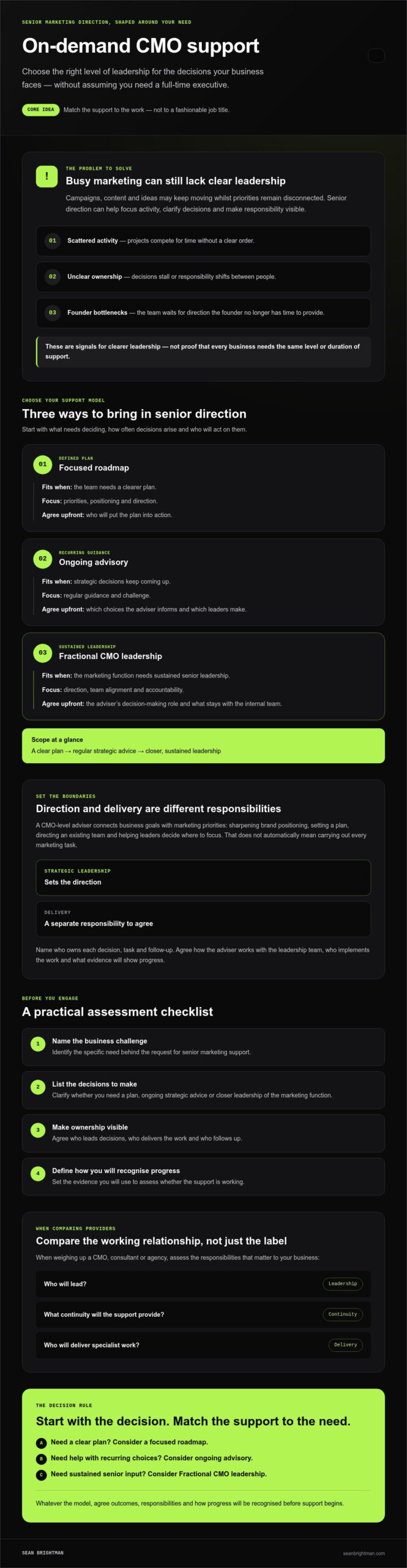
A strong engagement starts with a clear brief, not a list of requested tasks. Before comparing on-demand CMO services, work through four points: the business challenge, the decisions senior support must help resolve, the team available to act, and the level of guidance you need. For example, a team may have people to deliver marketing but lack agreement on which audience or priority to focus on. That calls for a different brief from one where nobody owns the marketing function.
Agree the intended outcome and how you’ll assess progress before discussing activity or deliverables. Otherwise, a full calendar of meetings and recommendations can look like progress without showing whether the underlying problem is being addressed.
Keep the brief grounded in your business. State the priority, the current constraint and the decisions you expect senior support to inform. Then choose indicators that fit the work. A positioning challenge might call for agreement on the target audience and message; a planning brief might focus on whether the team has clear priorities and owners. There’s no universal benchmark that suits every engagement.
Set review points to check what has changed, what remains unresolved and what the team will do next. Ask how recommendations will become decisions, and what evidence the adviser will use to assess progress. Be cautious of broad promises without a clear link to your challenge, or reports that count activity without showing what it means for the business.
Write down who owns each part of the work. Clarify who sets or advises on strategy, who handles internal delivery, whether specialist execution sits with another partner, and who makes final business decisions. Agree access to relevant information, the meeting cadence and how urgent decisions will be raised between scheduled discussions.
Accountability works both ways. The adviser should be clear about their responsibilities and reporting; your leadership team should identify who will make decisions and act on recommendations. If the brief is still fuzzy, explore strategic marketing direction as a first step towards defining the support your business actually needs.
Senior marketing support should fit the problem, not force your business into a pre-set package. Sean Brightman’s work centres on strategic direction, brand positioning, marketing systems and accountability. It’s advisory and leadership, not recruitment or advertising execution. The useful question is which decision or gap needs attention now, and what level of support would help address it.
Roadmapping suits a leadership team that needs a structured plan for marketing and brand direction. It helps clarify priorities, but doesn’t automatically include ongoing implementation.
An advisory retainer may fit when business owners face recurring marketing decisions and want continued guidance and accountability. Fractional CMO support is for a business that needs part-time senior marketing leadership, with a more active role in setting direction and aligning the marketing function.
If your challenge is specifically how to integrate AI into marketing systems in a practical way, AI consulting may also be relevant. It isn’t a default add-on; the need should come from the business problem.
Start with the facts that shape the decision: what the business is trying to achieve, where marketing is stuck, what the team can own internally and which choices need senior input. A useful discussion should help distinguish a need for a focused plan from a need for ongoing advice or embedded leadership.
Then agree the scope around the actual need. Clarify responsibilities, decision rights, how recommendations will be reviewed and what evidence will show progress. The goal isn’t to buy activity for its own sake. It’s to make sure the support addresses the uncertainty that prompted the conversation, without assuming one model fits every business.
If marketing priorities feel scattered or the team lacks a clear direction, discuss your marketing priorities with Sean Brightman and identify a suitable next step.
The right senior support starts with the gap you need to fill. If your team needs a clear plan, roadmapping can set direction. If key decisions keep recurring, an advisory retainer can provide ongoing guidance. If marketing needs senior leadership, Fractional CMO support offers a more embedded option. The best fit depends on the decisions, responsibilities and follow-through your business needs.
That’s the practical value of on-demand CMO services: access to strategic direction shaped around your business, without assuming every company needs the same model. Sean Brightman offers one-off roadmapping, ongoing advisory and Fractional CMO leadership. AI consulting is also available when practical AI integration is the challenge.
Start by naming the marketing issue that’s slowing decisions or scattering effort. Then consider your priorities, team capacity and the level of support that could bring focus. Discuss your marketing priorities with Sean Brightman and identify a suitable next step. Clearer direction starts with a sharper question.
On-demand CMO services give a business access to senior marketing direction without automatically requiring a full-time executive. The support can take different forms, from a one-off roadmap to regular strategic advice or part-time leadership of the marketing function. The right form depends on the decisions the business needs help with, the team available to act and how much ongoing leadership is required.
Not always. “On-demand CMO” is a broad description for senior marketing support accessed as needed, whilst “Fractional CMO” usually refers to part-time marketing leadership. A business might use a focused roadmap or advisory support without needing an embedded leadership role. Agree the adviser’s responsibilities, decision-making authority and level of involvement rather than relying on the title alone.
Yes, if the business has a clear need for senior marketing direction and a way to act on it. A small business might need help setting priorities, aligning marketing with business goals or guiding an existing team, without requiring a permanent executive role. Consider whether the available team can carry out agreed work, and define which decisions and outcomes the support should address.
Choose based on the gap. An on-demand CMO focuses on senior direction, priorities and leadership; a marketing agency commonly provides specialist delivery capacity. If you know what work needs doing but lack the people to do it, an agency may fit. If the work itself lacks direction, clarify the strategy first. Some businesses may need strategic guidance and separate delivery support, with responsibilities agreed between them.
Agree the business challenge, objectives, scope and responsibilities before work begins. Clarify which decisions the CMO will lead or advise on, who owns internal delivery, what specialist work sits elsewhere, and who makes final business decisions. Set expectations for access to the team, meeting cadence, review points and how recommendations will be handled. The details should reflect your needs, not a standard template.
Check progress against indicators agreed at the start, not activity alone. Depending on the brief, this might include clearer marketing priorities, named owners for key actions or faster resolution of a specific strategic decision. Review what has changed, what remains blocked and what the team will do next. Don’t treat more meetings or recommendations as proof of impact without connecting them to the agreed objectives.
Not necessarily. CMO-level support centres on strategy, leadership and decision-making; execution may remain with your internal team or a specialist delivery partner. Confirm this before engaging, including who will carry out agreed work and how progress will be tracked. Sean Brightman’s offering focuses on strategic leadership and advisory, including Fractional CMO support, roadmapping and ongoing advice, rather than advertising execution.
Reading is good. A roadmap is better.