

What if your agency isn’t the first thing that needs replacing? If you’re thinking, “my marketing agency is not strategic enough,” you’re probably seeing plenty of campaigns and deliverables, but little connection to business priorities. The agency waits for instructions. You’re left wondering what success actually looks like.
That frustration is real. But a tactical relationship doesn’t always mean the agency can’t think strategically. Sometimes the brief lacks clear goals, a defined audience or meaningful measures of success. Sometimes the agency is executing poorly. Those are different problems, and they need different fixes.
This article will help you diagnose which one you’re dealing with, reset the brief around commercial priorities and decide whether your business needs senior marketing direction beyond agency delivery. You’ll see what to ask of your agency, how to set clearer measures of progress and when a roadmap or Fractional CMO leadership can align marketing activity with business goals, without requiring a full-time hire.
Campaigns are going live. Content is being produced. Reports arrive on schedule. Yet you’re still unsure which business priority all that work is meant to move. That frustration is real: plenty of output can keep a marketing team busy without giving the business a clear direction.
Strategy is the set of choices behind the activity: what the business wants to achieve, which audiences matter, how the brand should stand out, what to prioritise and where to commit resources. A useful overview of marketing strategy can help frame the distinction. A campaign calendar shows what’s planned. It doesn’t explain why those activities deserve time and budget, or how they support business goals.
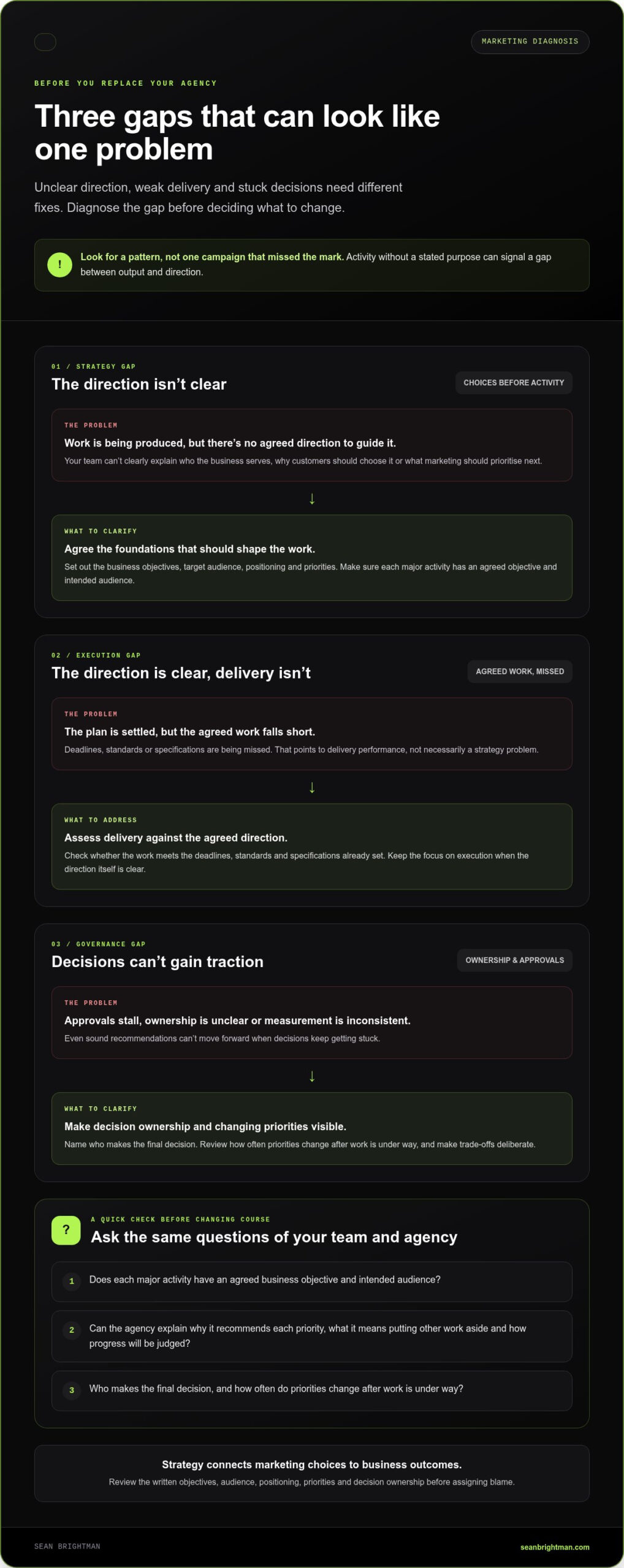
Strategy connects marketing choices to business outcomes. That’s the diagnostic sentence to keep in view. If an agency can list deliverables but can’t explain the objective, audience or intended commercial contribution behind them, the work may be tactical rather than strategic.
Look for a pattern, not one campaign that missed the mark. Recurring activity without a stated purpose can signal a gap between output and direction:
These signs don’t prove the agency is incapable. They do show that the work isn’t being tied clearly enough to choices and outcomes.
A strategic partner uses your objectives, positioning and understanding of customers to shape recommendations. Channel choices should follow the goal and audience, not habit or whatever happens to be easiest to produce.
Good recommendations also come with a rationale: why this activity, why now, what it asks you to deprioritise and how you’ll judge progress. You should hear a clear point of view, not automatic agreement with every request. For example, if a new campaign would pull resource away from a priority already in motion, the agency should flag the conflict and help you make an informed choice.
Strategic direction doesn’t mean every recommendation will be right. It means the thinking is visible, the trade-offs are discussed and the work has a reason to exist. That gives you something concrete to assess before deciding whether the issue sits with the agency, the brief or the way decisions are made inside the business.
If you’re thinking “my marketing agency is not strategic enough”, pause before deciding who’s at fault. The problem could sit in the strategy, the agency’s capability, the quality of delivery or the way decisions get made inside your business. These gaps can look similar from the outside, but each needs a different fix.
Start by checking the foundations: are your objectives, target audience, positioning and priorities clear? Does everyone know who has authority to approve work and change direction? If those answers shift between meetings, the agency may be responding to mixed signals rather than ignoring a settled plan.
These gaps can overlap. A brief that asks for more leads, greater brand awareness and a new audience all at once, without ranking those goals, gives the agency no clear basis for trade-offs. If different people then give conflicting feedback, the next version may swing in another direction. Before assigning blame, review the written objectives, audience, positioning, priorities and decision ownership.
Use the same questions with your team and agency. The answers, and where they differ, will show what needs attention:
The U.S. Bureau of Labor Statistics outlines marketing managers’ responsibilities, including assessing trends and choosing strategies, in its Duties of Marketing Managers overview. That’s a useful reference point: strategic direction involves judgement and choices, not simply carrying out a list of requests.
If the answers point to a wider disconnect between planning, people and processes, examine your marketing operations growth engine. A structured roadmap can help turn the diagnosis into clear priorities, owners and decisions. Explore senior marketing leadership if you need an experienced lead to align that direction with agency activity.
Changing agencies can feel like a clean break. But a new supplier won’t solve unclear goals, shifting priorities or missing decision ownership. If you’re thinking “my marketing agency is not strategic enough”, base the decision on evidence: what the agency can do, what it has actually delivered, what your business needs next and how both sides behave when problems surface.
There are three routes. Choose the one that addresses the real gap, not simply the one that promises a fresh start.
| Route | Best fit when | What to establish |
|---|---|---|
| Reset the brief | The agency delivers competently, but objectives, priorities or success measures are vague. | Clear goals, audiences, responsibilities, recommendations and review measures. |
| Add strategic leadership | The business needs someone to set direction and coordinate internal teams or multiple specialists. | Who owns the strategy, makes trade-offs and keeps activity aligned with business priorities. |
| Replace the agency | There’s evidence of a capability or delivery gap, or agreed direction repeatedly fails to shape the agency’s work. | The requirements for the next relationship, including scope, ownership and measures of progress. |
Try a reset when the agency can deliver the work but hasn’t had a clear enough operating brief. Put the commercial objective, target audience, priority activity and success measures in writing. Then agree a defined review period with specific outcomes, rather than accepting open-ended promises to “be more strategic”.
Make the expectations two-sided. Set out what the agency will recommend, what it will deliver and what its reporting should explain. The reset is also a test: can the agency turn clearer direction into relevant proposals and consistent work? If yes, you may have fixed the brief, not needed a new supplier.
Consider a change if clear, agreed direction still doesn’t influence recommendations or delivery. Repeatedly missing standards, deadlines or agreed priorities points to a problem the brief alone may not fix. Look at the pattern, not one disappointing result.
If the business uses several specialists or agencies, the missing piece may be someone on your side to set priorities, make trade-offs and keep everyone moving in the same direction. A Fractional CMO provides part-time senior marketing leadership; it’s a strategic lead, not another delivery supplier. And before bringing in anyone new, settle unresolved choices about positioning and commercial priorities. Otherwise, the same uncertainty follows you into the next relationship.
If you’ve concluded that “my marketing agency is not strategic enough”, don’t send another vague request to “think bigger”. Give the agency a brief it can use to make decisions, then judge the recommendations and work against it.
Build the reset in sequence:
Put the business objective, customer problem and target audience in plain language. Add your positioning, the proof points that support it, commercial constraints and decisions already made. Record assumptions too, such as an untested belief about why customers choose you. Mark it as an assumption, not a fact.
This stops the agency from treating every request as a fresh instruction. A strategic brand roadmapping approach can help turn those choices into a usable plan, with priorities and accountable decisions rather than a disconnected task list.
Agree an outcome measure that reflects the goal, alongside leading indicators that show whether the work is moving in the right direction. The right measures depend on the objective. Don’t judge a positioning project by the same measures as a lead-generation campaign.
Ask the agency to explain what the evidence suggests, what it recommends doing next and what the team expects to learn. Keep a regular review rhythm focused on progress, learning and decisions, not just a tour through completed tasks. Results can move alongside a campaign without proving that the campaign caused them, so treat performance data as evidence to interpret, not automatic proof.
Capture changes to assumptions, constraints and priorities as they happen. That record makes it easier to understand why the plan shifted and whether the shift was deliberate. For senior support turning a diagnosis into priorities and an accountable roadmap, explore strategic roadmapping support.
An agency can deliver strong work and still lack the authority to decide what the business should prioritise. That isn’t necessarily an agency failure. Agencies work within the direction they’re given; someone on the business side needs to connect marketing choices to commercial goals, make trade-offs and keep the whole system aligned.
If you’re still thinking “my marketing agency is not strategic enough” after clarifying the brief, ask a different question: who owns marketing direction across the business? Without that senior ownership, internal teams and external specialists can each do their part whilst pulling towards different goals.
A senior marketing leader turns business objectives into practical choices. They connect positioning and customer priorities to channel decisions, resource allocation and the work agencies are asked to deliver. They also give the agency a clear strategic brief and a decision-maker who can maintain focus when new requests compete for attention.
That leadership doesn’t stop at campaign delivery. It creates accountability for what the business is learning, whether the direction still makes sense and what should change next. A Fractional CMO provides this senior marketing leadership on a part-time basis. They lead strategy and align agency and internal activity, rather than acting as another delivery supplier or requiring a full-time hire.
The right support depends on the gap you’ve identified:
These options solve different problems. A roadmap sets out the direction; an advisory retainer provides ongoing input; a Fractional CMO takes part-time senior leadership across marketing. The point isn’t to add another layer of activity. It’s to put clear ownership above delivery, so specialists know what they’re working towards and leaders can make decisions with the wider business in view.
If you’ve identified a need for that direction, explore strategic marketing direction as a practical next step.
If you’re thinking “my marketing agency is not strategic enough”, don’t jump straight to replacing it. First work out whether the gap is unclear goals, weak execution or missing senior ownership. A sharper brief can reveal whether the agency can respond to clear commercial priorities.
Set out what the business needs marketing to achieve, who it needs to reach and how you’ll assess progress. If activity still lacks direction, the business may need someone to own strategy across internal teams and agency partners. A Fractional CMO provides part-time senior marketing leadership, whilst roadmapping and advisory support bring structure, direction and accountability.
You don’t need to solve everything at once. Make the next decision based on evidence, then give the team a clear route forward. Explore senior marketing direction with Sean Brightman and take the next step towards marketing that works in service of your business goals.
Look for repeated activity without a clear link to business goals, audiences or positioning. If you’re asking “my marketing agency is not strategic enough”, check whether recommendations explain why a campaign or channel matters, what it means prioritising it and how success will be judged. One missed report isn’t proof of a strategy problem. A persistent inability to explain the direction behind the work is a stronger warning sign.
Not automatically. First check whether the agency has a clear brief, access to the right information and a decision-maker who can maintain priorities. Reset the objectives, responsibilities and review measures, then assess the agency’s response over an agreed period. Consider changing providers if strategic gaps persist despite clear direction, or if the agency can’t meet the capabilities your business needs. A new agency won’t fix unclear goals or ownership by itself.
Yes. Campaign production and channel management are different capabilities from setting strategic direction. An agency may deliver work competently whilst relying on you to define the audience, positioning, priorities and measures of success. The useful question isn’t whether the agency is good or bad overall. It’s whether its strengths match the role you expect it to play, and whether someone in the business owns the decisions around that work.
Ask how each recommendation connects to a business objective, target audience and positioning. Request the evidence behind its priorities, the trade-offs involved and the measures it will use to learn. Clarify what should stop, who owns final decisions and when you’ll review the plan. These questions help create a sharper working brief. They won’t replace clear leadership, so make sure someone in your business can set priorities and make decisions.
Set a review period that fits the work and the decisions involved, rather than relying on an arbitrary industry-wide timeframe. Agree the changes you expect to see, such as clearer recommendations, aligned priorities, defined measures or improved delivery. Use regular checkpoints to assess evidence and decide what happens next. Make the reset time-bound and observable, but don’t demand guaranteed commercial results by a fixed date.
A new agency may help if your current provider lacks the capabilities or working approach your business needs. A Fractional CMO may be more relevant when you lack senior marketing ownership to set direction, coordinate suppliers and connect activity to commercial goals. The role provides part-time senior marketing leadership, not another delivery supplier. Diagnose the gap first: replacing execution without addressing missing leadership can reproduce the same problem with a different agency.
A useful report connects performance to agreed objectives, explains what the evidence does and doesn’t show, and recommends what to do next. It should make priorities and trade-offs clear, not just list posts, clicks or completed tasks. Choose measures that fit the goal, then use them to guide decisions and learning. Treat results as evidence to interpret, not proof that a campaign caused an outcome unless the analysis supports that conclusion.
Reading is good. A roadmap is better.