

Most marketing departments are just expensive hobbies. You are likely burning cash on uncoordinated tactics whilst your actual business valuation stays stagnant. It is the classic trap: plenty of noise, zero machinery. This makes measuring success with a fractional cmo difficult if you are chasing the wrong numbers.
Success is about systems, not just stats. If your marketing does not function as a predictable, accountable engine, it is failing. You need order, not more activity. You need a department that delivers results without constant hand-holding.
You want a department that runs like a machine and a dashboard that actually matters to your board. We agree that vanity metrics are a distraction. This article promises to show you how to move beyond superficial data and measure the structural impact of senior leadership on your growth. We will preview how to build a high-impact marketing engine, integrate AI for genuine scale, and ensure your organisation is primed for a maximum-value exit.
Most CEOs are addicted to activity. They see a team “doing stuff” and assume growth is happening. It isn’t. Busy work is not a strategy; it’s a distraction. When measuring success with a fractional cmo, you must look at the architecture, not just the activity. Architecture is the repeatable system that generates revenue. Activity is just noise.
The “Messy Department” syndrome is a silent ROI killer. It happens when you have uncoordinated tactics flying in different directions. One person is posting on LinkedIn whilst another is tweaking an ad. Nobody is looking at the engine. A Fractional CMO spends their first 30 days performing an audit. This isn’t a delay; it’s a recalibration. You don’t fix a broken engine whilst the car is moving at seventy miles per hour.
The ultimate success signal is Marketing Velocity. This isn’t about how fast you post. It’s about how quickly your organisation can implement, test, and scale strategic shifts. If your team is stuck in a loop of endless meetings without movement, your velocity is zero.
Clicks, impressions, and “likes” are fluff. They feel good in a board meeting but they don’t increase business valuation. If your current reporting focuses on top-of-funnel noise without showing a conversion engine, it’s masking a lack of strategy. You are measuring the wind instead of the sails.
A Marketing Manager manages the task. A Chief Marketing Officer builds the machine. Measuring success with a fractional cmo means looking past the dashboard to see if the plumbing actually works. You need to know if your spend is being captured by a system or simply evaporating into the atmosphere.
Success with a Fractional CMO is the creation of a scalable, repeatable growth engine that functions independently of individual personalities.
This definition aligns directly with your three-year exit plan. Investors don’t buy busy departments. They buy predictable systems. Order amongst chaos is a measurable business outcome. It reduces wasted spend and increases the efficiency of every pound you put into the market. If the department doesn’t run like a machine, you aren’t ready for an exit. True success is when the strategy dictates the tactics, not the other way around.
Revenue growth is a blunt instrument. It’s easy to buy growth if you have an infinite budget and a total disregard for margins. It’s much harder to build a capital-efficient growth engine. When measuring success with a fractional cmo, the primary focus shifts from “how much did we sell?” to “how efficiently did we sell it?”. You need a framework that prioritises profit over raw volume.
A battle-hardened strategist looks for an immediate reduction in wasteful spend. Most messy departments have at least 20% of their budget leaking into redundant software, unoptimised ad sets, or vanity projects that don’t move the needle. Cutting this waste is the first quantitative win. It stops the bleeding and funds the strategic work required to scale.
We also distinguish between marketing-sourced and marketing-influenced revenue. Sourced revenue is a direct hit from a campaign. Influenced revenue tracks how marketing touched a lead before sales closed the deal. A Fractional CMO ensures both are tracked to prove the department’s total commercial impact. If you want to see how these metrics transform a business, you can explore my Fractional CMO services to understand the mechanical shift required.
Your Customer Acquisition Cost (CAC) should never be a static number. If it remains unchanged whilst you scale, your strategy is likely stagnating. A Fractional CMO should optimise these marketing KPIs over a six-month horizon. The goal is a healthy, widening ratio between CAC and Lifetime Value (LTV).
We also track the Payback Period. This measures how many months it takes to recoup the cost of acquiring a single customer. If this period is stretching, your cash flow is at risk. High-impact leadership ensures this ratio improves as the system matures. Static CAC amongst competitors is a sign of a failing strategy; your system should be getting smarter and cheaper over time.
Pipeline velocity is the ultimate metric for mechanical efficiency. It measures the time a lead takes to travel from the first touchpoint to a signed contract. If your funnel has “leaky buckets”, your CMO must plug them. These leaks are usually found in the friction-filled hand-off between marketing and sales.
Success is a shorter sales cycle and a higher conversion ratio at every stage. You aren’t just looking for a higher volume of leads. You’re looking for a faster, tighter machine. Improving sales and marketing alignment ensures that every lead is treated with the same level of tactical precision, reducing the time spent in “purgatory” between departments.
A marketing department that relies on the CEO’s intuition is a liability. It is a bottleneck that prevents scaling and kills business valuation. Structural success is about building a machine that functions regardless of who is in the room. This shift from founder-led to system-led marketing is a core component of measuring success with a fractional cmo. If there is no documented strategy roadmap, there is no accountability; there is only a collection of people doing tasks.
We evaluate the machinery by looking at the outcome, not the effort. Your team shouldn’t be owning “social media posts”; they should be owning “inbound lead velocity.” When the department moves from reactive fire-fighting to proactive system-building, you have achieved structural success. To ensure these changes endure, we apply a Measurement Effectiveness Framework that prioritises long-term system health over short-term activity spikes.
AI is not a toy for generating generic blog posts. It is a functional component of a modern growth engine. We measure success here through the AI Adoption Rate within your marketing operations. This involves tracking the reduction in manual labour across repeatable processes like lead scoring, data entry, and content distribution. If your team is still doing by hand what a machine can do in seconds, you are burning margin.
The goal is to improve efficiency without sacrificing output quality. We track the performance of AI-assisted systems against traditional manual methods to prove ROI. For a deeper dive into this transition, see my guide on AI Consulting in 2026: From Tool Fatigue to Scalable Growth Engines. A successful integration means your team is freed up to focus on high-level strategy whilst the AI handles the mechanical heavy lifting.
Accountability requires clarity. Most messy departments suffer from overlapping roles and vague responsibilities. A Fractional CMO fixes this by implementing a “plug-and-play” system. This framework defines exactly who owns which part of the engine. It ensures that every team member knows their specific contribution to the 3-year exit plan.
When measuring success with a fractional cmo, the ultimate proof is the removal of the “Strategic Burden” from your shoulders. You should no longer be the person deciding which tactics to pursue or which AI tools to test. The system should provide the answers. This creates a more professional, disciplined environment where people own outcomes rather than just ticking boxes. It makes your marketing department an asset that adds genuine value to the business, rather than a cost centre that requires constant supervision.
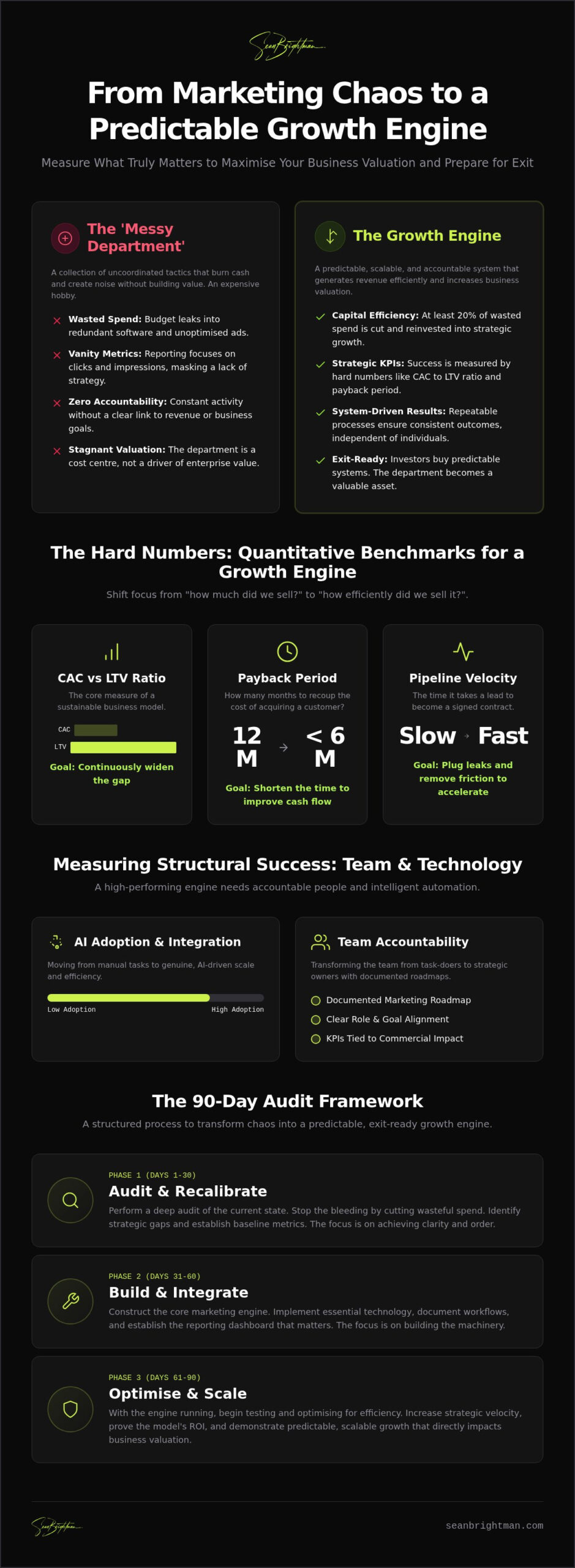
Measuring success with a fractional cmo is not a guessing game. It is a clinical, 90-day framework designed to install a growth engine. If you aren’t seeing structural shifts by day 90, you are just paying for more noise. We don’t wait a year to see if things are working. We track strategic velocity from the first week.
Phase 1 (Days 1-30) is about Clarity. We audit the internal mess. We identify the leaky buckets in your funnel and align marketing objectives with your commercial goals. Success in this phase is the total removal of ambiguity. You finally know what is broken and exactly how we intend to fix it.
Phase 2 (Days 31-60) focuses on Systems Architecture. We build the process. This is where the machinery is installed and the team begins following a documented roadmap. Success is measured by the transition from “doing tasks” to “following a system.” The department starts to feel like a machine rather than a collection of uncoordinated individuals.
Phase 3 (Days 61-90) centres on Execution and Optimisation. We look for Results. This isn’t just about raw lead volume; it’s about commercial evidence. By day 90, you should have a repeatable operating rhythm and early data showing improved efficiency. This 90-day sprint turns a chaotic department into a scalable asset.
Buyers covet machines, not personalities. If your marketing breaks when you leave the room, your valuation is capped. An essential part of measuring success with a fractional cmo is evaluating how well the business functions without your daily input. A battle-hardened strategist ensures your business is ready for an exit by building a growth engine that buyers actually want to buy.
Your brand positioning must be sharp enough to defend market share during a due diligence process. We measure this by looking at your “Defensibility.” Is your brand a commodity, or is it a category leader? A system-led department provides the documentation and predictable ROI that investors demand. If you want to increase your business valuation, you can start with a Fractional CMO roadmap.
The Strategic Brand Roadmap is your source of truth. It ensures consistency across every channel, from your LinkedIn presence to your automated email flows. We measure success by the “Consistency Score” of your messaging. If your brand sounds different on every platform, your system is failing.
A clear roadmap reduces decision fatigue for the board by providing a pre-validated path for every tactical choice. You stop debating which social media platform to use and start executing the plan. This roadmap is the bridge between your 3-year exit plan and the daily tasks your team performs. Without it, you are just wandering in the dark; with it, every action has a measurable purpose.
A strategy without a mechanism for accountability is just a wish list. You don’t need more ideas; you need more execution. Measuring success with a fractional cmo means looking at the long-term strategic velocity of your business. This is where the Advisory Retainer becomes the engine room of your growth. It ensures that the systems we build don’t just sit on a shelf. They move. They evolve. They deliver.
An external perspective is your greatest asset. Internal teams often become blind to their own inefficiencies. They get comfortable with the “messy department” status quo. A battle-hardened strategist identifies these blind spots immediately. We don’t care about corporate politeness. We care about fixing the machine. This transition from a chaotic marketing function to a scalable growth engine requires a partner who is willing to challenge your assumptions and keep the pressure on outcomes.
Hiring a full-time executive is often a mistake for UK scale-ups. A full-time CMO at a £150k+ salary brings significant overhead, recruitment risk, and often, a preference for corporate bloat over tactical precision. You are paying for a person, not necessarily a result. In contrast, a fractional strategic partner provides senior-level authority on demand. You get the expertise without the heavy tax bill or the long-term liability.
Senior leadership should be a functional component, not a permanent anchor. For many businesses, the Fractional Revolution in 2026 has proven that impact is more valuable than hours worked. You need a builder to install the system, then a strategist to oversee its performance. This is the smartest move for companies that want high-level direction whilst maintaining a lean, agile operation.
Don’t wait for your marketing to fix itself. It won’t. Start by conducting a Marketing Efficiency Audit today. Look at your spend. Look at your team’s output. If you cannot see a clear line between marketing activity and business valuation, your system is broken. Measuring success with a fractional cmo starts with setting three hard benchmarks for your first 90 days: process clarity, team accountability, and capital efficiency.
Once these benchmarks are set, you move from fire-fighting to scaling. You stop guessing and start measuring. If you are ready to stop wasting spend on uncoordinated tactics and start building a machine that buyers covet, your next move is clear. Fix the machinery. Book a roadmap session to define your path to a scalable, exit-ready growth engine.
Stop measuring noise. Start measuring the machine. Success isn’t found in a spreadsheet of clicks; it’s found in a marketing department that runs without your constant input. By focusing on capital-efficient growth and structural accountability, you turn marketing from a cost centre into a high-valuation asset. You move from the chaos of uncoordinated tactics to the precision of a growth engine.
Measuring success with a fractional cmo requires a shift from activity to architecture. You need a 90-day audit to clear the mess, a documented roadmap to provide direction, and AI integration to drive genuine efficiency. This isn’t abstract theory; it’s a mechanical overhaul of your growth engine. As a published author on marketing strategy and a battle-hardened strategist with a “get-your-hands-dirty” attitude, I specialise in building AI-powered systems that deliver strategic velocity.
Your business deserves a growth engine that is predictable, scalable, and exit-ready. Take the first step toward order and accountability today. Build your scalable growth engine with Sean Brightman. The path to a high-impact marketing machine is closer than you think.
Structural shifts happen within 30 to 90 days. The first month is about audit and clarity; we stop the bleeding and identify waste. By the second month, the systems architecture is being installed. By day 90, you should have a repeatable operating rhythm and early commercial evidence of improved efficiency. Don’t expect a revenue explosion in week one; expect a reduction in chaos and a clearer path to scale immediately.
Focus on Strategic Velocity and Process Clarity rather than just raw traffic. Measuring success with a fractional cmo in the early stages means tracking the reduction in uncoordinated spend and the increase in documented roadmap completion. You should also monitor your AI adoption rate and lead-to-customer conversion speed. Raw lead volume is a vanity metric if your conversion engine is still broken or your sales alignment is non-existent.
Yes, AI is a functional component of a modern growth engine, not a bolt-on toy. A Fractional CMO specialises in AI roadmapping to automate manual labour and improve output quality across your marketing operations. We treat your department as a mechanical system. If your team is still scoring leads or distributing content manually, the CMO fixes that plumbing to increase your margin and free up human talent for higher-level strategy.
Buyers pay for machines, not personalities. A Fractional CMO builds a growth engine that functions independently of the founder, which removes key-man risk. This documentation and system-led approach provide the predictable, scalable ROI that investors demand during due diligence. We transform your marketing from a messy, reactive cost centre into a professional, disciplined asset. A machine-led department is always more valuable than one that relies on founder intuition.
They serve different purposes; an agency executes whilst a Fractional CMO leads. Agencies often have a vested interest in selling you more of their specific services. A CMO provides the neutral, external perspective needed to manage those agencies or your internal team effectively. You need a strategist to design the machine and ensure accountability before you hire a team of specialists to turn the handles.
Alignment is non-negotiable for a high-impact department. A Fractional CMO implements a clear accountability framework that replaces ambiguity with clarity. We shift the focus from owning tasks to owning outcomes. If resistance continues, it usually identifies a skill gap or a cultural misfit that needs addressing. The system dictates the behaviour, and the CMO ensures the system is followed to maintain strategic velocity and hit your growth targets.
Measure the ROI through capital efficiency and the speed of implementation. Measuring success with a fractional cmo on an advisory retainer means tracking the reduction in wasted spend and the improvement in your LTV to CAC ratios. If your department is implementing strategic shifts faster and every pound spent is working harder, the retainer is delivering genuine value. You are paying for the machinery of growth, not just advice.
Reading is good. A roadmap is better.