
You don’t have a hiring problem. You have a structural architecture problem. Most founders think adding three more juniors will fix their lead flow, but it usually just makes the chaos more expensive. If you are still the one signing off on every LinkedIn post, your current marketing team structure for scale-ups uk is failing you. You’re paying for a bloated headcount with a low ROI whilst your own time is being drained by strategic tasks you should have delegated months ago.
Scaling requires a decisive shift from activity to impact. It’s about building a lean, AI-integrated engine that prioritises accountability over sheer volume. With 73% of marketers now piloting generative AI, the goal isn’t just to do more; it’s to do better with less. You need a functional machine, not a collection of individuals waiting for instructions. We agree that the “hire and hope” cycle is broken. It’s time to build a system that delivers strategic velocity instead of just more noise.
This article provides a clear roadmap to build a marketing department that runs without founder intervention. You’ll learn how to design an org chart that actually works, leverage AI to reduce overhead by nearly 9%, and transition to a professionalised growth unit. We are stripping away the corporate fluff to focus on the specific architecture that moves the needle for UK scale-ups.
Marketing organisational design is not a pretty chart with boxes and names. It is the architecture of your growth. Most UK scale-ups treat recruitment like a game of Tetris, trying to fill gaps with whatever talent is available. This is a mistake. You are building a machine, not a social club. If the blueprint is flawed, the machine will eventually seize up, regardless of how many people you throw at it.
The most common error is “junior bloat”. Founders often hire three juniors to do a senior strategist’s job. It looks cheaper on the balance sheet. In reality, it is a disaster. You end up with three people asking you what to do every morning. You haven’t bought growth; you’ve bought a management headache. Applying classic Marketing management principles requires a focus on strategy and control. Three entry-level coordinators cannot provide that level of oversight. They execute tasks whilst you are left to provide the brainpower.
The result of a poor marketing team structure for scale-ups uk is “random acts of marketing”. You see high activity levels but zero accountability. Posts go up. Emails go out. Ad spend disappears. Yet, the lead needle remains stagnant. By 2026, the market is too crowded for this scattergun approach. Success requires a strategy-first design that remains lean by prioritising capability over headcount.
How do you know if your structure is failing? Look at where the decisions are made. If you are still the de facto CMO, your structure is broken. You are the bottleneck. Other symptoms include:
Scaling activity is a vanity metric for internal teams. Sending ten emails instead of five doesn’t matter if the underlying strategy is flawed. You don’t need more hands; you need better systems. In a high-velocity scale-up, you must hire for the capability to solve problems, not the capacity to perform tasks. You are building growth engines that function as a cohesive system rather than a collection of individual contributors.
A scalable marketing engine is a high-performance system that converts strategic intent into repeatable revenue without requiring constant founder oversight.
When you focus on headcount, you add complexity and cost. When you focus on capability, you add speed and precision. The goal for 2026 is a lean architecture where every role has a clear, data-backed reason for existing.
Forget the generic advice telling you to hire eight distinct specialists immediately. Most scale-ups don’t have the budget or the lead volume to justify a massive internal payroll. Instead, you need a Strategy-Systems-Specialists (SSS) framework. This is a layered approach to building your marketing team structure for scale-ups uk. It ensures you have the brainpower to lead, the machinery to execute, and the flexibility to scale without the fixed cost of a bloated headcount.
This architecture stops you from making the “all-rounder” mistake. You don’t need one person who is average at everything. You need a system where high-level strategy dictates the work of specialised execution. By separating these layers, you maintain strategic velocity whilst keeping your burn rate under control.
The top tier is your “Strategic Architect”. For most businesses at this stage, a full-time CMO is an expensive luxury that often results in a senior leader doing junior-level work. You need the roadmap, not the 40-hour-a-week presence. A Fractional CMO provides this leadership, setting the direction and ensuring every pound spent aligns with your commercial goals. They provide the governance layer that keeps the rest of the team accountable.
Governance is about more than just checking boxes. It is about maintaining a rigorous focus on ROI. Many founders find that The Marketing Advisory Retainer: A CEO’s Guide to Strategic Velocity is the most efficient way to secure this senior oversight without the overhead of a permanent executive hire. This tier ensures that the “Why” and “How” are settled before you ever worry about the “Who”.
Tier 2 is the “Machine”. This is where you build the plumbing before you worry about the decorating. In 2026, this tier is heavily augmented by AI. You need a marketing team structure for scale-ups uk that prioritises systems over manual coordination. This layer handles lead routing, data attribution, and campaign automation. It ensures that when a lead comes in, the system knows exactly where it goes and how it’s measured.
Without this layer, your specialists are just guessing. Working with a Marketing Operations Consultant: Building a Scalable Growth Engine for 2026 allows you to install these data-driven feedback loops early. It transforms marketing from a creative cost centre into a predictable revenue engine. Once the machine is built, you can plug in specialists to fuel it.
Tier 3 is the “Specialist Execution”. These are the hands. Use agencies or freelancers for specific tasks like paid search, technical SEO, or high-end design. They are the tactical fuel for your Tier 2 engine. This approach prevents expensive hiring mistakes because you only bring expertise in-house once the demand is proven and the system is ready to support them. If you want to see how this architecture fits your specific business, a Strategic Roadmapping session can define the blueprint before you sign your next employment contract.
Hiring a full-time CMO is often the most expensive mistake a UK founder can make. In 2026, the average CMO salary in the UK sits at £187,500. When you factor in National Insurance at 13.8%, pension contributions, private healthcare, and equity, you are looking at a quarter-million-pound commitment before they have even opened their laptop. This is a massive weight to add to a marketing team structure for scale-ups uk that needs to stay agile and lean. You’re paying for a permanent desk when you actually need a strategic architect.
The difference in speed to impact is staggering. A Fractional CMO is a plug-and-play component. They arrive with a proven playbook and start auditing your systems on day one. Conversely, a full-time hire involves a three-month recruitment cycle, a three-month notice period, and a further three months to “settle in”. Scale-ups don’t have nine months to wait for a strategy. You need results in days, not quarters. Advisory models favour results because their tenure depends on them. Full-time roles, unfortunately, often favour job security and the slow creep of corporate bureaucracy.
The total cost of ownership for a senior executive in London or the wider UK is often hidden. Beyond the base salary, the “drag” of a full-time hire includes recruitment fees (typically 20-30% of salary) and the long-term friction of redundancy if the pivot doesn’t work. Contrast this with the advisory model. You get the same level of senior expertise without the terminal liability. It is a tactical exchange of high-level brainpower for specific, measurable outcomes. If you are still on the fence, read why you should Stop Hiring Full-Time CMOs: The Fractional Revolution in 2026.
Scale-ups require “surge” leadership. You need a heavy lift to build the 3-tier architecture mentioned previously, but you might not need that same level of intensity once the machine is running. A Fractional leader builds the engine and then steps back into a governance role. This prevents the “Seniority Gap” common in mid-market UK firms, where companies have plenty of doers but nobody holding the map. You gain the ability to pivot your strategy instantly without the legal and emotional friction of restructuring a permanent executive team. Transition to a full-time hire only when your growth has stabilised and you need a caretaker for a mature system, not a builder for a new one.
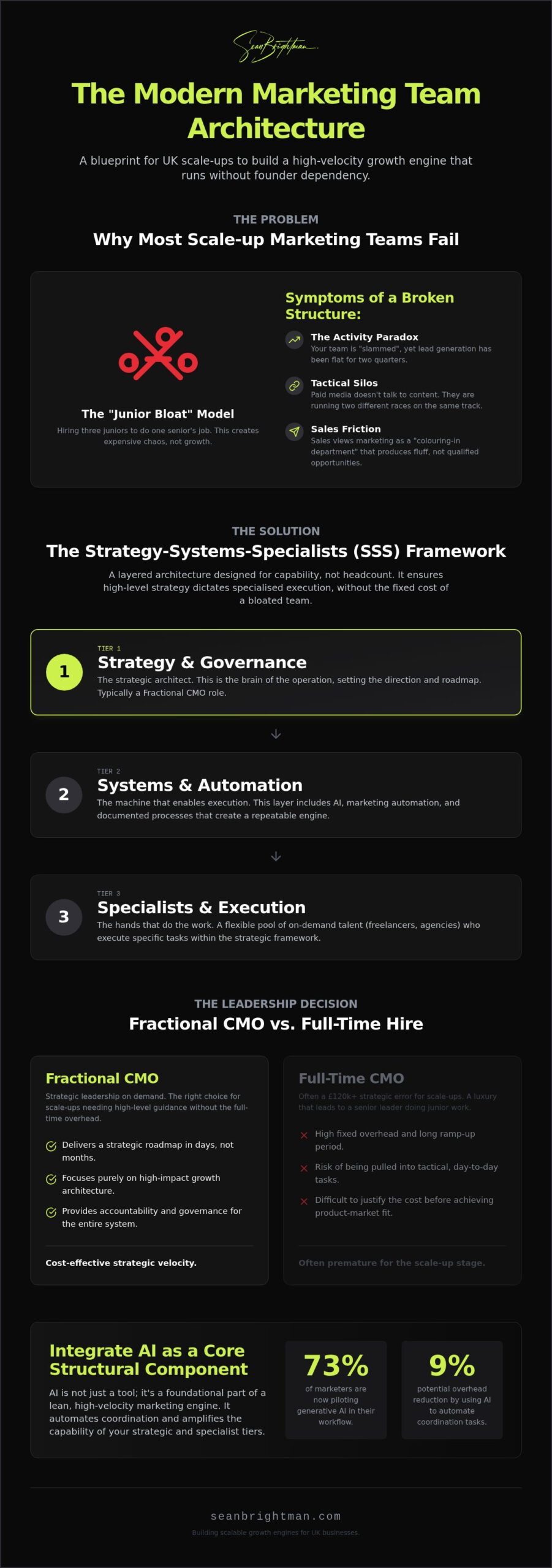
AI is not a fancy plugin for your browser. It is a structural component of the 2026 marketing team. If you are treating it as a tool for your juniors to write better emails, you are missing the point entirely. AI-powered systems are currently delivering an 8.9% reduction in marketing overhead whilst improving sales productivity. This is not about efficiency; it is about redesigning the marketing team structure for scale-ups uk to remove the need for manual coordination.
The “junior coordinator” role is dead. Traditionally, scale-ups hired entry-level staff to move data between spreadsheets, schedule social posts, and chase approvals. AI handles these tasks with 100% accuracy and zero salary. This shift allows you to move away from hiring for volume. You don’t need a larger team. You need a more capable one. Moving from experimental tool-use to an integrated growth engine requires a clear AI roadmap. You are shifting from “doing” to “architecting.” Building a coherent marketing systems architecture is what separates businesses with a fragmented tech stack from those running a centralised, high-performance growth engine.
Upskilling your existing team is more cost-effective than hiring “AI Specialists” who lack your industry context. 84% of UK marketers already use AI tools every day. Your job is to provide the structure that turns that individual usage into a collective system. It is about building a machine where AI handles the logistics and humans handle the strategic nuance.
The role of a Content Marketer has fundamentally changed. They are no longer writers; they are editors, strategists, and system managers. They manage the output of AI agents rather than grinding out blog posts manually. Similarly, reporting and analytics are now automated. Your team should spend zero time building dashboards and 100% of their time interpreting data and making strategic pivots. This frees up the strategic time that founders usually end up filling themselves.
Before you restructure, you need an AI roadmap session. You cannot design a modern team using a 2019 blueprint. A Fractional CMO acts as the lead architect here, identifying where AI can replace headcount and where it can amplify existing talent. The key metric is no longer just “cost per lead”; it is “output per head.” If your team size stays the same but your output triples, you have won. Focus on building systems that scale capability, not activity.
Don’t guess your way through this transition. If you want to build a team that leverages 2026 technology to outpace your competition, book an AI Consulting session to design your growth engine properly.
You don’t need a static org chart. You need a 90-day transformation plan. Static diagrams are for HR departments; dynamic roadmaps are for growth. Transitioning your marketing team structure for scale-ups uk from a source of frustration to a scalable engine happens in three distinct phases: Audit, Architect, and Activate. This isn’t a slow-burn corporate realignment. It is a rapid-fire correction designed to stop the bleeding and start the building. We are moving from a collection of individuals to a high-performance system.
Most founders wait too long to fix their architecture. They hope the next hire will be the “silver bullet” that solves the chaos. It never is. Structure must precede recruitment. By following a methodical roadmap, you ensure that every pound of salary and every hour of effort is directed toward a singular commercial outcome. This is about building a department that works for the business, not a business that works for the department.
Start by identifying the “activity traps” slowing down your business. These are tasks that feel like work but produce zero revenue. We review every channel, every tool, and every role against its actual impact on the bottom line. If a campaign isn’t performing, we kill it. If a role is redundant due to AI integration, we redesign it. This is the first step to un-messing the department. You cannot build a high-performance machine on top of a pile of waste. We find the hidden profit by stripping away the fluff and focusing on the 20% of activity that drives 80% of your results. A thorough marketing efficiency audit is the most reliable way to expose the hidden rot in your department and identify exactly which processes are draining your budget without moving the needle.
Once the mess is cleared, we design the blueprint. This involves defining the KPIs that actually matter to a CEO, such as customer acquisition cost (CAC) and lifetime value (LTV), rather than vanity metrics like “engagement” or “impressions.” We then select the right mix of fractional leadership and specialist talent to fuel the machine. This is where the 3-tier architecture becomes a reality, ensuring you have strategic depth without the overhead of a bloated permanent staff. You are architecting for capability, not just capacity.
Don’t leave your growth to chance. If you want to identify the bottlenecks in your current setup and design a custom architecture for your business, Book a Strategic Roadmapping Session with Sean Brightman today. We will find the mess and build the engine to fix it.
Sustainability requires governance. Establishing an Advisory Retainer ensures long-term accountability and prevents the team from sliding back into old habits of “junior bloat.” A solid marketing team structure for scale-ups uk is the foundation of every successful exit. When a buyer looks at your business, they aren’t just buying your product. They are buying the engine that sells it. Make sure yours is built for speed and precision.
The “hire and hope” cycle ends today. You’ve seen why bloated headcounts fail and how a 3-tier architecture outperforms a traditional org chart. Scaling isn’t about adding more hands to a broken wheel; it’s about building a better engine. By prioritising strategic leadership and AI-powered systems, you reclaim your time and ensure every marketing pound delivers a measurable return. The ideal marketing team structure for scale-ups uk isn’t a fixed payroll; it’s a flexible, high-velocity growth unit designed for impact.
You now have the blueprint to move from chaos to a scalable engine. You know that a Fractional CMO provides the senior oversight you need without the quarter-million-pound liability of a permanent hire. You understand that AI is a structural necessity, not a tactical toy. Now, you need the roadmap to activate it. Stop guessing and start designing. Build a smarter marketing system with a Strategic Roadmapping session. Use battle-hardened strategic advice to install the engine your business deserves. Let’s get to work.
The best marketing team structure for scale-ups uk is a 3-tier architecture comprising Strategy, Systems, and Specialists. This model separates high-level strategic leadership from the operational “plumbing” and tactical execution. It ensures you have senior oversight to guide growth whilst remaining lean enough to pivot without the friction of a bloated permanent headcount.
A Fractional CMO typically costs a fraction of a full-time executive salary, which averaged £187,500 in the UK in 2026. You are paying for high-impact strategic outcomes rather than 40 hours of desk time. This model eliminates the “drag” of National Insurance, pension contributions, and recruitment fees, making senior leadership accessible for fast-growth firms.
You must stop the moment you become the strategic bottleneck. If your time is consumed by signing off on social media posts or tweaking ad copy, you are draining your own ROI. Transition to a professionalised structure when your activity levels outpace your ability to maintain a cohesive growth roadmap or measure lead attribution accurately.
Secure your strategy and systems before hiring either. An agency is a tactical fuel source for specialist tasks like SEO or paid media, but they cannot build your internal growth architecture. Only hire in-house specialists once you have a proven, automated system that requires full-time management to maintain its velocity.
A Marketing Manager is a tactical doer, whilst a CMO is a strategic architect. Managers focus on the “how” of execution and task management. A CMO defines the “why” and “what,” ensuring the marketing team structure for scale-ups uk aligns with commercial goals and delivers a clear, scalable roadmap for the CEO.
AI significantly reduces the need for junior “coordinators” who traditionally handled manual data movement and scheduling. With AI delivering an 8.9% reduction in marketing overhead in 2026, you can achieve higher output with a smaller, more capable team. You are shifting from hiring for volume to hiring for system management capability.
Yes, a Fractional CMO is vital for recruitment because they design the architecture before you hire the hands. They define the specific capabilities required for your growth engine, ensuring you don’t make the mistake of hiring juniors to solve senior-level strategic problems. They provide the technical vetting that founders often lack.
A marketing advisory retainer is a governance layer that provides ongoing strategic accountability. It acts as a “plug-and-play” engine for your business, offering consistent senior oversight without the commitment of a full-time hire. It ensures your team stays on the roadmap and adapts to market shifts with clinical precision.
Reading is good. A roadmap is better.