
Busywork is the most expensive line item on your balance sheet. Your team is exhausted, your budget is bleeding, and the ROI is a ghost. When your marketing team lacks strategic direction, you don’t have a growth engine; you have a high-speed treadmill. It’s a cycle of motion without progress that drains your capital and your patience.
In 2026, with average marketing budgets tight at 7.8% of revenue, there is zero room for error. You cannot afford to waste 15% of that spend on AI initiatives or creative campaigns that lack a clear objective. You know the frustration of watching talented people throw uncoordinated tactics at the wall whilst you’re forced to micro-manage every campaign. It’s exhausting. It’s also unnecessary. You didn’t hire a team to be their babysitter; you hired them to drive revenue.
This article shows you how to break the cycle. You will learn how to install the leadership architecture that turns chaotic activity into measurable growth. We will cover how to organise a clear marketing roadmap, establish hard accountability through KPIs, and build a scalable system that doesn’t require your constant intervention. It’s time to stop the wasted motion and start moving the needle.
High activity is not the same as high impact. If your marketing department is shipping campaigns daily but the revenue line remains flat, you are caught in the Busywork Trap. It is a mechanical failure of leadership. When your marketing team lacks strategic direction, they default to “Random Acts of Marketing.” This is the phenomenon where uncoordinated tactics are launched in a vacuum. A LinkedIn post here. An email blast there. A new AI tool trial somewhere else. It feels like progress. It looks like work. But it kills ROI because there is no connective tissue between the activity and the objective.
The shift is subtle but lethal. Your team stops asking “How do we win?” and starts asking “What should we do next?” They are looking to you for the next task rather than owning the outcome. This creates strategic drift. The invisible cost is not just wasted spend; it is talent turnover. High performers hate wasting their careers on projects that don’t matter. If they can’t see how their work moves the needle, they will leave for a competitor who actually has a plan. Understanding Marketing strategy fundamentals is the difference between a functional growth engine and a broken gearbox.
A campaign is a tool. A strategic pillar is the blueprint. Teams default to tactics because checking a box feels good. It is easier to “do social media” than it is to define why you are on social media. This is channel-first thinking. It puts the platform before the person. You end up buying the machinery before you have designed the product. Strategy defines the audience and the value proposition. Tactics are just the delivery mechanism. Without the former, the latter is just noise.
You are likely the bottleneck. When you act as the part-time CMO, you become the narrowest part of the funnel. You are managing a department you don’t fully understand, and the emotional toll is heavy. Delegating tactics without a strategy is a recipe for expensive failure. Your job is to lead the business, not to babysit the marketing calendar. If you are the one deciding which TikTok trend to chase or which font looks “premium,” your marketing team lacks strategic direction. You shouldn’t be the one providing the spark; you should be the one holding a leader accountable to a roadmap.
When a marketing team lacks strategic direction, the root cause is rarely a lack of effort. It is a structural failure of perspective. Internal teams are often too close to the product to see the brand. They get bogged down in the minutiae of daily operations, watering every individual leaf whilst the forest burns. This internal bias is a silent killer of ROI. It prevents the team from identifying what to stop doing, which is often more important than deciding what to start.
Corporate politeness is another significant hurdle. In many UK scale-ups, the desire to maintain “team harmony” prevents the blunt honesty required for a strategic pivot. No one wants to tell the CEO that their favourite project is a resource sink. Without a robust Marketing systems architecture, consistency becomes impossible. You end up with a collection of uncoordinated silos rather than a unified growth engine. This lack of a repeatable framework means every new campaign starts from zero, wasting time and mental energy on reinventing the wheel.
Hiring “doers” to do “thinking” work fails every time. A Head of Marketing is often a brilliant executor, but they are not a CMO. There is a massive seniority gap between managing a budget and architecting a growth engine. If your leadership is focused on hitting a publishing schedule rather than identifying market opportunities, your marketing team lacks strategic direction. You need an architect, not just a foreman. If you feel like you’re constantly repeating yourself, it’s because your leadership layer isn’t translating your vision into a tactical roadmap.
Who owns the “Why” behind your marketing spend? If the answer is “everyone,” then the answer is “no one.” In many directionless teams, people end up marking their own homework. They report on vanity metrics, like social engagement or email open rates, because they are easy to track and look positive. However, these metrics rarely correlate with revenue growth. Breaking this internal echo chamber requires an external perspective that isn’t afraid to challenge the status quo. Sometimes, the most efficient way to install this accountability is through a Fractional CMO who can bridge the gap between your vision and the team’s execution.
AI is currently the most efficient way to burn your marketing budget. It is a force multiplier. If your strategy is sound, it scales your success. If your marketing team lacks strategic direction, AI simply helps you fail at light speed. It turns a drip of uncoordinated tactics into a flood of irrelevant noise. In 2026, marketers are allocating an average of 15.3% of their budgets to AI initiatives. Most of that spend is being incinerated on tools that lack a strategic use case. This is the “Tool Fatigue” trap. You don’t need more subscriptions; you need a system.
Adopting tech without a roadmap is just expensive procrastination. Professional AI consulting fixes this “shiny object syndrome” by aligning software with business outcomes. It shifts the focus from “What can this tool do?” to “How does this tool help us win?” Without this alignment, you are just automating the very busywork that is currently killing your ROI. You are buying a faster engine for a car that doesn’t have a steering wheel.
More content doesn’t equal more growth. If your core message is flawed, AI-generated content just dilutes your brand positioning faster than a human ever could. You end up with a high volume of generic, soul-less output that consumers in 2026 immediately ignore. AI-driven strategic velocity is the precise application of machine intelligence to accelerate validated business goals, not the automated production of unvalidated noise.
AI should inform your strategy before it touches your execution. It is about strategic intelligence, not just content generation. Use data-driven insights to find your “Strategic North Star” and identify which channels actually move the needle. Whilst email marketing offers an average ROI of £36 for every £1 spent, AI can pinpoint exactly which segments are ready to convert, making that return even higher. The role of the CMO is to govern this implementation, ensuring every tool serves the roadmap. It isn’t about chasing the latest LLM update; it’s about building a machinery of growth where AI acts as the fuel, not the driver. If your marketing team lacks strategic direction, they will remain stuck in the “AI for content” phase whilst your competitors build strategic intelligence engines.
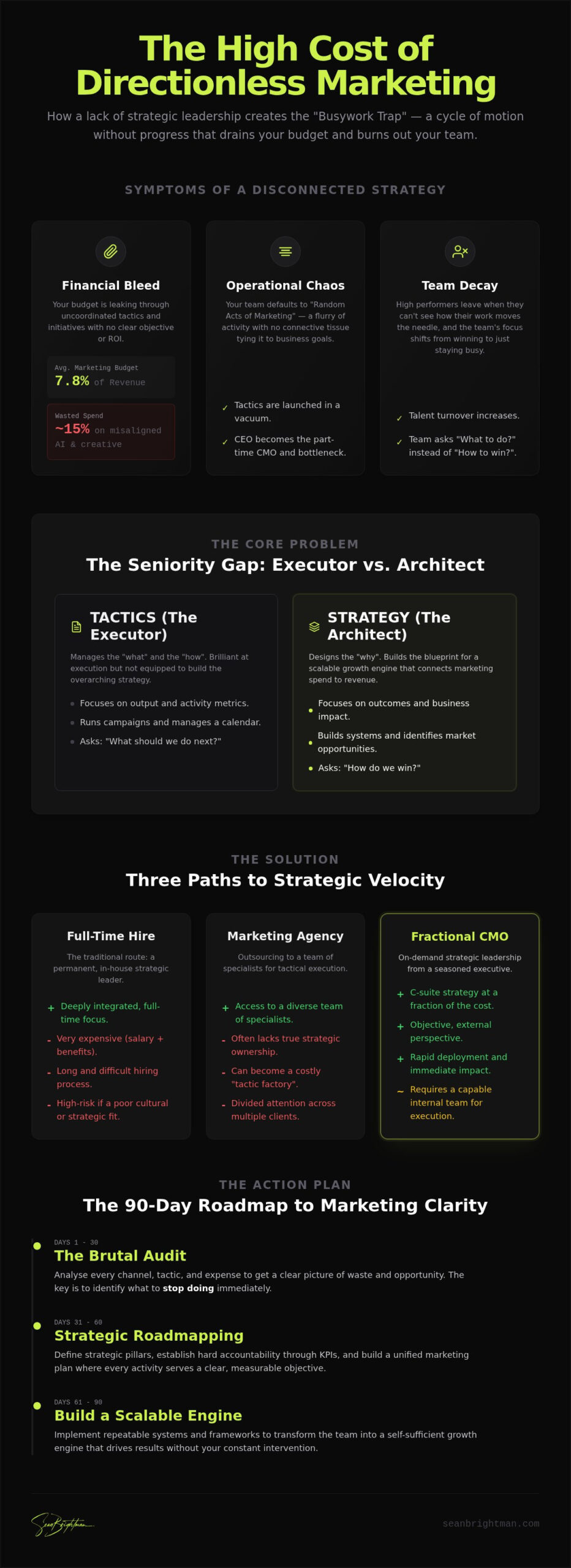
When your marketing team lacks strategic direction, you have three ways to install the missing leadership architecture. You can hire a full-time leader, hire an agency, or hire a Fractional CMO. Each path offers a different speed to value. Most CEOs default to the full-time hire. They think a permanent desk equals permanent progress. They are often wrong. In 2026, the average salary for a full-time UK CMO is reaching levels that mid-sized businesses simply cannot justify for the output they receive. Hiring a £150k CMO might be a £120k mistake if you don’t yet have the infrastructure for them to lead. You pay for their 40 hours, but you only need 4 hours of their strategic brain. The rest is spent in meetings or managing people they shouldn’t have to manage. It is an expensive way to buy a manager when you actually need an architect.
The agency route is equally risky. Agencies are execution shops. They want to sell you more social posts, more ads, and more content. Outsourcing strategy to an execution shop rarely works because their incentive is to keep the machine running, not to question if the machine should exist. They aren’t in your boardroom. They don’t understand your margins. They deliver tactics, not direction. This is why a Fractional CMO is the surgical option. You get the battle-hardened expert who has seen your problems before and knows the fix. They install the system and then step back. It is about impact, not hours.
The “Plug-and-Play” nature of fractional leadership is its greatest asset. You get 20 years of experience for 20% of the cost. They don’t need a three-month onboarding period. They arrive with a toolkit. Most importantly, they aren’t embroiled in internal politics. They can tell you the blunt truth because their career doesn’t depend on your approval of their personality. They are there to solve the problem, not to build an empire. If your marketing team lacks strategic direction, you need an external force to break the stagnation, not a new employee to join it.
Strategy is not a document on a shelf. It is a living process. An Advisory Retainer ensures that the roadmap is followed. It creates a cadence of accountability for your internal team. They stop marking their own homework. This bridges the gap between the board room and the marketing department, ensuring every pound spent aligns with your commercial goals. It turns your marketing department from a cost centre into a growth engine. If you are ready to stop the wasted motion and install high-level accountability, explore how a Fractional CMO can transform your team.
Clarity is a function of discipline. You don’t fix a broken department with a motivational speech or a weekend workshop. You fix it with a methodical 90-day reset. If your marketing team lacks strategic direction, the first 30 days are about subtraction. You cannot build a high-performance growth engine on top of a scrapyard.
Phase 1 is the Brutal Audit. We identify the “zombie” campaigns that have been eating your budget for months without a single conversion. Phase 2 is Strategic Brand Roadmapping. This defines the “How” and the “Who” with surgical precision. Phase 3 moves into Operational Alignment, where we restructure the team for impact rather than activity. Finally, Phase 4 closes the loop with hard accountability. We set KPIs that actually matter to the CEO, focusing on revenue and customer acquisition cost rather than vanity metrics.
Most teams are afraid to stop doing things. They think volume equals value. It doesn’t. We look for the technical debt in your marketing stack and simplify the tools to focus on what drives revenue. If a channel isn’t producing a measurable return, it gets cut immediately. A “Stop-Doing” list is the most effective way to reclaim a leaking budget and refocus your team on high-leverage tasks. We strip the machinery back to its core functional components so we can see what actually works whilst others are still tinkering with broken parts.
Positioning is your competitive weapon. It should make your rivals irrelevant by carving out a space only you can occupy. Once the strategy is set, your junior team can finally execute with confidence because they aren’t guessing. They know the boundaries. This alignment does more than just drive current revenue. It builds a growth engine that buyers covet, directly supporting your long-term business exit strategy.
When your marketing team lacks strategic direction, they are just waiting for a leader to draw the map. In 90 days, you can move from a state of expensive confusion to a high-velocity growth system. You move from “Random Acts of Marketing” to a scalable, predictable engine. Stop the motion. Start the progress.
Activity is not progress. You now know that the “Busywork Trap” and “Random Acts of Marketing” are symptoms of a leadership failure, not a lack of talent. When your marketing team lacks strategic direction, you are simply subsidising motion whilst your competitors capture the market. You cannot afford to wait for your internal team to find their way without a map. Every day spent in strategic drift is a day of wasted spend and lost opportunity.
You need a system that translates your vision into measurable revenue. As a Fractional CMO for high-growth UK brands and author of the definitive guide to marketing strategy, I specialise in installing AI-powered growth engines that deliver clarity and accountability. Stop micro-managing the tactics and start architecting the outcome. It is time to move from “What should we do?” to “How do we win?”
Book a Strategic Roadmapping Session with Sean Brightman today. It is time to turn your marketing department into the high-performance machinery your business requires. You have the vision; now get the architecture to match it. Your scalable growth engine is waiting.
If your team is constantly shipping but the revenue line is flat, you have a strategy problem. A lack of budget restricts the volume of your activity, but when your marketing team lacks strategic direction, the quality of that activity is irrelevant. Look for “Random Acts of Marketing” where tactics aren’t connected to commercial goals. If your team can’t explain why they chose a specific channel, more money will only help them fail faster.
Most agencies are execution engines. They are built to sell you more social posts, ads, or content. Whilst they might offer “strategy,” it is often just a plan to sell more of their specific services. True strategic direction must come from a leadership level that understands your margins and business exit goals. You need an architect to design the growth engine before you hire the builders to lay the bricks.
A Marketing Manager is a foreman who ensures the work gets done. They manage schedules and publishing calendars. A Strategic CMO is the architect who builds the growth engine. They focus on brand positioning, market opportunities, and commercial outcomes. If your current leader is asking you what the priorities are, you have a manager. You need a CMO to tell you where the growth is hidden and how to capture it.
You can install a leadership architecture and achieve marketing clarity in 90 days. The process starts with a brutal audit to stop the bleeding, followed by strategic roadmapping to define your North Star. By the end of this period, your team will move from chaotic activity to a cadence of accountability. It doesn’t take years to fix the motion; it takes a decisive shift in how you lead the department and its systems.
An AI roadmap provides the technical and strategic framework to modernise a stagnant team. It moves you away from using AI just for content generation and towards using it for strategic intelligence. This focus allows your team to automate the busywork whilst focusing on high-level brand positioning. Without this roadmap, AI is just another shiny object that accelerates your failure. It turns your team into a data-driven growth engine that scales with precision.
For a UK scale-up, a Fractional CMO is almost always the superior choice. You get senior expertise without the £150k salary and associated overheads. It is a “plug-and-play” solution that provides immediate impact without the internal politics of a permanent hire. You don’t need a full-time leader to build a strategy; you need an expert to install the system and ensure your team is accountable for measurable results.
The first signs are vanity metrics and CEO micro-management. If you find yourself checking social media captions or email fonts, your strategy is non-existent. You will also see high team burnout because they are working hard on things that don’t matter. When your marketing team lacks strategic direction, the ROI is a ghost, and your talented people will start looking for the exit because they can’t see the impact of their work.
The CEO should define the business objectives and the destination. They should not be designing the route. Your role is to hold the marketing leader accountable to the roadmap, not to be the part-time CMO. High-level input is essential for alignment, but micro-management is a sign that your leadership architecture is broken. You set the destination; let the expert drive the car. This ensures you focus on leading the company whilst the marketing engine runs.
Reading is good. A roadmap is better.