

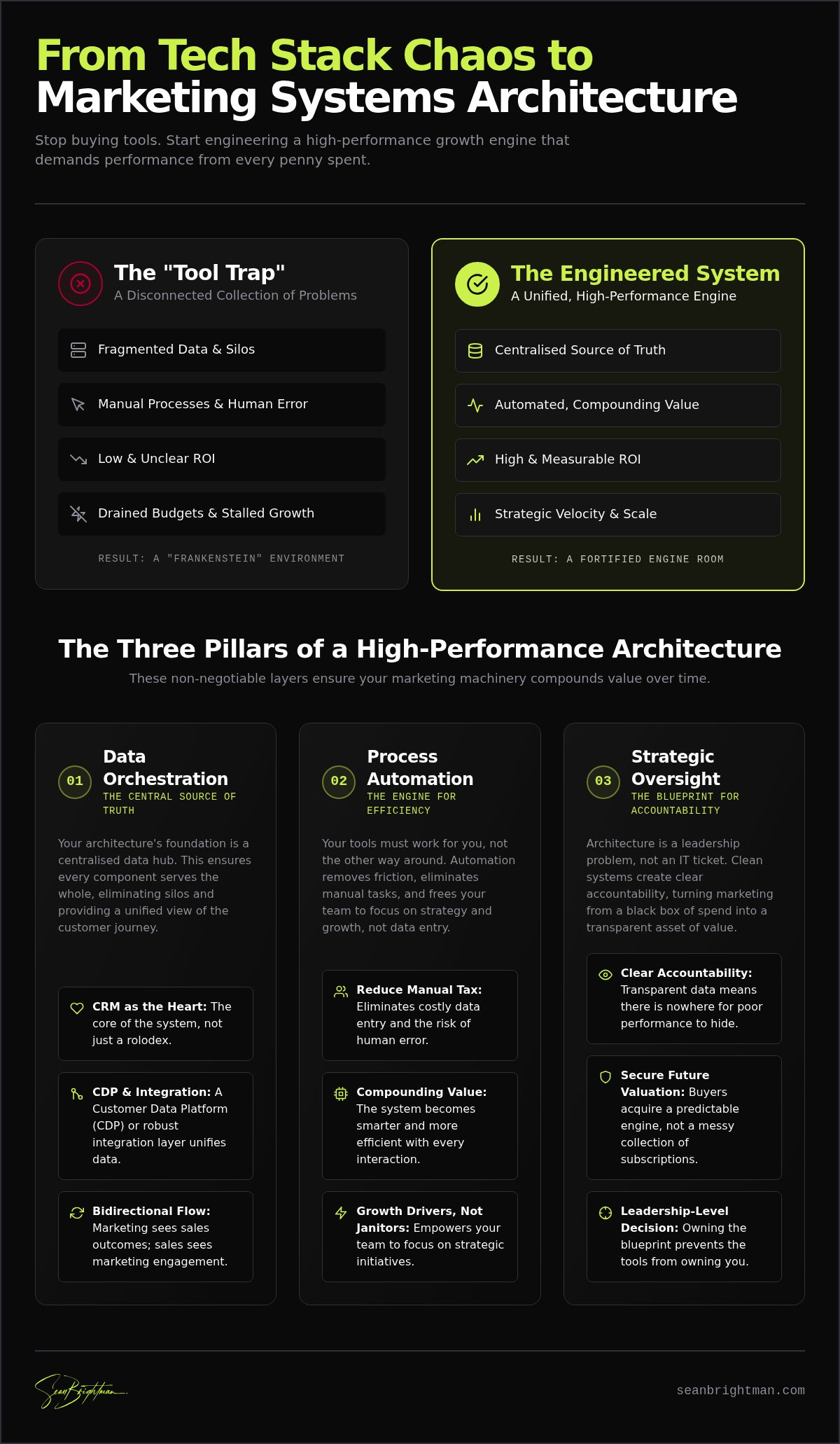
Your marketing tech stack isn’t an asset. It’s an overhead. Most businesses don’t have a strategy; they have a collection of expensive subscriptions that don’t talk to each other. You’re paying for “solutions” that only create more problems. Fragmented data. Zero accountability. Low ROI. It’s a mess that slows you down whilst draining your budget.
You know the feeling. You’ve got the best tools on the market, yet you still can’t get a straight answer on what’s actually driving revenue. To fix this, you need to stop buying software and start building a marketing systems architecture. It’s the difference between a pile of bricks and a fortified engine room. This isn’t about adding more features; it’s about engineering a centralised source of truth that demands performance from every penny spent.
I’m going to show you how to strip away the fluff and organise your tech into a high-performance growth engine. We’ll map out the blueprint for strategic velocity, ensuring your systems require less manual intervention and deliver more scale. It’s time to move from a tool-centric trap to a data-centric reality.
Stop thinking about your marketing stack as a list of logins. It isn’t. A stack is often just a pile of software sitting on your balance sheet, collecting dust whilst draining your budget. Marketing systems architecture is the structural blueprint for your growth machinery. It is the functional skeleton of your marketing department. Without it, your tools are just loose bones rattling around in a box. They have no connection, no purpose, and no power.
There is a massive difference between a system and a stack. A stack is what you buy. A system is how it works. To understand the depth of this, look at the foundational concept of a Marketing Information System. It’s about how information flows through your business to drive decisions, not just how many apps you can connect via Zapier. Effective architecture ensures that every component serves the whole.
Marketing systems architecture is the strategic alignment of data, tools, and human behaviour.
Most SMEs are caught in a cycle of buying “solutions” that solve nothing. They end up with ten broken tools instead of one working system. This creates a “Frankenstein” environment where data is buried in silos and manually moved between spreadsheets. The hidden cost is staggering. You aren’t just paying for the SaaS subscriptions; you’re paying for the friction.
Manual data entry is a tax on your growth. It leads to human error and delayed insights. Bad architecture kills strategic velocity. It forces your team to act as data janitors rather than growth drivers. When your infrastructure is a mess, your overhead skyrockets whilst your output stalls. You’re working for your tools, instead of your tools working for you.
Architecture is a leadership problem, not an IT ticket. If you don’t own the blueprint, the tools will eventually own you. Clean systems create clear accountability. When the data is centralised and transparent, there is nowhere for poor performance to hide. You can see exactly what is working and what is wasting money.
A solid blueprint is also your best insurance policy for an eventual exit. Potential buyers don’t want to acquire a messy collection of SaaS bills and manual processes. They want to buy a scalable, predictable engine. They want to see a system that requires less manual intervention to produce more revenue. Building your architecture today is how you secure your valuation tomorrow. It turns marketing from a black box of spend into a transparent asset of value.
Building a marketing systems architecture isn’t a shopping trip. It’s an engineering project. You aren’t looking for the “best” tools; you’re looking for the right layers. A high-performance stack relies on three non-negotiable pillars: Data Orchestration, Process Automation, and Strategic Oversight. If one is weak, the whole structure collapses. You end up with expensive software that creates more work than it saves.
These layers must be designed to compound value over time. Every new lead, every automated email, and every data point should make the system smarter and more efficient. This isn’t a static setup. It’s a “plug-and-play” infrastructure that allows you to swap tools as your business evolves without breaking the entire engine. If you’re struggling to connect these dots, bringing in a marketing operations consultant is the fastest way to bridge the gap between technical debt and strategic scale.
Your CRM is the heart of the system. But a heart without veins is useless. Many businesses treat their CRM as a glorified rolodex whilst data sits trapped in siloed Modern Marketing Platforms that don’t talk to each other. This is where the engine stalls.
To fix this, you need a Customer Data Platform (CDP) or a robust integration layer. This creates your single source of truth. Data must flow bidirectionally. Marketing needs to see sales outcomes to optimise campaigns. Sales needs to see marketing engagement to prioritise calls. If the data only moves one way, your architecture is broken. It’s that simple.
Automation should be a highway, not a car park. Most teams build workflows that eventually create “automation debt”—a messy web of triggers that nobody understands and everyone is afraid to touch. This isn’t automation; it’s a liability.
True marketing systems architecture focuses on scalable workflows. Lead scoring and nurturing aren’t just one-off tactics. They are architectural components that filter and route demand without human intervention. You don’t need a bigger team to manage this. You need a team organised to maintain the highway and ensure the traffic keeps moving toward revenue.
Tools collect data. People execute strategy. Even the most advanced AI-powered engine is useless if your team is stuck in “tactical hell.” Your marketing team structure for scale-ups UK must be designed to match your architecture.
The system must serve the strategy, not the other way around. If your team spends 80% of their time fixing integrations and 20% on creative growth, you’ve failed as an architect. Strategic velocity happens when the machinery handles the mundane, leaving your experts to focus on high-impact wins. If your current setup feels like a drag rather than a driver, a strategic roadmap can help you realign your infrastructure with your commercial goals.
“We already have the best tools in the market.” I hear this every week. It’s a vanity metric. Having a high-end toolset doesn’t mean you have a functioning marketing systems architecture. It often means you’ve just spent a fortune on a Ferrari whilst your team is still trying to figure out how to drive through a swamp. Tools are components. Systems are connections.
Most businesses fall victim to the “Feature Fallacy.” You buy software because of a shiny demo showing 50 features you’ll never use. You’re paying 100% of the price for 10% of the value. This isn’t just a budget leak. It’s an operational anchor. Every unused feature adds complexity. Every unnecessary button is a distraction. To find out where your budget is actually going, you need a marketing efficiency audit to identify the waste before it drains you dry.
Never let a SaaS vendor dictate your marketing strategy. Their software is built for their ideal customer, not necessarily your specific business model. When you adopt a tool-first mindset, you force your team to work around the software’s limitations. This is how you end up with “best-in-class” tools that create “worst-in-class” silos. They don’t talk. They don’t share data. They just exist in isolation.
The goal is a modular stack. Your marketing systems architecture should be agnostic. You should be able to rip out an underperforming CRM or a bloated email platform and plug in a better alternative without the whole engine seizing up. If your business depends on a single tool’s specific quirks to function, you don’t own your system. The vendor does.
Your team is paying a “Complexity Tax” every single day. It’s the time spent manually exporting CSVs. It’s the hours lost trying to reconcile data between three different dashboards. It’s the friction that stops a lead from becoming a customer because the hand-off between marketing and sales is broken.
For a CEO, this leads to “marketing blindness.” You see the spend. You see the activity. But you cannot see the direct line to revenue. This fragmentation isn’t just an internal headache; it spills over into customer behaviour. If your systems are disconnected, your brand feels disjointed. A customer sees one thing on your site, another in their inbox, and something entirely different when they speak to sales. That lack of cohesion kills trust and halts your strategic velocity.
Scaling a business without a plan isn’t growth; it’s just expensive chaos. You need a clinical framework to move from a mess to a machine. This isn’t about trial and error. It’s about engineering a marketing systems architecture that supports your commercial ambitions. To get there, you follow a five-step process: Audit, Blueprint, Integrate, AI-Layer, and Optimise.
The process starts with an “Audit and Excavate” phase to find where your data is currently buried. Only then can you move to “Blueprinting,” where you design the flow of information before touching a single piece of software. Once the logic is sound, you move into “Integration” to build your automation highways. In 2026, this must include an “AI Layer” to handle execution. Finally, you enter “Optimisation,” using an Advisory Retainer to ensure the engine remains tuned for maximum ROI.
You can’t fix what you can’t see. Most businesses have a “spaghetti” of integrations—a tangled web of Zapier tasks and manual workarounds that nobody fully understands. The first step is to map every tool, every data point, and every manual hand-off.
Identify the “leaks” where revenue is being lost. Is a lead dropping out because the CRM didn’t sync? Is your team wasting ten hours a week on manual reporting? This audit isn’t just a list of software; it’s a map of your operational friction. If you want to stop the bleed, start with a strategic roadmapping session to define your target state.
In 2026, architecture must be AI-ready. We are moving away from “tools that help humans” and toward “AI engines that execute tasks.” This requires a fundamental shift in how you organise your data. AI agents can only perform if your data is clean, structured, and accessible.
If your data is trapped in silos or formatted incorrectly, your AI strategy will fail before it starts. Your architecture should allow autonomous agents to pull real-time data, trigger multi-channel campaigns, and update lead scores without human intervention. This is how you achieve true strategic velocity whilst keeping your overhead low.
A system is only as good as the people running it. You must define clear ownership for every part of the engine. Who owns the data integrity? Who monitors the automation highways? Without governance, even the best architecture will eventually decay into a mess.
Set up dashboards that provide a “flight deck” view for leadership. You shouldn’t have to dig through five tools to see your CAC or LTV. You need a centralised source of truth that demands accountability from the marketing team. This creates a culture of data discipline where decisions are made based on evidence, not gut feelings.
You don’t need a full-time CMO to fix your infrastructure. In fact, hiring one to build your marketing systems architecture is often a strategic error. Full-time hires come with massive overhead and a tendency to get bogged down in internal politics. They focus on managing people whilst the machinery remains broken. You need an architect, not a permanent tenant.
A fractional cmo provides the senior-level authority required to strip away the fluff and build a high-performance engine. They bring a battle-hardened external perspective that cuts through bureaucracy. They design the system, ensure the integrations hold, and then step back. This isn’t about long-term dependency; it’s about high-impact intervention.
Once the blueprint is executed, your business doesn’t need constant strategic rebuilding. It needs maintenance. An Advisory Retainer provides exactly that. It’s the ongoing “engine tuning” that ensures your growth machinery remains optimised whilst your internal team handles the day-to-day execution. You keep the strategic velocity without the full-time cost.
UK scale-ups often fall into the trap of paying for a full-time salary when they only need senior strategy for a few days a month. Fractional leadership is “plug-and-play.” It’s efficient. It’s results-oriented. It’s about high-impact strategic direction rather than endless meetings and management cycles.
This model allows you to access senior expertise without the massive price tag of a permanent hire. You get the blueprint for a scalable marketing systems architecture and the leadership to implement it. Your team gets clear direction. Your business gets momentum. No ego. No fluff. Just a functional engine built for scale. For UK scale-ups who need senior-level direction without the full-time overhead, a professional marketing advisory delivers the strategic velocity and AI-powered systems that a traditional executive hire simply cannot match at the same cost.
Everything starts with a roadmapping session. This is a one-off, high-energy deep dive into your current operations. It’s a blunt assessment of your current mess. We don’t sugarcoat the reality of your data silos or your wasted SaaS spend. We find the leaks and design the fix.
This session creates your initial architectural blueprint. It defines exactly how your tools, data, and people will work together to drive revenue. It’s the first step toward a scalable, AI-powered growth engine that actually delivers on the promises your tech stack made years ago. Stop guessing. Start architecting.
You’ve seen the “spaghetti” integrations. You’ve paid the “Complexity Tax.” It’s time to stop letting SaaS vendors dictate your commercial limits. A high-performance marketing systems architecture isn’t a luxury for later; it’s the foundation for strategic velocity right now. You need a centralised source of truth and a scalable engine that demands accountability from every penny of spend. Architecture isn’t an IT problem. It’s a leadership decision.
I provide fractional CMO leadership for high-growth UK scale-ups who are tired of the corporate fluff. My focus is on building AI-powered growth engines with direct, blunt strategic advice that cuts through the noise. We don’t just add more logins to your balance sheet. We build the blueprint that allows your business to scale without the constant manual fire-fighting.
Build your growth engine: Book a Strategic Roadmapping session with Sean Brightman
The machinery for your next phase of growth is waiting to be built. Let’s get to work.
A tech stack is a collection of tools; architecture is the logic that connects them. Think of the stack as a pile of bricks and the architecture as the blueprint and mortar. One is a list of monthly subscriptions whilst the other is a functional growth engine. Architecture defines how data flows between tools and how your team interacts with the machinery to drive revenue.
The cost depends on your current technical debt and the complexity of your commercial goals. Building a robust system is a strategic investment in engineering a scalable asset rather than a simple purchase. You’re paying for the removal of friction and the creation of a centralised source of truth. The ROI comes from eliminating wasted SaaS spend and reducing manual labour costs.
No, you don’t need a full-time hire to build or manage the architecture. A full-time employee often lacks the “outside-in” perspective required to audit a messy department effectively. Fractional leadership is designed to build the engine then step back. Once the system is architected and automated, it requires senior oversight and maintenance, not a 40-hour-a-week babysitter.
AI cannot fix a mess; it only accelerates it. If your data is siloed and your processes are broken, AI will just produce bad results faster. You must build the marketing systems architecture first to ensure your data is clean, structured, and accessible. Clean data is the fuel and AI is the turbocharger. You can’t turbocharge a broken engine and expect it to run.
Operational clarity arrives almost immediately after the roadmapping phase. Technical implementation usually takes weeks rather than months. The goal is to reach a “minimum viable system” that provides a source of truth. Strategic velocity increases as manual friction is removed. You’ll stop guessing and start seeing clear, actionable data within the first 90 days of implementation.
Yes, the CRM is the heart of the architecture. Marketing doesn’t exist in a vacuum. If your lead data doesn’t flow seamlessly into sales workflows, your system is fundamentally broken. Architecture bridges the gap between marketing activity and sales outcomes. It ensures every touchpoint, from the first ad click to the final contract signature, is tracked, measured, and optimised for scale.
The first sign is “marketing blindness”—the inability to see which campaigns actually drive revenue. If your team spends hours every week manually exporting CSVs and reconciling spreadsheets, your architecture has failed. Other red flags include high SaaS spend with low tool adoption and a total lack of accountability for marketing performance. If your operations feel like constant chaos, they probably are.
A Fractional CMO acts as the senior architect who builds the blueprint before you buy the tools. They provide the blunt, strategic direction needed to cut through internal politics and fix technical debt. By focusing on marketing systems architecture, they ensure your department is built for scale without the overhead of a full-time executive. They build the machine, then tune it for maximum performance.
Reading is good. A roadmap is better.