
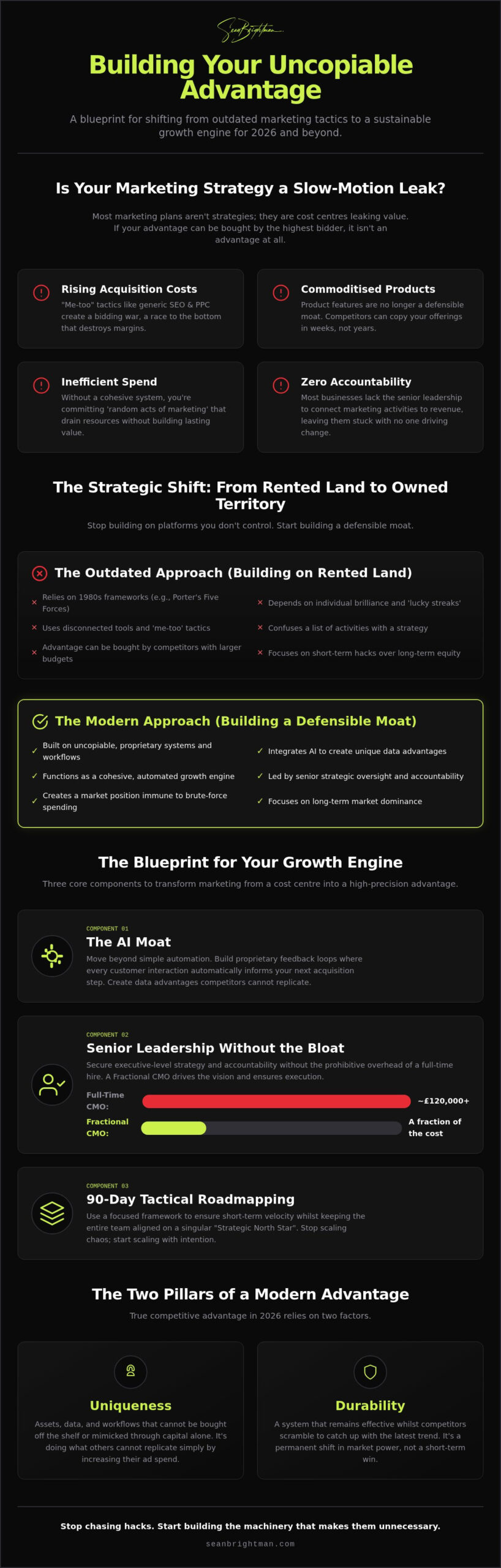
Your current marketing plan isn’t a strategy; it’s a slow-motion leak in your balance sheet. You’re likely watching your products become commoditised whilst your customer acquisition costs climb. It’s a race to the bottom that nobody wins. To break the cycle, you need a marketing strategy for sustainable competitive advantage that relies on systems, not just slogans. Most businesses lack the senior leadership to drive this change, leaving them stuck with inefficient spend and zero accountability.
You’ve probably realised that throwing more money at the same tired tactics won’t save you. You need a way to outpace the market without the £120,000 overhead of a full-time executive. This article provides the blueprint to build an uncopiable market position using AI-integrated operations and battle-hardened strategic oversight. We’ll examine how to transform your marketing from a cost centre into a high-precision growth engine. You’ll get a clear roadmap to market dominance, ensuring your business isn’t just surviving in 2026, but actually owning the space.
Sustainable competitive advantage isn’t a static trophy you win and keep. In the 2026 market, it’s a dynamic system of uncopiable assets that allow for long-term outperformance. Most UK businesses are still clinging to 1980s frameworks like Porter’s Five Forces. Those models were built for a world of physical moats and slow-moving competitors. Today, those moats are easily bridged by capital or software. A modern marketing strategy for sustainable competitive advantage requires shifting your focus from what you sell to how your growth engine actually functions.
The game has changed. Product features are no longer a defensible moat; they are copied in weeks, not years. If your primary advantage is a specific tool or a slightly better widget, you’re vulnerable. Real power now lies in operational systems. It’s the difference between having a fast car and owning the only petrol station in town. You need to build a system that produces results that competitors cannot replicate, even if they have a larger budget.
True advantage relies on two factors: uniqueness and durability. Uniqueness means doing what others cannot replicate simply by increasing their ad spend. It’s about proprietary data and specialised workflows. Durability ensures your position doesn’t evaporate the moment a new AI tool launches or a platform changes its algorithm. You aren’t looking for a quick win; you’re looking for a permanent shift in market power. Sustainable competitive advantage is the integration of proprietary data, AI-enhanced workflows, and senior leadership that creates a market position impossible to replicate through brute-force spending alone.
Most UK scale-ups confuse a temporary edge with a sustainable advantage. If your strategy consists of ‘me-too’ marketing tactics like standard SEO or generic PPC, you’re building on rented land. Any competitor with a larger bank balance can buy those same results tomorrow. This tactical fatigue destroys long-term brand equity and drains your resources without building lasting value.
A marketing plan is just a list of activities. A genuine strategy is a defensive system that makes those activities more effective over time. If your advantage can be bought by the highest bidder, it isn’t an advantage at all; it’s just an expense. You need to stop chasing the next hack and start building the machinery that makes hacks unnecessary. Without senior leadership to oversee this, you’re just throwing money at a leak and hoping for a flood.
Most businesses treat strategy like a PDF in a shared drive. It’s dead weight. A real marketing strategy for sustainable competitive advantage is a functioning machine. It’s the difference between a blueprint and the actual factory. You don’t need another document. You need an engine that produces predictable growth every single day. If your marketing relies on the individual brilliance of a single staff member or a lucky streak on LinkedIn, you don’t have a strategy. You have a gamble.
Your marketing department probably has too many decorators and not enough architects. Decorators worry about the colour of a landing page or the flair of a social post. Architects build the scalable marketing systems that ensure those assets actually drive revenue. You must stop committing ‘random acts of marketing’ and start following a cohesive roadmap. Systems provide the defensible moat that tools alone cannot offer. Anyone can buy a subscription to a CRM, but not everyone can build a system that uses that CRM to out-manoeuvre the competition.
Scale-ups often fail because they try to scale chaos. To build a moat, you must prioritise system design over creative execution. This starts by organising your data to create a proprietary feedback loop. Every interaction with a customer should inform the next step of your acquisition process automatically. When your systems learn from your market faster than your competitors can, you’ve won. Business owners must step back from the ‘doing’ and start designing the ‘how’. If you want to identify where your current engine is stalling, a Roadmapping session is the logical place to start.
Efficiency is doing things right. Effectiveness is doing the right things. You can be incredibly efficient at burning through your budget on the wrong channels. This is a fast track to failure. Sustainable profit isn’t driven by cutting costs on a broken process; it’s driven by making that process effective. You need to scrutinise your current marketing operations for hidden waste. Look for tasks that don’t contribute to the durability of your market position. If a process doesn’t add a brick to your moat, it’s just noise. Strip it out. Focus on the machinery that delivers long-term outperformance, not the minor tweaks that provide a temporary ego boost.
AI isn’t a shortcut for lazy writing; it’s a mechanical advantage for your growth engine. If you’re only using it to generate emails or social posts, you’re missing the point entirely. Everyone has access to the same basic tools. When everyone uses the same prompts, everyone gets the same average results. This is the AI Paradox: the more accessible the technology becomes, the less value it provides as a standalone tool. To build a marketing strategy for sustainable competitive advantage, you must move beyond the interface and into the integration.
Real defensibility comes from how you connect these tools to your proprietary data. Generic AI use is a commodity. Bespoke AI implementation is an asset. Through specialized AI consulting, you can identify the unique data advantages within your business that competitors simply cannot see. You aren’t just buying a subscription; you’re building a smarter machine that learns from your specific market behaviour. This turns a generic tool into a proprietary engine that drives long-term outperformance.
Traditional strategy relies on manual data analysis and static brand positioning. It’s slow. It’s reactive. By the time you’ve analysed last quarter’s performance, the market has already moved on. AI-powered strategy relies on real-time predictive growth engines. Instead of looking at what happened, you’re looking at what is about to happen. This allows for dynamic messaging that evolves as fast as your customers do. Static plans lead to ‘Tool Fatigue’ where you’re constantly chasing the next shiny object without ever building a foundation. AI-powered systems stop the chase by creating a self-optimising loop.
The goal is to find market gaps that your competitors are too slow to recognise. AI can scan vast amounts of competitor data, customer feedback, and search trends to highlight opportunities in hours, not weeks. This speed is your primary weapon. When you align these internal AI roadmaps with your business exit goals, you create immense value for shareholders. You aren’t just a company with a marketing team; you’re a company with a proprietary intelligence system. The AI Moat is the fusion of proprietary data and operational speed that makes your market position impossible to replicate through human effort alone.
Stop thinking about five-year plans. They’re works of fiction. By the time you’ve finished the document, the market has shifted, your competitors have pivoted, and your data is stale. You need a marketing strategy for sustainable competitive advantage that thrives on 90-day velocity. This isn’t about moving fast for the sake of it. It’s about moving toward a ‘Strategic North Star’ whilst ignoring the tactical noise. Most CEOs get distracted by shiny new platforms or trendy hacks. You must adopt a binary approach to resource allocation: invest in the growth engine, not the temporary exhaust. Invest in systems, not slogans.
Success starts with a marketing strategy roadmap that prioritises three critical phases. This framework ensures your team isn’t just busy, but actually building equity. You need to move away from ‘hope-based’ marketing and toward a clinical, systematic approach to growth. If your current plan feels like a list of chores rather than a path to dominance, it’s time to tear it up and start again.
The first step is the Brutal Audit. You must strip away every activity that doesn’t contribute to your moat. If it’s a ‘me-too’ tactic that anyone can buy, kill it immediately. It’s better to do three things exceptionally well than ten things with mediocre effort. Second is Positioning. You must define the uncopiable angle that makes price irrelevant. If you can’t explain why you’re different in one sentence, you aren’t. Finally, move to Systems Design. This is where you build the machinery to support the brand. It’s about creating a repeatable process that doesn’t break when you scale.
Strategy doesn’t fail because the ideas are bad. It fails because implementation is hard. Most marketing teams are busy, but they aren’t necessarily productive. They focus on ‘activity’ because it’s easier to measure than ‘impact’. They’ll give you reports on clicks and impressions whilst the revenue stays flat. You need a senior external force to ensure the roadmap stays on track. A marketing advisory retainer acts as that external pressure. It provides the strategic velocity needed to turn a plan into a functioning growth engine. It’s about driving high-impact results, not just filling a calendar with tasks.
If you’re ready to stop guessing and start building a defensible market position, book your Roadmapping session today and take the first step toward strategic clarity.
Hiring a full-time CMO in the UK is often a £120,000 mistake. That is a massive capital commitment for a scale-up to make before a single system has been built. Most businesses don’t need a full-time executive to sit in board meetings; they need senior leadership to build an uncopiable growth engine. A Fractional CMO provides the strategic depth you require without the corporate bloat. It’s about getting a high-level brain without the permanent overhead. You get the expertise of a battle-hardened strategist who has seen your specific problems before and knows the exact mechanical fix.
This leadership is the final piece of your marketing strategy for sustainable competitive advantage. A fractional leader doesn’t just ‘do’ marketing. They build the systems that your future full-time hires will eventually inherit. They move you away from the recruitment headache and toward immediate tactical precision. You’re investing in an architect who designs the machine, ensuring every pound spent is an investment in your company’s long-term value, not just a temporary spike in traffic.
You need a strategist to manage your agencies, not another agency to manage your budget. Agencies are execution specialists, but they’re rarely objective about where your money should go. They’ll always recommend more of what they sell. A Fractional CMO offers a blunt, external perspective that cuts through the noise of traditional consulting. They aren’t there to be polite or protect the status quo. They’re there to drive results. Stop hiring a pair of hands for tactical chores and start hiring a brain to design your market dominance.
Building a defensible moat starts with clarity, not a long-term contract. The most efficient way to begin is with a one-off roadmapping session. This identifies your Strategic North Star and strips away the waste in your current operations. Once the roadmap is set, an advisory retainer provides the ongoing accountability needed to keep the engine running. It’s time to stop guessing and start building a functioning growth machine. Book a strategic roadmap session with Sean Brightman to secure your position for 2026 and beyond.
Your business doesn’t need more tactics. It needs a marketing strategy for sustainable competitive advantage that functions like a well-oiled machine. We’ve established that 1980s frameworks are dead. You’ve seen how AI and systems architecture create moats that capital alone cannot buy. Now, you have a choice. You can continue with random acts of marketing, or you can install a senior leader to build a defensible future.
As the author of ‘The Book’ on marketing strategy, I provide the direct, battle-hardened advice that UK scale-ups need to dominate their space. I don’t offer corporate fluff; I offer a plug-and-play growth engine. It’s about moving from “hiring hands” to “hiring a brain” that understands how to scale operations without the permanent overhead of a full-time executive. You need an architect to design your dominance, not just a decorator to paint the windows.
Build your uncopiable growth engine with a Fractional CMO. You have the roadmap. Now, you need the accountability to execute it. Let’s turn your marketing from a balance sheet leak into a lasting legacy. You’ve got the vision; let’s build the machinery to match it.
A competitive advantage is a temporary edge that can be bought, like a surge in ad spend or a seasonal trend. A sustainable one is a defensible system that competitors cannot easily replicate through capital alone. It’s the difference between having a fast car and owning the only petrol station in town. True sustainability comes from proprietary data, unique operational systems, and senior strategic leadership that keeps the engine running whilst others stall.
Smaller UK firms compete by using AI for speed and precision rather than brute-force spending. Large corporations are often slowed down by bureaucracy and tool fatigue. A lean business can integrate AI into its core operations to identify market gaps faster. By building a marketing strategy for sustainable competitive advantage that uses bespoke AI engines, you can out-manoeuvre larger rivals who are still stuck in slow, manual cycles.
Most strategies fail because they are just lists of tactics disguised as a plan. They focus on random acts of marketing like social posts or generic SEO that any competitor can copy. Without a senior architect to design the growth engine, these efforts lack cohesion. They provide a temporary ego boost but fail to build a defensible moat, eventually leading to inefficient spend and the commoditisation of your products.
For a UK scale-up, a Fractional CMO is often the smarter play. You get a battle-hardened expert to design your systems without the £120,000 full-time salary overhead. Full-time hires often get bogged down in internal politics. A fractional leader remains objective, focusing entirely on strategic velocity and results. It’s about hiring a brain to build the machine, not just a pair of hands to manage the status quo.
You should see strategic clarity and operational improvements within a 90-day sprint. The goal of a roadmap is to create immediate velocity by stripping away what doesn’t work. Whilst a marketing strategy for sustainable competitive advantage takes time to fully mature, the shift from chaos to order happens quickly. By the end of the first quarter, your growth engine should be functioning with clear accountability and measurable impact.
AI only creates a moat if it’s integrated with your proprietary data. Simply using ChatGPT won’t save you because your competitors can do the same. The moat is built when you use AI to automate unique workflows or predict customer behaviour using your specific business insights. It’s the combination of speed and proprietary intelligence that makes your market position uncopiable, turning generic tools into bespoke strategic assets.
A growth engine requires three components: proprietary data, automated systems, and senior strategic oversight. Data provides the fuel, systems provide the machinery, and leadership ensures the engine is pointed at your Strategic North Star. Without all three, you just have a collection of expensive tools. A functioning engine produces predictable revenue and builds equity, ensuring your business outperforms the market regardless of tactical shifts or platform changes.
Brand positioning is the psychological component of your moat. It defines the uncopiable angle that makes price irrelevant to your target audience. If you aren’t positioned correctly, you’re a commodity. Strong positioning ensures that even if a competitor copies your features, they cannot copy your identity. It’s the difference between being a choice and being the only logical solution for a specific customer problem.
Reading is good. A roadmap is better.