

Buyers don’t care about your past trophies. They care about how much work they’ll have to do once you’ve cashed the cheque. If your lead generation relies on your personal network or your “gut feeling,” your business is a liability. A robust marketing strategy for business exit isn’t about polishing your logo. It’s about removing yourself from the equation. Acquirers want a machine, not a personality. If you’re the secret sauce, your valuation multiplier will suffer.
You’ve spent years building this company. Don’t let founder-dependency cap your exit at a lower SDE multiple when you could be chasing a 4.0x EBITDA valuation. You need a system that delivers predictable results without your daily intervention. This is the shift from owning a “job” to owning a “product” that’s ready for acquisition. It’s about building a growth engine that buyers can trust.
You’ll learn how to transform your marketing from a cost centre into a scalable, de-risked asset that maximises your valuation. We’ll break down the steps to systemise your lead generation, clarify your ROI, and prepare your operations for the most rigorous due diligence. Let’s build the engine that buyers covet.
A buyer isn’t paying for your past success. They’re paying for the certainty of their future revenue. In the context of exit planning, your marketing department is either a fragile cost centre or a robust growth engine. A professional marketing strategy for business exit is the process of turning the former into the latter. It’s a systemised approach to de-risking growth so the next owner doesn’t have to guess where the next lead is coming from. Buyers want your systems, not your charisma.
The “Founder Trap” is the ultimate valuation killer. If you are the primary reason the business grows, the business has no value without you. Charisma doesn’t scale. Systems do. When you step away, the leads shouldn’t stop. Buyers in 2026 are looking for institutionalised knowledge, not a hero founder. They want to see that your marketing is an asset that lives on the balance sheet, not just a series of ad-hoc activities. Your marketing strategy for business exit must focus on building a machine that operates independently of your personal input.
Due diligence is a forensic audit of your growth engine’s reliability. Buyers look for three specific markers. First, they want 24 months of predictable lead generation. Spikes are useless; consistency is gold. Second, they demand full documentation of marketing processes. If it’s not in a manual, it doesn’t exist. Finally, they look for channel diversification. Relying solely on one platform is a single point of failure that invites platform risk. A diversified acquisition strategy proves the business can survive a change in the digital landscape.
Performance marketing is rented attention. Brand equity is owned influence. Whilst performance marketing delivers immediate sales, it’s the brand that reduces the perceived risk of future revenue. Buyers pay higher EBITDA multipliers for companies that have a moat. In 2026, businesses in the $2M to $50M range often command a 4.0x EBITDA multiplier if they can prove their growth is systemised. Brand equity is the quantifiable financial de-risking tool that guarantees future revenue by securing customer loyalty before a single penny is spent on advertising.
Ad-hoc campaigns are for amateurs. When you’re preparing for a sale, you don’t need “creative ideas”; you need a documented machine. A buyer wants to see a Growth Engine that produces a predictable volume of leads at a defined cost. This is the core of a marketing strategy for business exit. It’s the difference between a business that survives on hustle and one that thrives on infrastructure. To build this architecture, most founders need a marketing strategy consultant to strip away the noise and install a repeatable system.
The goal is simple. Your marketing department must function without your daily input. If you’re still approving email copy or micromanaging ad spend, you’re a bottleneck. A buyer sees that bottleneck as a risk. They’ll wonder what happens when you’re gone. You need to move from being the conductor to being the owner of the orchestra. This transition is a key component of any comprehensive business exit strategy, ensuring the value remains when the founder exits the building.
Systems are your most valuable asset. You need Standard Operating Procedures (SOPs) for every marketing function, from lead scoring to content distribution. This creates a “Plug-and-Play” team. If a marketing manager leaves, the system remains. The new hire simply follows the manual. Before you even think about listing the business, audit your current efficiency. Are your customer acquisition costs (CAC) stable? Is your lead-to-close ratio documented? If you can’t measure it, you can’t sell the certainty of it. A strategic roadmap can help identify these operational gaps before they’re exposed in due diligence.
Technical debt is a deal-breaker. A buyer doesn’t want a messy sprawl of 50 unconnected software tools. They want a consolidated MarTech stack where data flows seamlessly. Data portability is non-negotiable. Can the buyer take over your CRM tomorrow without a six-month migration project? This is particularly vital in marketing strategy for tech companies, where the integrity of the data engine often dictates the final price. Clean data isn’t just a preference; it’s a transparency tool that builds trust during the most intense phases of due diligence.
Your marketing has two distinct audiences. The first is your customer. The second is your future acquirer. Most founders focus exclusively on the former and wonder why their exit valuation feels flat. A sophisticated marketing strategy for business exit requires you to market the business as much as the product. You aren’t just selling a balance sheet; you’re selling a narrative of future dominance. If your brand positioning doesn’t scream “category leader,” you’re leaving money on the table.
Category leadership isn’t about size. It’s about ownership. Buyers pay a premium for companies that define their space. When you own a category, you own the customer’s mindshare and the industry’s pricing power. This is why strategic marketing for CEOs must pivot toward the big-picture narrative at least 18 months before an exit. You need to show that you haven’t just captured a market; you’ve created a moat that competitors can’t easily cross.
Your ideal exit profile should dictate your current marketing roadmap. Strategic buyers are looking for synergy. They want to know if your audience access and brand equity will accelerate their own growth. They’ll pay more for a brand that fits their ecosystem like a missing puzzle piece. Financial buyers, such as Private Equity firms, have a different lens. They prioritise high efficiency and a low Customer Acquisition Cost (CAC). They want to see a lean, mean machine they can scale with capital. Your marketing strategy for business exit must be tailored to the specific appetites of these different groups.
The Information Memorandum (IM) is where your marketing narrative meets reality. You need to present your funnel as a “revenue machine” rather than a series of lucky breaks. Use case studies to prove market fit and demonstrate that your growth is scalable across different segments. A transaction-ready marketing funnel is a fully documented, data-validated sequence that converts cold traffic into profitable customers with zero manual intervention from the founder. If you can’t prove the pipeline is predictable, the buyer will discount your future earnings. Don’t just tell them you can grow; show them the blueprints of the engine that does it. A well-constructed marketing strategy roadmap is the functional blueprint that transforms these disconnected tactics into a documented path to enterprise value.
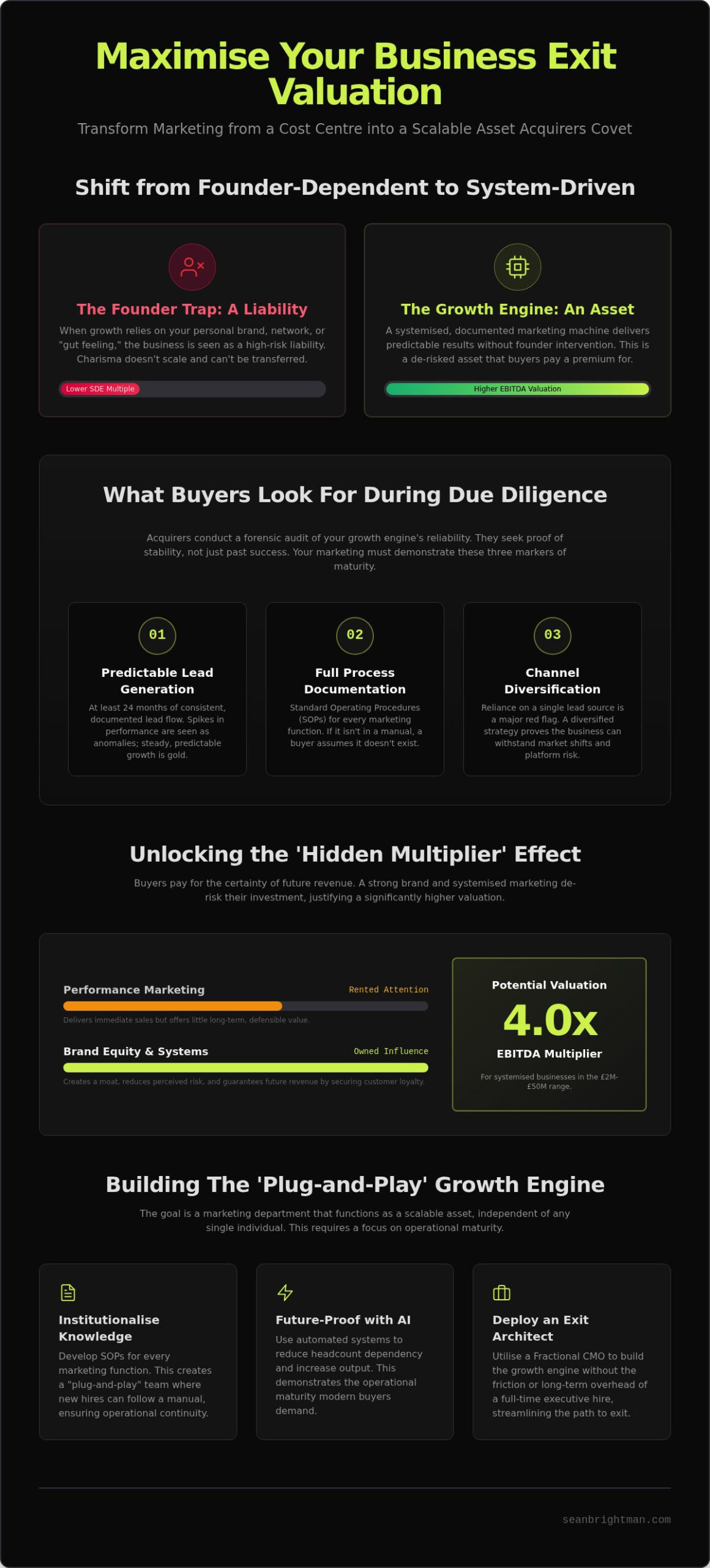
Manual marketing is a liability. In 2026, buyers will discount businesses that rely on legacy, human-heavy processes. They want lean, automated growth engines. If your marketing requires a small army to maintain, you’re carrying unnecessary overhead that eats into your EBITDA. A modern marketing strategy for business exit must prove that growth is decoupled from headcount. AI isn’t a novelty; it’s the mechanical advantage that makes your business a premium asset. Manual is a liability; AI-powered is an asset.
Efficiency is the new currency of M&A. With 88% of marketers reporting daily AI tool usage in 2026, buyers expect your systems to be automated. Implementing AI growth engines allows you to increase output whilst slashing operational costs. This isn’t about replacing every human; it’s about making every human ten times more productive. Buyers want this operational maturity. They want to see that your lead generation and nurturing systems are built on scalable tech, not fragile manual workflows. Moving from tool fatigue to functional systems is the primary goal of AI consulting during the exit preparation phase.
Buyers scrutinise your margins. AI reduces the cost of content production and customer service, turning high-cost activities into low-cost background processes. Automated lead scoring is another critical value-add. It proves to the buyer that you know your best customers and how to find more of them without human guesswork. By integrating these tools into your marketing roadmap, you demonstrate a level of sophistication that justifies a higher multiplier. You’re selling a future-proofed machine, not a relic.
Data is the fuel for your growth engine. However, messy data is a friction point in due diligence. Use AI to clean and segment your customer database before the sale process begins. In a world of commoditised AI tools, your proprietary data is your most valuable asset. It’s the unique intelligence that your competitors can’t buy. Document your AI workflows as part of your standard operations. This transparency gives buyers the confidence that they can take the keys and maintain momentum from day one. A data-driven marketing strategy for business exit ensures your valuation reflects your true potential.
If you want to build a growth engine that buyers covet, you need to audit your current systems for AI readiness. Start your transition today with AI consulting to de-risk your exit and maximise your sale price.
Hiring a full-time CMO 12 months before an exit is a tactical blunder. It’s expensive, slow, and creates unnecessary friction. Buyers don’t want to inherit a massive executive salary they might not need post-acquisition. A fractional CMO acts as an objective “Exit Architect” instead. They build the engine, document the manual, and prepare to hand over the keys. This is about strategic velocity, not long-term payroll. You’re buying the results, not the headcount.
An Advisory Retainer provides senior-level oversight without the baggage of a traditional employment contract. It allows you to maintain strategic velocity whilst you’re buried in the legal and financial grind of a sale. The core of your marketing strategy for business exit is to make the transition invisible to the customer but obvious to the buyer. You need a leader who can manage the transition to the new owner’s team without ego-driven friction. They ensure the machine keeps humming whilst the ownership changes hands.
Ego kills deals. Systems close them. A full-time executive often fears for their role post-acquisition, which can lead to defensive behaviour during due diligence. A fractional leader has no such conflict. They aren’t fighting for their job; they’re fighting for the sale. This objectivity allows them to maintain team morale and high-level accountability during the high-stress exit period. They act as the objective bridge between your founder’s vision and the buyer’s pragmatic requirements. They’re there to finish the job, not to nest.
Preparation beats luck. Your 90-day roadmap starts with a radical audit of your current systems. You then move to positioning your brand as a category leader and systemising every lead-gen workflow. The final step is creating a “marketing data room.” This is a curated repository of your SOPs, AI workflows, and performance data. It makes the due diligence process frictionless and proves you’ve built a growth engine, not just a business. It’s the ultimate proof of operational maturity. To ensure every element of this roadmap is aligned to your exit goals, follow a structured marketing strategy roadmap that drives exit-ready growth rather than a disconnected list of tactics.
Ready to build an engine that buyers covet? Start with a Strategic Brand Roadmapping session to define your marketing strategy for business exit and maximise your enterprise value.
A successful exit isn’t an accident. It’s the result of deliberate engineering. Your marketing strategy for business exit isn’t a final polish; it’s a structural overhaul. You must replace founder-dependency with systemised accountability. Buyers want systems, not charisma. They want predictability, not luck. By implementing AI-powered growth engines and documenting every SOP, you transform a fragile cost centre into a de-risked asset that commands a premium multiplier. Don’t leave your valuation to chance by clinging to legacy processes.
Stop fighting the “Founder Trap” alone. I am a Fractional CMO for UK tech scale-ups and the author of ‘The Book’ on marketing strategy. I specialise in building the AI-powered growth engines that acquirers covet. Whether you’re 12 or 36 months from a sale, the time to de-risk your operations is now. Build your exit-ready growth engine with Sean Brightman and turn your business into the most attractive deal on the market. You’ve done the hard work of building the company. Now, it’s time to ensure you get paid what it’s truly worth.
A marketing strategy for business exit is a systemised framework designed to de-risk your growth and prove to buyers that revenue is predictable. It isn’t about short-term campaigns. It’s about building a documented “Growth Engine” that functions independently of the founder. You’re moving from ad-hoc tactics to a scalable asset that lives on the balance sheet and justifies a higher valuation multiplier during due diligence.
You should start systemising your marketing at least 18 to 24 months before your target exit date. Buyers look for at least two years of consistent, data-backed performance to verify that your lead generation isn’t a fluke. Starting early allows you to identify technical debt, clean your customer data, and prove that your acquisition costs are stable. Waiting until the sale process begins is a tactical error that leads to lower offers.
Brand awareness increases valuation by acting as a financial de-risking tool. Whilst performance marketing buys immediate sales, a strong brand secures future revenue through customer loyalty and category leadership. Strategic buyers pay a premium for “moats” that competitors can’t easily cross. If your brand is the default choice in your niche, the buyer sees less risk and more certainty, which directly pushes your EBITDA multiplier higher.
You absolutely can prepare for an exit without a full-time CMO; in fact, hiring a permanent executive 12 months before a sale is often a mistake. A fractional CMO provides the same senior-level architecture without the long-term overhead or exit friction. They act as an objective “Exit Architect,” focusing on building a “Plug-and-Play” system that the buyer’s team can easily inherit. This model keeps your operations lean and your margins high.
Buyers focus on Customer Acquisition Cost (CAC), Lifetime Value (LTV), and the predictability of your lead-to-close ratios. They want to see that your marketing spend has a clear, documented ROI over a sustained period. Beyond the numbers, they’ll audit your “marketing data room” for documented SOPs and evidence of channel diversification. If all your leads come from one source, they’ll discount the business due to platform risk.
AI integration boosts your valuation by proving your business is lean and future-proofed. In 2026, buyers discount companies that rely on manual, human-heavy marketing processes that eat into margins. An AI-powered growth engine shows that you can increase output whilst reducing headcount. It demonstrates operational maturity and suggests that the new owner can scale the business with less friction and lower overhead than a legacy competitor.
A consultant is superior for exit preparation because they focus on the architecture and valuation, whereas agencies focus on execution and spending. You need a strategist to build the “Growth Engine” and document the systems that a buyer will actually purchase. An agency might deliver great ads, but a consultant ensures those ads are part of a de-risked, systemised asset that survives the founder’s departure.
You de-risk a founder-led brand by institutionalising your knowledge into documented SOPs and AI-driven workflows. Your marketing strategy for business exit must pivot the narrative from your personal charisma to the company’s proprietary methodology. Start by removing yourself from daily approvals and customer interactions. If the machine keeps humming when you take a month off, the buyer will believe it can survive without you.
Reading is good. A roadmap is better.