

Your marketing plan shouldn’t be a document you write once and ignore. A practical marketing planning process for SMEs is a short decision cycle: set priorities, take action, check the evidence and adjust. It’s not another list of tactics to squeeze into an already packed week.
If your marketing feels scattered or reactive, you’re not short of ideas. You need a clearer link between what the business wants to achieve and what your team can realistically deliver. With limited time and budget, trying to reach everyone on every channel can quickly waste effort.
This guide will help you build a focused plan your small business can execute, measure and adapt. You’ll connect marketing priorities to commercial goals, choose the audiences and channels that deserve attention, and turn decisions into practical actions with owners and measures. You’ll also set a review rhythm to help you spot what’s working, what isn’t and when to change course. The result isn’t a strategy that gathers dust. It’s a working plan your team can use to make better decisions week by week.
A marketing planning process for SMEs is a repeatable way to connect business goals with marketing choices, practical actions, clear ownership and regular reviews. It should help your team decide what to do, why it matters, who will do it and how you’ll judge progress. The output isn’t a polished document to file away. It’s a working set of decisions that can change when evidence or business priorities change.
The connection matters. If the business needs more repeat purchases, marketing priorities might focus on keeping in touch with existing customers. That choice should shape the activity, such as a planned email programme, and the measure, such as repeat enquiries or orders. A plan makes the reasoning visible, so activity isn’t mistaken for progress.
Keep the plan proportionate. A founder-led business with a long sales cycle has different capacity, customer relationships and measurement needs from a growing team selling directly online. Build around your sales model, available skills and current growth stage. Use enough structure to make decisions and follow through, not an enterprise-sized template that creates unnecessary admin.
Strategy sets direction: which audience to prioritise, how the business wants to be positioned and where it will focus. Marketing strategy provides useful context for that higher-level role. Planning turns those choices into work the team can carry out, with owners, resources, measures and review points.
For example, a small consultancy might focus on established businesses that need specialist advice. Its plan could assign someone to refine the website’s service pages, prepare useful email content and record relevant enquiries. Strategy says where to compete; the plan sets out the next steps.
Include the decisions and details your team needs to act, without copying a large organisation’s paperwork. A useful plan covers:
Keep the detail usable. If one person owns several tasks, make the workload realistic and the responsibilities clear. The right plan is one your team can understand, deliver and revisit.
Start with the business, not a brainstorm. A marketing planning process for SMEs should begin with the commercial result the business needs, then account for its capacity, constraints and evidence before selecting activity. Otherwise, it’s easy to create a busy plan that doesn’t solve the real problem.
Turn diagnosis into a planning priority by identifying the commercial outcome you need, the audience most likely to support it and a feasible marketing action you can measure.
Gather the information you can access: customer feedback, sales patterns, enquiries and results from existing channels. Look for useful signals. Are enquiries coming from the customers you want? Which routes appear to bring relevant prospects? Separate what you know from evidence and what you believe as an assumption to test.
A light-touch SWOT analysis can organise the discussion. Note strengths and weaknesses inside the business, then opportunities and threats in the market. Keep it grounded: a strength might be a clear specialist offer; a weakness could be limited time to create content. SWOT is a prompt for better questions, not proof of what customers want.
Use your diagnosis to work through these decisions:
For example, a specialist consultancy might aim to increase relevant enquiries from a defined client group by the end of a quarter. It could track qualified enquiries and their sources, measures the team can review and influence. Avoid objectives such as “post more” unless that activity clearly supports a business outcome.
If the diagnosis raises deeper questions about brand direction or market position, explore strategic brand roadmapping. A focused roadmapping engagement can help clarify choices when internal priorities remain unresolved.
Limited capacity makes prioritisation essential. The marketing planning process for SMEs shouldn’t try to cover every audience and platform. It should identify where the business can reach the right people, offer something relevant and learn whether its effort is working.
Compare potential audiences by their needs, fit with your offer, buying context and how reachable they are. Use customer conversations, sales patterns and enquiry details where available. If you don’t know what a group values or how it makes buying decisions, record that as a gap to investigate, not a fact.
Choose an initial audience narrowly enough to shape your message and channel choices. For example, “businesses that need advice” is too broad to guide much. A defined group with a shared need gives the team a clearer starting point without pretending other customers don’t matter.
Assess each channel against the same practical criteria. A simple table can show trade-offs without creating a false sense of precision.
| Criteria | Question to ask |
|---|---|
| Audience fit | Can you reach the priority audience there, in a context that suits your offer? |
| Evidence | Do customer feedback, enquiries or sales patterns suggest this channel is relevant? |
| Effort | What time and resources will it take to create and maintain useful activity? |
| Capability | Does someone have the skills and capacity to do it consistently? |
| Measurement access | Can you track a useful signal, such as relevant enquiries or customer responses? |
Channel suitability depends on audience behaviour and the business model. A consultancy with a considered buying journey may need a different mix from a retailer whose customers make quicker decisions. Don’t choose a channel just because it’s popular or sounds attractive. Choose it because there’s a reason to believe your audience is there and your team can sustain the work.
Separate established activity from experiments. Protect activity supported by evidence, then set aside realistic capacity to test one new idea at a time. Define what you’ll learn and when you’ll review it. If processes and systems are the main bottleneck, explore marketing operations planning. If priorities or accountability remain difficult to resolve, senior marketing advisory support may help clarify the next move. Learn more at Sean Brightman’s marketing advisory support.
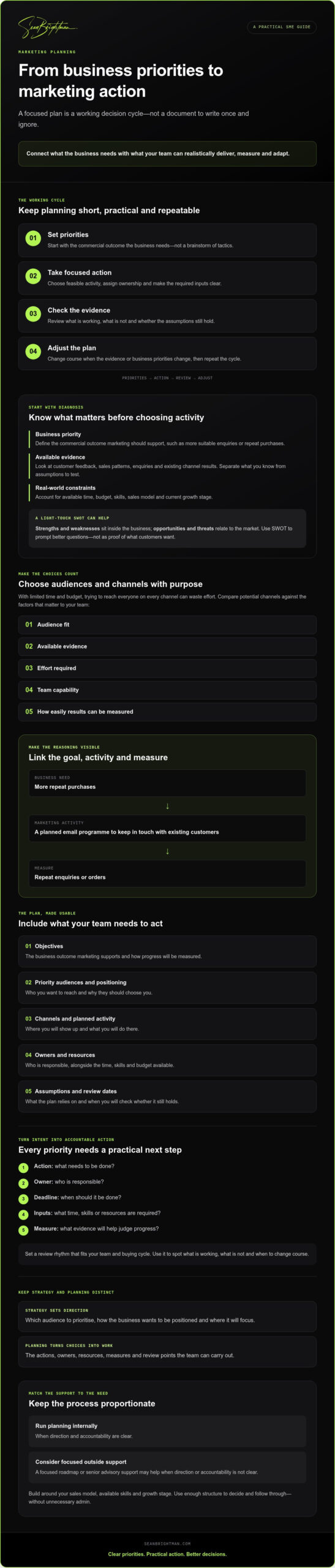
A plan earns its place when someone acts on it. Turn each priority into a task with a named owner, deadline and required inputs. “Improve the website” is too vague. “Update the service page to answer the three questions sales hears most often” gives someone a clear task and a reason to do it.
Keep the action list manageable. For each task, record:
The right review rhythm depends on your team and buying cycle. A business with a short sales cycle may be able to assess useful signals more often than one where decisions take longer. Set check-ins that give the team time to act and allow evidence to emerge. Don’t change course just because a task hasn’t produced an immediate sale.
Choose a small set of measures tied to your objectives. Where the data supports it, pair leading indicators, such as relevant enquiries or responses to an email, with commercial outcomes, such as qualified opportunities or sales. Activity counts can help you diagnose progress, but they aren’t results by themselves.
Useful progress measures show whether marketing is moving a business outcome closer, not simply whether the team has stayed busy.
Google Analytics 4 or a CRM can help, provided tracking is configured appropriately and the team knows what each measure means. If the data is incomplete, say so. A clear limitation is more useful than false certainty.
At each review, check three things: did the planned actions happen, what evidence emerged and which assumptions have changed? If an action stalled, find out whether the cause was lack of capacity, a missing input or a weak priority. If the business context or customer evidence has shifted, adjust the plan deliberately.
Record what changed and why. That gives the team a learning trail, rather than forcing it to start from scratch whenever results disappoint. The marketing team accountability page offers a related perspective on keeping attention on results, not activity.
If priorities or ownership keep slipping despite a clear plan, explore senior marketing advisory support as an option for adding strategic direction and accountability.
You don’t need a consultant just to write a plan. If the owner or marketing lead can access useful business evidence, make decisions and keep actions moving, the team can run the process internally. Outside support becomes relevant when the same issues keep blocking progress: priorities conflict, nobody clearly owns decisions, or the business can’t agree which audience or direction to back.
Before seeking input, write down the specific questions you can’t resolve. For example:
This turns “we need help with marketing” into a defined need. It also makes it easier to decide whether you need one-off direction or continuing support.
Yes. A capable owner or marketing lead can start with accessible sales, enquiry and customer information, then build a proportionate plan around the team’s capacity. Keep assumptions visible and review them as you learn. If decisions remain stuck or actions repeatedly lose ownership, the issue may be less about the template and more about direction, authority or accountability.
A Fractional CMO or marketing adviser can provide senior strategic direction, help focus priorities and support accountability without implying a full-time appointment. A focused, one-off roadmap may suit a business that needs clearer direction; an advisory retainer may fit when leaders want ongoing strategic input. This is strategic guidance, not recruitment or outsourced advertising execution.
Use this simple decision test:
The marketing planning process for SMEs should stay with the business, even when an adviser contributes. Your team still owns the decisions and delivery. For more detail on continuing strategic support, read the marketing advisory retainer guide.
If unresolved priorities or ownership are slowing your planning, discuss strategic marketing support with Sean Brightman.
A useful marketing planning process for SMEs turns commercial priorities into focused choices, owned actions and regular decisions about what to keep or change. Start with evidence, choose audiences and channels your team can realistically serve, then track measures that connect activity to business outcomes.
The plan doesn’t need to be elaborate. It needs to help your team act consistently and learn from what happens. If direction or accountability remains unclear, the right support can help you move forward without handing over ownership of the business’s decisions.
Sean Brightman offers senior Fractional CMO leadership and ongoing advisory support. If you need clearer direction before committing to continuing advice, one-off strategic roadmapping is also available.
Get clear strategic direction for your marketing plan, then put the next practical step on the calendar. You don’t need to do everything at once. Start with a priority your team can act on, measure and improve.
The marketing planning process for SMEs starts with the business context, then uses evidence to choose audiences, objectives and marketing activity. First, clarify the commercial priority and constraints. Review sales, enquiries, customer feedback and existing channel results where available. Choose a priority audience, set a measurable objective and select activity the team can deliver. Record assumptions, name owners and agree how you’ll review progress and adjust the plan.
Review your marketing plan often enough to spot problems and make decisions, but don’t force a universal timetable. The right rhythm depends on your team’s capacity, the type of activity and how long customers take to decide. Check whether planned work is happening, then assess results when enough evidence is available. Revisit the overall direction when business priorities, customer needs or available resources change.
An SME marketing plan should connect a business objective to clear marketing choices and accountable work. Include the outcome and timeframe, priority audiences, positioning, selected channels and planned activity. Name an owner for each action, note the resources and skills required, and choose measures that relate to the objective. Record important assumptions and set review dates. Keep the document lean enough for the team to use and update.
There’s no single marketing budget that suits every SME. Start with the business objective, the resources available and the cost of delivering the activity you’ve chosen. Separate planned spend from internal time, and consider whether the expected value justifies both. Set a limit the business can sustain, then track spend alongside relevant outcomes. Avoid choosing a budget solely by copying a percentage or figure that doesn’t fit your business model.
The best channel is one that fits your audience, buying journey, offer and team capacity. A business may use search to reach people actively looking for a solution, whilst another may rely more on referrals, email or social media to build relationships. Compare options by audience fit, available evidence, effort, team capability and access to useful measures. Start with a manageable shortlist, then test and review rather than trying to appear everywhere.
Yes. An owner or marketing lead can build a practical plan using accessible sales information, customer feedback and enquiry patterns. Start with a clear commercial priority, document what you know and mark assumptions that need testing. Outside help may be useful if priorities keep clashing, nobody owns decisions or the business can’t resolve its audience and positioning. Write down the unanswered questions first so any support can focus on the real gaps.
A marketing strategy sets direction: which audience to prioritise, how to position the offer and where the business should focus. A marketing plan turns that direction into practical work, including channels, actions, owners, resources and measures. For example, a strategy might prioritise repeat business from existing customers; the plan would specify how the team will communicate with them and how it will assess whether that activity supports the objective.
Reading is good. A roadmap is better.