

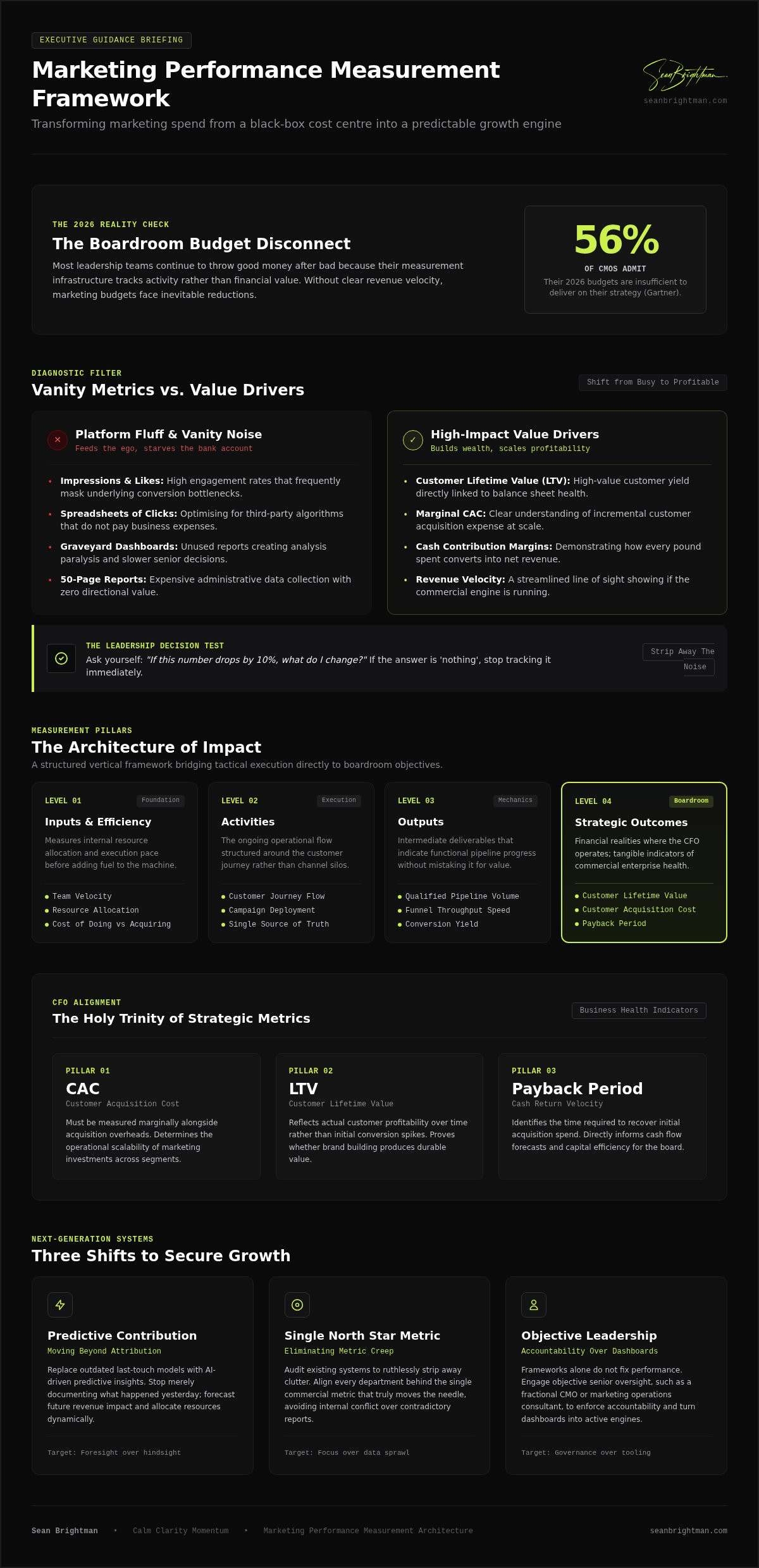
56% of CMOs admit their 2026 budgets are insufficient to deliver on their strategy. It’s a staggering figure from the latest Gartner data, yet most leaders continue to throw good money after bad because their marketing performance measurement framework is broken. You feel the squeeze. Marketing spend often looks like a black box to the board, and your current dashboard is likely a graveyard of vanity metrics. You have plenty of data but zero clarity on what actually moves the needle. It is frustrating. It is inefficient. It is a recipe for budget cuts.
You need a system that translates activity into outcomes. This guide shows you how to build a measurement framework that functions as a high-precision growth engine, not just a spreadsheet of clicks. We are talking about business value, not platform-reported fluff. You will learn how to create a clear line of sight from every pound spent to the revenue it generates. We will move your department from a messy cost centre to a structured system built on accountability and predictable results. It is time to stop guessing and start measuring what matters.
Most dashboards are a graveyard of dead data. They distract rather than direct. You don’t need more charts; you need a better marketing performance measurement framework. If your current report doesn’t trigger a specific action, it is noise. Plain and simple. Leaders fall into the ‘more is better’ trap. They are wrong. Data is cheap, but clarity is expensive.
In 2026, the volume of data available is overwhelming. More data usually leads to slower decisions amongst senior leadership. It creates a fog of analysis paralysis. Real leadership requires the ‘Decision Test’. Ask yourself: if this number drops by 10%, what do I change? If the answer is ‘nothing’, stop tracking it. You are wasting resources on a metric that has no pulse. Focus on movement, not just maintenance.
Stop tracking activity. Start measuring impact. There is a massive difference between a high engagement rate and a high Customer Lifetime Value (LTV). Likes and clicks are cheap. They feed the ego but starve the bank account. High engagement often masks a broken sales funnel. You might be ‘optimising for the algorithm’, but the algorithm doesn’t pay the bills. The customer does.
A robust modern marketing effectiveness measurement strategy focuses on business outcomes. It prioritises Marginal CAC and cash contribution margins. This is the shift from feeling busy to being profitable. It is the foundation of a scalable growth engine. You want a system that builds wealth, not just one that generates noise.
Complexity is the enemy of execution. When your tracking is too heavy, your marketing operations grind to a halt. You hit a point of diminishing returns. The cost of collecting data outweighs the value of the insight. Your board doesn’t want a 50-page report. They want a streamlined, senior-level view of revenue velocity. They need to know if the engine is running or if it’s stalled.
A streamlined marketing performance measurement framework removes the friction that keeps your team stuck in spreadsheets. Efficiency isn’t about seeing everything. It is about seeing the right things at the right time. Strip away the fluff. Build a system that gives you a clear line of sight from spend to revenue. Anything else is just expensive admin.
A marketing performance measurement framework isn’t a collection of spreadsheets. It is a bridge. It connects the daily grind of tactical activity to the high-level objectives in the boardroom. If your board doesn’t see how a campaign affects the bottom line, the campaign failed. You must translate marketing speak into financial value. This requires a structured architecture built on four distinct levels: Inputs, Activities, Outputs, and Outcomes.
Organise your framework around the customer journey. Don’t build it around channels. Channels are just pipes; the journey is the flow. When you measure by channel, you create silos. When you measure by journey, you create clarity. You also need a single source of truth. Internal debates over which data is ‘correct’ are a massive waste of time. Pick a source. Stick to it. Move on.
Efficiency is about how you use your resources. You need to track team velocity and resource allocation. It isn’t just about what you spend; it’s about how fast you move. A marketing operations consultant ensures these internal levers are tuned for performance. They help you distinguish the ‘cost of doing’ from the ‘cost of acquiring’. If your operational overhead is ballooning whilst your acquisition slows, you have a structural problem. Fix the machine before you add more fuel.
This is where the CFO lives. You need the holy trinity of metrics: Customer Acquisition Cost (CAC), Lifetime Value (LTV), and Payback Period. These aren’t marketing metrics; they are business health indicators. A full-funnel measurement framework links brand building to these hard numbers. It proves that brand equity isn’t just a ‘feeling’, it’s a financial asset that lowers CAC and increases LTV.
Ultimately, your marketing performance dictates your business exit valuation. High-growth engines with predictable returns are worth more than chaotic departments. If you want to increase the value of the firm, you must prove your marketing is a predictable revenue driver. For leaders looking to turn their messy department into a structured system, strategic roadmapping provides the necessary blueprint for growth.
Tracking is a rearview mirror. Contribution is the road ahead. In 2026, looking at what happened last month is no longer enough to justify your budget. You need to know what will happen next. Traditional attribution models have collapsed under the weight of signal loss and privacy regulations. A modern marketing performance measurement framework must shift from simple tracking to predictive contribution. It is about understanding the incremental value of every pound spent, not just documenting the final click.
AI models now bridge the gap between digital activity and the ‘dark social’ interactions that influence decisions behind closed doors. They measure the offline impact of your brand positioning that standard analytics miss. This isn’t a vague theory; it is a functional component of a modern growth engine. You are moving from manual reporting to an automated system that identifies growth opportunities in real-time. It is less about counting leads and more about forecasting revenue velocity.
Last-click is a lie. It credits the final touchpoint whilst ignoring the months of brand building that made the sale possible. If you optimise for the last click, you kill your long-term growth. You end up over-funding bottom-of-funnel tactics and starving the very activities that fill the funnel. It is a slow death for any brand. It rewards the order-taker and ignores the rainmaker.
Instead, leaders are turning to Marketing Mix Modelling (MMM) to gain a holistic view. This approach uses a marketing metrics road map to weigh multiple touchpoints without drowning in complexity. It provides the ‘ground truth’ that platform-reported data lacks. You see the whole machine, not just the last gear to turn. This is the difference between counting clicks and measuring commercial momentum.
Forecasting is the new accountability. AI allows you to predict revenue based on current lead velocity and market trends. You can spot the early warning signs of campaign fatigue weeks before the budget is wasted. This isn’t just about data; it’s about survival. If a campaign is stalling, the system should tell you before the CFO asks why. You need a dashboard that acts as an early warning system, not a historical archive.
Strategic AI consulting helps you build these predictive models into your daily operations. It enables real-time budget reallocation. You move money from failing channels to high-performing ones instantly. You aren’t just measuring the engine; you are tuning it whilst it runs. This is how you transform marketing from an abstract expense into a predictable, high-impact revenue driver.
Building a marketing performance measurement framework isn’t about buying a new tool. It is about stripping away the rot. You cannot build a high-performance engine on a swamp of bad data. Most leaders start with the ‘how’ before they define the ‘what’. This is a mistake. Follow a clinical, step-by-step process to move from a messy department to a structured system.
Step 1: Audit your current data. Most marketing teams are drowning in redundant tools and broken tracking pixels. Step 2: Define your North Star Metric. This is the one number that matters most to the board, usually linked to margin or revenue velocity. Step 3: Map the customer journey. Identify critical ‘value-exchange’ points where a prospect trades their attention or data for your expertise. Step 4: Select your tech stack based on strategy, not the other way around. Step 5: Establish a rhythm of accountability through regular advisory reviews. This is where the framework becomes a leadership tool.
Most CRMs are a disaster zone. You likely have redundant tools doing the same job and broken pixels sending false signals to your ad platforms. Identifying these leaks is your first priority. Data hygiene is the bedrock of a scalable growth engine that turns marketing spend into predictable revenue. If your data is garbage, your attribution is a fantasy. Clean the CRM to ensure your framework actually reflects reality. Stop guessing and start fixing the pipes.
Discipline is the difference between a dashboard and a decision. You need a split cadence. Use weekly tactical checks to keep the team on track. Use monthly strategic sessions to look at the big picture. A marketing advisory retainer provides the external pressure needed to maintain this discipline. It keeps the framework from becoming another forgotten spreadsheet.
When you present to the board, kill the 50-slide deck. They don’t want a data dump; they want clarity. Show them the line of sight from spend to revenue. Focus on the outcomes, not the activities. If you are ready to stop tracking noise and start driving value, build your strategic roadmap today. It is the only way to ensure your marketing performance measurement framework actually drives the business forward instead of just documenting its stagnation.
A marketing performance measurement framework is only as good as the person wielding it. Data doesn’t make decisions; leaders do. If you have a dashboard but no one is held accountable for the numbers, you have an expensive hobby, not a business strategy. You need a senior voice to interpret the signals and pull the levers. This is about moving from a culture of ‘doing things’ to a culture of ‘achieving things’. Dashboards are passive. Leadership is active.
The mental shift is simple but profound. You must transition from viewing marketing as a cost centre to treating it as a profit engine. In a cost centre, you look for ways to spend less. In a profit engine, you look for ways to invest more for a higher return. Every pound spent is a strategic investment in the firm’s future valuation. If you cannot prove the return, you aren’t investing; you are gambling. A robust framework provides the proof you need to justify every penny to the board.
Objectivity is the primary asset of an external leader. A fractional CMO has no interest in hiding poor results or protecting legacy projects. They are there to fix the machine, not to play office politics. They bring battle-hardened expertise from multiple successful scale-ups, allowing you to bypass the expensive learning curve that stalls most internal teams. You get senior-level authority and a proven marketing performance measurement framework without the £150,000 plus overhead of a full-time hire. It is a plug-and-play solution for strategic accountability.
The transition from a messy department to a structured profit engine happens in stages. It begins with a strategic brand roadmapping session to define your North Star and audit the existing data rot. The first 90 days are critical. You move from no framework to a predictable system by cleaning the CRM, fixing the tracking pixels, and establishing a rigid reporting cadence. By the end of three months, your marketing spend is no longer a black box. It is a clear line of sight to revenue growth.
Accountability is not about blame. It is about clarity and velocity. When everyone knows exactly how their work contributes to the bottom line, the team moves faster and with more purpose. You stop chasing vanity metrics and start chasing business value. Ready to fix your measurement and build a scalable growth engine? Book a roadmapping session with Sean Brightman today. Stop measuring noise and start driving results.
Your marketing spend shouldn’t be a black box. You have seen how a robust marketing performance measurement framework transforms a messy department into a structured, high-impact system. It is about replacing vanity metrics with business outcomes like LTV and CAC. It is about using AI to predict contribution instead of just tracking the past. Most importantly, it is about leadership. A framework without accountability is just a spreadsheet. You need a battle-hardened expert to enforce the discipline that drives growth.
Sean Brightman provides the Fractional CMO expertise and direct strategic advice needed to build an AI-powered growth engine that actually delivers. We strip away the corporate fluff to focus on what moves the needle. Stop measuring noise. Start driving value. It is time to treat your marketing as a profit engine, not a cost centre. Book a Strategic Roadmapping Session with Sean Brightman and turn your marketing into a predictable revenue driver. You have the tools. Now you need the execution.
A marketing performance measurement framework is a structured system that connects tactical activities directly to commercial business value. It is the machinery that translates marketing spend into revenue growth. Unlike a static report, it provides a clear line of sight from every pound spent to the financial outcome it generates. This framework ensures your team focuses on high-impact work instead of getting lost in the noise of vanity metrics.
You choose the right KPIs by working backwards from your board-level objectives. If a metric doesn’t influence a commercial decision, it doesn’t belong in your framework. Focus on outcomes like Customer Acquisition Cost (CAC), Lifetime Value (LTV), and cash contribution margins. Stop tracking activity for the sake of feeling busy. Your framework should prioritise metrics that prove marketing is a profit engine, not just a department that spends money.
Yes, a structured framework is even more critical for small teams with limited resources. It prevents you from wasting time on low-yield activities that don’t move the needle. By defining a clear North Star Metric, a small team can operate with the precision of a much larger department. It is about efficiency, not headcount. A well-built system ensures every hour and every pound is invested where it generates the most impact.
AI is essential in 2026 due to pervasive signal loss and the collapse of traditional tracking. You need AI-driven Marketing Mix Modelling (MMM) to bridge the gaps that standard analytics miss. It moves your measurement from backward-looking tracking to predictive contribution. Without AI consulting to build these growth engines, you are essentially flying blind. It allows you to forecast revenue velocity and identify campaign fatigue before you waste your budget.
You should review your performance on a split cadence. Tactical checks happen weekly to keep execution on track. Strategic reviews should occur monthly to ensure you are still aligned with commercial goals. Many leaders use an advisory retainer to maintain this discipline. Regular reviews prevent your reporting from becoming a forgotten spreadsheet. It keeps your strategy agile and ensures you reallocate budget to the highest-performing channels.
A dashboard is a passive historical archive; a marketing performance measurement framework is an active leadership tool. Dashboards tell you what happened in the past, often through a lens of vanity metrics like clicks or impressions. A framework tells you what to do next to drive business value. It includes the logic, the accountability, and the decision-making process required to turn data into growth. One is a report; the other is a functional component of your strategy.
The cost depends on the complexity of your current data rot and the scale of your operations. However, the real question is the cost of operating without one. Most businesses waste a significant percentage of their budget on activities that don’t drive revenue. Implementing a professional system is a strategic investment in your firm’s valuation. It is far cheaper to fix your measurement than to continue throwing good money after bad in a black box.
Your current model is likely failing because platforms like Google and Meta each over-claim credit for the same conversion. This deterministic tracking has collapsed under privacy regulations and signal loss. You are seeing a fragmented view of the customer journey. Moving to a holistic measurement framework resolves this by using incrementality testing and MMM. It provides a single source of truth that cuts through the conflicting data provided by individual ad platforms.
Reading is good. A roadmap is better.