
Why is your marketing team working harder than ever whilst your growth remains stagnant? It is a blunt question, but the answer usually isn’t a lack of effort; it is a systems failure. You’re likely paying a “Manual Tax” every day through disconnected tools, messy data, and expensive guesswork. Bringing in a marketing operations consultant isn’t about adding more software. It’s about fixing the broken machinery that is currently eating your budget. Most businesses treat marketing like an art project when they should be treating it like a precision engine.
You probably feel the friction every time you try to pull a report or justify a budget increase. You have a mar-tech stack that nobody uses and your decision-making relies on gut feeling rather than hard numbers. This article will show you how to stop the guessing and start scaling. We’ll explore how to build a repeatable system, get clear on AI implementation, and secure senior leadership without the £150,000 full-time salary. We’re going to strip away the fluff and build a growth engine that actually works for the 2026 market.
Marketing isn’t a creative brainstorm. It’s a logistical challenge. Most leaders think they have a “brand” problem or a “creative” problem. They don’t. They have a machinery problem. Think of a marketing operations consultant as the architect of your growth factory. If the factory floor is a mess, it doesn’t matter how good the product design is. Nothing gets shipped. Strategy without operations is just a hallucination. You need the pipes to work before you turn on the tap.
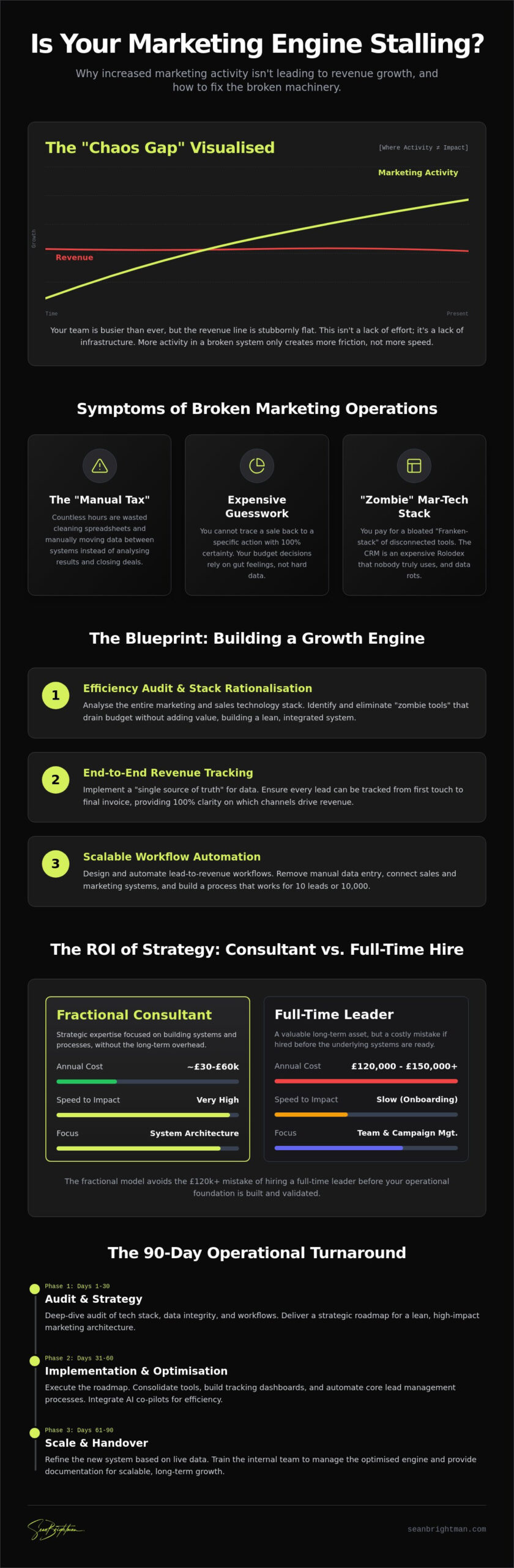
We see it constantly: the “Chaos Gap.” This is the point where your team is busier than ever. Activity is up; impact is down. They’re posting more. They’re sending more emails. They’re spending more on ads. Yet, the revenue line remains stubbornly flat. This isn’t a lack of effort. It’s a lack of infrastructure. You’re trying to drive a Ferrari with a lawnmower engine. More activity in a broken system only creates more friction, not more speed.
Stop asking for “more leads.” It’s the ultimate marketing myth. More leads are often just a distraction from a fundamental conversion failure. If your tracking is broken and your lead-to-revenue funnel is a sieve, more leads just means more wasted budget. You don’t need more fuel; you need to fix the holes in the tank. A solid operational foundation ensures that every pound spent is a pound tracked and every lead generated is a lead nurtured.
You can’t see which pound is actually working. If you can’t trace a sale back to a specific action with 100% certainty, you’re just gambling with the company’s future. Then there’s the tool fatigue. You’re likely paying for a CRM that your sales team treats like an expensive, digital Rolodex. It sits there, gathering dust, whilst your data rots. Finally, there’s the accountability vacuum. Everyone owns the “creative vision,” but nobody owns the actual growth numbers. This lack of ownership leads to the “Manual Tax”-wasted hours spent cleaning spreadsheets instead of closing deals.
Strategy is the map. Operations is the engine. You can have the most beautiful map in the world, but you aren’t going anywhere if the engine is seized. This is where Marketing management often falls apart in mid-sized UK firms. They hire an agency to “do the marketing,” but they have no internal operational lead to manage the flow of data and leads.
Agencies are great at specific tasks. They are terrible at owning your internal systems. Without a marketing operations consultant to bridge that gap, you’re just paying for activity, not outcomes. In the competitive 2026 market, “winging it” is an expensive hobby. You need a system that works whilst you sleep, turning strategy into a repeatable, mechanical process that delivers predictable revenue. It is about building a system that survives the departure of any single team member.
A marketing operations consultant is a plumber for your revenue. They don’t care about the colour of your logo. They care about the integrity of your data. The first step is always the audit. Most UK businesses are paying for a “Franken-stack” of tools that don’t talk to each other. We identify the tools that actually drive value and kill the “zombie tools” that just drain the budget. It is about building a lean, lethal machine, not a bloated collection of subscriptions.
You need to know which channel is delivering. Not just “clicks” or “engagement”, but actual closed-won revenue. We implement tracking that follows a lead from the first touch to the final invoice. This is how you stop guessing and start scaling. It removes the friction between marketing activity and sales results. Lead-to-revenue workflows are the tracks your business runs on. If the tracks are crooked, the train crashes. We design these workflows to be scalable, ensuring they work just as well for ten leads as they do for ten thousand.
Your CRM, automation, and analytics must function as a single unit. It’s about building a single source of truth. Manual data entry is a failure of the system. We ensure that AI Liberates Marketing Operations by automating the data-heavy grunt work that usually slows teams down. If your sales and marketing data doesn’t flow automatically, your system is broken. We connect the pipes so you can focus on the strategy. If your current setup feels like a house of cards, it’s time to look at a proper operational roadmap to rebuild the foundation.
Speed is a competitive advantage. We standardise how campaigns are launched so quality never slips. A true growth engine functions independently of individual staff members. It’s a machine, not a personality-driven project. This removes the “accountability vacuum” and ensures that when a number drops, we know exactly which part of the machinery needs oiling. Organising the team for maximum output is not about adding more meetings; it is about removing them. Operational efficiency in marketing is the art of maximising revenue impact whilst minimising the manual labour required to achieve it.
Hiring a full-time CMO in 2026 is often a £120,000 mistake. Most UK scale-ups pull the trigger on a senior hire far too early. They hire a manager to oversee a department that doesn’t actually exist yet. You end up paying a six-figure salary for someone to sit in meetings and look at broken spreadsheets. It is a waste of capital and a waste of talent. You don’t need a full-time executive to manage the chaos; you need a marketing operations consultant to eliminate it.
There is a fundamental difference between an agency and a consultant. One owns the tasks; the other owns the machinery. Agencies are built to execute. They want to run your ads, write your copy, and design your graphics. They are external forces. A consultant is an internal architect. We don’t just “do marketing”; we build the system that makes marketing possible. It is the difference between buying a car and building a factory that produces cars.
The fractional model is the only logical choice for businesses in the growth phase. You get 100% of the senior expertise for roughly 25% of the cost of a full-time hire. This isn’t about saving pennies; it is about capital efficiency. You can redirect that saved £90,000 into your ad spend or product development whilst still having a battle-hardened expert at the helm. An advisory retainer provides the ongoing accountability that one-off projects lack. It ensures the machine stays oiled and the strategy stays on track.
Agencies are incentivised to spend your money, not necessarily to save it. Their business model relies on high activity and high billables. They rarely care if your CRM is a bin fire or if your sales team is ignoring leads. They are focused on their specific silo, not your internal operational health. Without a strategic buffer to manage them, agencies often end up marking their own homework. You need someone on the inside who understands the plumbing, not just the paintwork.
A Fractional CMO is a plug-and-play leader. They bring an immediate impact because they’ve seen your specific mess a dozen times before. They don’t need three months of “onboarding” to understand your business. Their focus is singular: building the machine. Whilst a full-time hire might get bogged down in internal politics and “busy work,” a fractional consultant is there to deliver results. It is high-impact leadership without the long-term baggage of a heavy executive salary. You aren’t just running ads; you are building a predictable revenue engine. Before you can scale that engine effectively, however, you must ensure your marketing team structure for scale-ups UK is designed for strategic velocity rather than bloated headcount.
AI in 2026 is not a writing tool. It is an operational layer. If your team is still using ChatGPT just to churn out generic blog posts, you are missing the revolution. A marketing operations consultant integrates AI into the structural layer of your business to eliminate the “Manual Tax” we discussed earlier. This is about building a system that thinks, predicts, and optimises without human intervention. We are moving from reactive marketing to proactive, automated growth engines.
The real value lies in predictive analytics. Instead of looking at last month’s failed campaign, AI allows us to forecast growth with surgical accuracy. By analysing funnel velocity and historical data, we can predict where your revenue will be in six months. It removes the finger-in-the-wind guesswork that plagues most UK boardrooms. Research shows that AI-driven campaigns can deliver a 22% higher ROI and 29% lower acquisition costs. These aren’t just numbers; they are the result of a machine that learns from every interaction.
Scaling personalisation usually requires scaling headcount. AI changes that. We implement systems that handle lead scoring and hyper-personalisation at a scale that was previously impossible. This reduces operational costs by automating repetitive marketing tasks that usually drain your team’s energy. However, we avoid “AI for AI’s sake.” Every tool in your stack must have a clear path to profit. If it doesn’t improve the bottom line or save significant time, it is just expensive novelty.
AI is a mirror. If your CRM is a bin fire, your AI will simply produce faster, more efficient mistakes. Data integrity is the prerequisite for automation. We spend the first part of any 90-day plan cleaning your systems and ensuring your data flows are airtight. You cannot automate decision-making if the underlying data is a mess. An AI Roadmap is the strategic blueprint that converts technological potential into measurable commercial profit by 2026. Without this roadmap, you are just buying more “zombie tools” that will eventually fail.
Stop playing with prompts and start building a real engine. If you want to see how this works in practice, book an AI consulting and roadmapping session to audit your current stack.
Fixing a broken department isn’t a weekend project. It is a systematic reconstruction. Most businesses fail because they try to solve every problem at once, resulting in zero progress. A marketing operations consultant brings a phased approach that turns chaos into a predictable growth engine. We don’t guess; we execute a 90-day turnaround designed to stop the bleeding and start the scaling. This is about building long-term stability, not chasing short-term hacks.
Sean Brightman’s advisory model is built for the long haul. It isn’t about delivering a report and walking away. It is about providing the senior-level guidance required to ensure the machine keeps running. You get the “battle-hardened expert” in your corner without the overhead of a full-time executive. It is high-impact, low-friction leadership that focuses on the bottom line.
Strategy is useless without accountability. Our advisory retainers provide monthly sessions to keep your growth engine on track. I act as a blunt sounding board for the CEO, helping you avoid expensive mistakes before they happen. It’s about ensuring your marketing team remains focused on the right numbers, not just vanity metrics. We provide the external pressure needed to maintain internal order. This is strategic oversight, not just tactical advice.
Don’t spend another penny on advertising until you have a map. A one-off roadmap session is the most efficient entry point for any business. We define your goals, audit your current mess, and draw a clear line to revenue. It is the quickest way to get clarity on your AI implementation and your operational future. Stop guessing and start building a system that actually delivers. If you are ready to fix the machinery, book a strategy roadmap session with Sean Brightman today. It is time to turn your marketing from a cost centre into a growth engine.
The choice for 2026 is binary. You can continue paying the “Manual Tax” on a broken system, or you can rebuild your department into a precision engine. We have established that activity without architecture is just expensive noise. By leveraging a marketing operations consultant, you move beyond tactical busywork and into a model where data integrity and AI-driven automation dictate your growth. Strategy is the map; operations is the fuel. Without both, you are stationary.
As the author of “The Book” on marketing strategy and a specialist in AI roadmapping, I have helped high-growth UK businesses replace chaos with accountability. You don’t need a bloated full-time salary to get senior-level results. You need a battle-hardened expert who can plug in, fix the machinery, and set a rhythm for repeatable success. The transition from a cost centre to a growth engine starts with a single decision to stop winging it.
Build your scalable growth engine-Book a call with Sean Brightman
Your future revenue is waiting for a better system. It is time to build it.
A marketing operations consultant acts as the architect of your growth engine. They spend their time auditing systems, cleaning data, and automating workflows to remove the “Manual Tax” from your department. Their goal is to ensure your strategy isn’t held back by broken pipes. They bridge the gap between high-level board goals and the tactical reality of your marketing technology stack.
One builds the engine; the other provides the fuel. A consultant focuses on your internal systems, strategy, and operational efficiency. An agency is typically an external force hired to execute specific tasks like running ads or creating content. You hire a consultant to ensure your internal machinery is ready to handle the leads an agency generates without wasting budget.
Hire a fractional leader when your marketing activity is high but your revenue remains flat. If you are spending significant budget on ads but cannot track the ROI with 100% certainty, you have a systems failure. A Fractional CMO provides the senior leadership needed to fix these issues without the £150,000 plus full-time salary and heavy PAYE commitment.
Yes, by treating AI as a structural necessity rather than a novelty tool. A marketing operations consultant builds a roadmap to integrate AI into your data processing, lead scoring, and predictive analytics. This moves your team away from manual grunt work and towards high-level strategy. It is about using AI to drive measurable profit, not just generating generic content.
The ROI is found in increased efficiency and reduced waste. Research indicates that AI-driven operations can deliver a 22% higher ROI and 29% lower acquisition costs by optimising funnel velocity. You also save the significant cost of a “bad hire” by building a repeatable system that functions independently of any single team member’s personal workflow.
No. A consultant exists to make your current team more lethal. We remove the repetitive, manual tasks that drain their energy and prevent them from doing their best work. By standardising processes and organising the team for maximum output, we free up your creative talent to focus on strategy. It is about better orchestration, not replacement.
The investment for an advisory retainer is tailored to the complexity of your systems and the speed of the required turnaround. It is designed to be a high-impact, lower-cost alternative to a full-time executive hire. You get senior expertise and ongoing accountability without the long-term baggage of a heavy salary or the recruitment fees of a traditional hire.
The first step is always the Efficiency Audit. We must find the hidden profit leaks and identify which “zombie tools” are draining your budget before we can rebuild. You cannot optimise a system if you don’t know where the friction is occurring. This audit provides the clinical data needed to design a scalable marketing team structure for UK scale-ups that actually works.
Reading is good. A roadmap is better.