
Your marketing team isn’t a support desk for the sales department, yet you’re likely treating it like one. Most CEOs are currently staring at bloated budgets and AI hype that produces nothing but tool fatigue and vague reports. You’ve realised that throwing more software at a broken strategy doesn’t fix the engine; it just makes the smoke more expensive. It’s time to stop paying for activity and start demanding architected growth.
You want a system that runs without your constant intervention and a team that understands how to blend brand authority with technical precision. I agree that the current corporate fluff is exhausting. This is why a marketing leadership consultant is no longer a luxury but a tactical necessity for 2026. You need a builder, not a cheerleader. You need someone to install a machine, not just manage the mess.
In this guide, you’ll discover how to replace messy manual processes with AI-powered machinery that actually scales. We’ll map out a clear, actionable strategy that turns your marketing function into a high-impact growth driver whilst removing the burden of daily oversight from your desk. It is time to move beyond the hype and start building for results.
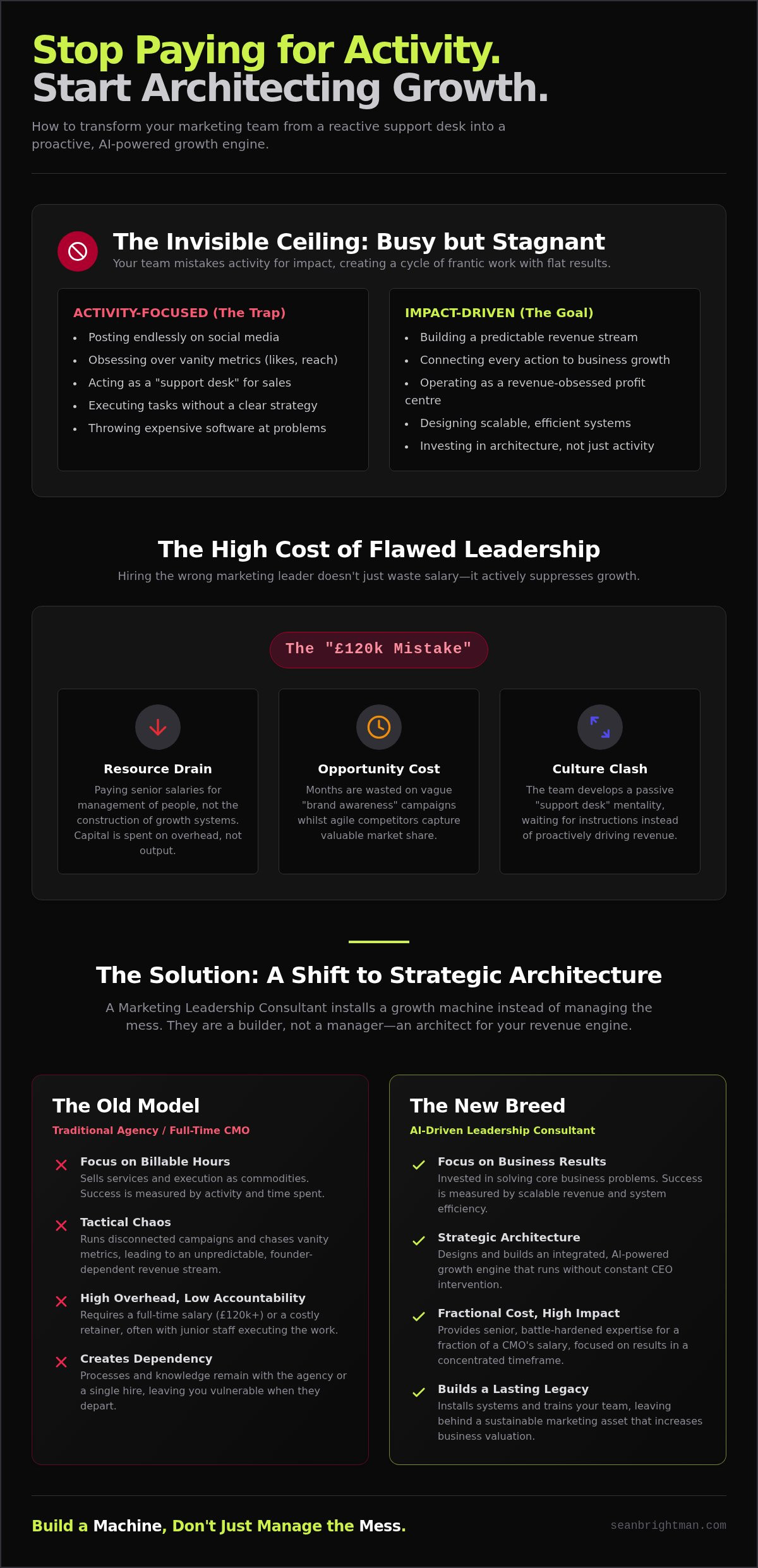
Your marketing team is likely exhausted. They are posting to LinkedIn, tweaking ad copy, and sending newsletters at a frantic pace. Yet, the needle isn’t moving. This is the invisible ceiling. It occurs when a business mistakes activity for impact. You don’t have a productivity problem; you have an architecture problem. Most founders fall into the “SME Trap”, hiring doers to execute tasks when they actually need a growth architect to design the machine.
Without a high-level marketing strategy, your team is simply throwing expensive spaghetti at the wall. They are acting as a support desk rather than a growth driver. This “Marketing Leadership Gap” doesn’t just drain your monthly budget; it actively suppresses your business valuation by creating an unpredictable, founder-dependent revenue stream. A marketing leadership consultant steps in to bridge this gap, replacing tactical chaos with strategic precision.
Tactics are cheap. Execution is a commodity. Fifty social posts a month won’t save a flawed brand position or a broken conversion funnel. If your team is obsessed with vanity metrics like “likes” or “reach” whilst revenue remains flat, you are witnessing a systemic failure. Marketing stagnation is a leadership failure, not a tactical one. It is the result of a team running without a map, led by “experts” who focus on the colour of the button rather than the mechanics of the sale.
Junior-heavy agencies exacerbate this. They are built to sell billable hours and specific services, not to solve your overarching business problems. They provide hands, not a brain. When you need senior leadership to navigate the complexities of 2026, a revolving door of junior account managers won’t cut it. You need a partner who understands how to build systems, not just run campaigns.
The “£120k mistake” is a common sight in scale-ups. Founders hire a full-time CMO, expecting a miracle, only to find they’ve bought a high-priced manager who wants a six-figure execution budget to match their salary. In a high-growth environment, this lack of accountability drains capital and demoralises the entire company. You need the expertise of a veteran without the permanent overhead or the corporate ego.
A marketing leadership consultant fixes the plumbing before you turn on the taps. They provide the decisive, battle-hardened authority required to turn a messy department into a functional growth engine. By focusing on architecture over activity, they ensure every pound spent is an investment in scalable revenue, not just another line item in a bloated budget.
The traditional business advisor is a relic. You don’t need someone to sit in a boardroom and nod whilst you explain your problems. You need a marketing leadership consultant who builds engines. This is the battle-hardened expert who combines high-level strategy with the technical grit required for 2026. They aren’t generalists; they are specialists in growth architecture. They arrive with a toolkit, not a clipboard.
This new breed operates on a plug-and-play basis. They integrate into your leadership team, identify the friction, and install the solutions. They provide senior authority without the £120k salary or the corporate ego. It is about maximum impact in a concentrated timeframe. You are buying the result, not the hours. You are investing in a partner who has seen the chaos before and knows exactly how to fix it.
In 2026, AI is no longer a novelty. It is the fuel for your growth machinery. A marketing leadership consultant moves your team beyond playing with chatbots and into scalable AI implementation. They focus on orchestration. This means building intelligent workflows that automate the mundane and amplify the creative. They understand that marketing leadership fundamentals must now include a deep grasp of technical systems.
The roadmap to an AI-integrated department isn’t about buying more software. It is about organising your data and your people around a new reality. A consultant ensures your AI strategy serves your business goals, not the other way around. They turn tool fatigue into operational efficiency. If you want to see how this looks in practice, you might consider an AI consulting deep dive to audit your current stack.
Velocity is the only metric that matters in a scale-up. Hiring a full-time CMO often slows you down with bureaucracy and long-term onboarding. Choosing fractional cmo services is a strategic play for speed. You get the expertise of a veteran on a part-time basis. This provides more directional clarity than a mid-level full-timer ever could.
An advisory retainer keeps the engine tuned. It ensures that as you grow, your strategy remains sharp and your team stays focused on revenue. This isn’t a budget cut. It is an investment in senior-level precision that drives a higher ROI than a traditional hire. It is about getting the right brain at the right time.
Agencies are built to sell services. Consultants are built to solve problems. This is the brutal reality most founders ignore whilst their marketing budgets evaporate. If you ask an agency for a strategy, they will inevitably suggest the one thing they happen to sell: more ad spend, more content, or more social management. It’s a fundamental conflict of interest. They are execution machines, not strategic architects.
A marketing leadership consultant sits above the fray. They don’t have a team of junior designers to keep busy or a monthly retainer to protect through upsells. Their only loyalty is to your bottom line. They provide the objective scrutiny required to turn a cost centre into a profit engine. You don’t need more “creative”; you need accountability. You need a leader who manages the machine, not just the creative output.
Letting an execution-focused team dictate your brand direction is a recipe for stagnation. They focus on the “how” before you’ve even settled the “why”. This is particularly dangerous if you’re eyeing the door. A marketing strategy consultant is essential for business exit preparation because buyers don’t pay for pretty logos. They pay for predictable, scalable growth machinery that doesn’t break when the current agency leaves.
An external, unbiased perspective is your best defence against groupthink. It’s about seeing the friction your internal team has become blind to. The consultant identifies the structural rot that no amount of fancy ad copy can fix. Strategy is about making hard choices. Agencies rarely make the choice to tell you to stop spending money on their services. They are contractors; you need an architect.
Most agencies operate in a vacuum. They send monthly reports filled with green arrows that don’t correlate to your bank balance. A leadership consultant acts as your internal enforcer. They audit agency output, challenge their assumptions, and ensure every pound spent is an investment in your growth machinery. It is about architecting systems, not just buying ads.
Stop being a “good client” who pays bills without question. Start being a leader who demands results. By positioning a marketing leadership consultant between your business and your agency, you ensure that execution always follows architecture. You get the hands you need, directed by the brain you’ve been missing. It is the difference between buying a service and building an asset.
Most marketing departments are black boxes. Money goes in; activity comes out; revenue remains a lucky byproduct. If you want to scale in 2026, you cannot afford to guess. You need a clinical assessment of your current engine. A marketing leadership consultant doesn’t care about your team’s intentions; they care about your friction. They look for the grit in the gears that is slowing down your customer acquisition.
The audit is a diagnostic tool designed to strip away the corporate fluff. It is about identifying what is broken before you try to build on top of it. We look at the data, the people, and the processes to find where your budget is being incinerated. This isn’t a performance review; it’s an architectural inspection.
Your marketing operations consultant starts with the plumbing, not the paint. There is no point in driving more traffic if your lead-scoring system is broken or your CRM is a graveyard of unorganised data. We find hidden profit by removing the tactical friction that prevents your team from executing at speed. Efficiency in 2026 is measured by the ratio of automated output to manual intervention within your revenue-generating workflows.
By fixing the operational foundation, we ensure that every future pound spent on marketing actually has a chance to convert. It’s about building a machine that can handle scale without breaking. If you are ready to stop the bleeding, book a roadmapping session today to identify your biggest operational leaks.
A brand without a roadmap is just a series of expensive accidents. We define a clear direction for the next 12 to 24 months to ensure your team stays focused on the long-term prize. Effective strategic brand roadmapping prevents “shiny object syndrome” by giving you a filter for every new tool or trend that hits the market.
This roadmap aligns your marketing leadership with your ultimate goals, whether that is a business exit or aggressive expansion. It ensures everyone is pulling in the same direction. We build a sustainable legacy by establishing a culture of results that survives long after the consultant has finished their work. It is about moving from chaos to a calculated growth strategy.
The ultimate goal of a marketing leadership consultant isn’t to occupy a permanent seat at your boardroom table. It is to make themselves redundant. Success is measured by the strength of the systems left behind, not the length of the contract. You are investing in an architect to build a machine, not a handyman to keep patching the leaks. This is about creating a legacy of predictable growth that survives long after the initial engagement ends.
We replace the “support desk” culture with a culture of accountability. Marketing should be a profit centre, not a black hole for budget. By establishing clear reporting structures and results-based KPIs, we ensure your team knows exactly what is expected of them. You move from a state of “hoping it works” to a state of “knowing why it does”. This shift in behaviour is what separates stagnant SMEs from scalable enterprises.
If you are planning a business exit, this architectural approach is mandatory. Buyers don’t pay for “brand vibes” or a marketing manager with a “magic touch”. They pay for a documented, high-impact growth engine. Proving that your marketing is a system, not a person, significantly increases your business valuation. It turns your marketing department into a tangible asset rather than a monthly liability.
Once the growth engine is built, it requires regular maintenance to maintain peak performance. An advisory retainer ensures long-term strategic velocity. These monthly sessions keep the roadmap on track and the team focused on revenue. I act as the straight-shooting partner for the CEO, providing the blunt honesty required to navigate the complexities of 2026.
This model is built on high-level direction, not daily hand-holding. We use AI consulting to future-proof the business, ensuring your systems evolve as technology advances. It is about maintaining a competitive edge whilst keeping internal overheads lean. You get senior-level oversight without the senior-level salary.
The transition from chaos to order begins immediately. In the first 30 days, we stop the bleeding. We audit the friction, identify the waste, and begin the systems mapping process. This isn’t a period of “discovery” and endless meetings. It is a period of clinical assessment and immediate tactical pivots. We move fast because your competitors won’t wait for a six-month strategy deck.
Stop settling for marketing activity that yields zero accountability. It is time to move from “trying” to “architecting”. If you are ready to build a high-impact growth machine that runs without your constant intervention, the choice is clear. Stop playing at marketing and start building an engine. Move from activity to architected growth today.
Marketing stagnation isn’t a problem of effort; it’s a problem of architecture. You’ve seen why your team remains busy whilst revenue stays flat and why junior-heavy agencies can’t provide the senior direction you need. Scaling in 2026 requires a high-impact growth machine that blends human strategy with AI precision. It’s about building a sustainable legacy that increases business valuation whilst removing the burden of daily oversight from your desk.
As a seasoned marketing leadership consultant, I help UK scale-ups bridge the gap between tool fatigue and actual implementation. Whether it’s through the methodology published in my book, fractional CMO leadership, or expert AI consulting for operations, the focus remains on results over fluff. You don’t need another manager; you need a battle-hardened expert to fix the plumbing and tune the engine for maximum velocity.
It’s time to stop paying for activity and start demanding architected growth. Architect your growth engine with Sean Brightman today and turn your marketing department into a clinical revenue driver. Your machine is waiting to be built.
A consultant typically delivers a specific project or roadmap whilst a Fractional CMO integrates into your leadership team on a part-time basis. One provides the plan; the other provides the ongoing direction and accountability to execute it. Sean Brightman offers both, allowing you to choose between one-off strategic roadmapping or a recurring fractional engagement. It is the difference between buying a map and hiring a navigator to steer the ship.
Costs vary significantly based on the consultant’s track record and the complexity of your growth engine. Hiring a veteran marketing leadership consultant is a high-ROI alternative to the “£120k mistake” of a full-time CMO hire. You are paying for senior-level precision and a “plug-and-play” methodology rather than attendance. Whilst entry-level advisors are cheaper, they often lack the battle-hardened expertise required to fix messy departments and implement AI-powered systems.
If your current results are stagnant, a new agency will likely just sell you a different version of the same broken tactics. You need a consultant to fix your architecture before you hire hands to execute it. Agencies are built to sell billable hours and specific services like advertising. A consultant is built to solve business problems and ensure your agency remains accountable to revenue, not just vanity metrics.
A consultant moves your team past tool fatigue and into scalable orchestration. Sean’s AI Consulting focuses on building intelligent workflows that automate manual bottlenecks and improve marketing efficiency. It isn’t about playing with chatbots; it’s about architecting a machine where AI handles the mundane tasks whilst your humans focus on high-level strategy. This future-proofs your operations and ensures your marketing systems remain competitive in a rapidly evolving landscape.
Prioritise a “get-your-hands-dirty” attitude and a proven, published methodology over corporate politeness. You need a straight-shooter who has seen your specific chaos before and knows exactly how to fix it. Look for evidence of senior-level authority and a focus on building systems rather than just providing “insights”. A consultant with a published book on strategy offers a transparent, structured path to success that generalist advisors simply cannot match.
Absolutely. Buyers don’t pay for founder-dependent activity; they pay for predictable, scalable systems. A consultant architects a growth engine that proves your marketing is a machine, not a person. By documenting processes and establishing a culture of accountability, you increase your business valuation significantly. It turns your marketing department into a covetable asset that continues to drive revenue long after you have handed over the keys.
You should expect to see tactical pivots and the removal of obvious friction within the first 30 days. However, building a scalable growth engine is a journey that typically follows a 90-day strategic roadmap. The goal is to stop the bleeding immediately by auditing waste and then transition into architecting long-term systems. Velocity is the priority, ensuring you move from chaos to order in a concentrated, high-impact timeframe.
A one-off Roadmapping session provides the clarity you need to start, but an Advisory Retainer ensures you finish. Strategy is useless without execution and accountability. A retainer provides monthly sessions to keep the growth engine tuned and ensures your team doesn’t drift back into “busy-work” habits. It offers the CEO a straight-shooting partner to maintain strategic velocity and adapt the machine as market conditions or technologies change.
Reading is good. A roadmap is better.