

The growth model that looks fastest at another tech company could be the wrong one for yours. The right marketing growth models for tech companies depend on how your customers buy, how quickly they realise value and what your business economics can sustain.
If you’re unsure whether product-led, sales-led or marketing-led growth fits, you’re not alone. The labels can make the choice seem simpler than it is. Copying a competitor’s playbook won’t help if your buyers behave differently or your marketing activity isn’t tied to acquisition, retention and revenue.
This guide compares the strengths and limits of the main growth models, so you can choose based on customer behaviour and unit economics, not fashion or guesswork.
You’ll also learn how to test your assumptions, track whether the model is working and turn the evidence into practical priorities. The goal isn’t to choose a label and stick with it. It’s to build a growth system that fits your product, buyers and business.
A growth model is the repeatable way a company acquires, converts and retains customers. It describes how customers experience value, become paying users and continue using or expanding their relationship with the business.
A growth model is the repeatable customer and revenue motion; a marketing strategy is the set of choices that helps make that motion work. A channel plan names where you’ll show up. A campaign calendar schedules activity. A software stack supports the work. None of these, on its own, explains how the company will reliably turn prospects into lasting customers.
The growth model defines the motion: for example, whether customers mainly discover, try and adopt a product themselves, or buy through a sales team. The go-to-market strategy sets out how the company reaches a chosen market and positions its offer. The growth engine is the connected set of people, processes, product experiences and channels that puts the strategy into action.
Consider a software company aiming for self-serve adoption. Customers need to understand and experience value without a lengthy sales process. The company might target a specific business segment, then connect useful content, a low-friction product journey and follow-up based on user behaviour. Growth hacking also puts experimentation and scalable growth at the centre, but experiments still need to support a coherent model.
A familiar playbook isn’t proof of fit. A product that’s easy to set up and delivers value quickly may support self-serve adoption. A platform that requires specialist implementation, integration or organisational change may need sales and customer support to guide the buyer. The buying group matters too: one user making a simple decision is different from several stakeholders weighing risk, technical fit and budget.
Pricing and contract value affect the economics. A lower-value offer may struggle to support a high-touch sales process, while a larger contract may justify more expert involvement and a longer evaluation. Implementation effort and time to value matter just as much. If customers need substantial help before seeing a benefit, sign-ups alone won’t show that a product-led motion is working.
That’s why marketing growth models for tech companies should be chosen using evidence about customer behaviour, product value and business economics, not copied from a fashionable success story. Compare the models on consistent terms, then test which one fits.
Each model puts a different part of the customer journey in the driving seat. The useful question isn’t “which is best?” but “where can your company create value reliably, and what must it do to help customers get there?”
| Model | Best-fit conditions | Strengths | Constraints | Leading indicators |
|---|---|---|---|---|
| Product-led | Customers can discover and experience value through product use. | Usage can drive adoption, learning and upgrades. | Weak onboarding or slow time to value can stall activation. | Activation, time to value, repeat use and product-qualified opportunities. |
| Sales-led | Buying involves multiple stakeholders, guidance or complex implementation. | People can address concerns, align decision-makers and shape a solution. | Requires sales capacity and can involve a longer buying process. | Qualified opportunities, stage progression and conversion by segment. |
| Marketing-led | Buyers research options before engaging directly with a supplier. | Useful content and consistent positioning can build understanding and demand. | Interest may not translate into qualified conversations or revenue. | Engaged target accounts, qualified enquiries and assisted conversions. |
| Partner-led | Trusted access, integration or specialist delivery helps customers buy or succeed. | Partners can extend reach and strengthen the offer. | Growth depends on partner alignment, incentives and clear coordination. | Partner-sourced opportunities, referrals and progression to revenue. |
Product-led growth makes sense when people can explore the product, understand its value and make progress without extensive one-to-one guidance. That doesn’t rule out sales. A self-serve route can support straightforward needs, while sales steps in when account complexity, user activity or implementation requirements call for human support.
Sales-led growth earns its place when buyers need help building a case, involving stakeholders or managing technical change. Set clear hand-off rules: define which behaviours or requirements trigger human support, who owns the next step and how product activity informs the conversation.
Marketing-led growth suits buyers who compare approaches and gather information before speaking with sales. Marketing helps them understand the problem, assess options and see how the offer is relevant. Partner-led growth relies on another organisation’s trusted relationships, complementary product or specialist delivery to reach or serve customers. The route needs to fit the company’s market and offer, not just a promising channel.
Hybrid models can work, but “everyone owns growth” often means nobody owns the hand-off. Name the owner for each stage, agree what qualifies a lead or partner opportunity, and track whether it progresses. For help turning a model choice into sequenced priorities and accountable decisions, strategic marketing roadmapping can provide a useful framework.
Choose the model that matches how customers make decisions and reach value, not the one that sounds easiest to scale. Start with the buying process: who feels the problem, who evaluates the product, who approves the spend, and how long does a decision take? Then identify what customers need to use the product successfully. A simple tool may need clear onboarding; a product tied to existing systems may need technical guidance or implementation support.
Software doesn’t automatically mean product-led growth. If buyers need internal approval, specialist advice or help proving the business case, a self-serve journey may not support the entire sale. Product-led elements can still help with discovery or evaluation, but the growth motion should reflect the actual purchase and adoption process.
Map the customer journey from first discovery through evaluation, purchase, activation and expansion. Use customer interviews, sales conversations and product data to find where people pause, ask for help or drop out. Then identify what could unblock them: a person, a partner, a more useful product experience or educational content.
Let observed buying behaviour choose the growth model, not the model you wish customers would follow. Compare patterns across the segments you serve. One group may adopt independently, while another needs guided evaluation. Different paths can work, provided the hand-offs are deliberate.
Connect each acquisition measure to what happens next. Website visits or enquiries show activity; qualified pipeline, conversion, retention and expansion indicate whether that activity contributes to commercial progress. Track early signals, such as product activation or qualified meetings, alongside later outcomes, such as closed revenue and customer retention.
Use your own data to compare customer acquisition cost (CAC), customer lifetime value (LTV) and payback. Before comparing models, agree what each measure includes: which acquisition costs count, how you calculate customer value, and whether payback means the time until gross profit or another defined contribution measure covers CAC. Keep the period, segment and attribution rules consistent. If the underlying data is incomplete, label assumptions rather than presenting estimates as facts.
This gives you a practical fit test for marketing growth models for tech companies: follow customer behaviour, then check whether the economics support repeating that motion.
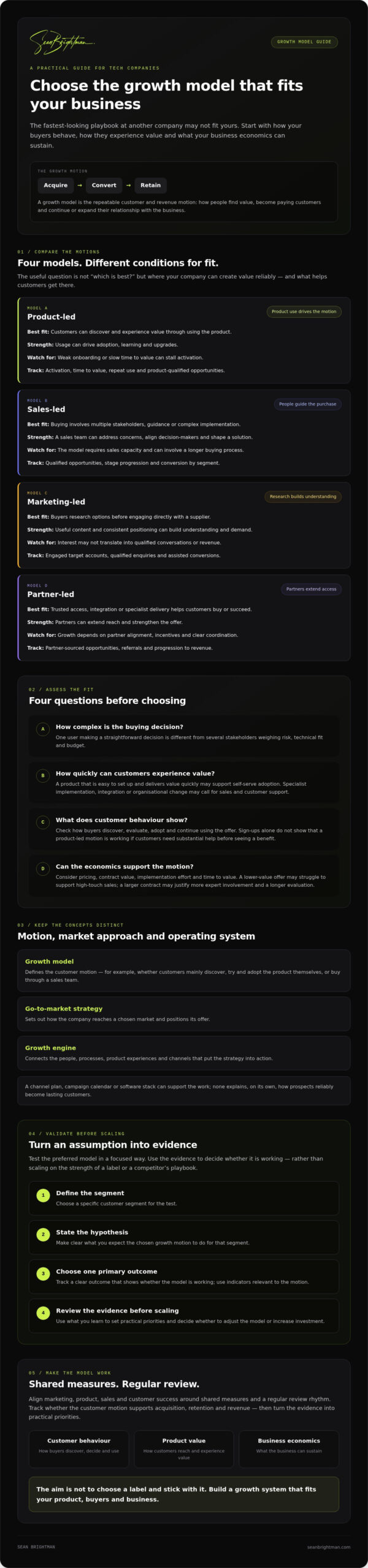
Don’t make a company-wide bet on an untested assumption. Run a bounded test to see whether a specific growth motion works for a defined group of customers. Before you start, choose one primary outcome, supporting indicators and the evidence that would make you continue, adjust or stop.
Keep the test narrow. Choose a customer segment, offer and acquisition or activation motion, then record the baseline and write down your assumptions. Changing several things at once makes the results difficult to interpret.
For example, when testing a sales-assisted path, define which customer signals trigger sales involvement and track whether those prospects progress. Don’t treat more meetings as success unless they lead to stronger qualification or commercial outcomes.
Reliable tests depend on clear processes for recording activity, assigning ownership and reviewing results. See marketing operations and scalable growth systems for more on building that operating discipline.
A test is useful only if it changes what the team does next. Turn the findings into a short plan: name the priority, assign an owner, identify dependencies and set a review point. If the evidence is mixed, record what remains uncertain and design the next test to resolve it. Strategic brand roadmapping can help sequence those choices into a clear direction.
Still unsure which motion the evidence supports? Discuss a growth roadmap with Sean to turn the decision into priorities and accountable next steps.
A growth model won’t run itself. Marketing, product, sales and customer success need shared definitions of progress, clear ownership and reliable hand-offs. Otherwise, one team celebrates sign-ups while another sees stalled activation or customers who never reach value.
Name an owner for each stage: acquisition, conversion, activation, retention and expansion. Clarify who acts when a prospect becomes a sales opportunity, when product usage signals a need for support, or when a customer is ready to grow their account. Agree what each hand-off includes and how the receiving team confirms it’s complete.
Separate strategic accountability from execution. A leader sets direction, priorities and measures; internal teams or providers carry out assigned work. AI can support workflows such as analysis, personalisation or content development, but it can’t decide which growth model fits the business or take responsibility for the outcome. People still need to check the evidence and own the decisions.
Set a regular review cadence. Bring together leading indicators, customer evidence and commercial outcomes. Ask what’s changing, where customers are getting stuck and whether the priorities still make sense. Change the plan when the evidence changes, not simply because a new tactic looks appealing.
Watch for warning signs: teams are pursuing conflicting priorities, positioning shifts between channels, or marketing measures don’t connect to pipeline, retention or revenue. These are leadership and alignment problems, not simply requests for more activity.
Fractional CMO support can provide senior marketing direction on a part-time basis, with strategic oversight rather than full-time placement or advertising execution. If the main need is to establish direction and sequence priorities, roadmapping can create a structured plan. If the business needs continued guidance and accountability, an advisory retainer may be a better fit. The marketing advisory retainer offers more context on ongoing strategic direction.
For marketing growth models for tech companies, the operating system matters as much as the choice of model. Clear ownership, shared measures and regular decisions turn strategy into coordinated work. If you’re weighing up the next step, explore Fractional CMO, roadmapping and advisory support with Sean.
The strongest marketing growth models for tech companies aren’t borrowed from a competitor. They fit how your customers buy, experience value and continue using your product. Product-led, sales-led, marketing-led and partner-led motions each have a place, and a hybrid can work when ownership and hand-offs are clear.
Start with customer behaviour and your own unit economics. Then test one focused hypothesis, define what success looks like and decide in advance whether to continue, adjust or stop. A burst of activity isn’t proof of growth. Look for progress through the customer journey and towards commercial outcomes.
Make the model workable with shared measures, clear decision rights and regular reviews. If your team needs senior direction, Fractional CMO support offers part-time marketing leadership. Strategic roadmapping can turn direction into a structured plan, while ongoing advisory provides continued guidance and accountability.
Talk through your growth model with Sean to identify practical next steps. You don’t need to copy someone else’s playbook; you can build a model that fits your business and improve it with evidence.
A marketing growth model describes the repeatable way a tech company attracts, converts and retains customers. It shows how customers discover the offer, decide to buy, reach value and continue using or expanding their use of it. It’s different from a channel plan or campaign calendar: those organise marketing activity, while the growth model explains how that activity connects to customer behaviour and business growth.
There’s no single best model for every B2B SaaS company. Product-led growth may fit when customers can try the software and experience value without much assistance. Sales-led growth may fit complex purchases involving several decision-makers, technical evaluation or implementation support. Marketing-led and partner-led motions can also play key roles. Assess how your target buyers evaluate and adopt the product, then test the motion against customer and commercial evidence.
No. Product-led growth depends on customers being able to discover, adopt and realise value through the product itself. If onboarding is difficult, implementation is substantial or buyers need guidance to build internal agreement, a self-serve path may not be enough. Software companies can still use product-led elements, such as a self-serve trial, alongside sales support. Check activation, time to value, retention and expansion before making product-led growth the primary motion.
Choose based on what buyers need to make a decision and succeed after purchase. Product-led growth is more plausible when users can experience value independently and adoption doesn’t require extensive support. Sales-led growth may suit purchases with multiple stakeholders, detailed evaluation or complex implementation. Map the journey from discovery to activation, then identify where customers ask for help or stall. You can support self-serve users with sales by setting clear qualification and hand-off rules.
Yes. A company could combine self-serve product adoption for simpler needs with sales support for larger or more complex accounts. Marketing may create demand across both routes, while partners help reach customers or support implementation. The risk is confusion, not variety. Set clear ownership, shared definitions and hand-off rules so teams know who acts next, which customer fits each route and how each motion contributes to acquisition, retention or revenue.
Start with a small set of measures tied to the model you’re testing. Track a leading indicator, such as qualified enquiries, onboarding completion or product activation, alongside outcomes such as conversion, retention and expansion. Record a baseline, define each metric consistently and review a specific customer segment. Don’t treat traffic or sign-ups alone as proof of progress. Set decision criteria in advance, then continue, adjust or stop based on the evidence.
Reading is good. A roadmap is better.