

Marketing isn’t a creative experiment. It’s a mechanical function. If your current strategy feels like a series of expensive “random acts” with no clear ROI, you’re not alone. Most UK CEOs are watching nearly 8% of their revenue vanish into a black hole of unmeasured campaigns and vague promises. You’re likely exhausted by the lack of accountability and the constant noise of AI tools that don’t actually move the needle. Building a marketing engine for predictable growth requires a shift from chasing trends to architecting a system. It’s about moving from “hope” to “hardware.”
This guide cuts through the fluff. You’ll learn how to stop the bleed and start constructing a growth engine that delivers consistent, documented revenue. We’ll look at the 2026 landscape, from navigating the transparency requirements of the EU AI Act to mastering first-party data in a world without reliable cookies. You’ll get a clear roadmap to turn your marketing department into a well-oiled machine that runs on logic, not luck. It’s time to stop guessing and start engineering.
Most UK marketing departments are running on caffeine and chaos. They mistake motion for progress. “Random Acts of Marketing” are tactical lunges made without a strategic foundation. It’s a LinkedIn post here, a sporadic newsletter there, and a disconnected ad campaign that nobody tracked. It is activity without strategy. In 2026, with average marketing budgets flatlining at roughly 7.7% of revenue, you cannot afford to “spray and pray.”
The “more leads” mindset is the primary trap. CEOs often demand more volume, but volume on a broken system is just expensive noise. If your conversion rates are poor, doubling your lead flow simply doubles your waste. Predictable growth isn’t a lucky strike; it’s the mechanical output of a structured engine. You don’t need more ideas. You need a machine that processes capital into revenue with clinical precision.
Busy-work is the silent killer of ROI. Your team might be “busy” producing content, but if that content doesn’t map to a specific stage of the buyer journey, it’s just fluff. You need a revenue signal, not just social media engagement. Identifying “busy-work” is simple: if a task doesn’t directly contribute to lead quality or pipeline velocity, it’s a distraction.
Stop hiring junior executioners to “do the marketing” before you have a blueprint. A junior cannot build a machine; they can only pull levers. Without a senior architect to design the workflow, you’re just paying for someone to make noise more efficiently. You must prioritise high-level strategy over low-level execution if you want to stop the bleed.
Scaling spend on a broken system doesn’t bring more revenue; it just accelerates failure. Building a marketing engine for predictable growth requires you to fix the plumbing before you turn on the taps. This means integrating robust marketing automation systems to handle lead scoring, CRM integration, and nurture workflows. If these aren’t in place, your data is a lie.
True predictability relies on sharp market positioning that creates demand before the “buy” button is even clicked. You must move from hope-based marketing to data-led machinery. In this model, every £1 spent has a clear, documented path to a return. This isn’t about being “creative.” It’s about being architectural. When the engine is built correctly, growth becomes a choice, not a gamble.
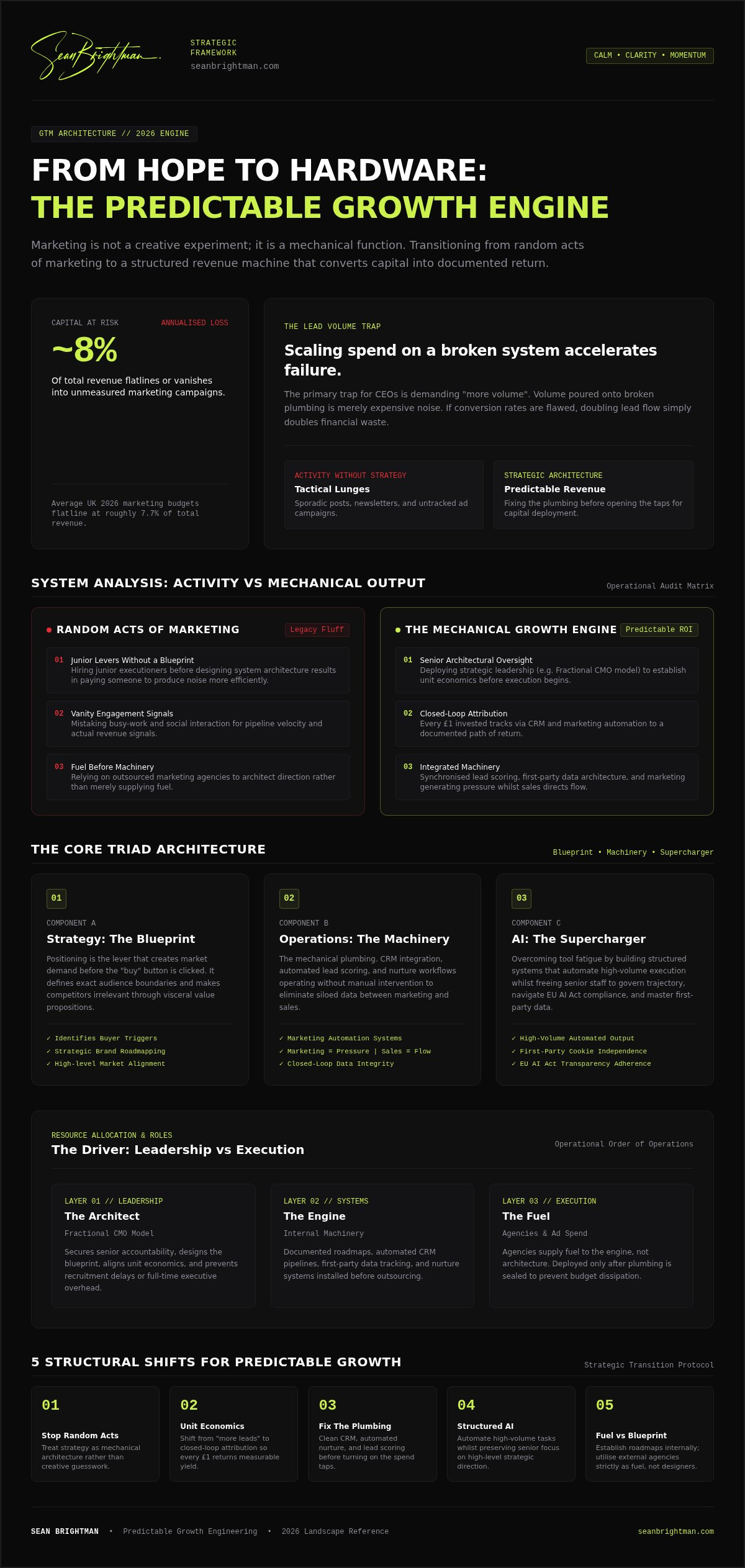
A marketing engine is a functional assembly, not a list of creative ideas. It consists of three core components: Strategy, Systems, and AI. Think of strategy as your blueprint, systems as your plumbing, and AI as the supercharger. Most CEOs focus on the fuel, such as ad spend, whilst ignoring the engine’s internal mechanics. This is a mistake. Building a marketing engine for predictable growth requires you to treat your go-to-market plan like a piece of industrial hardware. When you commit to building a marketing engine for predictable growth, you are moving away from the chaos of “random acts” and toward a system that produces revenue by design.
Positioning is often dismissed as “fluff” by technical leaders. This is a tactical error. Sharp positioning is the lever that creates market demand. It defines exactly who you serve and why your competitors are irrelevant. You need a Strategic brand roadmapping process that identifies the specific triggers that make buyers act. In a saturated 2026 market, your Unique Selling Proposition must be visceral. It should be something your customers covet. Without this blueprint, your execution team is just guessing.
Operations are the physical plumbing of your growth engine. This is where building a predictable growth engine becomes an engineering task. Your CRM, lead scoring, and automated workflows must function without manual intervention. Prioritise a clean, integrated tech stack over a collection of “shiny object” tools. If your tools don’t share data, you have silos, not a system. Mechanical alignment between marketing and sales is non-negotiable. Marketing generates the pressure; sales directs the flow. If you want to scale, you must invest in a scalable growth engine built on operational discipline.
AI acts as the supercharger in this architecture. It provides predictive power, identifying which leads are likely to close before a human ever looks at the data. It handles the high-volume execution tasks that used to bog down your team. But remember: AI cannot fix a broken strategy. It only amplifies what is already there. If your architecture is sound, AI makes it unstoppable. If you’re ready to stop guessing, consider an advisory retainer to help audit your current machinery.
Forget growth hacks. They are a temporary fix for a permanent problem. You need a blueprint, not a shortcut. Building a marketing engine for predictable growth starts with a cold, hard look at your current waste. Most UK firms are burning budget on activities that look good in a report but never hit the bank account. You must move from “feeling” to “fixing.”
The roadmap is a five-step mechanical process:
Perform a brutal efficiency audit on your budget. If you can’t tie an activity to a revenue signal, stop doing it. This isn’t about being mean; it’s about being effective. You need a 90-day plan for immediate marketing transformation. This plan should prioritise fixing the “plumbing” before you buy more “water.” Building a marketing engine for predictable growth requires you to value long-term stability over short-term spikes.
Set KPIs that actually correlate with business value. McKinsey’s research on marketing-driven growth shows that companies integrating data with creative purpose grow revenue twice as fast as their peers. Don’t track “brand awareness” if you can’t track its impact on pipeline velocity. Every metric must justify its existence on your dashboard.
Select the right tools for your specific business model. Do not buy a complex software suite just because it’s popular. A bloated tech stack is an operational liability that creates data silos. Your infrastructure must be integrated, ensuring data flows from the first click to the final sale without manual intervention. This is where you turn your CRM from a digital Rolodex into a revenue generator.
Document every process. The engine must not be person-dependent. If your marketing fails because a key employee leaves, you don’t have an engine. You have a hostage situation. Organise the team for maximum output and clear accountability. In a well-oiled machine, every team member owns a specific metric. When everyone knows exactly which lever they are responsible for pulling, the machine runs smoothly. Once the infrastructure is solid, layer in AI to handle high-volume tasks. This frees your team to focus on the next strategic pivot whilst the engine maintains its own velocity.
Most CEOs are stuck “playing” with ChatGPT. They treat it like a magic trick rather than a tactical component. This is how you fail. To win in 2026, you must transition to AI consulting for growth. This means integrating intelligence into the very fabric of your funnel. AI is the supercharger that makes your engine run faster with less manual effort. It handles the high-volume execution whilst your team focuses on the blueprint. Building a marketing engine for predictable growth is impossible without this level of automation.
Content production used to be a labour-intensive cost centre. Now, it’s an automated workflow. Research indicates that 40% of marketing leaders achieve ROI via reduced costs and agency rationalisation through AI. You can scale your lead processing capacity without hiring more staff. AI isn’t just for writing copy. Use it for deep market research and competitor analysis. It scans thousands of data points to find the revenue “signal” your competitors are missing. Implementing AI-driven lead scoring ensures your sales team only talks to buyers, not tyre-kickers. This saves time. It saves money. It creates precision.
You need a real-time “health check” of your machinery. AI-powered dashboards don’t just report numbers; they identify bottlenecks. If leads aren’t converting, the AI tells you why. It might be a messaging mismatch or a technical glitch in the plumbing. This removes the guesswork from your weekly briefings. It replaces “I think” with “I know.” The machine identifies the failure point before it becomes a crisis. Building a marketing engine for predictable growth requires this level of clinical oversight. An Advisory Retainer ensures a senior strategist is monitoring these AI outputs, making sure the machine stays on track. Don’t let your AI run wild. Guide it with senior leadership. If you are ready to stop playing with prompts and start engineering results, book an AI Consulting session to audit your stack.
An agency cannot build your engine. They are fuel, not the machine. If you outsource your entire strategy to an external execution house, you are abdicating your responsibility as a CEO. You need an internal architect to design the systems we have discussed. Building a marketing engine for predictable growth requires senior oversight that understands your board-level objectives. Agencies are specialists in channels. They are not specialists in your business architecture. Specialists create silos. Architects create systems. If you want a well-oiled machine, you need someone who owns the blueprint, not just the tools.
You need a strategist, not a “head of marketing” who just manages social media. In 2026, the Fractional CMO revolution has changed the game for UK scale-ups. You get senior-level authority without the £150,000 plus salary of a full-time hire. This is about cost-benefit. You pay for the brain, not the desk space. A Fractional CMO ensures the marketing strategy aligns with your vision. They bridge the gap between high-level theory and the grounded reality of execution. This is senior leadership on demand. It provides the “Chief Architect” role necessary to keep the machinery moving toward a clear ROI. It is about impact, not headcount.
Building the engine is only half the battle. You have to keep it tuned. A Marketing Advisory Retainer provides the external accountability your team needs to maintain speed. It is easy for internal teams to get bogged down in the day-to-day noise. Quarterly reviews act as a mechanical check-up. They keep the engine tuned for performance and prevent tactical drift. This isn’t just about growth. It is about exit readiness. A documented, mechanical engine is an asset that adds significant value to your business valuation. Investors buy systems, not luck. They want to see a machine that produces revenue regardless of who is pulling the levers.
If your marketing department currently feels like a series of disconnected parts, it is time to bring in a driver. Stop paying for activity and start investing in an architecture that scales. Ready to build? Book a Strategic Brand Roadmapping session to begin the transformation and turn your marketing into a predictable revenue generator.
Stop treating your marketing budget like a gamble. Predictable revenue isn’t a byproduct of luck; it’s the mechanical result of a well-designed system. By ditching random acts of marketing and installing a structured framework of strategy, systems, and AI, you secure your company’s future. Building a marketing engine for predictable growth means moving from hope-based tactics to a documented roadmap that scales with your ambition.
Sean Brightman, author of the definitive book on marketing strategy and a battle-hardened Fractional CMO for UK high-growth brands, specialises in these AI-powered systems. You’ve seen the roadmap. You know the components. Now you need the architect to start the assembly. Don’t let your budget bleed for another quarter whilst your competitors automate their advantage. It’s time to stop guessing and start engineering.
Book a Strategic Brand Roadmapping session with Sean Brightman to turn your marketing department into a high-velocity revenue machine. Your growth engine is waiting.
A marketing engine is a permanent assembly of strategy, systems, and AI designed to produce revenue by design. It’s not a one-off campaign or a series of social media posts. Building a marketing engine for predictable growth involves creating a mechanical workflow where every £1 spent has a documented path to a return. It’s the difference between hoping for leads and engineering them through a closed-loop system that scales with your business goals.
Most businesses can install the core architecture of an engine within 90 days. The first 30 days are dedicated to a brutal audit and roadmapping. The following 60 days focus on implementing the tech stack and documenting processes. It’s not an overnight transformation. You are building a permanent asset, not a temporary hack. Once the plumbing is fixed, the engine requires ongoing tuning through an advisory retainer to maintain its peak velocity.
You don’t need a full-time executive to manage a well-designed engine. In 2026, many UK companies are ditching the £150,000 plus full-time CMO salary in favour of fractional leadership. A Fractional CMO acts as the architect, providing the senior strategy and accountability required to drive the machine without the massive overhead. This model allows you to invest more in the actual machinery and AI tools whilst keeping high-level expertise on demand.
Investment levels depend on your current revenue and growth targets. Industry data shows that high-performing companies typically allocate around 7.7% of total revenue to their marketing budget. This spend is split between in-house labour, martech, and external execution. Building a marketing engine for predictable growth focuses on reallocating wasted ad spend into permanent systems. You aren’t just spending money; you’re investing in an internal asset that increases your business’s valuation for a future exit.
AI provides the predictive power that traditional marketing lacks. It scans vast datasets to identify high-intent buyers and forecast pipeline health with increasing accuracy. It acts as a supercharger for your lead scoring and content distribution. By removing human bias and manual bottlenecks, AI ensures your engine reacts to market signals in real-time. It’s not about replacing your team; it’s about giving them the intelligence to make better strategic decisions.
An engine is your internal infrastructure, whilst an agency is the fuel. Agencies are specialists in specific channels like SEO or PPC. They shouldn’t own your strategy or your data. If you outsource the “brain” of your marketing, you lose control of your growth. You need an internal architecture that you own. Use agencies to execute specific tasks once your blueprint and systems are firmly in place under senior strategic guidance.
If you can’t trace a sale back to a specific set of actions, your marketing is random. Random marketing relies on “gut feel” and reactive tactics. Systematic marketing is documented and measurable. It uses closed-loop attribution to show exactly how every lead entered the funnel and why they converted. If your team is constantly chasing the latest “shiny object” tool without a roadmap, you are running on chaos, not a machine.
Positioning is the tactical blueprint for your entire engine. It defines exactly why you are the only logical choice for your ideal customer. Without sharp positioning, your engine is just a high-speed delivery system for a weak message. It’s the lever that creates demand before a prospect even talks to sales. Effective roadmapping locks this in first, ensuring every automated workflow and AI-generated campaign is hitting the right psychological triggers in your market.
Reading is good. A roadmap is better.