

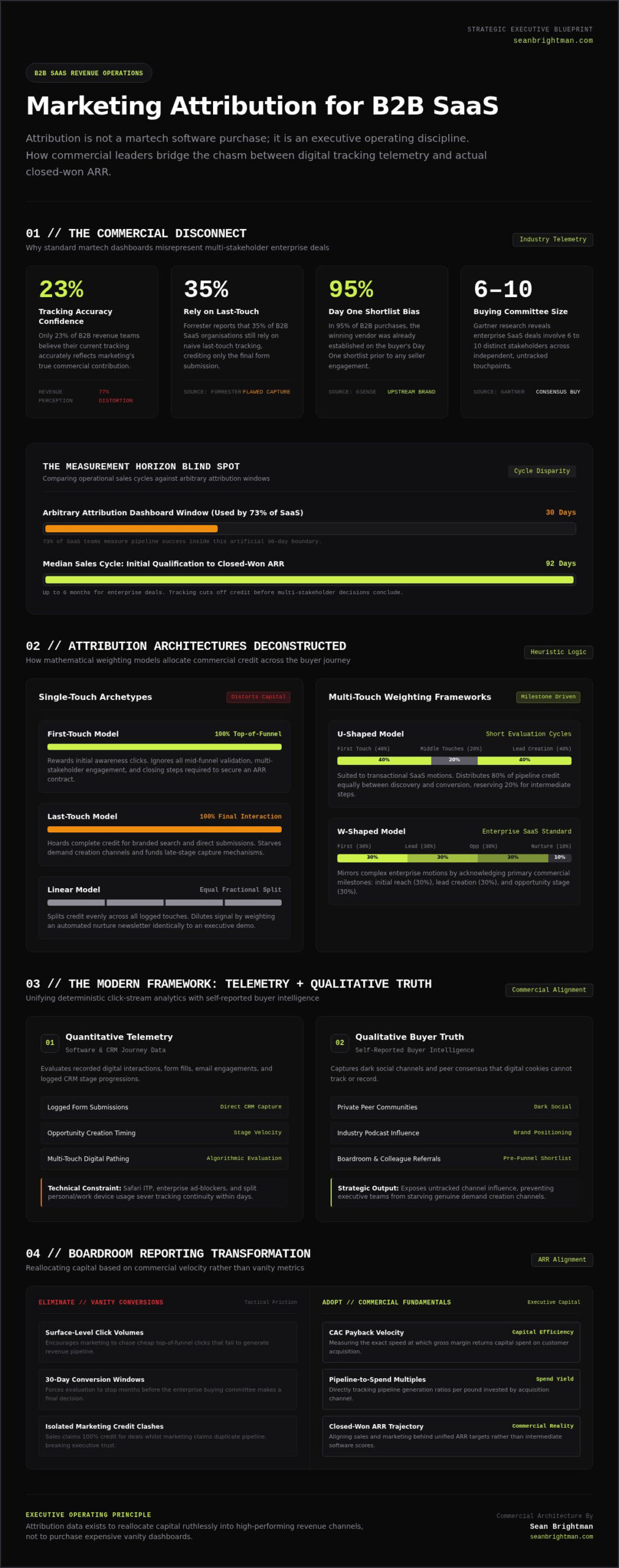
Attribution is not a martech purchase; it is an executive operating discipline. Yet research shows that only 23% of B2B revenue teams believe their tracking accurately reflects marketing’s true commercial contribution. If you are wrestling with marketing attribution for b2b saas across a protracted buying cycle, buying another software tool will not fix your pipeline blind spots.
You already know the internal friction. Your board demands ruthless CAC payback transparency, whilst marketing presents surface-level click volume and sales claims sole credit for every inbound contract. When an enterprise purchase involves six to ten decision-makers navigating a six-month sales cycle, basic dashboards end up claiming 100% credit for deals that were closing anyway.
You do not need more software bloat. You need a pragmatic system that connects marketing spend directly to qualified pipeline and closed-won ARR. In this guide, you will discover how to select the right attribution framework for your specific ARR stage, cut wasted channel spend through clean data visibility, and establish undeniable commercial alignment between sales and marketing.
Most attribution frameworks treat enterprise software procurement like a direct-to-consumer checkout. That premise is broken. Applying transactional tracking logic to marketing attribution for b2b saas creates expensive blind spots, skewing capital toward bottom-of-funnel capture whilst starving genuine demand generation.
According to Forrester, 35% of B2B SaaS organisations still rely on last-touch attribution. Even worse, 73% measure pipeline success within an arbitrary 30-day window, despite the median sales cycle running 92 days from initial qualification to closed-won ARR. When standard software tracking attempts to evaluate commercial influence, it credits the final form submission rather than the months of upstream positioning that created the buyer’s intent. Understanding the mathematical limitations of both single-touch and multi-touch attribution models prevents your leadership team from mistaking digital activity for commercial momentum.
Enterprise SaaS deals are committee decisions, not individual impulses. Gartner research indicates that the average enterprise purchase involves six to ten distinct stakeholders, each conducting self-directed research across independent touchpoints.
These buyers do not click neat tracking links in sequence. They evaluate solutions in private peer communities, listen to industry podcasts, and compare operational notes long before speaking to sales. Research from 6sense reveals that in 95% of B2B purchases, the winning vendor was already established on the buyer’s Day One shortlist before any direct seller engagement began. A standard analytics cookie cannot track boardroom consensus.
Client-side tracking is crumbling under modern technical constraints. Safari’s Intelligent Tracking Prevention, enterprise ad blockers, and split personal-work device usage sever tracking continuity within days.
When linear tracking fails, revenue teams default to funding what remains measurable: paid brand search and late-stage retargeting. This creates a dangerous feedback loop. Attribution software claims complete credit for prospects who were already navigating directly to your domain, whilst the channels building genuine market awareness receive zero capital. The business ends up buying expensive vanity dashboards instead of driving incremental ARR.
Every attribution model forces a specific mathematical bias onto your commercial strategy. That bias directly dictates where marketing leadership allocates capital. Pick the wrong model, and you incentivise your team to chase low-value activities that fail to generate revenue.
First-touch attribution rewards top-of-funnel reach. It assigns complete revenue credit to initial awareness clicks, ignoring the complex mid-funnel education required to sign a contract. Last-touch does the exact opposite. It hoards credit for branded search queries and direct submissions, starving foundational brand work. Neither framework works for complex sales cycles. Getting marketing attribution for b2b saas right requires understanding how multi-touch architectures weight pipeline influence across an established customer journey mapping framework.
Heuristic multi-touch models use rule-based logic to distribute pipeline credit across recorded buyer touchpoints. Each framework reflects a fundamentally different go-to-market philosophy:
Full-path and data-driven models remove static weighting rules entirely. They deploy machine learning to evaluate historical CRM journeys, assigning dynamic weightings based on how specific touchpoint combinations accelerate deal velocity or drive post-sale expansion.
They are powerful, but they require substantial operational maturity. Feeding algorithmic engines with low conversion volume generates statistical noise rather than strategic clarity. If you lack hundreds of closed-won deals each quarter, an over-engineered algorithmic model will mislead your leadership team. When internal reporting fractures across competing methodologies, bringing in independent Fractional CMO guidance helps leadership install a clean commercial measurement framework before committing to bloated software tiers.
Relying solely on digital tagging creates a distorted view of your pipeline. Software telemetry tracks the physical mechanics of a visit, but it cannot explain the buyer’s underlying motivation. Effective marketing attribution for b2b saas demands a hybrid framework: marry hard technical telemetry with direct, qualitative customer truth.
Software logs UTM parameters, referral paths, and device metadata. Qualitative attribution captures the untracked interactions that actually convinced the executive committee to evaluate your platform. When you run both streams simultaneously, the gaps disappear. Establishing rigorous marketing operations systems gives your revenue team the operational discipline needed to unify these signals instead of drowning in disconnected dashboard views.
Stop forcing buyers through restrictive dropdown menus on your demo request forms. Dropdowns force prospects into arbitrary boxes like “Search Engine” or “Social Media”, hiding the real catalysts behind their visit.
Install a mandatory, blank text field: “How did you first hear about us?”
When buyers type freely, patterns emerge immediately. A prospect whose UTM parameters read “Direct” or “Organic Search” will write: “Recommended by our VP of Eng after hearing you on the SaaS podcast,” or “Mentioned in a private CMO community.” You can also audit initial sales call recordings to capture offline influence mentioned during discovery discussions. Compare those direct admissions against your tracking parameters to identify the dark social channels actively fueling your pipeline.
Attribution data must map to commercial milestones, not web conversions. Tracking isolated ebook downloads or generic form submissions produces vanity volume. Your measurement engine must tie directly into your CRM opportunity stages.
Aligning quantitative web interactions with qualitative pipeline milestones turns attribution from a defensive reporting exercise into an offensive growth lever.
Most attribution failures stem from premature technical optimisation. Deploying an enterprise intelligence suite when you have fifty customers is operational madness. Effective marketing attribution for b2b saas requires matching your measurement framework strictly to your revenue scale and data density.
Follow this five-stage maturity blueprint to avoid over-engineering your tech stack:
Premature software purchases drain capital without delivering clarity. Research reveals that the median implementation and calibration period for a dedicated attribution platform is 14.2 weeks. Early-stage startups simply cannot afford three months of operational drag.
When deal volume is low, statistical models break down. Focus entirely on qualitative discovery, native CRM campaign tagging, and clean UTM governance. Tie every marketing metric directly to qualified opportunities rather than digital interactions. Do not waste capital on dedicated platforms until your transaction volume provides genuine mathematical significance.
Scaling past £20M ARR changes the commercial equation completely. Growth now relies as heavily on net revenue retention and account expansion as it does on new customer acquisition.
At this tier, attribution must track cross-functional account engagement, product usage data, and multi-buyer interactions across complex corporate structures. G2 reports that 51% of B2B software buyers now initiate vendor discovery in AI chatbots like ChatGPT and Perplexity rather than search engines, with 71% using AI tools during their evaluation. Tracking these non-linear journeys demands sophisticated data warehousing rather than basic point solutions.
Managing this architectural shift requires seasoned commercial leadership. Rather than rushing into expensive permanent hires, you can deploy a fractional CMO to build your enterprise revenue architecture and enforce data governance. To audit your measurement systems and establish board-level pipeline visibility, book a strategic consultation today.
An attribution dashboard is useless if it sits in isolation. Dashboards do not generate revenue; decisive capital reallocation does. If your leadership team reviews attribution reports merely to debate internal credit, you are burning executive time. Board members do not care which campaign claimed the final click. They care about CAC payback velocity, pipeline yield, and commercial capital efficiency.
Mastering marketing attribution for b2b saas means turning telemetry into commercial action. It gives you the operational clarity required to starve underperforming initiatives and pour capital into proven pipeline drivers.
High-performing revenue teams use attribution data to reallocate budget without sentimentality. When data shows that expensive paid search campaigns capture low-intent leads whilst unmeasurable organic channels generate enterprise pipeline, move the budget immediately.
Present this reality to your board in their financial language:
Maintaining this operational discipline requires constant oversight. Establishing a structured marketing advisory retainer gives executive teams continuous strategic accountability, ensuring marketing spend aligns directly with enterprise ARR targets.
Attribution breakdowns are rarely technical problems. They are strategic leadership deficits. Purchasing another enterprise tracking subscription will not solve misaligned commercial incentives, broken CRM hygiene, or conflicting pipeline definitions.
Software provides raw telemetry; experienced leadership extracts commercial truth. An authoritative strategist strips out redundant tooling, unifies sales and marketing taxonomies, and bridges the gap between digital spend and boardroom metrics. You do not need more dashboards. You need seasoned executive direction to turn your marketing attribution for b2b saas into a repeatable, scalable growth engine.
Attribution is not a tool you purchase; it is an executive operating discipline. Solving marketing attribution for b2b saas does not require another bloated software stack. It requires strategic clarity. By pairing quantitative telemetry with qualitative, self-reported buyer insights, your leadership team uncovers what truly drives qualified pipeline across complex buying committees.
Match your measurement framework directly to your ARR maturity stage. Reallocate budget ruthlessly away from vanity clicks and into channels with proven CAC payback velocity. When your data reflects commercial reality, marketing ceases to be an unpredictable cost centre and becomes an undeniable revenue driver.
Gain absolute clarity over your pipeline with independent strategic marketing advisory without agency markup. Benefit from bespoke AI roadmapping and commercial marketing architecture designed by a published author on strategic marketing and brand methodology. Build your scalable revenue engine with Fractional CMO advisory and turn your attribution data into sustainable enterprise traction.
Single-touch models assign 100% of pipeline revenue credit to an isolated moment, either the initial prospect visit or the final conversion event. Multi-touch attribution distributes fractional credit across multiple documented interactions throughout the buyer journey. Single-touch models reward transactional volume, whilst multi-touch models reflect the reality of marketing attribution for b2b saas by measuring how content, campaigns, and sales touches collaborate to close enterprise accounts.
Automated software tracking only captures digital mechanics like clicks, referrer headers, and UTM tags. It is blind to word-of-mouth recommendations, peer communities, private Slack groups, and podcast mentions. Asking buyers a simple, open-ended question on demo forms uncovers the true catalyst behind their search. Blending self-reported narrative truth with technical telemetry exposes the invisible touchpoints that actually generate qualified commercial demand.
Standard attribution setups default to a 30-day tracking window. Enterprise software deals, however, routinely take several months to negotiate across multi-stakeholder buying groups. Because browser cookies expire and prospects switch between hardware, earlier foundational touchpoints get wiped clean. Standard tracking ends up crediting the final branded search click, falsely presenting late-stage navigation as the primary driver of pipeline value.
Early-stage startups under £1M ARR should avoid complex algorithmic models entirely. When conversion volume is low, algorithmic weighting produces statistical noise rather than strategic clarity. Instead, use a basic first-touch or U-shaped model inside your CRM, paired with mandatory qualitative self-reported fields on inbound forms. Direct founder discovery interviews will tell you far more about deal creation than a bloated attribution platform.
Dark social describes untracked peer-to-peer influence occurring across channels like WhatsApp, direct messages, private communities, and offline industry gatherings. Because tracking pixels cannot access these private exchanges, standard software attributes the subsequent inbound visit as direct traffic or organic search. This systematically starves demand generation channels of marketing budget while over-crediting capturing mechanisms that merely harvested demand created elsewhere.
Yes. For companies scaling toward £5M ARR, standard CRMs handle marketing attribution for b2b saas effectively if data discipline is enforced. By capturing UTM parameters on lead creation, custom opportunity fields, and mandatory self-reported text responses, revenue teams can build functional first-touch and U-shaped reports without adding third-party tracking overhead. Tooling is rarely the bottleneck; standardising your commercial definitions and pipeline governance is.
Dedicated attribution software becomes necessary when deal flow exceeds manual spreadsheet reconciliation, usually past £10M to £20M ARR. At this volume, enterprise accounts involve dozens of concurrent touchpoints across multiple decision-makers. Dedicated tools aggregate account-level domain activity, integrate server-side data warehouses, and stitch fractured buying signals together. Buying these tools before reaching this threshold simply creates expensive martech bloat without commercial utility.
Reading is good. A roadmap is better.