
Investors don’t hate marketing; they hate gambling with their capital. If your board sees your budget as a black hole for “brand awareness” rather than a predictable revenue machine, you’ve already lost the argument. In the current UK market, justifying marketing spend to investors requires more than just a deck of vanity metrics and fragmented data. You’re likely facing intense pressure to integrate AI whilst struggling to prove the ROI of your existing channels. It’s a frustrating cycle of defensive reporting that does nothing to secure your next round of funding.
It’s time to stop defending a cost centre and start building a growth engine. This guide will show you how to transform your marketing function into a defensible, scalable system that investors actually want to fund. We’ll move past the “brand vs performance” binary and focus on mechanical precision. You’ll learn how to align your 2026 strategy with board-level expectations, implement AI with tactical purpose, and create a roadmap that turns investor scepticism into long-term confidence. This is about building a system, not just running a campaign.
The 2026 market has no patience for the traditional civil war between brand and performance. Investors have stopped listening to pleas for “brand awareness” that can’t be mapped to a ledger. We’ve entered the era of unit economics. Justifying marketing spend to investors now requires a holistic view of the growth engine; where every £1 spent is an investment in a machine, not a gamble on a creative whim.
This isn’t about choosing between long-term reputation and short-term clicks. It’s about defensible market positioning versus vague sentiment. Investors today fund profitable velocity, not growth at any cost. They want to see a system that scales with mathematical certainty, where the brand acts as the moat and performance acts as the engine.
Clicks are cheap. Impressions are noise. In a high-stakes boardroom, these numbers are met with scepticism. Modern boards demand a clear view of marketing effectiveness that translates directly into Contribution Margin. If you can’t demonstrate how your spend survives after variable costs, you aren’t speaking the language of capital.
Activity is a cost; impact is an equity-builder.
The economic shift of the last few years killed the “burn-to-learn” model for UK scale-ups. Boards now demand “AI-efficiency” as a baseline requirement. They want to see how you’re using automation to lower overheads whilst maintaining high-quality output. Your marketing strategy cannot be a collection of tactics. It must be a financial roadmap that mirrors the company’s broader fiscal goals.
Investors look for three things in your budget: predictability, scalability, and defensibility. They don’t fund departments; they fund growth engines built on systems. If your budget looks like a list of expenses rather than a portfolio of assets, expect a rejection. You need a strategy that treats every marketing activity as a functional component of a larger revenue-generating machine.
Investors don’t fund luck. They fund machinery. If you want to secure your budget for 2026, you must stop presenting “ideas” and start presenting a growth engine. This engine relies on three non-negotiable pillars: Systems Architecture, Accountability, and AI Integration. Together, these pillars create defensibility. They prove that your revenue isn’t a fluke of the market, but a result of your design. Justifying marketing spend to investors becomes a clinical, mathematical exercise once these pillars are in place.
A viral campaign is a one-off bet. A system is a revenue asset. When investors conduct due diligence, they aren’t looking for screenshots of high engagement; they’re looking for the plumbing. They want to see a repeatable process that turns £1 into £5 with boring regularity. This is where a marketing operations consultant becomes an essential hire for a scale-up.
Building this engine requires you to document your growth machinery. You need to map your data flows and define your attribution models with surgical precision. Show the board how your tech stack integrates to create a closed loop of feedback and execution. This documentation isn’t just “admin”; it’s evidence of a scalable business model. It’s the difference between a department that asks for money and a department that generates value.
Accountability & Leadership: The second pillar is the human element. Investors need to know who is steering the ship. They want a strategist who prioritises the ledger over the awards cabinet. Accountability means having a senior leader who owns the numbers and isn’t afraid of blunt honesty when a channel underperforms. This leadership ensures the machine remains calibrated and focused on the only metric that matters: profitable growth.
Stop talking about “using ChatGPT” to write social posts. That’s a toy. In 2026, investors demand structural growth through technology. They want to see AI consulting that re-engineers your production costs and improves your margins.
Frame your AI spend as a capital expenditure (CapEx) rather than a simple subscription fee. You’re investing in a permanent efficiency gain that reduces the cost of customer acquisition whilst increasing the quality of your output. When you demonstrate how AI lowers your overheads, justifying marketing spend to investors shifts from a request for cash to a proposal for margin expansion. If you need to define your technological path, a strategic roadmapping session can clarify exactly where AI will deliver the highest ROI.
Investors don’t fund busywork. They fund velocity. Activity is just noise; velocity is movement with direction. If your marketing budget looks like a list of monthly bills, you’re failing the boardroom test. You need to shift the conversation from “what we’re doing” to “what we’re building”. Justifying marketing spend to investors becomes effortless when you prove that your budget is creating a permanent increase in Enterprise Value.
This requires a binary shift in how you define value. It’s about building assets, not just paying for exposure. Consider these contrasts:
A well-positioned brand isn’t just a logo. It’s a competitive moat. It lowers your future CAC and increases your customer lifetime value. It makes the business easier to scale and, eventually, easier to sell. This is the core of a marketing strategy for business exit. You’re building a growth engine that buyers covet, not a PPC account they have to fix.
Late-stage investors and buyers look for “clean” growth. They want to see that your revenue isn’t dependent on a single person or a lucky algorithm change. A messy marketing department suggests risk. Risk leads to a “haircut” on your valuation. To avoid this, you need a strategic brand roadmapping process. This creates a documented, defensible path that proves your marketing is a calculated engine of growth. It shows the board you know exactly where your next £1m is coming from.
Anyone can outbid you on Google Ads. That isn’t a moat; it’s a bidding war. A true moat is your positioning. It’s the psychological space you own in the market that competitors cannot simply buy their way into. Strategic clarity creates a defensible position that protects your margins even when the market gets crowded.
When justifying marketing spend to investors, highlight how your spend builds this long-term ROI. You’re moving away from tactical noise and towards a structural advantage. Strategic positioning is the ultimate asset. It ensures that your marketing spend isn’t just “maintenance” but is actively building a business that is harder to compete with and more valuable to own.
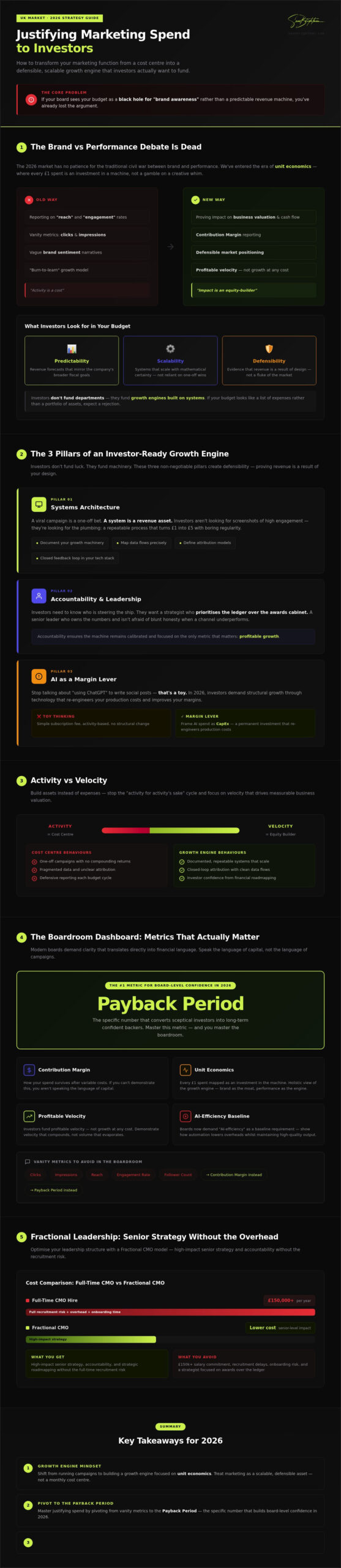
Investors don’t care about your LTV/CAC ratio if the LTV is based on a three-year projection that might never happen. In 2026, cash is king. Justifying marketing spend to investors requires you to lead with the “Payback Period”. This is the time it takes to recoup the acquisition cost in cold, hard cash. If your payback period is under six months, you have a growth engine. If it’s over eighteen, you have a liability. You aren’t just justifying marketing spend to investors; you’re proving the fiscal health of the entire operation.
Stop hiding behind blended CAC. Investors want to see the granularity of your acquisition costs by channel. A low blended CAC often masks a failing paid search account propped up by organic referrals. Be blunt about what’s working and what isn’t. Presenting these numbers with honesty builds more board-level confidence than a polished deck of averages.
CFOs don’t buy “brand feel”. They buy “price elasticity” and “direct traffic”. To present brand equity effectively, show the board how your brand strength allows you to maintain higher prices than the competition. Demonstrate how your direct-to-site traffic reduces your reliance on expensive paid channels. This isn’t about being liked; it’s about being efficient.
Last-click attribution is a convenient lie. It credits the shop door for the sale while ignoring the billboard that brought the customer to the street. Move towards incrementality testing to prove spend effectiveness. Prove what happens to revenue when you turn a channel off. Use a balanced scorecard of leading indicators like pipeline velocity and lagging indicators like closed revenue to provide a complete picture.
Investors want a financial roadmap. You must present a model that says: “If we spend £X, we get £Y.” Maintaining this predictability requires senior oversight. A marketing advisory retainer keeps the engine calibrated. When an experiment fails, don’t bury it. Present it as a “cost of learning” that narrows your focus on what scales. Investors trust leaders who own their data.
If you’re ready to build a dashboard that actually secures your budget, book a strategic briefing here.
Hiring a full-time CMO for a UK scale-up is often a premature move that burns through runway. A senior leader with a £150k+ base salary, plus National Insurance and benefits, creates a heavy fixed cost before your growth engine is even built. Investors see this as a high-risk gamble on a single individual. Justifying marketing spend to investors is much simpler when you decouple senior strategy from full-time headcount. You need the brainpower, not the overhead.
The fractional cmo model offers a leaner, more surgical alternative. It provides immediate board-level credibility without the recruitment risk or the long-term equity drain. This is about buying expertise in blocks, focusing on high-impact strategic shifts rather than administrative presence. An external advisor brings the brutal honesty your board craves; they aren’t incentivised to sugar-coat failing channels or protect a bloated budget.
Most scale-ups suffer from a “messy middle” where tactical execution and high-level strategy never meet. A Fractional CMO organises this chaos. They don’t just “manage” the team; they architect the systems we discussed in earlier sections. Within 90 days, you should have a documented roadmap that turns your marketing budget into a defensible financial asset. This rapid-fire delivery of clarity is exactly what justifies marketing spend to investors during a funding round. They want to see a strategist who can diagnose a problem and deploy a fix without a six-month onboarding period.
A senior leader’s job is to build a machine that eventually functions without them. The Fractional CMO focuses on upskilling your existing team, turning “doers” into strategic executors. This allows you to allocate more of your budget to active growth levers whilst keeping the strategy at a senior level. It’s a binary choice of efficiency:
This structure allows you to prove the system before committing to a full-time hire. You only scale the headcount once the revenue machine is predictable and the unit economics are solid. This pragmatic approach shows investors that you are a steward of their capital, prioritising scalable systems over corporate ceremony. It’s the difference between a department that looks busy and one that drives business valuation.
The era of “burn and learn” is over. In 2026, the boardroom only rewards precision. You’ve seen why the old brand versus performance debate is a distraction. Success now depends on building a documented growth engine that prioritises unit economics and cash flow over vanity metrics. By shifting to a fractional leadership model whilst focusing on systems architecture, you remove the recruitment risk that makes investors nervous. You aren’t just asking for money anymore; you’re proposing a scalable revenue machine.
Mastering the art of justifying marketing spend to investors requires a pivot from defensive reporting to strategic offensive. It means presenting a dashboard that CFOs respect and a roadmap that buyers covet. This is how you transform marketing from a black hole for cash into your most valuable enterprise asset. My approach combines battle-hardened senior leadership with AI-powered growth engine expertise to deliver direct, no-fluff strategic advisory.
Ready to build a machine that scales? Book a Strategic Roadmapping session to justify your 2026 growth plan. Let’s get to work.
Stop using the term “brand awareness” and start talking about price elasticity and direct-to-site traffic. Sceptical investors care about how your brand positioning reduces your reliance on expensive paid channels. Show them that a strong brand allows you to maintain higher margins than competitors whilst lowering your future customer acquisition costs. It’s about building a defensible moat that survives algorithm changes and bidding wars. Brand is a financial asset, not a creative luxury.
The “Payback Period” is the most critical metric for a cash-flow-conscious Series A board. Whilst CAC and LTV are standard, they are often based on optimistic projections that boards find hard to trust. The payback period tells investors exactly how many months it takes to recoup their capital in cash. If you can prove a payback period under six months, you are demonstrating a highly efficient growth engine that is ripe for further investment.
An agency executes tactics; a Fractional CMO architects the strategy. If your primary goal is justifying marketing spend to investors, you need a senior leader who understands the ledger, not just the creative. A Fractional CMO provides the senior oversight and accountability required to build a defensible roadmap. Once the system is architected, you can use agencies or internal teams to execute the specific tasks whilst the CMO focuses on strategic direction.
Present AI spend as a structural efficiency gain rather than a simple subscription expense. Use AI consulting to show the board how you are re-engineering production costs and improving margins across the board. You should frame these implementations as capital expenditures that provide permanent improvements to your output quality and velocity. Investors want to see that you are using technology to lower your overheads whilst maintaining a scalable, high-speed growth machine.
Frame “failed” spend as a calculated cost of learning within a predictive growth model. Investors understand that not every experiment wins, but they have no patience for unmonitored waste. Use a balanced scorecard of leading indicators, such as pipeline velocity and lead quality, to show that the engine is moving in the right direction even if the revenue hasn’t hit the ledger yet. This proves you are building a repeatable system, not just gambling.
A Fractional CMO provides the immediate board-level credibility that scale-ups often lack during a raise. They help you organise the “messy middle” of your marketing department and create a 90-day roadmap specifically designed for due diligence. Having a battle-hardened strategist who can speak the language of unit economics gives investors confidence that their capital won’t be wasted on unproven tactics or premature, expensive full-time hires that the business doesn’t yet need.
Prove sustainability by showing the granularity of your acquisition costs by channel rather than relying on a blended average. You must demonstrate that your CAC isn’t propped up by a single, volatile source that could disappear. Use incrementality testing to prove spend effectiveness and show how your brand moat is organically lowering your long-term acquisition costs. This logical, data-driven approach removes the guesswork from your growth projections and builds long-term investor trust.
A defensible marketing budget is one built on repeatable systems rather than individual, lucky campaigns. It must be supported by a clear systems architecture and a strategic roadmap that links every £1 spent to a specific business outcome. Defensibility comes from predictability. If you can show the board that your marketing function is a functional component of the revenue machine with high-confidence modelling, your budget becomes an investment they actually want to fund.
Reading is good. A roadmap is better.