
Most CEOs are paying for expensive marketing advice that evaporates the moment the consultant leaves the Zoom call. It’s a frustrating cycle of high fees and zero momentum. Successfully integrating a fractional cmo into your team isn’t about adding another person to your payroll; it’s about installing a strategic engine that drives velocity. You need a builder, not a talker.
You probably feel like your current marketing activity is random and unmeasured. Your team is working hard, but they lack the senior direction to turn that effort into equity. It feels like a cost centre because it lacks a battle-hardened architect to own the results. You want accountability for every pound spent, not just more creative ideas that never launch. This friction is what stops a good business from becoming a market leader.
This guide provides the blueprint to turn your marketing function into a scalable growth engine. You’ll learn how to embed a high-impact leader who builds a plug-and-play system rather than just a list of tasks. We are moving from chaos to a clinical roadmap that prepares your business for massive scale or a lucrative exit. It is time to stop guessing and start executing with precision.
Most CEOs treat a Fractional CMO like a high-end freelancer. They wait for the “new hire” to ask what needs doing. This is a fundamental mistake. Successfully integrating a fractional cmo into your team is a system installation, not a recruitment win. If you view this as just filling a seat, you’ve already lost the battle for strategic velocity.
The failure usually starts with a focus on activity rather than architecture. Activity-Based Marketing is a series of random acts: a weekly blog post, a few LinkedIn updates, or an unmeasured email blast. It feels busy but achieves nothing. Architectural Marketing is different. It’s the construction of a repeatable, scalable growth machine. One produces noise; the other produces equity.
The “freelancer mindset” kills value. A freelancer takes orders to complete tasks. A Fractional CMO gives direction to achieve objectives. If you’re paying for senior leadership but using them to “help out” with copywriting, you’re burning cash. You need a head, not just more hands. This requires a shift in how you view the role from day one.
Your job as CEO is simple but difficult. You must provide the keys to the engine, not just a seat at the table. If the CMO doesn’t have the authority to challenge your current team or scrap failing projects, they’re just a decorative addition to your C-suite. Integrating a fractional cmo into your team requires you to step back so they can step up.
A Fractional CMO must be treated as a senior partner from the first hour. You face a binary choice: do you want a “doer” or a “designer” of growth? A doer follows your lead. A designer builds the path. Set the expectation for blunt honesty over corporate politeness. You aren’t paying for a “yes man”; you’re paying for the “battle-hardened expert” who knows where the bodies are buried in your current strategy.
Clear boundaries prevent senior leaders from becoming overpaid project managers. The CMO owns the “Why” whilst the team owns the “How”. This distinction is the bedrock of a successful Marketing advisory retainer. They define the market position and the strategic roadmap. They don’t spend their time tweaking Google Ads. By separating strategic advisory from tactical execution, you ensure your investment goes toward building the machine, not just oiling the gears.
Velocity is not about moving fast; it is about moving in the right direction at speed. Most marketing departments are just busy. When integrating a fractional cmo into your team, the first 90 days must be clinical. You aren’t here to “settle in”. You are here to rebuild. A structured Strategic brand roadmapping session is the non-negotiable first step. Without it, you are just painting a house that has no foundation.
Days 1 to 30 are about brutal honesty. We look at the bank account first, then the creative. This phase is designed to strip away the fluff and find the signal in the noise. We focus on three critical areas:
Days 31 to 60 move from strategy to machinery. We stop relying on spreadsheets and start building scalable marketing operations. This is where we create your AI roadmap. We move from playing with tools to installing automated growth engines that work whilst you sleep. We define the KPIs that actually matter to a CEO. We don’t care about “likes” or “shares”. We care about pipeline velocity and customer acquisition cost. This phase delivers the “Growth Engine” blueprint. It gives your internal team a map and gives you a dashboard of truth.
Days 61 to 90 are about establishing accountability. The system is live. The team knows their roles. The Fractional CMO ensures everyone stays on the roadmap. This isn’t about micromanagement; it is about discipline. By day 90, marketing is no longer a mystery or a cost centre. It is a predictable, scalable part of your business machinery. You can see exactly how the integration has turned random activity into strategic velocity.
If you want to see how this roadmap fits your specific business model, you can explore the Fractional CMO options available today to begin the process.
A strategic roadmap is useless if the engine has no fuel. In 2026, that fuel is data. Integrating a fractional cmo into your team requires more than a login to Slack and a seat at the monthly board meeting. It demands a clinical “Data Handshake” between your senior leader and your entire tech stack. If the CMO cannot see the raw numbers, they cannot drive growth. They are simply guessing with your budget.
This is where AI consulting becomes a functional necessity rather than a corporate trend. Most teams are currently “playing with tools” like ChatGPT for basic social media copy. A Fractional CMO moves you toward scalable growth by automating the machinery. We audit your tech stack to determine if it is fuel for the engine or just expensive overhead. If a tool does not contribute to the data handshake or provide actionable insights, it is dead weight that belongs in the bin.
The CMO needs unfiltered access to your CRM and financial data from day one. You cannot hide the “messy” parts of the business if you want them fixed. Data cleanliness is the first hurdle in any AI implementation. If your CRM is a graveyard of dead leads and unmapped fields, your AI will hallucinate. We clean the pipes so the engine can run. The final output is a dashboard that the CEO actually understands. We ignore vanity metrics. We focus on the truth about your pipeline and your customer acquisition cost.
We integrate AI into daily operations for immediate cost-saving. This is not just about content generation. It is about using AI for strategic insights that humans simply miss. We build an AI-powered growth engine that reduces your reliance on increasing headcount. Your existing team is trained to work alongside these systems, not fear them. We move from manual labour to mechanical precision. Integrating a fractional cmo into your team means giving them the keys to the data so they can build a lean, high-output asset. This is how you achieve strategic velocity without the bloat of a traditional marketing department.
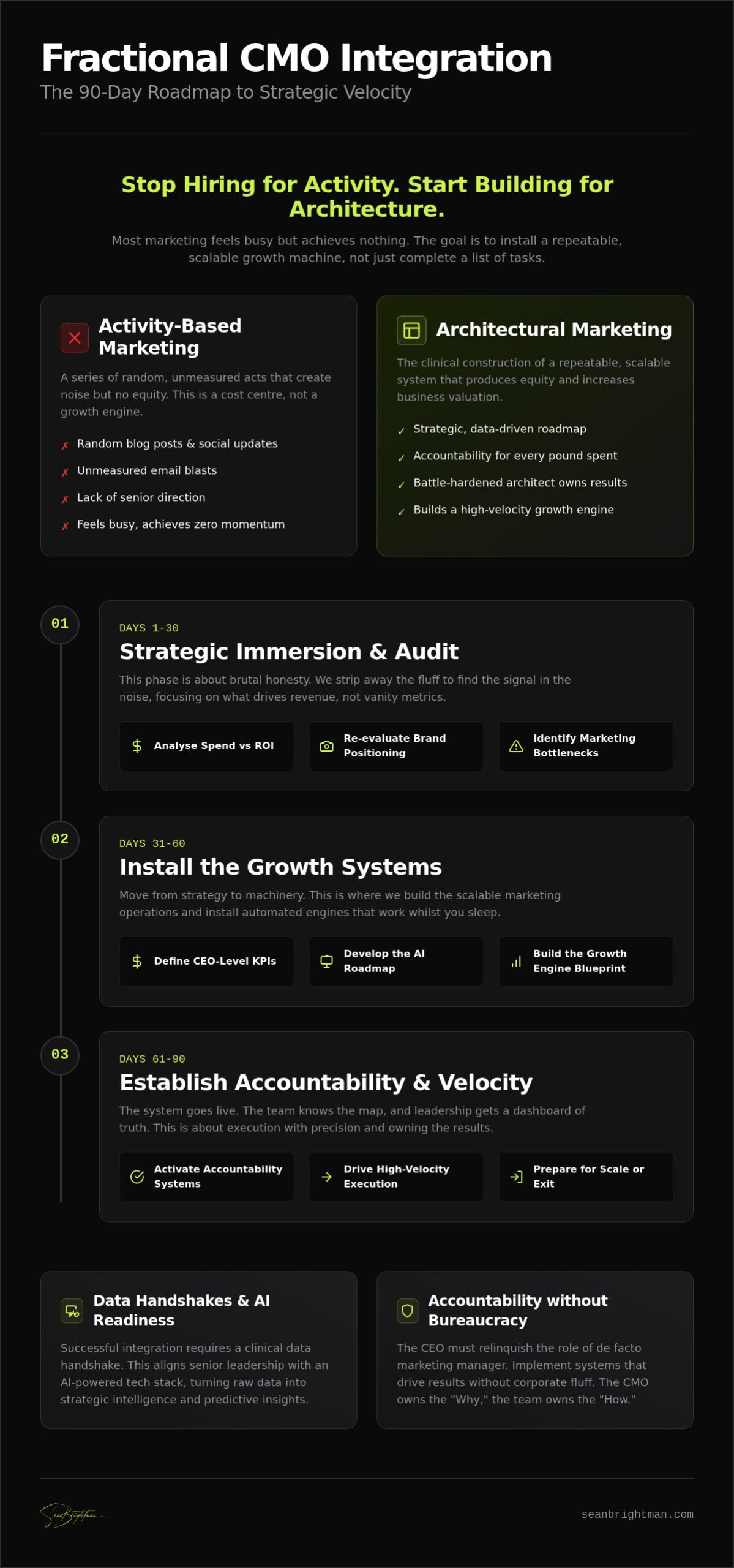
Your biggest bottleneck is likely staring at you in the mirror. CEOs often struggle with integrating a fractional cmo into your team because they cannot stop being the de facto marketing manager. You need to let go. You aren’t hiring a helper; you’re hiring an architect. If you’re still approving social media posts or tweaking ad copy, you’re failing to lead. You’re also burning the very strategic velocity you’re paying to create.
To drive true team discipline, consider the role of a Marketing operations consultant. They manage the plumbing. The Fractional CMO manages the strategy. This setup ensures accountability without you needing to dive into the weeds. It creates a buffer that allows you to focus on the business whilst the marketing engine runs on a clinical, pre-defined schedule. Accountability is about results, not hours logged.
Establish a staccato rhythm of reporting. Reports are for bureaucrats; briefings are for leaders. You don’t need a fifty-page slide deck once a month. You need a ten-minute high-impact briefing once a week. What’s the pipeline? What’s the blocker? What’s the fix? If the CMO isn’t challenging your assumptions, they aren’t doing their job. A “battle-hardened expert” maintains strategic integrity by saying “no” to the CEO’s distractions.
The Fractional CMO manages external agencies and internal staff without micromanaging. They own the “Why” so the team can own the “How”. This requires a binary rule: the CEO sets the destination; the CMO builds the vehicle. When targets are missed, we don’t look for excuses. We look for the mechanical failure in the system. Accountability is built into the architecture, not added as an afterthought. If you want to see how this leadership model scales, you can enquire about an Advisory Retainer to start the transition.
Stop treating the CMO like an external consultant. Your team will follow your lead. If you treat them like a vendor, the team will treat them like an intruder. Integrating a fractional cmo into your team means giving them a seat in your internal comms. Put them in Slack. Give them a company email. They must be present for high-level board or strategy discussions. If they aren’t in the room when the big decisions are made, they can’t align the marketing engine to your commercial goals. They are a partner, not a provider.
A business is a machine. If the machine breaks the moment you walk away, it isn’t a business; it’s a high-stress job. Integrating a fractional cmo into your team is the most effective way to build a marketing strategy for business exit that actually moves the needle on valuation. Buyers don’t buy your personality. They buy your systems. They buy the certainty that revenue will continue to flow without the founder’s personal network or a “hero” employee.
A proven growth engine is the most valuable asset on your balance sheet. It is not just about leads today. It is about the documented, automated infrastructure that guarantees leads tomorrow. A Fractional CMO builds this from the ground up, ensuring that the marketing function is a functional component of the business rather than an abstract theory. This is about building equity, not just chasing quarterly targets.
Buyers pay a premium for documented, automated marketing machines. They want to see that your growth is a result of machinery, not magic. Reducing “Key Person Dependency” is critical for a lucrative exit. If the founder is the primary rainmaker, the business has a glass ceiling. By proving scalability through historical data and AI-driven efficiency, you turn marketing from a cost into an investment-ready asset. You are selling a predictable future, not a chaotic past.
The transition from a Fractional leader to a full-time hire is a strategic move, not an emotional one. It usually happens much later than you think. You only need a full-time CMO when the engine is so large that it requires forty hours a week just to keep the gears turning. Until then, stay lean and high-impact. Avoid the £120k to £150k overhead of a full-time hire until the revenue justifies the permanent seat.
When the time comes, use your Fractional CMO to hire and train their full-time successor. They know the plumbing. They know exactly what the role requires because they built the roadmap. This ensures zero loss in momentum during the transition. However, many CEOs choose to stay with the fractional model indefinitely. They realise they don’t need a full-time executive; they need the strategic velocity that only a concentrated, battle-hardened expert provides. Integrating a fractional cmo into your team is not just a temporary fix; it is a long-term play for business maturity.
Activity is a cost. Architecture is an asset. You’ve seen why most marketing fails: it lacks the senior direction to turn random acts into repeatable revenue. Integrating a fractional cmo into your team isn’t about adding a consultant; it’s about installing a battle-hardened expert who owns the “Why” whilst your team masters the “How”.
We’ve covered the 90-day roadmap to velocity and the technical data handshakes required for AI-powered growth. This isn’t about more meetings; it’s about more momentum. You need a system that increases your business valuation and prepares you for a lucrative exit. Marketing shouldn’t be a mystery; it should be machinery.
Sean Brightman is the author of “The Growth Engine” methodology and a specialist in AI-powered marketing transformation. With a proven track record in UK scale-up growth, he helps CEOs stop guessing and start scaling. It’s time to turn your marketing from a cost centre into a clinical growth machine.
Book a Strategic Roadmapping Session with Sean Brightman to install your growth engine today. Your future valuation depends on the systems you build now.
Most engagements range from two to eight days per month. It depends on the complexity of your roadmap and the speed of growth you require. A Fractional CMO isn’t a full-time employee; they are a high-impact strategic force. They focus on outcomes rather than clocking hours. This model provides senior leadership at a fraction of the £120k to £150k cost of a full-time UK hire. You get strategy without the executive bloat.
Yes, they provide the senior direction your current team lacks. Successfully integrating a fractional cmo into your team means they own the “Why” and the strategy. Your internal staff or external agencies own the “How” and the execution. They install accountability and discipline, ensuring every team member knows their role in the growth engine. This prevents random acts of marketing and focuses everyone on your commercial exit or scale goals.
An agency sells services; a Fractional CMO sells strategy and results. Agencies are often “doers” focused on specific channels like SEO or paid media. A Fractional CMO is a “designer” who sits on your side of the table. They manage the agencies and ensure their activity aligns with your business objectives. They are your internal advocate, not an external vendor looking to upsell more billable hours or creative projects.
Modern leadership requires moving from manual labour to AI-powered efficiency. A Fractional CMO audits your tech stack and builds an AI roadmap to automate repetitive tasks. This isn’t just about using tools for basic content. It is about using AI for strategic insights and data analysis. They ensure your team works alongside AI systems to increase output without increasing your permanent headcount. They turn technology from a toy into a growth engine.
Costs vary based on the scope of the engagement and the seniority of the expert. However, a Fractional CMO is significantly more cost-effective than a full-time hire, which currently averages between £120k and £150k in the UK. You pay for high-level strategic velocity rather than a full-time salary and benefits package. This allows you to invest the savings back into your actual marketing spend or AI infrastructure to drive faster results.
You are ready when marketing feels random and unmeasured. If you have a team but no senior strategic direction, you’re likely burning cash on activity that doesn’t scale. Most businesses with annual revenues between £1 million and £30 million are in the “sweet spot”. You need the expertise to grow but don’t yet need the overhead of a permanent C-suite executive. It is about your readiness to install systems over activity.
Yes, by reducing “Key Person Dependency” and building documented systems. Buyers pay a premium for a business that runs on a growth engine rather than the founder’s personal effort. Integrating a fractional cmo into your team ensures that your marketing is an automated, scalable asset on your balance sheet. They provide the historical data and ROI proof points that sophisticated buyers demand during the due diligence process to justify a higher valuation.
They need a clinical data handshake with your entire tech stack. This includes unfiltered access to your CRM, financial reports, and current marketing performance metrics. They look for the signal in the noise to identify where your budget is being wasted. You must be prepared to share the messy reality of your numbers. Only with clear data can they build a clinical roadmap that leads to strategic velocity and measurable commercial growth.
Reading is good. A roadmap is better.