

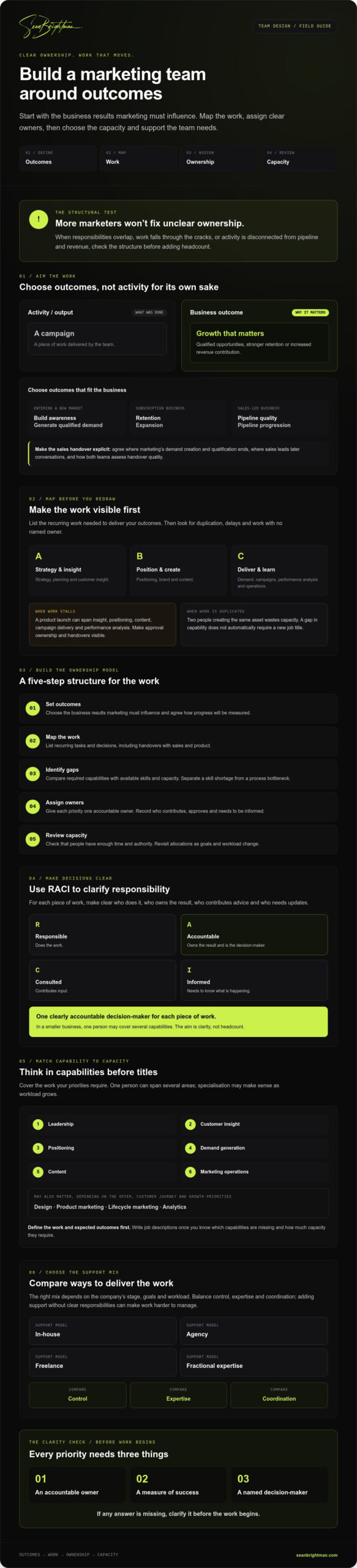
More marketers won’t fix a team where nobody owns the outcome. When responsibilities overlap, important work falls through the cracks and activity doesn’t connect to pipeline or revenue, the issue may be the structure, not the headcount. Learning how to structure a modern marketing team starts with the work that drives growth, then gives each part a clear owner.
Marketing needs a mix of skills, but the harder question is whether to hire, outsource or bring in fractional expertise, and how to combine those choices without creating confusion. Adding people without clear responsibilities and decision rights can make work harder to manage, not easier.
This guide shows how to build a structure that fits your company’s stage, goals and workload. You’ll learn how roles can evolve as the team grows, how to combine employees with specialist partners and senior advisory support, and how to set measures tied to business outcomes. The aim isn’t a complicated org chart. It’s a team with clear accountability and the capacity to deliver.
A modern marketing team isn’t defined by its org chart. It’s a group with the capabilities and decision rights to influence the business outcomes that matter. The right structure depends on your goals, customers and workload, not a template copied from another business.
An org chart shows who reports to whom, but it can’t resolve competing priorities, duplicated tasks or work nobody owns. Marketing management covers strategy, planning and implementation. Team design needs to connect those disciplines to clear priorities and responsibility.
Translate company goals into a small set of marketing outcomes. Choose measures that reflect how your business grows, rather than tracking activity for its own sake. A campaign is an output; qualified opportunities, stronger retention or increased revenue contribution are outcomes.
The emphasis depends on your business. A company entering a new market may need to build awareness and generate qualified demand. A subscription business might focus on retention and expansion, whilst a sales-led business may prioritise pipeline quality and progression. Choose outcomes that fit your model and stage, then agree how marketing and sales will share responsibility. For example, marketing may create and qualify demand while sales leads later conversations. Define the handover and how both teams will assess its quality.
Use this test for every priority: Does it have an accountable owner, a measure of success and a named decision-maker? If any answer is missing, clarify it before the work begins.
Before deciding who reports to whom, list the work needed to deliver your outcomes. Include recurring activities across strategy, insight, demand, brand, content and operations. Mark what’s duplicated, where work gets stuck and what has no named owner. A gap may call for a new capability, but it doesn’t automatically mean you need a new job title.
Make handovers visible. A product launch, for example, may involve product insight, positioning, content, campaign delivery and performance analysis. If everyone assumes someone else owns approval, the work stalls. If two people create the same asset, capacity is wasted.
The RACI concept can clarify responsibilities. Identify who is Responsible for doing the work, who is Accountable for the result, who should be Consulted and who needs to be Informed. Give each piece of work one clearly accountable decision-maker. In a smaller business, one person may cover several capabilities. The goal is clarity, not headcount.
That’s the practical starting point for how to structure a modern marketing team: define the outcomes, map the work and assign ownership before redrawing the org chart.
Turn your priorities into a working ownership model. This five-step sequence shows how to structure a modern marketing team without assuming every capability needs its own hire or job title.
Think in capabilities before titles. Most teams need some form of leadership, customer insight, positioning, demand generation, content and marketing operations. Design, product marketing, lifecycle marketing or analytics may also be important, depending on the offer, customer journey and growth priorities.
One person might cover several areas in a smaller business. As workload grows, specialisation may make sense. Define the work and expected outcomes first. Write job descriptions once you know which capabilities are missing and how much capacity they require.
Separate three responsibilities that are often muddled: strategic ownership sets direction and is accountable for the result; specialist contribution brings the skills needed to deliver; approval authority makes the final call. These may sit with different people, but everyone should know who holds each responsibility.
For example, a marketing lead could be accountable for a product launch outcome, with specialists contributing positioning and content and a named decision-maker approving claims or investment. Document handovers and dependencies with product and sales. Shared delivery should not mean unclear accountability.
Set measures that match each person’s remit. Assess a content specialist on whether content reaches the intended audience and supports qualified demand, not simply on the number of pieces published. A marketing operations owner might focus on data quality, useful reporting and reliable handovers. Activity counts can help diagnose workload, but on their own they’re weak measures of impact.
Clear processes help responsibilities hold up as work scales. Explore marketing operations and scalable growth systems for more on building the supporting structure. If priorities or accountability remain unclear, Fractional CMO leadership can provide senior direction without a full-time appointment.
There’s no prize for building the biggest team. Choose a resourcing model that matches the work: how often it’s needed, the expertise it requires and how closely it must connect to your customers and product. A smaller team can cover more ground when priorities are clear and external support is chosen selectively.
| Model | Control | Continuity | Specialist depth | Coordination load | Best suited to |
|---|---|---|---|---|---|
| In-house hire | High | High | Depends on the hire | Internal management and onboarding | Steady work needing product or customer context |
| Agency | Shared | Set by the engagement | Can span several specialisms | Briefing, feedback and approvals | Defined delivery needs or capacity gaps |
| Freelancer | Shared | Varies by arrangement | Focused expertise | Scoping and coordination | Specific tasks or short-term specialist input |
| Fractional senior leadership | Strategic direction with internal delivery | Ongoing or agreed support | Senior marketing perspective | Works best with a clear internal point of contact | Setting priorities and accountability without a full-time CMO |
Bring work in-house when it’s steady, central to growth and relies on close knowledge of your product, customers or internal teams. Before creating a permanent role, check whether the workload is likely to remain consistent and who will manage, onboard and support the person. A specialist can add capability, but the role needs a clear remit and enough work to justify it.
Agency support can suit a defined specialist delivery need or a temporary capacity gap. Freelancers can add focused expertise without creating a permanent role. Fractional leadership is different: it provides senior direction when the business needs sharper priorities and accountability, but not a full-time CMO. It doesn’t replace the people responsible for day-to-day delivery.
Mixed models work best when one internal owner joins the pieces together. Without that person, briefs, approvals and handovers can create more coordination work than the external support removes. Before work begins, agree the scope, decision rights, dependencies and measures of success.
If the gap is senior direction rather than hands-on capacity, consider fractional CMO leadership without a full-time role. The right answer to how to structure a modern marketing team isn’t choosing one model for everything. It’s keeping ownership inside the business and matching specialist support to the work that needs it.
Don’t start with new job titles or reporting lines. First check what the business needs, what work already happens and where it gets stuck. This sequence turns those findings into a structure you can test, rather than a permanent reorganisation based on assumptions.
Not every gap calls for a new hire. Separate three problems: a skills gap means the team lacks a capability; a capacity gap means the skill exists but there isn’t enough time; a decision-making problem means work is stalled by unclear authority or approvals. Each requires a different response.
Rank gaps by business impact, urgency and the cost of leaving them unresolved. A simple capability matrix can make the trade-offs visible:
Use these examples as prompts, not assumptions. Fill the matrix with your own evidence: workload, skills, bottlenecks and links to priority outcomes. Check dependencies too. A new role won’t solve a delay caused by missing product input or slow approvals.
Before changing responsibilities, record a baseline: which priorities have owners, where handovers break down and how current work performs against its intended outcomes. Set a review date once the new arrangement has had enough time to operate. Check results, workload and decision delays, not just completed tasks.
If ownership is clearer but outcomes haven’t shifted, investigate the work, dependencies and measures before adding another role. A pilot lets you adjust the structure while the change is still manageable. For help turning priorities into a practical sequence, read building a marketing strategy roadmap that works.
Need a structured way to assess priorities and capability gaps? Explore strategic roadmapping support before committing to a new team design.
As the team changes, the leader’s job shifts from personally pushing every task forward to keeping the system clear. Strategy, priorities and decision rights must remain visible, especially when employees and external specialists share the work. That’s how you stop new capacity creating new confusion.
Knowing how to structure a modern marketing team is only part of the work. The structure also needs a management rhythm that checks whether priorities still fit the business, responsibilities remain clear and the team has capacity to deliver.
Use planning sessions to choose priorities for the next working period and state what the team will not do. That trade-off protects focus. Then review progress against business outcomes, what campaigns have taught you, where work is blocked and whether workload is manageable.
Involve sales, product or senior leadership when their decisions or customer insight affect delivery. Keep a simple decision log with the decision, who made it and what happens next. This helps prevent teams reopening settled questions or guessing who has approval.
Review four things together:
AI may help with repeatable tasks such as organising information, supporting analysis or speeding up early content drafts. Treat it as a capability within a managed workflow, not a replacement for strategy or accountability. Assign someone to check accuracy, context, brand fit and approval before AI-assisted work reaches customers or informs a decision. For practical guidance, explore practical AI consulting for scalable marketing growth.
If the team can deliver but lacks senior direction, a fractional CMO or adviser can help set priorities, clarify accountability and maintain focus without a full-time CMO. This support guides the operating model; it doesn’t replace every specialist or remove the need for internal owners.
Need to connect team responsibilities with business priorities? Discuss a practical team and marketing roadmap to define what the structure needs to deliver next.
The strongest marketing structure isn’t the most elaborate. It connects business goals to clear ownership, gives people decision-making authority and matches in-house capacity with the specialist support the work requires. That’s the practical answer to how to structure a modern marketing team.
Start with outcomes, map the capabilities and workload needed to influence them, then review whether the structure is working. Keep priorities visible as the team grows, and adjust roles when evidence shows a genuine gap, not just because the org chart looks untidy.
If senior direction is the missing piece, fractional CMO and advisory support can provide strategic guidance on a part-time basis. Roadmapping can help turn business goals into a structured marketing and brand direction, with clearer priorities and next steps.
Talk through your marketing team structure and next steps. A clear plan can help your team focus its effort, own the work and build momentum with confidence.
Structure it around the business outcomes marketing needs to influence, then assign clear owners to the work and decisions required. To decide how to structure a modern marketing team, map the necessary capabilities, check current skills and capacity, and identify gaps before creating roles. Give each priority an accountable owner, a measure of success and a named decision-maker. Review the arrangement as business goals and workload change.
Cover the capabilities your priorities require, which may include marketing leadership, customer insight, positioning, demand generation, content and marketing operations. Add design, product marketing, lifecycle marketing or analytics when the business needs them. These are capability areas, not a mandatory list of job titles. In a smaller team, one person may cover several. Define the responsibilities and expected outcomes first, then decide whether they need dedicated roles.
A small business should keep the structure lean: name an owner for each priority, make responsibilities explicit and avoid creating roles before confirming the work and capacity required. One marketer may cover several capabilities, while specialist or senior external support can fill specific gaps. Keep decision-making simple. For each priority, clarify who leads, who contributes and who approves, then review whether the arrangement is delivering against business goals.
Neither model fits every business. Organising by function, such as content or demand generation, can build specialist expertise. Organising around outcomes or customer journeys can help teams connect work across channels. Avoid creating channel silos where each team optimises its own activity without shared goals. Start with the outcomes and recurring work, then choose the arrangement that gives each priority clear ownership and makes cross-team decisions straightforward.
Consider an in-house hire when the work is ongoing, the capability is consistently needed and close product or customer knowledge matters. Check that there’s enough sustained workload, as well as management and onboarding capacity to support the role. An agency may suit a defined specialist requirement or a delivery gap. Compare the options by control, continuity, expertise and coordination effort, then set scope and measures before work begins.
Yes. A fractional CMO can provide senior marketing leadership on a part-time basis, helping an existing team clarify priorities, direction and accountability. This is strategic leadership, not a replacement for every specialist or a promise to take over all delivery. Agree decision rights with the business and team, including who owns execution and approvals. It can suit a company that needs senior direction but not a full-time CMO.
AI should influence how work gets done, not remove the need for clear roles or accountable decisions. Identify suitable workflows, such as organising information or supporting early analysis, then name who checks the output for accuracy, relevance and brand fit. Assign responsibility for approving work before it informs decisions or reaches customers. Build practical AI capability into existing roles or add specialist support where needed, without treating tools as a substitute for strategy.
Reading is good. A roadmap is better.