

Marketing objectives should drive business results, not just collect vanity metrics. Setting marketing team objectives and key results means pairing a clear, qualitative objective with measurable key results that show progress. When targets reflect wider business priorities, they guide the team’s work and define how success is judged.
It’s easy to fill a plan with activity: more posts, clicks or campaigns. But activity matters only when it moves the business towards a meaningful outcome. The challenge is choosing targets that are ambitious enough to matter and realistic enough to pursue.
This guide explains how marketing objectives shape strategy, how to set specific, achievable goals, and how to monitor performance and adapt. You’ll learn to connect targets to business priorities, choose measures that reveal progress, and keep the team focused on outcomes rather than busywork.
Start by tracing each marketing target back to a business priority. That connection turns strategy into focused work instead of a list of disconnected campaigns.
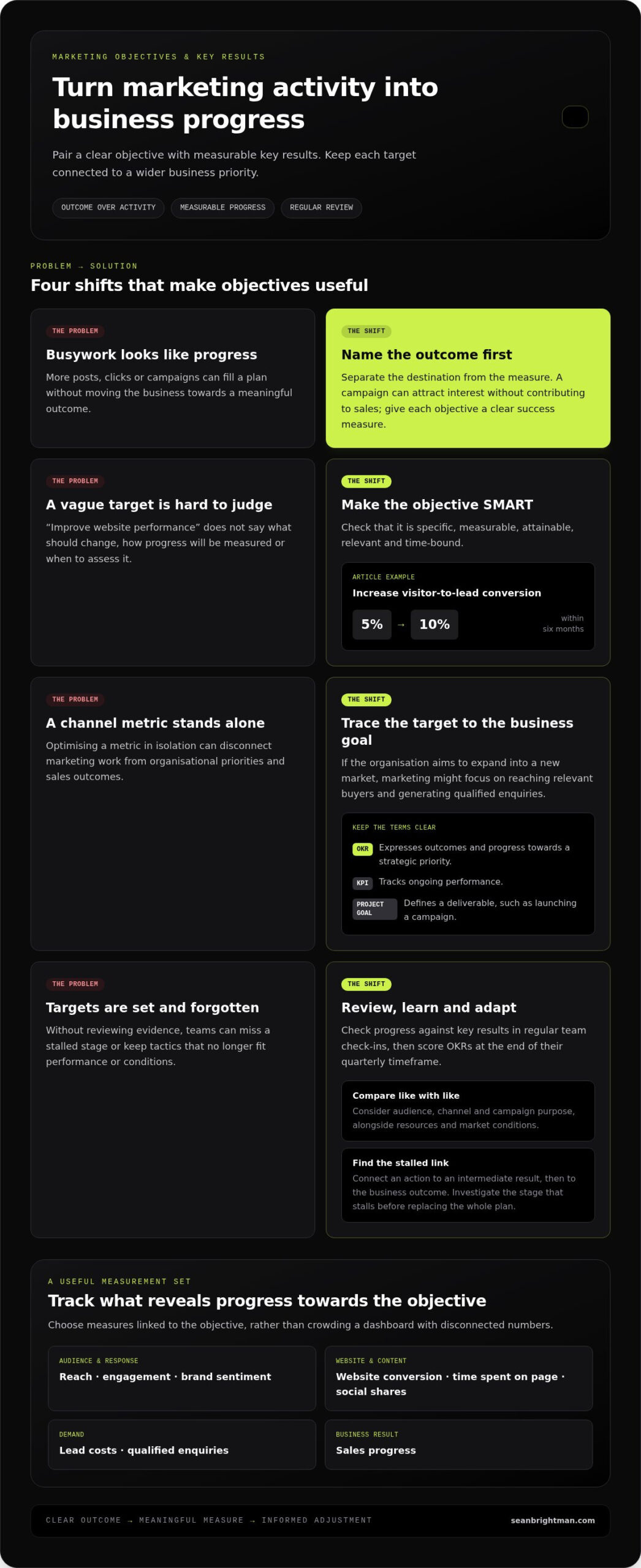
Separate the destination from the measure. A marketing goal can describe a qualitative ambition, such as strengthening trust, while an objective makes progress measurable, such as improving customer retention. Give each objective a clear success measure. Publishing posts or running advertising is activity, not the outcome. A campaign, for example, can attract interest without contributing to sales.
Choose the business result marketing must support, then define an objective around its contribution. If the organisation aims to expand into a new market, marketing might focus on reaching relevant buyers and generating qualified enquiries. Check the connection with sales and other teams: an objective should support organisational priorities, not optimise a channel metric in isolation. Explain how its measure signals progress towards the wider goal.
Build each OKR around a strategic priority and a sales outcome. For example, if the company needs stronger sales from a new offer, make that the objective and use measurable key results to track qualified leads or sales progress. Marketing OKRs express outcomes and progress; KPIs track ongoing performance, while project goals define deliverables, such as launching a campaign. OKRs commonly run quarterly. Set only objectives and key results the team can own and review meaningfully.
Record each objective, key result, owner and business rationale in one shared team tracker. An OKR document or project-management board keeps progress visible; the right tool is the one your team will update and use in reviews. Explain how each measure connects marketing activity to sales or strategy, and invite team members to flag dependencies. This clarity helps everyone understand their role and what success looks like.
A marketing objective turns a business priority into a measurable target. A practical approach to setting marketing team objectives and key results starts by naming the outcome, then deciding how the team will recognise progress.
Begin with a business objective, then identify the audience behaviour marketing can influence. If the priority is stronger brand awareness, consider recognition among target buyers or relevant social media engagement. If it is conversion, focus on moving interested prospects towards an enquiry or purchase. Ask the people delivering the work to suggest possible measures. Don’t choose a metric simply because it is easy to collect.
Test every draft against five checks: specific, measurable, attainable, relevant and time-bound. Replace “improve website performance” with a defined target, such as increasing visitor-to-lead conversion from 5% to 10% within six months. Next, check the baseline, available resources and the team’s influence over the result. A deadline without delivery capacity is wishful thinking; a measure without a connection to business objectives is noise.
Use the objective to state the outcome, then key results to show evidence of progress. For brand awareness, aim to strengthen recognition and track relevant audience reach. For demand generation, focus on qualified enquiries and follow their progress into sales conversations. For retention, target stronger customer loyalty and track repeat purchasing behaviour. Keep measures tied to outcomes, not simply activity volume.
Common mistakes include vague outcomes, vanity metrics, targets disconnected from business priorities and results the team cannot influence. Treat setting marketing team objectives and key results as a working process: test whether each measure guides a useful decision. If your objectives need a clearer route into delivery, a marketing roadmap can connect priorities, measures and work.
A marketing strategy sets out how to reach prospective customers and turn them into sales. Monitor whether its actions move people through that journey, then adjust based on evidence.
Keep the plan current: revisit goals and objectives using analytics and check-ins, and let feedback, results and future projections guide revisions.
Set objectives based on evidence, not optimism. Effective marketing OKRs link a business outcome to measurable results, a clear owner and work the team can realistically deliver.
Even when the right target is uncertain, set specific, measurable, numerical goals and use the results to iterate. A key result might be for repeat customers to account for 25% of sales; other examples include increasing social media followers by 15% over six months or securing media coverage in three industry publications within the next quarter.
Set goals for each stage of the customer journey, so marketing and sales contribute throughout rather than focusing on selected stages. For funnel goals, start with sales targets and work backwards to the leads, traffic and awareness needed to support them.
Sean Brightman’s AI Consulting can help you assess how practical AI systems could support marketing priorities and objectives. Explore where AI fits your strategy, keeping the focus on useful outcomes rather than adopting tools for their own sake.
If objectives lack a clear route to delivery, Roadmapping can connect priorities with the work needed to move them forward. An Advisory Retainer provides ongoing strategic input as plans evolve. Choose support that matches the challenge: exploring AI’s role, turning objectives into a roadmap or maintaining strategic direction.
Bring a defined marketing challenge and the business outcome you want to support. That gives the discussion a practical starting point. Visit seanbrightman.com to get in touch with Sean Brightman.
Next, make your objectives part of how the team chooses and prioritises work. Before adding a campaign, ask which outcome it supports, who owns the result and what should stop if priorities shift. This discipline keeps strategy connected to daily decisions instead of leaving it on a planning document.
The value of setting marketing team objectives and key results lies in making trade-offs visible. If your team needs senior marketing direction, Sean Brightman offers Fractional CMO support. Roadmapping can connect priorities to execution, while AI Consulting can help assess where practical AI systems fit your marketing work.
Choose the support that matches the challenge in front of you. Contact Sean Brightman to discuss your marketing priorities. Make the next move with focus, and give the team a clearer path forward.
Make goal setting more efficient by gathering business priorities and campaign evidence before the planning discussion. Ask sales which customer objections or lead-quality issues matter most, then use that input to shape marketing’s contribution. Record each proposed objective, decision-maker, data source and dependency in one shared document. This preparation keeps the discussion focused on decisions, rather than reconstructing context.
Monitor indicators that match the work’s place in the customer journey. For a paid campaign, click-through rate shows whether an advert attracts clicks, while Return on Ad Spend measures revenue generated per pound invested in advertising. Pair these with a quality or conversion measure so rising traffic doesn’t disguise weak enquiries. Choose a small, relevant set for each campaign and apply its definitions consistently.
A practical framework connects business priorities to team objectives, measurable results, named owners and supporting work. Record dependencies, decision rights and progress in a shared place, so contributors know where to raise blockers. For example, a product launch objective might depend on sales enablement and website updates. Review OKRs over a quarterly cycle, then carry forward only priorities that remain relevant.
Reading is good. A roadmap is better.