

AI won’t rescue messy marketing data. Preparing your marketing data for AI means making it accurate, connected, governed and useful for a defined business goal. AI-ready data isn’t simply a larger dataset; it’s information your team can trust to support a specific decision or outcome.
Focus on the foundations before choosing a model or launching a pilot. Poor-quality inputs can produce unreliable outputs, while disconnected systems make it harder to see what’s working. The practical fix is to assess what you have, identify what’s missing and prepare only the data your use case needs.
This guide shows you how to assess marketing data readiness, engineer useful features and build governance into the process. You’ll also learn how to connect each preparation decision to a business goal, so the work supports measurable priorities rather than AI for its own sake.
AI marketing tools work best with consistent, clearly labelled records: structured tables for transactions and campaign events, plus text or images tagged with useful categories. Choose platforms that connect data sources and support access controls, lineage and audit trails. Preparation costs depend on source count, data condition, integration work and monitoring needs; the price depends on the case and is given after a quote request.
Governance makes marketing data traceable, controlled and fit for analytics tools and AI models. Build it into your data environment before connecting new applications.
Map each important field from its original source to the analytics report or AI model that uses it. Record its owner, definition, update frequency, permitted uses and any transformations.
Use shared definitions for measures such as campaign conversion, so teams don’t combine records based on different meanings. Version control and audit trails show what changed, when it changed and which outputs relied on that data.
Set access rules by role and purpose, then document who owns each dataset. Apply privacy controls to customer information and create policies that support GDPR compliance.
Limit access to the fields an AI model needs. For example, campaign analytics may require purchase category and response history, not every detail in a customer record. Review permissions whenever data moves between platforms.
Set a review process for high-impact decisions. A human owner can check whether an output uses the intended data and whether its result should inform a marketing action. This gives teams a practical way to challenge errors.
Track access exceptions, unresolved lineage gaps and repeated output errors as governance signals. Adobe reports that 62% of consumers say transparency about AI use directly affects their trust. Explain where AI contributes to marketing decisions, and keep a record of the data and rules behind those decisions.
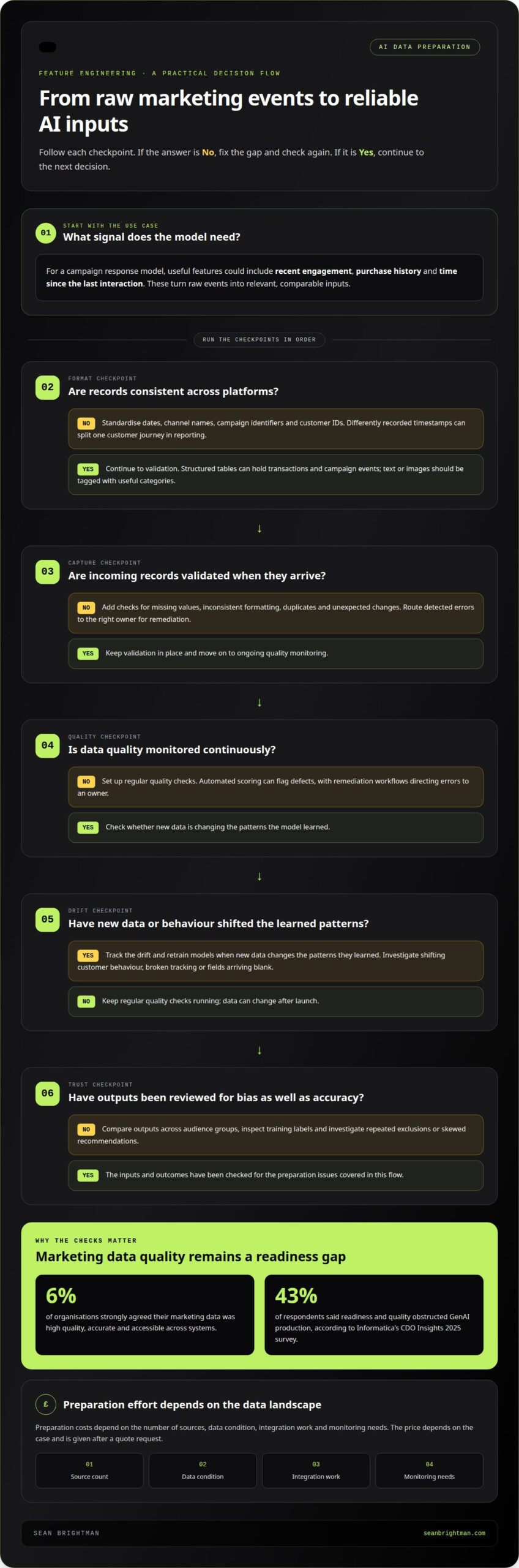
Start with the business outcome, then prepare data to support it. To unify CRM, web analytics and advertising platforms, connect records through shared identifiers and definitions, while preserving their source and timing.
Agree on the meaning of each metric before feeding it into an AI model. Define whether a conversion means a purchase, a signed agreement or another event, then apply that definition consistently across reports and teams.
Use common naming conventions for fields such as campaign source and customer status. The Scottish Government notes that common standards can improve data quality and interoperability, making information easier to reuse and link.
Connect CRM records, web analytics events and advertising results through shared customer, campaign and time references. Preserve the original source and timestamp so teams can trace each interaction instead of losing useful context by flattening the data.
Check that matching fields describe the same thing across platforms. A click in an advertising report and a visit in web analytics are different events, even when they belong to the same journey.
Start with a data audit, not an AI tool. Gartner’s Q3 2024 survey found 63% of organisations either lacked, or were unsure they had, suitable data management practices for AI.
Sean Brightman helps turn marketing data readiness into a practical AI plan tied to business priorities. If your data is spread across disconnected platforms, or teams can’t agree on what success means, AI Consulting can clarify the use case, capabilities and decisions that need support.
Roadmapping can sequence the work: identify valuable data gaps, set governance priorities and define what to prepare before a model goes live. An Advisory Retainer provides ongoing strategic guidance as your needs and AI initiatives develop.
The right next step depends on the bottleneck: unclear goals, fragmented data or a lack of implementation direction. If you’re ready to make those decisions, contact Sean Brightman to discuss your priorities.
Preparing your marketing data for AI isn’t a one-off clean-up. Treat it as an ongoing business capability, with clear ownership and regular decisions about which use cases deserve attention. As customer behaviour, campaign priorities and systems change, revisit whether the data still supports the decisions you want AI to improve.
Choose one outcome and give it an accountable owner. That keeps the work grounded in business value instead of letting new tools dictate the agenda. Sean Brightman can help shape your strategy and decide how to move from data readiness to practical action.
If you’re ready to set that direction, contact Sean Brightman to discuss your priorities. Start with the decision you want to improve, then build from there.
AI-ready marketing data is information an AI tool can interpret and use for a defined task. It needs clear labels, usable formats and enough context to distinguish events, customers and outcomes. For example, product recommendations need meaningful product and purchase records, not an unlabelled export. Readiness depends on whether the data supports the intended decision, not simply how much information is stored.
The foundations are similar, but ownership and access can differ. An in-house team usually works across its organisation’s systems and definitions. An agency may serve several clients, each with separate data permissions, reporting conventions and campaign goals. Keep client datasets distinct, document who can access them and agree how results are defined before combining information for analysis.
Structure unstructured material before using it. For support emails, label examples by topic or outcome; for customer feedback, use consistent sentiment categories. Text extraction can make documents searchable, while image labels can describe relevant visual content. Keep the original source attached to each record, and remove irrelevant or sensitive material before it enters a model workflow.
Build in-house when your team can maintain the connections, transformations, monitoring and access controls the use case requires. A managed integration tool may suit standard sources and limited engineering capacity, but it still needs clear ownership. A sound plan for preparing your marketing data for AI considers ongoing maintenance, flexibility and auditability, not just setup speed. Either approach needs upkeep as platforms and data fields change.
AI can produce misleading figures when inputs use different definitions or contain incomplete records. For example, an advertising platform may count an attributed conversion differently from a CRM report of completed sales. Time periods, duplicate events and delayed updates can widen the gap. Trace the figure to its source, check the calculation and confirm both systems measure the same outcome.
Preparing your marketing data for AI means making information usable for a chosen task, not cleaning everything indiscriminately. The work can include selecting relevant sources, resolving inconsistent records, creating meaningful labels, setting access rules and testing whether outputs support the intended decision. For a small team, start with one clear use case and a manageable dataset, then expand as the process proves useful.
Reading is good. A roadmap is better.