

More activity won’t fix a marketing team that’s focused on the wrong work. If you’re asking how to improve marketing team performance, resist the easy answer: add campaigns, tools or hours. A packed calendar can still leave the team’s contribution to business goals unclear, especially when priorities keep shifting and every request seems urgent.
When results stall, the cause might be strategy, skills, process or capacity. Treating every problem as an effort problem only adds pressure and noise. Better performance comes from fixing the system around the team, not simply demanding more output.
This guide will help you diagnose what’s holding your team back, set priorities and measures people can act on, and build an improvement plan with clear ownership and review points. You’ll learn how to distinguish meaningful progress from activity and focus the team on work that supports business goals.
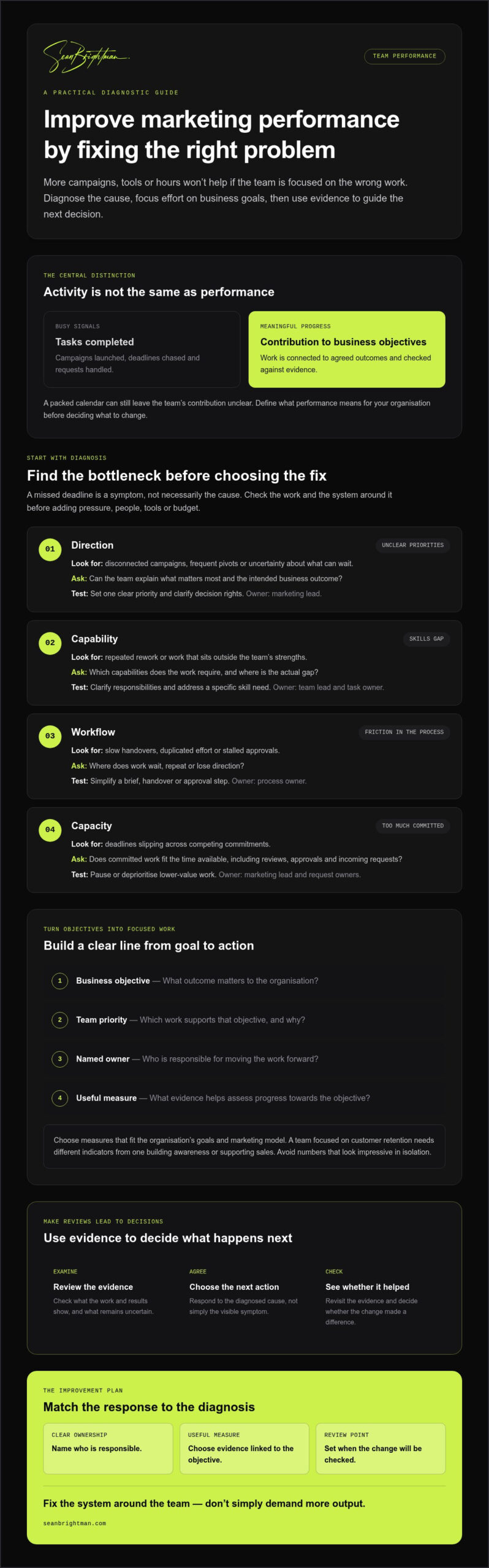
The team is busy. Campaigns are moving, deadlines are being chased and the request queue keeps growing. Yet if nobody can explain how that work supports business results, more activity won’t solve the problem. To work out how to improve marketing team performance, define what performance means for your organisation, then identify the gap between that goal and what the team is delivering.
Marketing performance isn’t a tally of tasks completed or campaigns launched. It’s the team’s contribution to agreed business objectives. The discipline of Marketing management covers the analysis, planning, implementation and control of marketing programmes. Apply that thinking to your team: connect work to a business outcome, check whether it’s being delivered, then assess what the evidence shows.
Separate symptoms from causes. A missed deadline is a symptom. The cause might be conflicting priorities, unclear approvals, a capability gap or insufficient time. Changing people, buying tools or adding budget before checking the cause risks treating the visible problem while the real one remains.
Strong performance starts with a small number of current business objectives that marketing can influence. The team should be able to explain which priorities support those objectives and why. Ownership is clear, delivery is dependable, and decisions respond to evidence rather than habit or the loudest request.
Measures depend on the organisation’s goals and marketing model. A team focused on customer retention needs different indicators from one building awareness or supporting sales. Choose measures that help assess progress towards the agreed objective, not numbers that look impressive in isolation.
Start with questions, not assumptions. Ask each team member to name the priorities and explain why they matter. Compare the capabilities those priorities require with the team’s current skills and responsibilities. Then compare available time with committed work, including reviews, approvals and incoming requests.
Use this quick diagnostic before proposing a restructure or new investment:
Test the answers against actual work and results. If priorities conflict, clarify direction first. If one skill is missing, identify that gap before concluding the whole team needs to change. If capacity looks tight, check whether lower-priority work can stop. Diagnose first, then choose the intervention.
A missed target doesn’t automatically mean someone failed to perform. The cause may sit upstream: priorities keep changing, a task lacks a clear brief, approvals stall or the team has more work than available time. Pinpoint the constraint before adding training, headcount or another tool.
Use this comparison to focus your investigation. Choose one small change to test, then check whether it removes the obstacle.
| Symptom | Question to investigate | Action to test | Owner |
|---|---|---|---|
| Disconnected campaigns or frequent pivots | Can the team explain the audience, offer and intended business outcome? | Set one clear priority and decision rights. | Marketing lead |
| Repeated rework or work outside the team’s strengths | Which capabilities does the work require, and where is the actual gap? | Clarify responsibilities; address a specific skill need. | Team lead and task owner |
| Slow handovers, duplicated effort or stalled approvals | Where does work wait, repeat or lose direction? | Simplify a brief, handover or approval step. | Process owner |
| Deadlines slipping across competing commitments | Does committed work exceed the time available? | Pause or deprioritise lower-value work. | Marketing lead and request owners |
Ask team members to describe the target audience, offer and business outcome in their own words. If their answers conflict, or campaigns pull in different directions, the issue may be leadership and alignment rather than execution. Frequent priority changes and unclear decision rights are further clues.
Use a focused planning process to connect strategic choices to practical priorities. The strategic brand roadmapping guide explores how to turn direction into a plan. If senior oversight is missing, fractional CMO leadership is one option to consider.
Map a recurring task from brief to delivery. Note the skills it needs, each handover and every approval. If capable people are reworking vague briefs or waiting for decisions, fix the process before prescribing training. If the workflow is clear but a specific skill is missing, address that capability gap directly.
Check capacity separately. Compare actual commitments with available time, including unplanned requests and review work. A team that can’t protect time for agreed priorities may need fewer competing demands, not a performance warning.
How people communicate can reveal hidden friction. The New Science of Building Great Teams examines team interaction, a useful reminder to look beyond task lists and inspect how decisions and handovers happen. To improve marketing team performance, fix the constraint, not just the visible symptom.
Once the bottleneck is clear, turn the diagnosis into a working agreement. A priority without an owner is a wish. A metric without a business outcome is noise. This five-step process shows how to improve marketing team performance by aligning the work, accountability and evidence.
If new work becomes a priority, make the trade-off explicit. Decide which existing task will pause or move down the list. Otherwise, priorities multiply while capacity stays fixed.
Choose measures that fit the objective, channel and customer journey. A measure useful for assessing awareness may tell you little about retention. Activity counts, such as emails sent or posts published, show what the team did, not whether it contributed to a business outcome.
Keep a compact scorecard: the objective, priority, owner, one or two leading indicators, the relevant lagging outcome and the next review date. Avoid universal targets. What’s useful depends on the organisation, its starting point and marketing model. Record attribution limits too. If several factors influence an outcome, explain what the data can and can’t show instead of presenting an uncertain connection as proof.
For each priority, define the expected result, who is accountable, who can approve delivery and when progress will be reviewed. Team members need room to execute, but decision rights must be clear enough to prevent work stalling in a queue or competing requests quietly taking over.
Use the scorecard to make decisions, not to police activity. If the indicator moves but the outcome doesn’t, investigate the assumption or the customer journey step. If neither moves, decide whether to change the approach or release capacity. Clear ownership turns measures into action, while review dates stop priorities from drifting.
A dashboard won’t improve results by itself. Its value comes from what the team decides after looking at it. Build a recurring review around evidence and action, not a tour of completed tasks.
Keep the discussion focused on the work and the evidence. A missed target isn’t a verdict on an individual; it’s a reason to investigate. If you need to discuss someone’s development or performance, do that separately and privately, with the right context. Mixing the two can turn a useful review into a meeting people attend to defend themselves.
Ask three questions: what changed, what does the evidence suggest, and what decision is now required? Skip updates everyone can read beforehand. Record the decision, action, owner and review date so the learning doesn’t disappear when the meeting ends.
Before adding work, check whether current priorities still fit business needs. If the cause of a result is uncertain, run a contained experiment with a clear hypothesis and review point. This creates a chance to learn without committing the team to a large change based on a hunch. Better decisions, not more reporting, are how to improve marketing team performance.
Consider additional senior direction when no one clearly owns strategy, prioritisation or accountability. A Fractional CMO provides part-time senior marketing leadership. The role is to set direction and create priorities, ownership and review mechanisms, not to recruit a full-time leader or replace the team’s execution.
For a closer look at the model, read the Fractional CMO leadership guide. If your team needs clearer strategic direction and accountability, explore Fractional CMO leadership as one option.
A diagnosis only matters if it changes what happens next. Turn the evidence into a small plan: name the bottleneck, choose an intervention that addresses it, assign an owner, decide how you’ll measure progress and set a review date. That’s how to improve marketing team performance without defaulting to another tool, a new hire or simply more campaigns.
Keep the team responsible for execution. Strategic guidance can sharpen direction and create accountability, but it shouldn’t replace the people doing the work. Make that boundary clear in the plan from the start.
Choose one or two priorities that address the diagnosed constraint. For example, if approvals stall delivery, test a clearer decision route before investing in more capacity. If the team lacks direction, agree which work supports the current business objective and what can wait. Keep the intervention proportionate to the problem.
For each priority, record the baseline, the evidence you’ll collect, the person responsible and the date you’ll review progress. A baseline might be the current number of approval stages or the present level of a relevant outcome. Don’t invent a target before you know what the evidence can support.
At the review, use what the team has learned to make the next decision. If the intervention hasn’t addressed the cause, revise the plan rather than layering on extra work.
Roadmapping can turn strategic questions into a structured direction and plan. An advisory retainer can provide ongoing strategic direction and accountability, while the internal team retains ownership of delivery. This can help when no one internally clearly owns priorities or the review process.
If an outside perspective would help clarify your next move, discuss strategic marketing support. An initial conversation can help you explore whether roadmapping, Fractional CMO leadership or ongoing advice fits the challenge. The aim is a clearer plan and stronger ownership, not a promise of guaranteed results.
Improving performance doesn’t mean keeping everyone busier. It means identifying what’s blocking progress, choosing priorities that support business goals and giving the team a clear way to measure and review its work. That’s the practical answer to how to improve marketing team performance: fix the cause, then focus effort where it can make a difference.
If strategy, prioritisation or accountability lacks a clear owner, senior support can help bring structure. Fractional CMO services provide part-time marketing leadership, while roadmapping and advisory support can turn strategic questions into direction, ownership and review. Where a diagnosed workflow issue calls for it, AI consulting focuses on practical marketing implementation.
Discuss a clearer strategic direction for your marketing team and explore what kind of support fits your needs. Your team already has the capacity to make progress. Give it a sharper plan and a clear next step.
Start by identifying what’s limiting results, then match your response to that cause. Check whether the team has clear priorities, the skills and time to deliver them, and a workable process. Agree the business outcome, assign an owner and choose evidence to review. The best way to improve marketing team performance isn’t to demand more activity; it’s to remove the obstacle stopping valuable work from contributing to agreed goals.
Choose measures that reflect the business objective, channel and stage of the customer journey. Pair a leading indicator the team can influence, such as completing a relevant customer journey step, with a lagging outcome, such as enquiries or retention where appropriate. Campaigns launched or posts published show activity, not commercial contribution. Record attribution limits clearly, and avoid targets that aren’t grounded in your organisation’s context.
Review progress often enough to make timely decisions, but don’t create meetings that outpace the evidence. A regular operational check-in can surface delivery blockers, while a broader review can assess whether priorities and outcomes still fit business needs. Set the rhythm around the pace of your work and how quickly useful data becomes available. Every review should end with a decision, an owner and a date to revisit it.
Yes, if the main constraint isn’t a genuine lack of capacity or capability. Clarify priorities, remove low-value work, reduce unnecessary handovers or address slow approvals before assuming you need another hire. Check how much time goes to unplanned requests and rework. If the workload still exceeds available capacity after those changes, you’ll have stronger evidence to decide whether additional resource is needed.
Activity may be disconnected from business priorities, or the team may lack the direction, workflow or capacity to turn effort into outcomes. Frequent changes, unclear briefs and delayed decisions can keep people occupied without moving important work forward. Trace activities to their intended business objective, then inspect where delivery gets stuck. Also check whether your measures show outcomes or merely count tasks completed.
A Fractional CMO may help when your organisation needs senior marketing direction but lacks clear strategic ownership or leadership capacity. The role provides part-time senior leadership to shape priorities and accountability; the internal team remains responsible for execution. It isn’t a recruitment service or a substitute for advertising execution. First identify the leadership gap, then decide whether part-time strategic oversight fits the need.
Start with a current business objective, then define the marketing contribution the team can reasonably influence. Check the baseline, available skills and capacity, and the time needed for evidence to emerge. Set a leading indicator for progress alongside the relevant business outcome, and name an owner and review date. Avoid copying targets from another organisation; realistic goals depend on your starting point, model and resources.
Reading is good. A roadmap is better.