

You don’t need a full-time specialist for every marketing challenge. A practical way to get senior marketing expertise affordably is to bring in an adaptable generalist who can plan and deliver work across channels. Assess their portfolio and case studies by how clearly they connect campaign activity to business objectives and KPIs.
Senior experience doesn’t have to mean a permanent role or a specialist for every function. A Fractional CMO can bring strategic direction across positioning, priorities, campaigns and marketing systems, helping you connect the work to business goals without coordinating separate advisers yourself.
Start by defining the decisions and outcomes you need help with. Then assess whether a one-off roadmap, ongoing advisory or embedded leadership fits the work. Look for clear strategic thinking, relevant experience and accountability, rather than choosing based on a title alone.
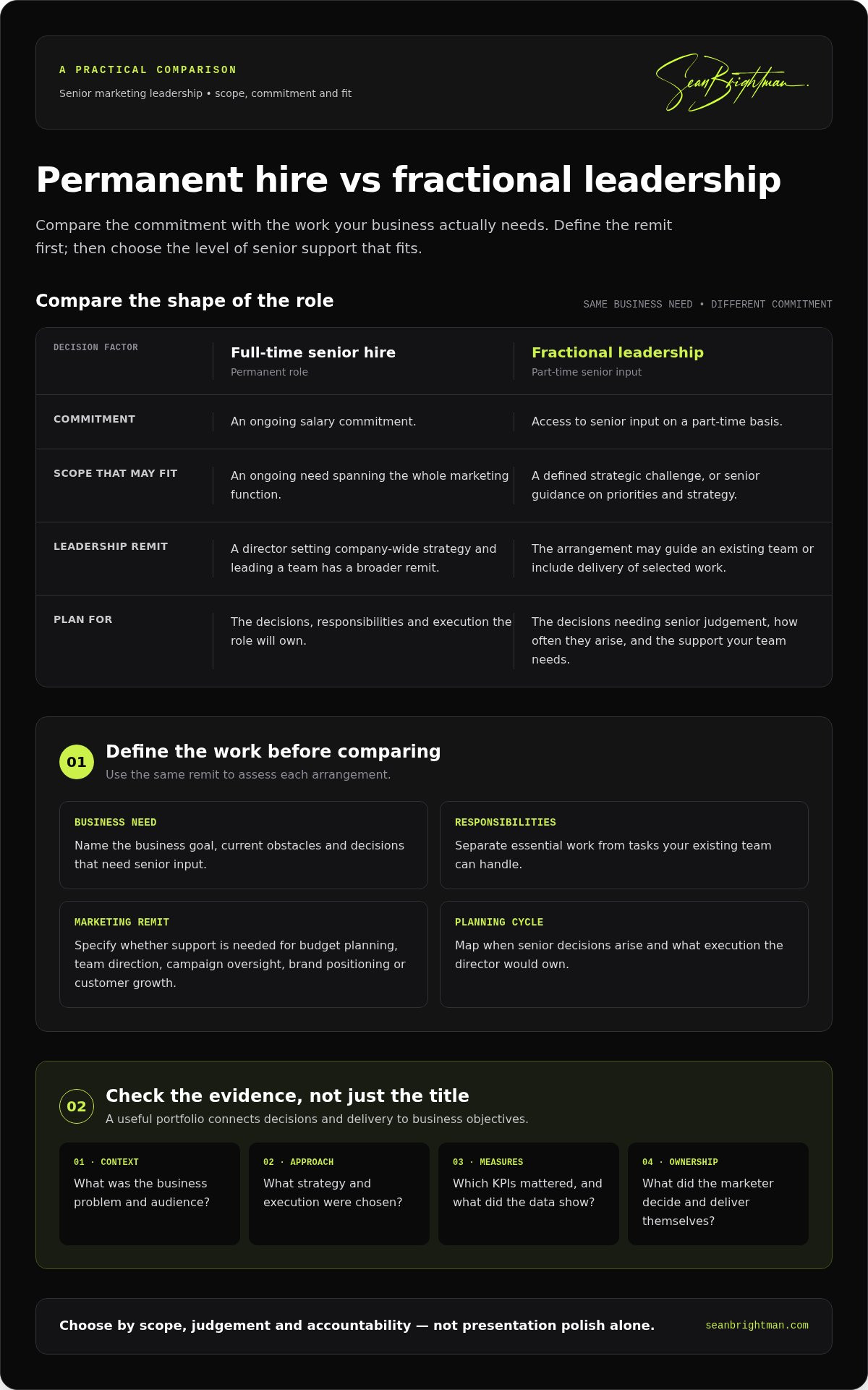
A portfolio should show how a marketer thinks, not just what they made. If you’re deciding how to get senior marketing expertise affordably, look for evidence of relevant decisions and delivery. A useful case study explains the business problem, audience, strategy and execution, then connects the activity to business objectives. Ask which KPIs mattered, how the results shaped decisions and what changed as a result.
Look for the full chain from activity to outcome. An email case study, for example, should explain its purpose, audience and success measures, not simply display a polished template. Check whether the marketer distinguishes activity, such as sending emails, from results that support a business objective. Ask what the data showed and what they would change next time. Their answer can reveal strategic thinking and practical judgement.
Assess breadth against the work your business needs. An adaptable generalist may contribute across digital, content, email and brand marketing, while planning and delivering campaigns end to end. If repeat customers matter, look for CRM and lifecycle marketing experience that can support stronger customer engagement and long-term value. A varied career can be useful, but the portfolio still needs relevant examples, clear ownership and evidence of delivery.
Use a consistent review process for every portfolio. Match each case study to a business priority, identify its KPIs, then note the marketer’s role and decisions. Separate their contribution from work completed by an agency or wider team. If they use AI, assess whether they apply it critically and ethically as support, rather than a substitute for marketing expertise. To get senior marketing expertise affordably, compare evidence of relevant judgement and delivery, not job titles or presentation polish.
Compare the cost of a full-time role with the scope of support you actually need. A permanent senior hire brings an ongoing salary commitment, while fractional leadership gives you access to senior input on a part-time basis. Define the decisions, responsibilities and level of involvement required before comparing options.
Start by defining the work. A director setting company-wide strategy and leading a team has a different remit from someone guiding a focused marketing function. Specify whether you need support with budget planning, team direction, campaign oversight, brand positioning or customer growth. Then separate essential responsibilities from work your existing team can handle. This gives you a clearer basis for assessing the level of commitment.
Compare like with like. A full-time role and fractional leadership differ in time commitment, responsibilities and how the work is delivered. For example, a business that needs someone to lead a team day to day may require a different arrangement from one seeking senior guidance on priorities and strategy. Be clear about the work, the decisions involved and the support your team needs.
To decide whether a permanent hire makes sense, map the work across a typical planning cycle. Identify which decisions require senior judgement, how often they arise and what execution the director would own. If the need is ongoing and spans the whole marketing function, a full-time role may fit. If it centres on a defined strategic challenge, consider whether a narrower remit would meet the need. A clear marketing roadmap can help sharpen that scope before you commit.
A Level 3 marketing apprenticeship typically takes 15-18 months in the UK. For businesses planning future capability, this offers a longer-term route to consider alongside an immediate senior hire.
Marketing professionals can progress into management and director roles, or work as freelance consultants. That progression may help you assess whether your organisation needs senior leadership now or can develop capability over time. Use the remit you have defined to guide the decision: if you need strategic direction immediately, focus on support that can provide it; if the need is evolving, include development in your workforce plan.
Start with the problem, not the job title. Write a brief that names the business goal, current obstacles and decisions needing senior input. For example, a retailer might need a clearer customer acquisition plan, not someone to manage every daily post. Define the outcomes, responsibilities and how the senior marketer will work with existing staff. A focused brief helps you identify support that matches the actual need.
Search for people with part-time, fractional or interim marketing leadership experience. Ask trusted business contacts for introductions, and use professional networks to find candidates with relevant sector knowledge. Review their portfolios and case studies against the brief. Look for evidence they have set direction, prioritised activity and worked with teams to put plans into action. A director who has led a similar challenge may be more relevant than one with an impressive title alone.
Use a structured conversation to test judgement. Give each shortlisted candidate the same practical scenario, such as slow repeat purchases or an unclear brand position. Ask how they would diagnose the issue, what information they would need and which actions they would prioritise. Strong answers connect the proposed work to a business objective, explain trade-offs and identify how progress would be measured.
Before agreeing a working arrangement, set out its boundaries. Specify decision-making authority, key deliverables, internal contacts and how updates will happen. Clarify whether the senior marketer will guide an existing team or personally deliver selected work. Agree how you’ll review priorities as business needs shift. This keeps the role focused and prevents part-time leadership from becoming an undefined catch-all. Look for someone who can make senior-level decisions and work constructively with the people handling day-to-day tasks.
Yes, these routes can help businesses find advice or fund defined projects, but support depends on the scheme and location. Start with your local Growth Hub and describe the business challenge in practical terms. For example, explain whether you need a clearer route to market, stronger customer retention or a plan for digital activity. Ask what support covers, who can apply and what outcomes the programme expects. That conversation helps you distinguish useful marketing guidance from general business support.
Compare any available support programmes with the work you need done. Some focus on advice, while others support a specific project or business objective. Read the eligibility rules, application process, covered activities and reporting requirements. If you’re considering a grant, check whether marketing strategy, research or campaign delivery qualifies as an eligible cost. Prepare a short project outline with its objectives, proposed work and measures of progress, then compare it with the scheme’s criteria.
Keep the limits clear. A grant is not a general marketing budget, and advice does not automatically include implementation. A programme might help you refine a growth plan, while your business still needs to assign someone to carry it out. Record what the support will deliver, what your team must provide and how you’ll measure progress. This makes it easier to compare a funded project with other ways of addressing the same need.
Use public support to sharpen the decision, not to outsource ownership of the strategy. Once you understand the available help, identify the gaps it leaves: direction, prioritisation or a workable plan for delivery. If you need to turn scattered marketing activity into a focused programme, map your marketing priorities into clear objectives and next steps.
CRM and lifecycle marketing are useful skills for businesses seeking to deepen customer engagement and increase long-term customer value. Choosing a manager and team that support career progression and nurture talent can help professionals advance.
Sean Brightman’s AI Consulting is a practical next step when you need senior guidance on AI’s role in marketing. Use it to assess where AI could support your work, how it fits your business priorities and which decisions still need human judgement. The aim is a clearer direction, not adopting tools for their own sake.
If your wider challenge is setting marketing priorities, Roadmapping provides a one-off strategy session and a structured plan. An Advisory Retainer offers ongoing strategic input, while Fractional CMO support provides senior leadership on a part-time basis. Choose the option that matches the decision in front of you, rather than adding complexity before you know what needs solving.
To discuss your marketing challenge, email Sean Brightman at sean@seanbrightman.com.
Getting senior marketing expertise affordably comes down to matching the support to the decision your business needs to make. Before taking action, write a short brief: identify the priority, the decision holding progress back and what your team can deliver. That gives the conversation a useful starting point and keeps the focus on the work, not a job title.
Sean Brightman offers Fractional CMO, AI Consulting and Roadmapping. Each addresses a different need, from senior marketing direction to practical AI guidance or a clearer plan. Be precise about the challenge you want to solve, then choose the kind of input that will move it forward.
Contact Sean Brightman to discuss your marketing expertise needs. A focused next step can make the path ahead easier to act on.
Ask the marketer to walk through a project and explain their personal contribution, the starting position and how the outcome was measured. Then, with their permission, request a relevant reference who can speak to that work. For example, if they claim to have improved lead quality, ask how the team defined a qualified lead and what else could have influenced the result. This tests whether they can substantiate claims and explain context.
A generalist may not have experience that matches your specific priorities, so review case studies for clear ownership, meaningful KPIs and results linked to business goals. An unclear brief can also turn a part-time role into an undefined catch-all. Set responsibilities and deliverables before agreeing on the support.
Reading is good. A roadmap is better.