
Your marketing isn’t underperforming. It’s broken. Most CEOs are currently watching their capital evaporate into a cloud of tactical noise whilst waiting for a “single hire” saviour who doesn’t exist. It’s a cycle of high spend and zero accountability. You want a growth engine; you’ve got an expensive hobby. If you’re ready to stop the rot, you need to understand how to fix a broken marketing function with clinical precision.
You’ve likely felt the frustration of vanity metrics that don’t move the needle on the balance sheet. This guide provides a blunt, battle-hardened framework to diagnose marketing decay and install a high-impact growth engine for 2026. It’s about results, not activity. Strategy, not just more social media posts. We are stripping away the corporate fluff to reveal the mechanics of real revenue.
We’ll replace the chaos with a machine that delivers clear ROI. You’ll discover how to secure senior leadership without the £150k salary commitment. We’re moving from internal confusion to external accountability. This is your strategic reset for a new era of growth.
Most marketing departments operate in a state of high-velocity stagnation. They produce content, send emails, and tweak social profiles whilst the revenue line remains flat. This is the “Activity Trap.” It’s the loudest symptom of a department that lacks a coherent Marketing strategy. If you want to learn how to fix a broken marketing function, you must first stop confusing movement with progress. Busy is not the same as effective.
Then there is “Founder Centricity.” This occurs when marketing only gains momentum when the CEO personally intervenes. It’s a bottleneck, not a system. Without your constant input, the machine grinds to a halt. This leads to data silos where nobody can prove ROI. According to a Gartner report from August 2026, only 14% of chief executives consider their CMOs highly effective at market shaping. That is a staggering failure rate. It stems from a lack of a single source of truth, leaving leadership to guess which half of their budget is being wasted.
Many firms fall into the trap of hiring one mid-level manager and expecting a miracle. You want a strategist, a copywriter, and a technical wizard in one body. It is a fantasy. You end up with junior-level execution that lacks any senior direction. This “busy-ness” is a mask. It hides the fact that your brand has no strategic positioning. You aren’t building a growth asset; you are just paying for someone to manage the noise. High staff turnover is the inevitable result when a hire is set up to fail by impossible expectations.
The cycle is predictable. You demand results. The team produces more “stuff.” The results don’t move. You get angry. They get burnt out. Your marketing function has become an order-taker. They wait for you to tell them what to do rather than acting as a growth-driver that tells you where the market is going. This broken loop creates a toxic culture of “trying new things” every fortnight without ever finishing one. It’s a psychological drain on the entire organisation. To understand how to fix a broken marketing function, you have to break this loop and stop treating marketing as a cost centre to be managed and start treating it as a machine to be engineered.
Fixing the engine isn’t about increasing headcount. It’s about structural integrity. You need a strategy that nails your positioning before you spend a penny on execution. Most teams fail because they focus on “likes” and impressions whilst ignoring the revenue line. This disconnect is one of the core forces eroding marketing effectiveness in modern businesses. If you want to know how to fix a broken marketing function, start with the data. Connect every activity directly to the balance sheet. No accountability means no growth.
AI isn’t a luxury; it’s the baseline. You must move from manual labour to automated efficiency to stay competitive in 2026. This isn’t about replacing humans. It’s about removing the friction that slows them down. It’s about building a machine that runs on logic, not hope. A mature function treats marketing as a series of integrated components. If one part fails, the whole system stalls. You can begin this process by booking a strategic roadmapping session to identify the gaps in your current setup.
Tools are not a strategy. However, the wrong tech stack will blind you. You need a scalable growth engine that doesn’t collapse when you double your spend. Marketing Operations is the plumbing of your business. If your systems don’t talk to each other, you lose visibility. Fixing the plumbing is a non-negotiable step in how to fix a broken marketing function. You need a single source of truth for every lead and every pound spent.
Hire for outcomes, not outputs. A “T-shaped” marketer provides broad strategic knowledge with deep expertise in a specific channel. This is often far more effective for a UK scale-up than a bloated agency retainer. Your team should own the revenue target, not just the content calendar. Structure your department to be lean and high-impact. Centralised functions often provide better consistency, but they must remain agile enough to pivot when the data demands it. It’s about owning the result, not just ticking boxes.
Stop looking at campaign reports. Start looking at the system. A marketing efficiency audit is about finding where the capital is leaking. Most CEOs look at activity; I look at outcomes. To understand how to fix a broken marketing function, you need a binary check. Is the problem the people, the process, or the positioning? If the positioning is off, the best people in the world won’t save you. If the process is broken, your people are just busy being busy.
Check the foundations. Does a clear strategic brand roadmapping document actually exist? If it’s just a collection of tactics in a spreadsheet, it’s not a roadmap. It’s a shopping list. We also measure “Strategic Velocity.” This isn’t how many emails you sent. It’s how fast your marketing moves the needle on business objectives. Slow velocity usually points to a lack of senior direction. You’re steering a ship with a broken rudder.
Does the market actually care about what you’re saying? Most messaging is “Me-Too” noise. It’s invisible. You’re saying the same things as your competitors, just in a different colour. Positioning isn’t a creative exercise for a Friday afternoon. It’s a mechanical component of growth. If your positioning is weak, your customer acquisition cost (CAC) will skyrocket. You fix the function by sharpening the blade, not by swinging harder at a blunt target.
Messy data is a silent killer. If your CRM doesn’t talk to your lead gen tools, your ROI is a guess. This technical debt creates “Ghost Tasks.” These are the manual workarounds and spreadsheet reconciliations that consume up to 40% of your team’s time. It’s wasted energy. In 2026, the cost of not having a defined AI marketing roadmap is terminal. You’re paying for manual labour whilst your competitors use autonomous systems to scale. This is how to fix a broken marketing function: stop the leaks, clear the debt, and automate the mundane.
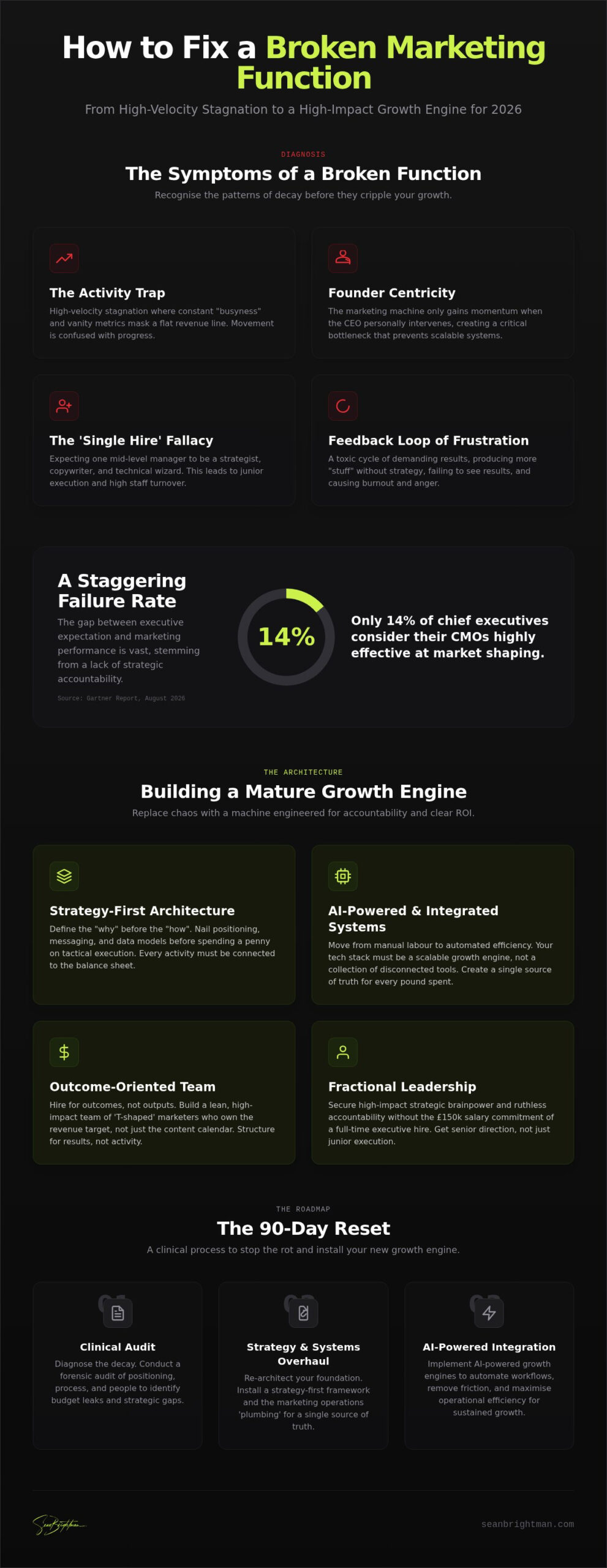
You cannot talk your way out of a broken system. You have to engineer your way out. Understanding how to fix a broken marketing function requires a structured, time-bound intervention. We don’t aim for incremental “improvements” that vanish by next quarter. We aim for a total mechanical reset. This 90-day sprint is designed to move your department from a chaotic cost centre to a high-velocity growth engine.
AI is your force multiplier. With 46% of marketers already using AI to streamline creative assets, staying manual is a choice to be slow. Your next “hire” shouldn’t be a person; it should be a well-engineered prompt or an autonomous agent. Use AI to automate the mundane reporting and data entry that currently eats your budget. Practical implementation moves the needle from reactive guessing to predictive analytics. We aren’t just using tools. We are building a machine that learns and scales whilst your competitors are still manually proofing emails.
Stop asking “What did we do?” and start asking “What did we achieve?”. A culture of accountability requires a “Brutal ROI” framework. If a campaign doesn’t have a clear line to the balance sheet, it doesn’t happen. This mindset shift is essential for how to fix a broken marketing function. By applying a marketing strategy for business exit, you force your team to build a growth engine that is a tangible, valuable asset. You aren’t just marketing for today. You are building a system that buyers would covet.
If you are ready to stop the rot and install a system that actually delivers, it is time to fix your growth engine and reclaim your marketing budget.
You don’t need a £120k CMO. You need four days of senior brainpower a month. Most businesses are drowning in overhead whilst starving for direction. They hire full-time executives for roles that only require part-time strategy. This is the core of how to fix a broken marketing function without bankrupting the company. You pay for the impact, not the attendance. It’s about surgical intervention, not office politics.
The Fractional Revolution is the response to this inefficiency. It provides senior leadership without the crushing commitment of a full-time salary and benefits package. This is plug-and-play expertise. A Fractional CMO doesn’t just fix the function; they train your existing team to maintain the new standards. It’s a transfer of capability. You aren’t building a dependency; you are building an internal asset.
Don’t confuse a Fractional CMO with an agency. An agency is a factory that produces outputs like ads and emails. A Fractional CMO is the architect who designs the factory. One executes; the other directs. You need the architect first. If you hire an agency without senior direction, you’re just paying a factory to produce things that might not even fit your business goals. Clinical direction must always precede tactical execution.
Fixing the engine is only half the battle. You have to keep it running. The Advisory Retainer model provides the ongoing direction to ensure the “Fix” stays fixed. It includes monthly accountability sessions for both the CEO and the marketing team. This acts as an external force that keeps internal complexity at bay. It’s a sharp-minded partner who provides the “get-your-hands-dirty” attitude required to maintain strategic velocity. We focus on the numbers that matter, not the vanity metrics that feel good.
If your marketing spend is high but your growth is flat, you are ready for a reset. If you are tired of being the only person in the room who cares about ROI, you are ready. The cost of delay is measured directly in your EBITDA. Every month you operate with a broken function is a month of leaked capital and missed opportunities. You don’t have to fire everyone and start over. You just need to install a better system. The first step is booking a strategic roadmapping session to define the exact path forward. Stop guessing. Start engineering. This is how to fix a broken marketing function for 2026 and beyond.
Movement isn’t growth. If your marketing spend is currently vanishing into a cloud of tactical noise, you don’t need a larger team; you need a better machine. We’ve mapped out the diagnostic shift from activity to outcomes and the 90-day reset required to install senior-level systems. You now have the blunt blueprint for how to fix a broken marketing function by prioritising clinical strategy over “busy-ness” and leveraging AI to eliminate manual debt.
As a battle-hardened Fractional CMO and published author of “The Book” on marketing strategy, I specialise in building AI-powered growth engines that run on logic. You can secure high-impact accountability and senior leadership without the £150k salary commitment. It’s time to stop the rot and start engineering revenue. Book a Strategic Roadmapping Session to Fix Your Marketing Function today. Your marketing shouldn’t be a mystery whilst you’re trying to scale. It should be a predictable, scalable asset that drives your business forward.
Yes, it’s absolutely possible. Most underperforming teams aren’t incompetent; they are leaderless. They are stuck in the “Activity Trap” because nobody has defined the commercial objective. By installing senior direction through a Fractional CMO, you provide the guardrails they need to succeed. You stop the “trying new things” cycle and replace it with a focused roadmap. Fixing the system usually fixes the people.
Senior expertise is about pattern recognition. A battle-hardened strategist has seen your specific chaos dozens of times before. They don’t need forty hours a week to spot a broken CRM or weak positioning. By using a structured roadmapping methodology, a Fractional CMO identifies the high-impact levers in hours. They focus on the 20% of activities that drive 80% of your revenue. It’s about surgical precision, not desk time.
The cost is significantly lower than the alternative of a full-time executive hire. Whilst I don’t provide recruitment services, industry data suggests a fractional model is far more cost-effective than a fully-loaded CMO salary. You avoid the overhead of pensions, bonuses, and national insurance. The real question is the cost of delay. Every month you run a broken function, you leak capital through inefficient ad spend and missed opportunities. You pay for impact, not desk time.
You are effectively burning cash. Tactics without a strategy are just noise. Without a clear brand position and a defined growth engine, your marketing is invisible to the market. You’ll suffer from high customer acquisition costs and inconsistent lead flow. A strategic roadmapping session is the first step to installing the logic your business needs. You must define the “why” before you spend a penny on the “how.”
AI is the ultimate efficiency tool for how to fix a broken marketing function. It eliminates the “Ghost Tasks” that consume up to 40% of your team’s time. By implementing AI-powered growth engines, you automate mundane reporting and content production. This allows your human talent to focus on high-level strategy and creative problem-solving. AI moves your department from manual labour to automated, predictive efficiency. It’s a force multiplier for growth.
Ownership is the key distinction. A consultant provides a report and leaves. A Fractional CMO integrates into your leadership team and takes responsibility for the results. One offers abstract theory; the other provides functional integration. A Fractional CMO acts as an external force that brings order to internal complexity. They don’t just tell you what is wrong; they install the systems and provide the accountability to fix it.
A comprehensive marketing transformation generally follows a 90-day reset framework. The first 30 days focus on a strategic deep dive and positioning fix. The next 30 days involve a systems overhaul and AI integration to clear technical debt. The final 30 days establish an advisory retainer for ongoing accountability. This structured approach ensures the transformation is permanent. You move from chaotic activity to a machine that runs like a growth engine.
Agencies are execution engines; they are not architects. If you hire an agency to fix your function, you’re asking the builders to design the house. They will sell you the services they happen to provide, whether you need them or not. To understand how to fix a broken marketing function, you need senior-level direction first. A CMO defines the strategy and then holds the agency accountable for the execution. Direction must precede production.
Reading is good. A roadmap is better.