

AI enthusiasm won’t secure a marketing budget. A clear business case might.
A business case sets out a proposal’s benefits, costs and potential risks so decision-makers can judge whether the investment makes sense. Creating a business case for AI in marketing means linking a specific use case to measurable outcomes, not pitching a tool simply because it looks impressive.
It’s sensible to ask what AI could improve, but a strong case also accounts for the work required to make the technology useful. Data, integration, skills and change all affect whether a promising idea can deliver value.
This guide explains what a business case should cover, how to assess your organisation’s readiness for generative AI, and how to weigh marketing benefits against implementation and ongoing costs. You’ll learn to define a focused use case, set success measures and make the decision easier to defend. No inflated projections, just a practical way to test whether AI belongs in your marketing plan.
Traditional marketing software follows set rules; AI tools can generate or analyse outputs, so compare controls as well as features. AI can draft copy variants, summarise campaign data and surface patterns, while people retain approval.
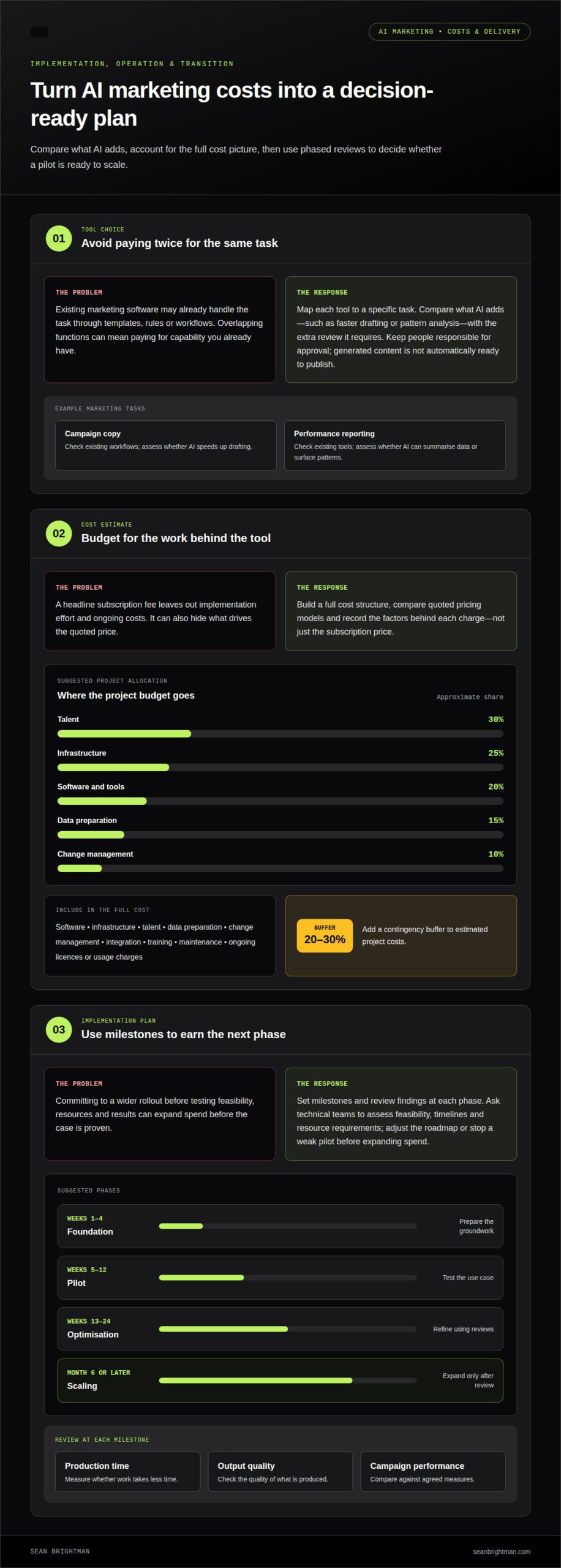
Map each tool to a specific marketing task, such as producing campaign copy or reporting performance. Check whether existing software already handles it through templates, rules or workflows. Then assess what AI adds, such as faster drafting or pattern analysis, and what extra review it requires. Avoid paying for overlapping functions or treating generated content as ready to publish.
Build a cost structure covering software, infrastructure, talent, data preparation and change management. A suggested AI project allocation is approximately 30% for talent, 25% for infrastructure, 20% for software and tools, 15% for data preparation and 10% for change management. Include ongoing licences or usage charges, integration, training and maintenance. Add a 20-30% contingency buffer to estimated project costs. Compare quoted pricing models and record what drives each charge, rather than relying on a headline subscription fee.
Set milestones before committing to a wider rollout. The suggested foundation phase takes weeks 1-4, the pilot phase takes weeks 5-12, and optimisation takes weeks 13-24; scaling begins in month 6 or later. At each review, measure agreed metrics such as production time, output quality and campaign performance. Ask IT or technical teams to assess feasibility, timelines and resource requirements. Use review findings to resolve challenges, adjust the roadmap or stop a weak pilot before expanding spend.
A business case sets out a proposal’s expected benefits, costs and potential problems. For AI marketing, it should connect a defined business need to evidence, resources, risks and measurable outcomes.
AI marketing relies on relevant data, a tool that can process it and connections to the systems that hold it. Data quality, access, integration and human review all affect whether outputs are useful and safe to apply.
For a major proposal, use the UK Government’s Five Case Model: strategic, economic, commercial, financial and management cases. This structure turns an idea into a decision-ready plan, with relevant evidence, clear responsibilities and outcomes executives can assess.
Readiness means more than access to a model. Assess the business need, data, people and controls before moving from experimentation to action.
Gather a baseline before launch, using relevant campaign records such as production time, conversion rates, engagement or cost per lead. Record the period covered, data owner and calculation method so later comparisons are meaningful. Ask marketing stakeholders which outcomes matter, then link the proposed use case to those measures. Separate changes plausibly linked to AI from seasonal shifts, campaign changes or other activity.
Map risks to each workflow: inaccurate copy, biased audience assumptions, exposure of confidential material or unclear approval ownership. For every risk, document its possible impact, who monitors it and what action follows. Restrict access to approved systems, retain human review for customer-facing outputs and define an escalation route when results fail quality checks. These controls make the project’s boundaries clear before teams adopt it.
Sean Brightman can help turn your AI marketing proposal into a practical decision and delivery plan. Use AI Consulting to test the opportunity, challenge assumptions and shape the business case. Roadmapping can turn an agreed direction into priorities and next steps, while an Advisory Retainer provides ongoing strategic input as the initiative develops.
This is a useful next step when teams have a promising use case but lack alignment on its value, risks or implementation path. The aim isn’t to add AI for its own sake. It’s to decide where it fits, what needs to be in place and how to move forward with purpose.
Contact Sean Brightman to discuss your AI marketing business case.
Turn the decision into ownership: name who will sponsor the work, where responsibility sits after launch and what would trigger a rethink. This keeps AI connected to changing commercial priorities rather than locked inside an outdated business case. Give each review a decision to make, not just a status update.
A disciplined approach to creating a business case for AI in marketing makes the proposal useful beyond initial approval. If your organisation needs sustained senior marketing ownership to turn strategy into action, Sean Brightman’s Fractional CMO offering may be a fit.
For a focused conversation about the next step, contact Sean Brightman to discuss your case. A sound decision can be to proceed, reshape the plan or stop. Clarity is progress, and it gives your team a stronger platform for what comes next.
Calculate AI ROI by comparing attributable financial benefit with total cost, then expressing the net return against the investment. Include direct savings, additional contribution from converted demand, and costs such as licences, integration, staff time and review. For a content tool, count avoided production effort only when it replaces paid work or frees capacity for valuable activity. Keep assumptions separate from observed results.
How quickly AI delivers a return depends on how soon a use case affects measurable business outcomes and how much setup it requires. A tool that streamlines an existing task may show value sooner than a project needing new data connections, workflow changes and team adoption. Track when benefits begin, when costs accrue and whether gains persist. Distinguish early efficiency improvements from longer-term commercial impact.
Creating a business case for AI in marketing starts with defining one decision the investment should improve, such as selecting content variations for a campaign. Compare the proposed approach with the current process and other practical options. Set out who owns delivery, what evidence informs approval and which conditions would trigger a pause or redesign. This makes the case a decision tool, not a technology pitch.
Estimate ROI by modelling conservative, expected and stronger outcomes, using consistent cost and benefit definitions for each scenario. For a campaign tool, estimate the value of additional qualified conversions, then subtract tool costs and the labour needed to review its output. Avoid counting faster production and the same saved staff hours as separate benefits. Replace projections with actual pilot results as they become available.
Choose KPIs that show whether the tool improves both output and business value. For content workflows, track the share of assets approved without substantial rework, factual corrections required and time from brief to approval. For campaigns, assess qualified conversion rate and revenue contribution alongside engagement. Compare results with a consistent pre-AI baseline, and make brand or compliance failures visible rather than hiding them in averages.
When creating a business case for AI in marketing, choose a contained workflow, such as drafting first versions of email subject lines, and assign an accountable owner. Record the current process and define acceptable quality before testing. Give the team approved inputs and clear human-review rules, then run the AI-assisted workflow alongside the usual approach. Compare output, corrections and downstream results, document exceptions, and decide whether to refine, expand or stop.
Reading is good. A roadmap is better.