

A static customer journey map is a snapshot, not a strategy. AI-driven customer journey mapping analyses customer interaction data across touchpoints to reveal patterns and changes, while traditional mapping relies on feedback, direct observation and market research. AI can sharpen the picture, but it cannot replace sound judgement or reliable data.
Traditional maps take time and effort to build, while customer behaviour keeps changing. A map can quickly lose touch with what customers actually do. The answer is not to automate everything. Use AI where it adds useful evidence, then make decisions with a clear view of its limits.
This guide explains how AI-based journey mapping differs from the traditional approach, then walks through the practical steps: set a goal, organise your data, identify key touchpoints and turn patterns into actions. You’ll also learn where AI can mislead and why human oversight matters.
AI-powered journey maps analyse customer data to reveal patterns; traditional maps rely on feedback, direct observation and market research. For UK customer analytics, treat UK GDPR and PECR as design constraints: assess how personal data is used, explain that use clearly, and ensure tracking and AI workflows meet applicable requirements. Build the map by setting an outcome, organising usable data, identifying touchpoints and turning evidence into actions.
Compare the evidence behind each map before choosing how to tailor it. Traditional customer journey research captures what customers report and what teams observe, but mapping one segment can take 4-8 weeks. AI can process large interaction datasets to expose patterns across points in a journey. Use those patterns to sharpen the map, not to treat predictions as customer testimony.
Start with the customer decision you want to improve, then connect data to journey stages. Show what customers do, where friction appears and which action could improve the outcome. AI-driven customer journey mapping works best when teams can trace each insight to a reliable input, rather than accepting a polished chart without context.
Traditional mapping builds a visual account from research; AI adds analysis of patterns across customer data. Use the tools to connect touchpoints, understand behaviour and guide decisions, not to automate judgement.
Map the customer’s route across channels, then compare each touchpoint with what happens next. CRM records, website analytics and customer feedback can show where people engage, stall or leave. Machine learning can group recurring behaviours into patterns, while natural language processing can identify common themes in written feedback. Check that each signal relates to the same customer segment and journey stage.
Bring analytics into a shared visual map so teams can interpret the same evidence together. Connect each data point, such as repeated product-page visits, to its context and potential friction. Automation can refresh the analysis as new interactions arrive, while visualisation makes assumptions and gaps easier to challenge. Keep the map legible: too many metrics can obscure the decision.
Predictive analytics can estimate which leads may progress, which customers may churn and how deal size may vary. A lead model might weigh engagement signals alongside CRM history; a churn model might flag changes in service interactions. Treat predictions as prioritisation signals, not certain outcomes. Compare them with later results, then review the actions and definitions shaping the model.
Choose tools around the work: CRM and web analytics for behavioural data, text analysis for feedback, machine learning for pattern detection, and visual mapping for collaboration. UK teams can use these tool categories to connect evidence without assuming one platform covers every task. Prioritise compatible data and a clear hand-off between analysis and action. A strategic AI roadmap can help align those choices.
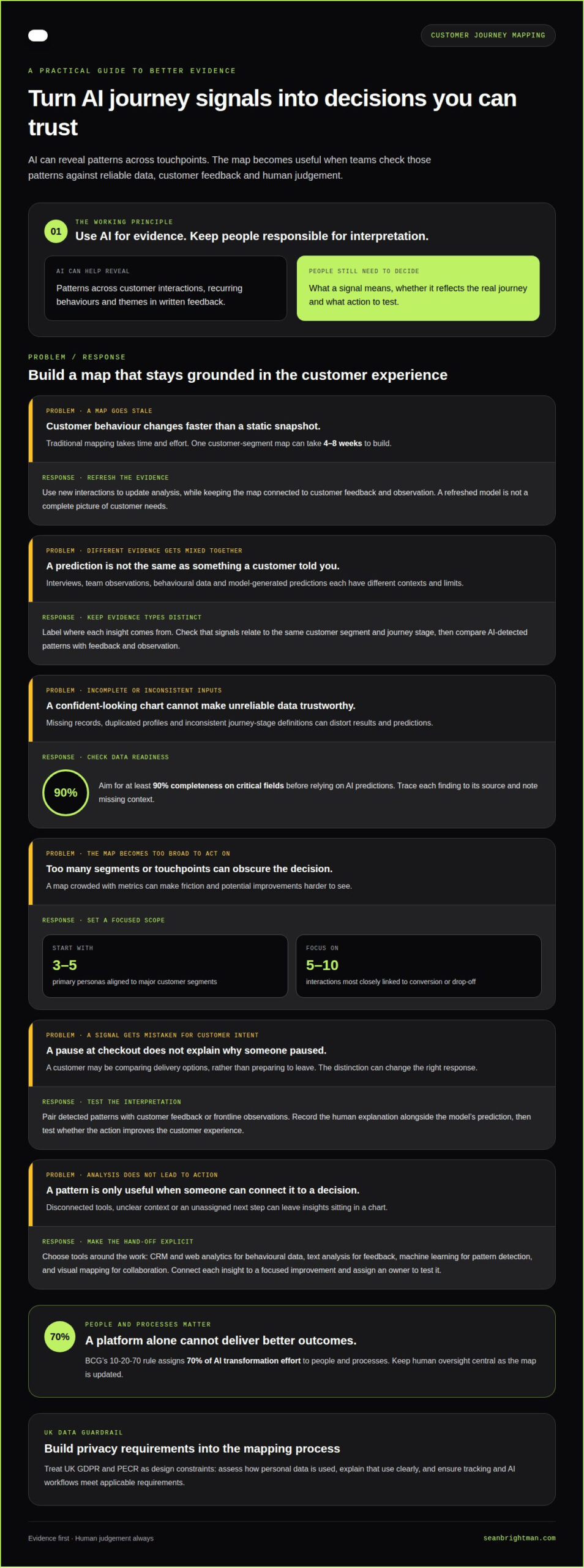
AI can surface patterns across journey stages, but those patterns do not reveal every customer’s intent. Treat the insights as evidence to test against human experience and business outcomes.
Use AI to organise engagement signals, then ask people what those signals mean. A customer who pauses on a checkout page might be comparing delivery options, not preparing to leave. That distinction changes the right response. BCG’s 10-20-70 rule assigns 70% of AI transformation effort to people and processes, reinforcing that a platform alone cannot deliver better outcomes.
Keep the map dynamic, but do not mistake a refreshed model for a complete picture of customer needs.
Check each finding against its sources before acting. If a model flags a drop in engagement between product research and purchase, examine the relevant interactions and ask whether the map reflects the real journey. Incomplete records, duplicated profiles and inconsistent stage definitions can distort results. A confident-looking chart cannot make unreliable inputs trustworthy.
Then test whether the recommended action improves the customer experience, rather than merely changing a metric.
Turn AI analysis into a working journey, not a dashboard nobody uses. A useful output connects customer interactions to a clear decision, an owner and a measurable outcome.
Sean Brightman can help turn journey-mapping analysis into clear strategic decisions. When your team needs to connect customer insights with AI priorities, AI Consulting can shape the approach; Roadmapping can organise the next steps. An Advisory Retainer provides ongoing strategic input as priorities develop.
The right next move depends on the gap: unclear use cases call for sharper AI direction, while disconnected initiatives need a practical roadmap. Bring the customer journey challenge, the decisions you need to make and the outcomes you want to improve.
Contact Sean Brightman to discuss your customer journey mapping priorities.
Choose a focused first application, with a named decision owner and a clear business outcome. Before expanding, decide what evidence would justify scaling the work, changing its direction or stopping it. AI-driven customer journey mapping should inform a real decision, not become another polished visual that sits unused.
Build accountability into the plan from the start. Give the people responsible for customer experience, marketing and data a shared view of what the map informs, who acts on its findings and how decisions will be revisited. This makes analysis part of your working strategy, rather than a standalone technology project.
Sean Brightman offers Fractional CMO, AI Consulting and Roadmapping to help connect marketing priorities, AI decisions and strategic direction. If you’re ready to explore how those pieces fit your organisation, discuss your next strategic step with Sean Brightman.
Start with the customer decision that matters most, then build from there.
Customer behaviour now spans search, social platforms, email, service interactions and in-person experiences. In 2026, 60% of searches end without a website visit, so a website-only view can miss important decision points. Teams are turning to AI to connect signals across channels and respond to changing behaviour, rather than relying on a map that captures only one part of the customer’s experience.
AI-driven customer journey mapping starts by bringing relevant customer interaction data into an analysis process, then grouping behaviours and identifying relationships between events. For example, a retailer could examine whether delivery questions often come before order cancellations. The team can investigate the pattern, improve delivery information and monitor subsequent customer responses. The analysis guides a test; it does not establish the cause on its own.
Traditional methods build understanding through interviews, observation and research, giving teams direct context about customer motivations. AI adds the ability to analyse behavioural signals across channels and detect recurring paths. Use interviews to understand why someone struggled, and analytics to locate where that struggle often occurs. The approaches work best together: one adds human context, while the other helps reveal broader patterns.
AI can help teams spot recurring friction, prioritise parts of a journey and tailor interventions to observed behaviour. This can make analysis more responsive than a map created only during a research project. But recorded activity may not capture customer intent, and predictions can be wrong. Use insights to choose a test, then assess the result against customer experience and business outcomes.
Customer analytics can involve personal data, so plan its use with UK GDPR and PECR in mind. Explain data use clearly, limit access and protect information from misuse. Bias can arise when a dataset under-represents a customer group, and poor-quality records can distort patterns. For example, duplicated profiles may make a behaviour appear more common. Review data coverage and model outputs across relevant groups.
Reading is good. A roadmap is better.