

Campaigns don’t become strategy just because they perform. You know when to move from tactical to strategic marketing when activity no longer connects clearly to business goals, or when the goals themselves have shifted. Tactical work runs over weeks or months; strategic marketing looks further ahead and steers decisions towards outcomes that matter.
It’s easy to get pulled into the next campaign, content deadline or channel report. Execution matters, but without a clear commercial purpose, a busy marketing team can struggle to show what its work is changing.
This article explains how to make the shift: start with business goals, choose measurable outcomes and connect each campaign to the customer journey. You’ll also learn when to revisit your strategy, what to measure and how to keep marketing focused on impact, not just output.
Move towards strategic marketing when campaign choices need to support wider commercial priorities, not just immediate delivery. There’s no fixed growth stage for making the shift. Assess the business context, set outcomes, choose activity and measure the results.
Map the organisation’s commercial model, revenue drivers, competitors and internal priorities. Then connect business planning to marketing: corporate goals set the direction, marketing objectives define its contribution, and campaign plans determine the work. Check that teams share the same priorities. Avoid planning channels in isolation from sales capacity, customer demand or profit drivers.
Look for signs that recurring campaigns are competing for resources, teams can’t explain their commercial contribution, or business priorities have changed. These are stronger signals than company size or age. A smaller business entering new markets may need a longer-term plan, while a larger organisation with stable goals may still rely on tactical execution. Judge the shift by complexity and alignment.
Separate long-term choices from short-term actions. Strategic marketing sets the direction that tactical marketing serves.
Set a longer planning horizon for strategic choices, then organise campaigns into shorter delivery cycles. Strategic marketing can define how the business will win customers over a one-to-three-year period, while tactics respond over weeks or months. A monthly email newsletter, for example, may support customer retention, but it isn’t the strategy itself. Check that each short cycle advances the longer-term direction.
Start with the business position, target audience and intended outcome; choose tactics afterwards. Strategic planning decides where to compete and what customer value to create. Tactical planning selects channels, messages and delivery dates. Posting project photos on social media every week is an action, not a commercial objective. Before judging its value, connect it to a measure such as quote requests or conversions.
Protect capacity for immediate demand whilst reserving deliberate effort for longer-term improvements. A small business might keep responding to current enquiries while improving its customer journey or positioning. Don’t let urgent tasks consume every planning session; equally, don’t pause useful activity for an abstract strategy exercise. For example, a tactical goal to increase quote requests by 25 percent this quarter can guide immediate work within the wider plan.
Build the change into existing planning and reporting rather than setting an arbitrary deadline. There’s no fixed duration for the shift: it depends on how quickly leaders agree priorities, teams connect activities to outcomes, and useful performance evidence becomes available. Review execution weekly and performance monthly, then adjust tactics against results. A clear marketing roadmap can help keep immediate decisions pointed toward longer-term goals.
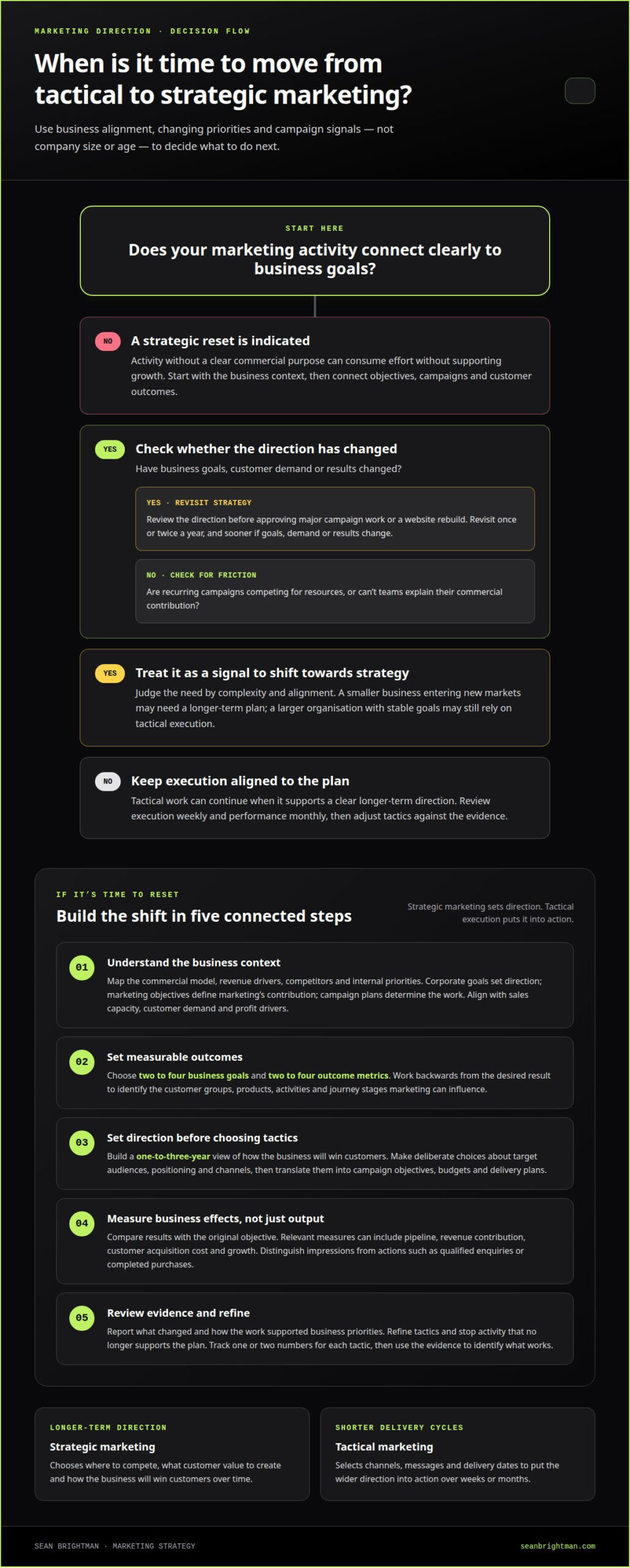
Review the direction before committing to major campaign work or a website rebuild. Revisit it once or twice a year, and sooner if business goals, customer demand or results change.
Diagnose weak campaigns before adding more activity. Tactical work without a clear strategic link can consume effort without supporting growth, and reach alone doesn’t show whether people took action. Check whether campaigns attract the intended audience, convert leads into closed business and produce a return on investment. If results fall short, find where the customer journey breaks before changing channels.
Review the strategy before approving a campaign or website if its audience, offer or business goal has shifted. A new design can’t fix unclear positioning, and another campaign won’t repair a customer journey that loses people. Check that the proposed work supports the brand promise and addresses the right customer need.
Use these signals to decide whether marketing needs clearer direction, not simply more activity. One weak campaign isn’t enough; look for patterns across priorities, customers and commercial results.
Sean Brightman helps businesses turn marketing priorities into clear direction and practical next steps. If campaigns keep moving but their connection to commercial goals remains uncertain, Roadmapping can bring those priorities into focus. An Advisory Retainer provides ongoing strategic input as business needs and marketing decisions evolve.
For businesses exploring how AI fits their marketing approach, AI Consulting can help assess the opportunity against wider objectives. The right next step depends on the challenge: clarify the direction, make better-informed decisions or keep strategic thinking connected to execution.
If you’re ready to discuss your marketing direction, contact Sean Brightman.
Before approving your next campaign, write down the business decision it needs to support. Name the customer behaviour you want to influence, the evidence that would show progress and what you’ll change if the response falls short. This short test turns strategy into a working tool, not another document on a shelf.
Deciding when to move from tactical to strategic marketing is only the start. The real test is whether leadership can keep priorities clear while campaigns adapt to customer behaviour. If direction, execution and accountability are pulling apart, Sean Brightman can help bring them back into alignment. A Fractional CMO provides strategic leadership; Roadmapping clarifies priorities and next steps; AI Consulting helps assess how AI fits your business objectives.
Contact Sean Brightman to discuss your marketing direction. Make the next move with purpose, then put it to work.
Prioritise metrics that reveal where commercial progress stalls. Pipeline contribution can show whether marketing creates sales opportunities; conversion by stage can reveal where prospects drop away. Retention and expansion contribution help assess ongoing customer value. If opportunity numbers rise but fewer progress to sale, for example, investigate that stage before increasing lead-generation activity.
Decision-making changes first. Teams bring commercial context and recommendations into planning instead of waiting for a campaign brief. Leaders discuss trade-offs, agree on ownership and use results to decide what continues. For example, a marketing review might recommend pausing a familiar activity to test a stronger customer proposition. The shift is from completing requests to influencing choices and taking responsibility for outcomes.
Urgent requests, fragmented ownership and pressure to show visible activity can crowd out strategic work. Teams may default to producing deliverables because output is easy to report, while cross-functional decisions take longer. For example, sales may request a new campaign before agreeing which customer problem it should address. Protect time for planning and commercial discussion, or short-term requests will set the agenda.
Tactical marketing is the specific work a team carries out to reach customers or prompt an action. A limited landing-page test, for example, can compare two messages for the same offer. It has a defined audience, channel and task. The tactic describes what the team will do; it doesn’t, by itself, explain why that action deserves priority.
Strategic marketing makes the choices that guide the work; tactical marketing puts those choices into action. For example, a business might choose to compete through specialist expertise, then develop proof points and customer communications to demonstrate it. The strategic choice shapes what the team says and to whom. Without that direction, separate campaigns can send inconsistent signals.
Trace each tactic from its intended customer response to a business outcome, then review the evidence. For a product launch, map how a prospect discovers the offer, evaluates it and reaches a purchase decision. Check whether the tactic supports a relevant step and whether the results available show progress. If the link is unclear, revise the activity or its purpose before repeating it.
Reading is good. A roadmap is better.