
Hiring a senior leader just to “keep the lights on” is a tactical failure that costs you more than just a day rate. Most UK businesses confuse stability with progress. When you’re weighing up a fractional cmo vs interim cmo uk, the decision shouldn’t be about how many days they sit at a desk. It’s about whether you’re plugging a gap or building a system.
You’re likely staring at a marketing department that’s constantly busy but failing to deliver a measurable ROI. The thought of a £150k+ full-time salary is eye-watering, yet the complexity of IR35 compliance makes you hesitate to bring in outside help. You need senior grip, but you don’t need the corporate bloat. Discover the critical differences between fractional and interim marketing leadership to ensure you hire for growth, not just stability. This guide previews the 2026 financial thresholds, the “build vs. maintain” mindset, and exactly which model fits your current business stage. It’s time to stop renting a placeholder and start installing a strategic engine that actually scales.
Stop confusing capacity with capability. Most CEOs treat senior marketing hires as a way to “buy more hands.” It’s a mistake that leads to expensive, stagnant departments. When you’re weighing up a fractional cmo vs interim cmo uk, you aren’t just choosing a contract length. You’re choosing between a placeholder and a builder. One maintains the status quo; the other disrupts it to create value.
The Fractional executive model has gained massive traction because it decouples senior expertise from the requirement of a full-time desk. In the UK market, the distinction is often blurred by recruitment agencies, but the objectives are fundamentally different. You must decide if you’re trying to survive a transition or engineer a breakthrough. The Fractional CMO is the strategic architect for your growth engine.
An interim leader is a professional gap-filler. They arrive when your CMO quits or goes on parental leave. Their mission is preservation. They keep the lights on, manage the existing team, and ensure the current marketing plan doesn’t derail whilst you search for a permanent replacement. It’s a full-time, intensive role that usually lasts between three and nine months. They don’t rewrite your strategy; they just make sure the team follows the one already on the desk. They are a tactical safety net for businesses that already have a functioning system but lack a head to steer it.
The Fractional CMO doesn’t just fill a seat. They rebuild the chair. This is a long-term strategic partnership, typically involving two to four days of high-impact work per month. They aren’t there to manage the “business as usual” tasks; they’re there to fix what’s broken and organise the business for scale. They focus on positioning, ROI, and building automated growth systems that don’t require a £150k+ full-time salary to maintain. In the context of fractional cmo vs interim cmo uk, the fractional leader is your strategic accelerator. They stay with the business for years, providing the senior-level accountability that “busy” marketing departments often lack.
The difference is the finish line. An interim’s success is a smooth handover to a successor. A fractional CMO’s success is a scalable marketing machine that delivers measurable revenue. One manages the “now”; the other builds the “next”.
Hiring a senior leader to simply “manage the mess” is a waste of capital. The distinction in the fractional cmo vs interim cmo uk debate boils down to one question: are you treading water or building a ship? One model protects your current revenue. The other engineers your future growth. If you hire an interim to “fix” a broken strategy, you’re likely paying a premium for a temporary patch on a structural leak.
Strategic velocity is the real metric that matters. It isn’t just about moving fast. It’s about moving fast in the right direction. Interims provide operational speed. They keep the existing machinery running. Fractional CMOs provide strategic velocity. They recalibrate the machinery, strip out the friction, and ensure every pound spent on marketing actually hits the bottom line. Before committing, many CEOs benefit from Strategic Brand Roadmapping to diagnose where the engine is failing before they hire a mechanic.
You need an interim when your marketing department is already a high-performing unit. If your team is hitting targets but your leader has exited suddenly or taken leave, an interim is the “safe pair of hands” you require. Their mission is continuity. They manage the internal politics, keep the agencies accountable, and ensure there is no dip in performance whilst you conduct a permanent recruitment search. Success for an interim is handing over a stable, predictable ship to the next full-time hire. They are the guardians of your current momentum.
You need a fractional CMO when your marketing feels “busy” but lacks a clear ROI. This is for the founder who has hit a growth plateau and needs senior-level direction without the £150k+ salary commitment. The fractional leader doesn’t just manage the team; they install a scalable growth engine that continues to function long after their involvement scales back. They focus on positioning, systems, and accountability. They turn marketing from a cost centre into a predictable revenue driver.
If you’re tired of marketing plans that look good in slides but fail in the market, it’s time to stop looking for a manager. You need a strategist who builds for the long term. You can explore how a battle-hardened strategist can fix your growth engine by reviewing my Roadmapping service today.
The UK’s tax regime has inadvertently created a golden age for fractional leadership. In the debate of fractional cmo vs interim cmo uk, the tax man is often the silent partner in the room. Traditional interim roles, which typically involve full-time hours and direct management of internal staff, frequently fall “inside IR35.” This adds a massive tax burden to your payroll. Fractional roles, by contrast, are built on a foundation of independent advisory and strategic delivery. They are designed to sit outside the payroll, offering a cleaner, more efficient commercial engagement for both parties.
Success in 2026 requires moving away from the “hours for money” trap. You aren’t buying a person to sit in a chair from nine to five. You are buying a result. A fractional CMO operates as a genuine business-to-business partner, focusing on high-impact deliverables rather than administrative presence. This shift from input-based hiring to outcome-based investment is what separates growing UK firms from those stuck in the recruitment loop.
Navigating off-payroll working rules is a strategic necessity, not an administrative chore. For medium and large businesses, the responsibility for determining IR35 status is yours. As of April 2026, the thresholds for “small” company exemptions have increased to a turnover of £15 million and a balance sheet total of £7.5 million. If you exceed these, you must be precise. Fractional advisors typically pass the “substitution” and “control” tests because they provide a specialist service on their own terms, often using their own equipment and methodology. They don’t look like employees because they aren’t employees. They are an external force brought in to fix a specific problem.
The math is simple and brutal. A full-time CMO in the UK can carry a total loaded cost of between £300,000 and £450,000 once you factor in National Insurance, pension contributions, bonuses, and recruitment fees. That is a massive bet on a single individual. A fractional leader removes that overhead. You pay for the strategy and the systems, not the benefits package. The real value, however, lies in the “cost of inaction.” A broken marketing system costs you revenue every single day it remains unfixed. The Marketing Advisory Retainer provides a framework for ongoing accountability, ensuring your team stays focused on ROI without the long-term liability of a six-figure salary. You gain senior-level grip with the flexibility to scale the engagement as the business evolves.
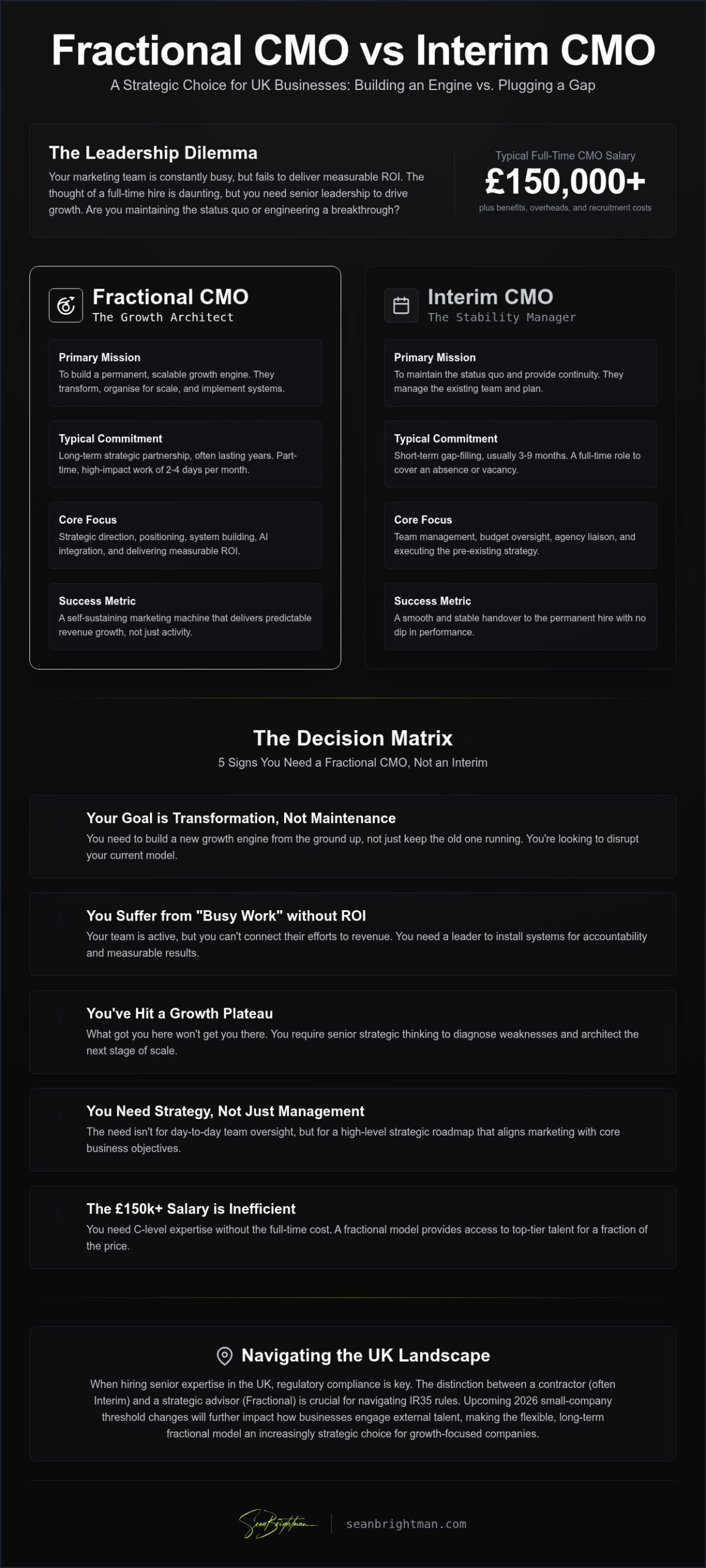
Deciding between a fractional cmo vs interim cmo uk isn’t about your budget. It’s about the state of your marketing engine. If your department is a black hole where capital disappears without a trace, an interim won’t save you. They’ll just watch the money burn from a more senior seat. You need a fractional leader when the problem is structural, not just a lack of headcount. It’s the difference between needing a mechanic to fix the car and needing a driver to keep it in the lane.
Are you suffering from Tool Fatigue or Strategy Fatigue? Tool Fatigue is when you’ve bought every SaaS product on the market but your data still doesn’t talk to itself. Strategy Fatigue is worse. It’s the feeling that you’ve tried every “hack” and nothing sticks. If you’re building a marketing strategy for business exit, you need a fractional architect. An interim is a manager. They keep things steady. A fractional CMO is a mentor who builds a legacy system that functions perfectly long after they’ve left the building.
If your current marketing plan doesn’t include a robust AI roadmap, you’re already obsolete. Interims rarely have the remit or the time to overhaul your entire tech stack with agentic AI. They’re hired to maintain the status quo. Fractional CMOs are different. They’re incentivised to create efficiency through automation because they’re paid for outcomes, not hours. They don’t just use AI tools; they build AI-powered growth engines that strip out human error and maximise strategic velocity.
Stop settling for maintenance when you need a transformation. You can book your strategic roadmapping session to see exactly where your engine is leaking revenue.
In 2026, the CMO’s playbook has been shredded. If you’re still choosing between a fractional cmo vs interim cmo uk based on who has the best CV, you’re missing the point. The modern fractional leader isn’t just a strategist; they are an AI orchestrator. They don’t just manage people; they design agentic workflows that execute complex tasks without human friction. Whilst an interim keeps your legacy processes alive, a fractional CMO builds the replacement. They move you from a state of “doing marketing” to a state of “owning a growth engine.”
Sean Brightman’s methodology is a plug-and-play solution for UK scale-ups that requires zero hand-holding. It strips away the corporate politeness that slows down most consultancies. You don’t need a 50-page PDF that collects dust on a digital shelf. You need a functioning system. This is about strategic velocity: the ability to pivot and scale based on hard data rather than gut feelings. It’s about results, not activity. This, not that.
AI consulting is no longer a “nice to have” niche. It’s the core component of senior leadership in 2026. With 25% of customers now using AI-powered platforms as their primary tool for researching products, your brand cannot afford a “wait and see” approach. Moving from manual marketing tasks to automated, intelligent systems is the only way to maintain a competitive edge. Roadmapping sessions provide the surgical blueprint for this engine. They identify the specific bottlenecks in your funnel and replace them with high-efficiency automation. This isn’t about replacing your team; it’s about giving them a machine that actually works. We build the architecture that allows your marketing to run at a speed that manual teams simply can’t match.
Accountability is the #1 missing ingredient in most marketing departments. Teams are often “busy,” but revenue remains flat. An Advisory Retainer solves this by keeping the CEO and the marketing team aligned on the same North Star. It’s a clinical approach to management: this worked, that didn’t. Fix it. Move on. This model provides the senior-level grip you need to stop the strategic drift that plagues mid-sized firms. It ensures that the high-level strategy designed during the Roadmapping phase is actually executed with precision. You gain a partner who is just as invested in your ROI as you are, acting as an external force that brings order to internal complexity. It’s time to stop renting a placeholder and start installing a leader who builds for the future.
Stop hiring for seats and start hiring for systems.
Choosing between a fractional cmo vs interim cmo uk isn’t just an HR decision. It’s a choice between maintenance and transformation. If you need a safe pair of hands to keep the lights on whilst you recruit, hire an interim. But if your marketing results have plateaued and your team is drowning in “busy work,” you need a builder. In 2026, stability is a trap. You need an AI-powered growth engine that delivers measurable ROI without the £150k+ salary burden.
You’ve seen the distinction. One model manages the status quo; the other disrupts it to create value. As a published author on marketing strategy and a specialist in AI-powered systems, I provide the direct CEO-level advisory required to turn marketing from a cost centre into a revenue driver. Don’t let strategic drift kill your momentum. It’s time to install the leadership your business deserves.
Book a Strategic Roadmapping Session with Sean Brightman today and get the clinical clarity you need to scale with confidence.
The distinction lies in the mission. An interim CMO is a full-time, temporary placeholder hired to maintain stability during a leadership gap. A fractional CMO is a part-time, long-term strategic partner brought in to build and scale systems. In the fractional cmo vs interim cmo uk debate, think of the interim as the caretaker and the fractional leader as the architect. One keeps the lights on; the other builds a new growth engine.
A fractional CMO typically provides a 40% to 60% cost saving compared to the total loaded cost of a full-time hire. In the UK, a full-time CMO can cost between £300,000 and £450,000 annually when you factor in salary, National Insurance, pension, and recruitment fees. Fractional models remove this massive overhead. You pay for high-level strategic output and growth systems without the long-term liability of a six-figure PAYE contract.
Most fractional engagements are naturally lower risk for IR35 because they focus on advisory and strategic delivery rather than “filling a seat.” They usually pass the substitution and control tests as independent business entities. However, the responsibility for determining status lies with the client if they are a medium or large business. The April 2026 threshold changes mean more firms must be precise with these determinations to avoid tax complications.
Yes, a fractional CMO provides the senior-level grip needed to keep agencies accountable. Many marketing departments suffer from “busy work” that fails to deliver a measurable ROI. A fractional leader cuts through the noise, sets clear KPIs, and ensures your external partners are executing a strategy that actually drives revenue. They act as your internal advocate, translating complex technical reports into clear, commercial results that the board can actually understand.
A fractional CMO typically works between two and eight days per month, depending on the complexity of your marketing engine. The most common model in the UK is a monthly retainer covering four to eight days of strategic work. This concentrated timeframe ensures maximum impact. It focuses on high-level decision-making and accountability rather than getting bogged down in daily administrative tasks that don’t move the revenue needle.
Consultants sell you a map; fractional CMOs help you drive the car. A marketing consultant often delivers a one-off report or a strategy document that ends up gathering dust. A fractional CMO takes ownership of the outcome. They integrate into your leadership team, provide ongoing accountability, and ensure the strategy is actually executed. It’s the difference between buying an abstract theory and installing a functional, high-performance component into your business.
The right time is when your marketing has hit a plateau or feels chaotic. If you have a team of “doers” but no one steering the ship, you’re wasting capital. Scale-ups often reach a point where the founder can no longer manage marketing effectively but cannot justify a full-time executive salary. Hiring a fractional leader at this stage allows you to build a scalable system before committing to a permanent, expensive hire.
Modern fractional leaders are essential for AI orchestration. In 2026, success isn’t just about using tools; it’s about designing AI-powered growth engines. A fractional CMO helps you move from manual tasks to automated, intelligent workflows. They provide the strategic blueprint for AI implementation, ensuring your team uses agentic systems to increase efficiency and output. This prevents “tool fatigue” and focuses on practical, revenue-generating automation that scales your marketing efforts rapidly.
Reading is good. A roadmap is better.