
Your marketing isn’t failing because your team is lazy. It’s failing because it’s leaderless. Most founders are currently trapped in a cycle of managing tactical execution whilst trying to run a business; a recipe for burnout and stagnating ROI. When you weigh up a fractional cmo vs head of marketing, the decision isn’t just about a job title. It’s about whether you want a permanent overhead or a precision strike on your growth bottlenecks.
You know the feeling. The marketing spend is high, but the messaging is inconsistent and disconnected from your actual business goals. You’re exhausted from being the final word on every creative asset. It’s time to stop acting as the accidental marketing director. This article identifies the invisible leadership failures sabotaging your growth and reveals how to bridge the gap without a £150k salary commitment. We will explore the shift toward fractional leadership, the necessity of an AI-aligned roadmap, and how to install a repeatable marketing system that delivers clear accountability for every pound spent.
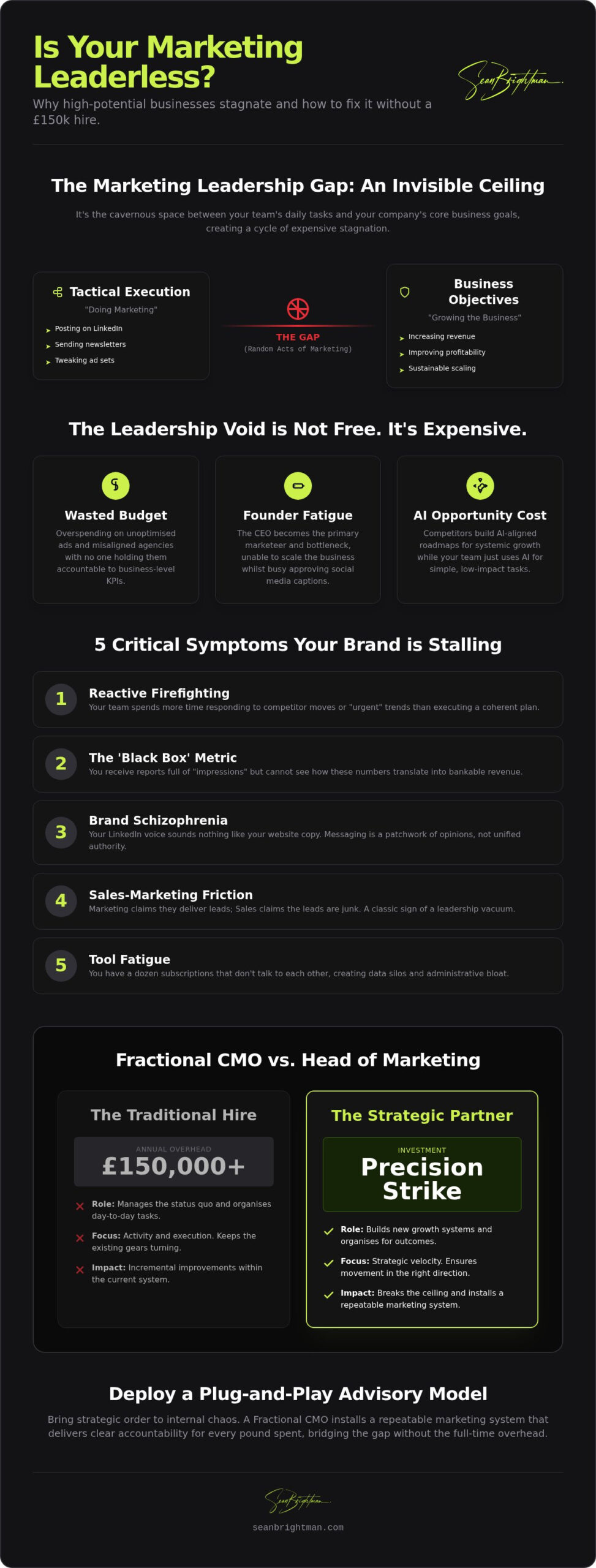
Most UK businesses hit a wall they cannot see. It is not a lack of effort. It is not a lack of staff. It is the marketing leadership gap. This gap is the cavernous space between tactical execution and your actual business objectives. Your team is “doing marketing,” but your business isn’t growing. This is the invisible ceiling that keeps high-potential companies stuck in a cycle of expensive stagnation.
The gap usually appears during the transition from founder-led sales to a formal marketing team. You hire a few specialists. You might even hire a manager. But you still lack a lead engineer for your growth engine. You have people to turn the gears, but no one to design the machine. This is where the debate of fractional cmo vs head of marketing becomes critical. One manages the status quo; the other builds the system that breaks the ceiling.
Your team is likely exhausted. They are posting on LinkedIn, sending newsletters, and tweaking ad sets. They are busy. But “busy” is a vanity metric. Strategic velocity is about movement in the right direction, not just movement. If your marketing activity is disconnected from your revenue goals, you are just committing random acts of marketing.
The difference lies in the level of thinking. A manager organises tasks. A CMO-level strategist organises outcomes. Without senior leadership, your team defaults to what is easy or trendy rather than what is effective. This is how Fractional executives provide value. They don’t just add more “doing” to the pile. They ensure the “doing” actually moves the needle.
A leadership void is not free. It is incredibly expensive. You pay for it in three specific ways:
Choosing between a fractional cmo vs head of marketing is about resourcing for the future. You don’t need a £150k overhead to get senior-level clarity. You need a mechanic who knows where to hit the engine to make it roar.
Stagnation is rarely quiet. It’s a cacophony of misaligned efforts and wasted capital. If your growth has plateaued, you don’t have a market problem. You have a leadership problem. Recognising these five symptoms is the first step toward reclaiming your momentum:
The strategic role of a Chief Marketing Officer (CMO) is to eliminate these frictions. When weighing up a fractional cmo vs head of marketing, the goal is to find the leader who can dismantle these silos before they become permanent fixtures of your culture.
Panic is the default state of a leaderless marketing department. Without a senior strategist, the team suffers from “shiny object syndrome.” They chase the latest AI tool or social platform because they lack the conviction to say no. Strategic brand roadmapping replaces this panic with precision. It turns your marketing from a series of disjointed experiments into a repeatable growth machine. More content is rarely the answer. Better direction is.
If your departments are at war, you’re losing money. The blame game between lead generation and closing is a systemic failure. It happens because there is no unified revenue goal. A senior leader bridges this gap by aligning both teams under a single commercial roadmap. They ensure marketing isn’t just “generating noise” but is actively warming up the right prospects for the sales team to close. This level of oversight is why many UK firms now choose a fractional cmo vs head of marketing; they need the battle-hardened experience to fix the pipes, not just manage the flow. If your engine is misfiring, you might need a bespoke roadmapping session to find the leak.
Most UK businesses are currently treating AI like a novelty. They are “playing” with ChatGPT. That is not a strategy; it’s a distraction. If your team is using AI to generate more noise without improving the signal, you have a leadership failure. The gap isn’t technical. It is strategic. You don’t need more prompts. You need a system.
The core issue is that many teams use AI for tasks, not systems. They automate the writing of a mediocre newsletter whilst the overall growth engine remains broken. When you weigh up the fractional cmo vs head of marketing debate, you must ask who has the technical foresight to integrate AI into your core architecture. The traditional duties of a chief marketing officer have shifted. It is no longer just about brand and creative; it is about technical orchestration.
AI should be a lever for operational efficiency. It should reduce your cost per acquisition and increase your speed to market. If it’s just making your team “busier,” it’s failing. The CEO should not be the one figuring out AI implementation. Your time is too valuable for prompt engineering. You need a leader who can build an AI roadmap aligned with your brand positioning, ensuring technology serves the business goals rather than just adding to the tool fatigue.
AI is only as good as the data it consumes. A common symptom of leadership failure is messy, siloed data that prevents AI adoption. A Fractional CMO doesn’t just look at the creative; they look at the plumbing. They organise your systems for future-proofing, ensuring your CRM and analytics are clean enough to power an automated growth engine. This is about building a machine that requires less human oversight over time.
Ignoring this shift is a high-stakes gamble. Competitors who prioritise AI consulting and strategic integration will outpace you on every metric. They will have lower overheads and higher strategic velocity. You can’t bridge this gap with a junior hire. You need a battle-hardened expert who knows how to turn AI from a toy into a functional component of your revenue machine.
Stop assuming that senior results require a full-time seat at the table. It’s a common myth that keeps UK founders trapped in expensive hiring cycles. You don’t need more people; you need a better machine. When you compare a fractional cmo vs head of marketing, you’re choosing between a permanent overhead and a high-impact intervention. One is a long-term liability; the other is a strategic asset.
A full-time Head of Marketing in the UK often demands a total compensation package exceeding £150k. That is a massive financial commitment before a single lead has been generated. By choosing a Fractional CMO, you access the same C-suite experience for a fraction of the cost. You bypass the recruitment fees, the pension contributions, and the six-month “onboarding” period. You get the diagnosis and the cure on day one.
Many founders try to bridge the leadership gap by hiring more agencies. This is a mistake. Agencies are doers, not owners. They optimise within their specific lanes; SEO, PPC, or social; but they rarely look at your business holistically. They are incentivised to keep their retainers, not necessarily to grow your bottom line.
This leads to supplier drift. Without senior internal leadership, who is holding your agencies accountable? Who is ensuring their work aligns with your 2026 revenue goals? A leader owns the strategy. An agency executes a brief. If your brief is broken, the agency will simply help you fail faster. You need someone on your side of the table who understands the mechanics of the whole engine.
The solution isn’t a new hire. It’s a new system. A Roadmap First approach allows you to diagnose the machine before you commit to more headcount. Within 90 days, you can identify hidden profit in your existing systems and install a robust Marketing operations framework. This isn’t about fluff; it’s about establishing an operating rhythm that creates real accountability.
We build the roadmap, clean the data, and align the team. This creates a repeatable growth engine that doesn’t rely on the founder’s intuition. If you’re ready to stop the hiring guesswork and start scaling with precision, you can book a strategic advisory session here to begin your audit.
Fractional CMOs are not consultants who drop a 50-page PDF and vanish. They are the external force that brings internal order. When you weigh up a fractional cmo vs head of marketing, the primary difference is the speed of impact. A full-time hire spends their first 90 days “learning the culture.” A fractional leader spends their first 90 days rebuilding the engine. It is strategic velocity over corporate ceremony.
The Marketing advisory retainer is designed for CEOs who need high-level guidance without the bloat. It provides a direct line to senior expertise, ensuring your team stays aligned with the roadmap we’ve established. No more guessing. No more “trying things out.” Just senior-level accountability that keeps the needle moving whilst you focus on running the business.
Traditional marketing leadership is often bogged down by bureaucracy and office politics. Fractional models strip that away. It is a get-your-hands-dirty approach that prioritises results over status. We don’t care about ladder-climbing; we care about the growth engine. UK scale-ups are increasingly moving toward this model because it offers senior-level accountability on demand. You get the brain of a seasoned CMO with the agility of a startup, bypassing the recruitment lag and the £150k price tag.
This plug-and-play model allows you to scale your leadership as you scale your revenue. You don’t need a full-time executive to tell you your messaging is broken. You need an expert who has seen your specific chaos before and knows exactly how to fix it. It is about precision, not presence.
If you plan to sell your business, your marketing cannot be a personality-led black box. Buyers covet systems. They want to see a machine that produces predictable revenue regardless of who is sitting in the chair. Using a Marketing strategy for business exit ensures your brand is a tangible asset, not a liability. We build the growth engine that buyers fight over.
Sean Brightman’s methodology focuses on creating these repeatable, scalable systems. We document the process, clean the data, and align the AI-powered roadmap to your commercial goals. Stop guessing and start leading with a battle-hardened expert. Your next step is to bridge the gap. Book a roadmapping session today to identify your bottlenecks and build a growth engine that actually delivers.
Stop letting your marketing be a black box that swallows your budget. You’ve seen the symptoms: reactive firefighting, messy data, and the high-priced myth of the full-time hire. The choice between a fractional cmo vs head of marketing isn’t just about headcount. It’s about whether you want a manager or a mechanic. You need a leader who has built growth engines for exit and understands the systemic shift toward AI. You don’t need a £150k overhead to get C-suite clarity; you need a plug-and-play system that works whilst you sleep.
As a Fractional CMO for high-growth UK scale-ups and an AI-powered growth engine specialist, I help founders bridge the leadership gap with tactical precision. I am the author of the definitive guide to marketing strategy, and I focus on results, not corporate fluff. It is time to dismantle the invisible ceiling holding your brand back. Book a Strategic Roadmap session with Sean Brightman to stop the guesswork and start leading with senior-level accountability. Your growth engine is waiting to be built. Let’s get to work.
A marketing leadership gap is the disconnect between daily tactical activity and your overarching business objectives. It occurs when a team is busy executing tasks but lacks the strategic oversight to ensure those tasks drive revenue. You have the engine, but nobody is steering the car. This gap often surfaces during founder-to-team transitions, leaving the CEO stuck managing creative approvals instead of focusing on high-level growth.
No, agencies are execution partners, not strategic owners. They excel at optimising specific channels like SEO or PPC, but they rarely understand your entire commercial landscape. Agencies are incentivised to protect their retainers, which often leads to supplier drift where their work becomes misaligned with your evolving goals. You need an internal force to hold them accountable and ensure every agency partner is pulling in the same direction.
A full-time Head of Marketing in the UK often costs upwards of £150k once you include salary, bonuses, and benefits. In the fractional cmo vs head of marketing debate, the fractional model offers a massive cost advantage. You pay for high-impact strategic advisory without the permanent overhead of a C-suite salary. This allows you to deploy senior leadership on demand, scaling the investment as your revenue grows rather than committing to a massive liability.
If your team is consistently busy but the needle isn’t moving, you have a leadership problem. Underperformance is a symptom of a broken system, not necessarily bad personnel. Look for black box reports filled with vanity metrics that don’t translate into bankable revenue. If you’re still the one making every creative decision as a founder, your team isn’t underperforming; they’re leaderless. They need a roadmap, not more management.
In 2026, AI consulting is a mandatory component of modern marketing leadership. It isn’t just about using ChatGPT to write emails; it’s about building AI-powered growth engines that improve operational efficiency. A Fractional CMO ensures your tech stack isn’t a Frankenstein of disconnected tools. They build an AI-aligned roadmap that organises your data integrity and future-proofs your systems, ensuring technology serves your commercial goals rather than creating more administrative bloat.
The first step isn’t a job advert; it’s a diagnostic audit. You must identify exactly where the pipes are leaking before you commit to new headcount. Start with a strategic roadmap to define your growth levers and clean up your data systems. This allows you to understand whether you need a permanent hire or a high-impact advisory retainer. Closing the gap requires clinical precision, not a desperate recruitment drive.
You’ll see strategic clarity within the first few weeks. However, building a repeatable growth engine typically takes about 90 days. During this period, we dismantle the random acts of marketing and install a robust operating rhythm. You’ll notice an immediate shift in accountability and messaging consistency. By the end of the first quarter, the focus moves from reactive firefighting to scalable, data-driven execution that delivers predictable ROI.
Absolutely. Hiring without a roadmap is a high-stakes gamble. When comparing a fractional cmo vs head of marketing, the roadmap defines the role you actually need. Without one, you’ll likely hire a generalist who spends months trying to find their feet. A roadmap provides the blueprint for the machine you’re building, ensuring any future hires are brought in to execute a proven strategy rather than figuring it out on your dime.
Reading is good. A roadmap is better.