
Hiring a full-time CMO in 2026 feels like the “safe” move for a UK scale-up. It isn’t. For most, it is a £250,000 anchor that drags your runway into the dirt. When weighing up a fractional cmo vs full time cmo for startups, the traditional choice often leads to a messy department with no clear direction. You are likely feeling the burn rate anxiety whilst fearing a “bad” expensive hire that you cannot afford to get wrong. It is a high-stakes gamble with your company’s future.
This guide will prove why a full-time hire might be your biggest strategic mistake. We will show you how fractional leadership drives faster growth through tactical precision and AI-powered engines. We will strip away the corporate fluff to compare the true costs and outcomes of both models. You will learn how to install senior accountability, implement a clear marketing roadmap, and build scalable systems designed for a clean exit. It is time to stop hiring for ego and start hiring for impact.
Hiring a heavy-hitter too early is a classic scale-up blunder. It is the £150,000 mistake. You bring in a full-time Chief Marketing Officer (CMO) before you have a repeatable growth engine or even a basic product-market fit. The result? You pay a “patience tax” whilst they spend six months “learning the culture.” By the time they produce their first meaningful strategy deck, your runway is half-gone. You have traded your survival capital for corporate seniority.
The choice between a fractional cmo vs full time cmo for startups comes down to one thing: velocity. A full-time hire often defaults to “expensive activity.” They want a team of six, a massive tech stack, and a £20,000-a-month agency retainer to do the heavy lifting. They build a kingdom; you need a machine. A Fractional CMO is different. They focus on outcomes, not hours. They provide senior strategy injected exactly where the friction is highest, without the baggage of a permanent C-suite salary.
The hidden costs of a full-time hire are brutal. It isn’t just the base pay. It is the 25% recruitment fee. It is the equity dilution that haunts you during your exit. It is the benefits package and the employer National Insurance contributions. These are fixed costs that don’t care if your lead volume drops or the market shifts. A fractional model converts these fixed liabilities into variable strategic investments. You get the brain without the overhead.
Founders often hire a full-time CMO because they are tired of managing agencies they don’t understand. They want the marketing problem to “go away.” It won’t. If your marketing department is a chaotic mix of disjointed tactics, a full-time hire won’t magically fix the system. They often inherit the mess and add another layer of bureaucracy. Without a clear roadmap, you just have an expensive executive watching a broken engine. You need accountability, not just a warm body in a chair.
There is a pervasive myth that “full-time” equals “more committed.” It is nonsense. A full-time CMO is often insulated by their contract. A fractional leader survives on results. They bring cross-industry insights that a single-company executive simply misses. In 2026, the competitive edge is being “plug-and-play.” You don’t need someone to sit in meetings for 40 hours a week. You need someone to build a growth engine. This involves high-level AI consulting to automate the mundane and focus on the strategic. Fractional advisory gives you the strategic seniority you need, exactly when you need it.
The debate between a fractional cmo vs full time cmo for startups isn’t about preference. It is about physics. A full-time hire provides corporate stability. They are there for the 9-to-5, the watercooler chats, and the internal politics. A fractional leader provides strategic velocity. They exist to solve a specific problem, build a specific engine, and then get out of the way. You aren’t paying for a bum on a seat; you are paying for a battle-hardened brain that has seen your exact mess ten times before.
Accountability is baked into the fractional model. A full-time executive has a notice period and a golden parachute. They can coast for months before the board notices a lack of progress. A fractional CMO is only as good as their last deliverable. If the needle doesn’t move, the contract ends. This creates a relentless focus on high-impact wins rather than “busy work” or empire building. You get the intensity of a founder with the expertise of a veteran.
Let’s talk numbers. A senior CMO nationally commands £150,000 to £200,000. Once you add bonuses, NI, and recruitment fees, you are looking at £15,000 to £20,000 every month. A fractional leader typically costs a fraction of that for the same strategic output. The opportunity cost is even higher. It takes months to find a permanent hire. A fractional partner starts on Monday. This speed is critical when you are preparing for an exit or a fresh funding round. Buyers don’t want to see a department that relies on one person’s charisma. They want a documented, scalable growth engine.
Full-time CMOs often fall into the trap of “hiring their way out” of problems. They build massive teams and bloated budgets to justify their seniority. A fractional leader does the opposite. They build lean, automated systems that require fewer people, not more. Everything starts with strategic brand roadmapping. This document is the blueprint for your growth. It defines the “what” and the “how” so your internal team or agencies can execute with precision. If you are tired of guessing, an advisory retainer provides the ongoing oversight to ensure that roadmap stays on track.
Deciding between a fractional cmo vs full time cmo for startups isn’t about your budget. It is about your stage. If you wait until your marketing is a dumpster fire, you have already lost. You need to recognise the friction points before they stall your growth. Here are the four non-negotiable signs that it is time to bring in senior leadership on a fractional basis.
A fractional leader doesn’t just “help out.” They install the machinery you lack. They take the weight off the founder’s shoulders and replace chaos with a clinical, results-oriented framework.
Founders often become the frustrated middleman between the business and its external partners. You spend your day translating your vision to an ad agency that doesn’t “get” your brand. A fractional leader stops this cycle. They organise your external partners, set clear KPIs, and hold them accountable to results, not just “brand awareness.” Founder-led marketing fails the moment you spend more time managing tools than steering the ship.
Building a marketing strategy for business exit requires senior-level documentation. Buyers discount businesses where the marketing knowledge sits solely with the founder. They want to see a plug-and-play growth engine that survives your departure. A marketing advisory retainer ensures this documentation is built in real-time. It provides the ongoing senior oversight needed to keep the engine running whilst you focus on the deal. Don’t let a lack of systems shave 20% off your valuation.
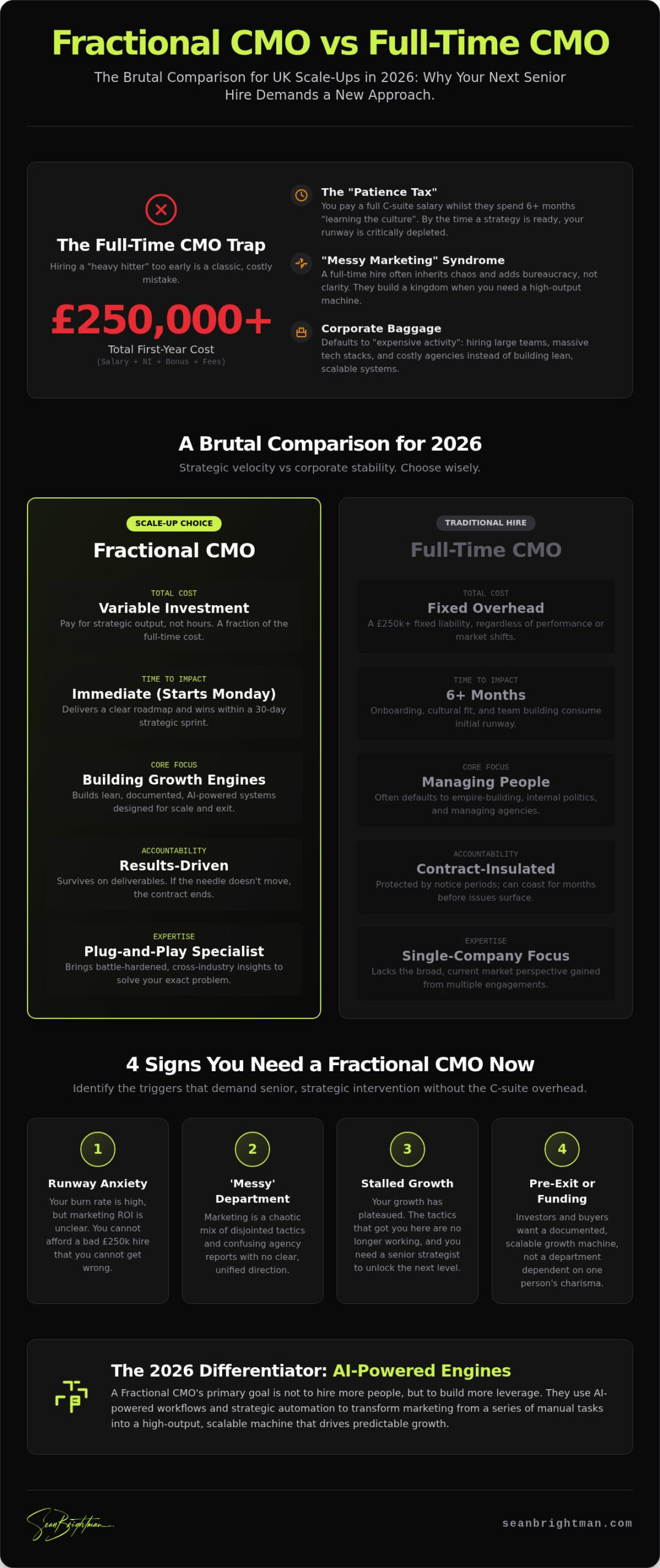
In 2026, a CMO who doesn’t understand agentic AI is a liability. The debate of fractional cmo vs full time cmo for startups usually focuses on cost. That is a mistake. The real divide is between those who build manual teams and those who build AI-powered growth engines. A full-time hire often brings an outdated playbook to a modern market. Whilst 96% of CMOs admit AI is transforming the function, only about one-third have actually implemented the change. A fractional leader uses AI consulting to build systems that solve problems whilst you sleep.
We move beyond basic prompts. Integrating AI into your core operations means automating the entire lead-to-revenue lifecycle. It involves an “AI Efficiency Audit” to gut your current tech stack of redundant, expensive software. You stop paying for “seats” and start paying for outcomes. This is how you find hidden profit in your current marketing spend. It is the difference between having a “tool” and having a functional component of your business machinery that doesn’t require constant manual management.
A fractional partner acts as a high-level Marketing Operations Consultant. They don’t just suggest tools; they architect strategic workflows. This replaces expensive manual labour with automated precision. Industry data as of August 2026 indicates that marketing automation is projected to increase from 16% to 36% by 2028. If you are still hiring full-time staff for tasks that an AI agent can handle, you are burning cash. The fractional CMO is the architect of your AI roadmap, ensuring your team is lean and your output is massive.
Board reports are often full of “fluff” like brand sentiment and social engagement. Full-time CMOs use these metrics to play corporate politics and justify their tenure. Fractional leaders don’t have that luxury. They rely on AI to track real-time marketing ROI across every channel, from top-of-funnel discovery to final conversion. This provides a clinical, unbiased view of what is actually working. You get senior accountability without the ego-driven narratives. It is about hard data, not polished presentations that hide a lack of progress.
Build a scalable growth engine that doesn’t require a massive headcount by hiring a Fractional CMO who specialises in AI integration.
Corporate onboarding is a slow-motion car crash. A full-time executive typically spends their first 90 days “absorbing the culture” and “meeting stakeholders.” You don’t have 90 days. When you weigh up a fractional cmo vs full time cmo for startups, you are choosing tactical speed over corporate ceremony. Onboarding a fractional leader is about a 30-day strategic sprint. You identify the friction, fix the leaks, and install the machinery. It is leadership without the ego.
A fractional CMO doesn’t need a desk or a parking space. They need access to your data, your tech stack, and your team. The goal is to move from chaos to clarity before the first month is out. You define what “winning” looks like in 90 days, not three years. This isn’t about building a career; it’s about building a growth engine. We establish a rhythm: weekly accountability to keep the team focused and monthly strategic reviews to pivot as the market demands.
The sprint begins with a marketing operations consultant audit. You stop guessing and start measuring. We look for “quick wins”-tactical adjustments that can often pay for the fractional retainer within the first six weeks. This might involve gutting a bloated ad account or automating a manual lead-nurture sequence. You fix the immediate leaks whilst setting the long-term vision. It is tactical surgery followed by strategic architecture.
Once the engine is built, you don’t let it rust. An advisory retainer provides ongoing strategic velocity. It gives you a “battle-hardened” perspective in your corner. This keeps you from making a £50,000 mistake on a trend that won’t last. In the fractional cmo vs full time cmo for startups debate, the retainer model is the clear winner for flexibility. You get the brain of a veteran without the weight of a permanent C-suite salary. It is a scalable asset, not a fixed liability.
Stop hiring CVs and start building systems. Book a roadmapping session with Sean Brightman to turn your marketing from a cost centre into a high-output growth engine.
The decision between a fractional cmo vs full time cmo for startups is ultimately a choice between agility and baggage. You don’t need a £200,000 anchor dragging your runway into the dirt. You need a high-velocity strategic partner who installs the machinery required for a scalable exit. Stop hiring for corporate stability that your business hasn’t earned yet. Focus on building an AI-powered growth engine that delivers senior accountability without the ego.
By opting for fractional leadership, you secure a battle-hardened perspective and a clinical roadmap for growth. You replace messy, disjointed tactics with automated strategic workflows that drive real-time ROI. It is about impact, not headcount. It is about outcomes, not hours. The future of your scale-up depends on how fast you can turn chaos into a repeatable, documented system.
Stop wasting money on the wrong hires. Build your growth engine with Sean Brightman.
Your marketing department should be your greatest asset, not your biggest headache. Take the first step toward a leaner, more profitable future today.
A consultant gives advice whilst a fractional CMO takes ownership. Consultants deliver reports and leave you to execute the findings. A fractional CMO builds the engine, manages the team, and stays accountable for the results. It is the difference between a spectator and a player-coach who is active in your business machinery.
Usually, it is not. At the pre-seed stage, you need a founder who can sell, not an executive who can strategise. Hiring a fractional leader before you have basic product-market fit is a distraction. Wait until you have enough data to build a repeatable growth engine. Focus on survival and initial traction first.
Most fractional CMOs work between 5 and 15 hours per week. It is about strategic impact, not desk time. They attend key meetings, steer the roadmap, and unblock the internal team. If you are counting hours, you are missing the point of the fractional cmo vs full time cmo for startups debate. You pay for the brain, not the clock.
Yes, this is a core responsibility. A fractional CMO acts as your translator and enforcer. They set the KPIs, audit the output, and fire agencies that underperform. You stop being the middleman and start seeing real accountability from your external partners. They ensure your agencies are functional components, not just cost centres.
Costs vary based on the complexity of your engine and the frequency of advisory sessions. Whilst specific retainers are bespoke, they are significantly lower than the £15,000 monthly cost of a full-time, heavy-hitter executive. Some industry professionals report that retainers often reflect the level of strategic velocity required to hit your next funding milestone.
Some do, but it shouldn’t be the primary motivator. Equity is often used as a performance kicker rather than a salary replacement. It aligns the leader with your long-term exit goals. However, most professional fractional partners prioritise their retainer to ensure they remain a variable, scalable asset that you can dial up or down.
You are ready when your marketing engine is so complex that it requires 40 hours of senior oversight every week. If your growth is predictable and you have a team of 10 people to lead, the transition makes sense. Until then, the fractional cmo vs full time cmo for startups comparison favours the leaner, more flexible model.
Look for battle-hardened experience in your specific sector or stage. They should have a history of building engines, not just managing big budgets. Ask for proof of AI integration and scalable systems they have built for previous exits. Avoid anyone who only talks about brand awareness and “vibes” without mentioning hard ROI.
Reading is good. A roadmap is better.