

A launch date doesn’t prove demand. Developing a go-to-market plan for a new product means making the hard calls before launch activity gathers pace: which customers have the sharpest need, what evidence supports that choice, and what would make them buy. Start campaigns before answering those questions and you risk spending time and budget learning what the market could have told you first.
It’s sensible to want momentum, but activity isn’t progress if your team is still guessing about the target segment, proposition or route to market. A strong plan sequences evidence-backed decisions, not just launch tasks. It gives marketing, sales, product and customer support a shared direction, named owners and measures to check whether assumptions hold.
This guide shows you how to choose a focused initial market, align your product, positioning, channels and commercial model, then turn the strategy into milestones and learning measures. You’ll see how to validate demand before scaling activity, assign accountability and adapt the plan as customer evidence comes in. The result is a practical route from product concept to launch, not another strategy document that sits untouched.
A product can be ready to ship and still lack a credible route to customers. Developing a go-to-market plan for a new product means connecting what you’re offering to a specific group of buyers, a reason they should choose it, and a practical way to sell and deliver it.
A go-to-market plan connects a product with its chosen customers and sets out the commercial steps needed to reach them. A go-to-market strategy sets the direction; the plan translates that direction into decisions and action. It’s narrower than a full business plan, which covers the wider organisation, and more focused than a marketing strategy, which guides marketing priorities across the business.
This distinction matters. Without decisions on the customer, proposition, channels, sales approach and measures, teams can mistake launch activity for progress. The plan should also change as evidence accumulates. Treat it as a working guide, not a document to file away once the launch date is set.
Build the plan around the choices that shape how the product reaches its first customers. Make the reasoning visible, including what’s known and what still needs testing.
For example, a team might have evidence that a particular type of business struggles with a recurring problem, but only an assumption that it will pay for a proposed solution. Label these separately. That stops an untested belief from quietly becoming a launch commitment.
A campaign promotes an offer. The go-to-market plan determines how the offer reaches customers and whether the organisation can support its promise. Campaign messages can create attention, but product readiness, pricing, sales conversations, fulfilment and customer support all affect whether a launch is ready to proceed.
Imagine a product with a clear message but no agreed sales process or plan for handling customer questions. More promotion won’t fix those gaps. It may expose them sooner.
A launch date is a milestone, not proof of market readiness. Before committing, check whether the target customer, proposition and route to market are clear, whether essential teams are prepared, and which signals will guide the next decision. If important assumptions remain untested, adjust the sequence. Launch when the plan is ready to meet the market, not simply because the calendar says so.
Good research doesn’t ask people to predict the future. It checks whether the problem is real, urgent and connected to action. Compliments are easy to collect. Evidence takes more work.
Interest is what people say; evidence of demand is what they’re willing to do. That might mean sharing their current process, committing time to a trial or taking a concrete step towards a purchase. Use developing a go-to-market plan for a new product to organise that learning before you lock in launch decisions.
Don’t begin with the broadest possible audience. Group potential customers by the needs they share, the context in which the problem occurs, its urgency and how readily you can reach the people involved. Prioritise a segment where the problem is specific and you can speak both to those who experience it and to those who influence the buying decision.
Existing customer feedback, sales conversations and support enquiries can point you towards useful questions, but check that the information is relevant and reliable. A pattern in recent conversations may be more useful than an old assumption built into a slide deck.
Match the test to the uncertainty. Interviews help you understand the problem and the customer’s current workarounds. A prototype can reveal whether the proposed solution makes sense in practice. A pilot or sales conversation can test whether people will invest time, involve colleagues or discuss commercial terms. A landing-page test may help assess response to a proposition, but clicks alone don’t prove purchase intent.
Use this sequence to turn research into a decision:
There’s no universal conversion threshold that proves demand. Set criteria that fit your product, sales cycle and risk. Record each finding, its source and confidence level, then list unresolved questions and the evidence needed to answer them. If people praise an idea but won’t take a next step, treat that as a signal to investigate, not a green light.
If your team needs help turning customer evidence into clear priorities and accountable next steps, strategic roadmapping support can help structure the work.
Once you’ve narrowed the customer and problem, make the choices fit together. A proposition aimed at small firms with a simple, urgent need calls for a different buying experience from a complex product that requires approval across several teams. Developing a go-to-market plan for a new product means making those connections explicit, rather than choosing channels simply because competitors use them.
Write a plain-English statement that names the audience, problem, benefit and credible distinction. For example: “For [customer] dealing with [problem], this product helps [benefit] by [difference].” It’s a working tool, not a slogan. Put it in front of target buyers and check whether they understand the value without your team translating internal jargon.
Compare the offer with the choices customers actually face. These may include a competitor, an existing supplier, a manual workaround or doing nothing. If your distinction only makes sense inside your organisation, sharpen the proposition before building the channel plan.
Assess how buyers prefer to purchase, how complex the decision is, and whether your team can provide the sales guidance, onboarding and support the product needs. Digital commerce can make straightforward purchases easier to complete, but customers may need more help with setup. Direct sales can support complex decisions and provide closer feedback, but require the capability to manage those conversations. Partners and platforms can extend reach, though you may have less control over the customer relationship and experience.
Use this comparison to surface trade-offs. The right answer depends on customer access and your ability to deliver, not on a channel’s popularity.
| Business context | Route to consider | Trade-off to examine |
|---|---|---|
| Simple offer, straightforward purchase | Digital commerce | Convenient buying, but onboarding and support still need clear ownership. |
| Complex decision or several stakeholders | Direct sales | More guidance and feedback, with greater demands on sales capability. |
| Customers are accessible through trusted intermediaries | Partners | Potentially broader reach, with less control over the customer experience. |
| Buyers already use a relevant platform | Platform route | Access to an established environment, balanced against platform dependence. |
Then examine the commercial model alongside the channel. Payment structure, contract terms and the steps needed to start using the product can add friction or remove it. Make sure the promised buying experience matches what your team can support.
Record why you chose each route, what you give up and what evidence would prompt a change. For a broader view of how positioning connects with growth priorities, read the strategic brand roadmapping guide.
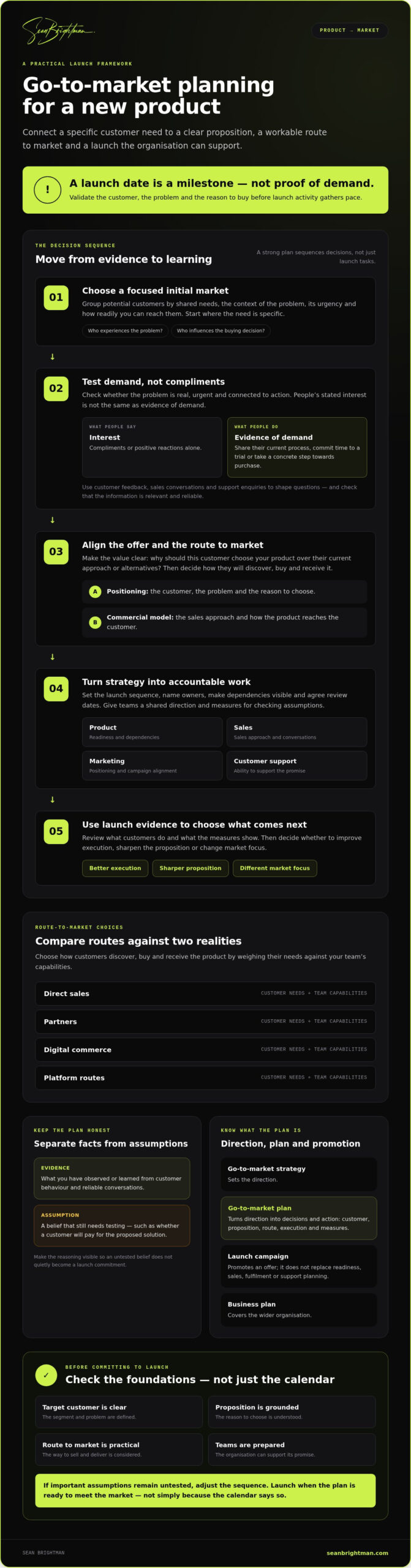
A strategy only becomes useful when people know what to do next. Translate your choices into workstreams, owners, dependencies and decision dates. Developing a go-to-market plan for a new product means giving each team a clear part to play, not simply circulating a launch date and hoping the pieces come together.
Coordinate product readiness, sales enablement, marketing, delivery and customer support. For each workstream, name one accountable owner, what they must deliver, what they depend on and how the team will know it’s ready. A marketing milestone, for example, may depend on approved product information, a working purchase process and a support team prepared to handle customer questions.
Map the preparation, launch and post-launch work that suits this product. Not every launch needs the same phases. Build decision gates around real risks, such as unresolved product issues, unclear sales guidance or support gaps. At each gate, specify who decides and what evidence they need. A fixed date can anchor the schedule, but it shouldn’t overrule a readiness concern.
Plan fallback actions before pressure hits. If a dependency slips, decide whether to move the date, narrow the launch scope or adjust the sequence. If demand signals weaken, pause expansion and review the proposition. If operational readiness falls short, hold back promotion until the team can deliver the promised experience.
Choose measures that show movement through the customer journey, not just work completed. Depending on the product, track awareness, qualified demand, conversion, activation and retention. Pair each measure with an owner, a data source and a review rhythm, so the team can spot issues and act rather than debate whose numbers are right.
Impressions, meetings booked and tasks completed can help diagnose execution. On their own, they don’t show whether customers are adopting the product or whether the commercial model is working. Connect activity to customer behaviour and commercial objectives, then review the evidence regularly and assign follow-up actions.
For more on the systems and accountability that support consistent execution, read the marketing operations growth engine guide. If your team needs direction turning priorities into owners and milestones, explore strategic roadmapping support.
A launch isn’t the finish line. It’s the point where assumptions meet customer behaviour. Set a review rhythm that suits your buying cycle, then compare what you observe with the objectives and hypotheses in your plan. Developing a go-to-market plan for a new product should create a feedback loop, not a one-off launch checklist.
Look at who responds, what prospects ask in sales conversations and how customers use the product. Gather feedback from customers and frontline teams, then look for recurring patterns rather than reacting to one loud opinion. Compare the evidence with your original assumptions about the customer, problem, proposition and route to market.
Keep context attached to every finding. Early results may reflect a small or unusual group, a limited launch or an execution issue. Don’t treat them as conclusive until you’ve considered who was reached, what they experienced and whether the evidence is strong enough to support a decision.
Diagnose the gap before changing the plan:
This helps the team avoid rewriting the proposition to solve a delivery problem, or blaming a channel before checking whether the offer resonates.
Internal teams may need an outside perspective when priorities conflict, positioning remains unclear or nobody owns the decision process. Strategic roadmapping can help clarify direction, sequence choices and establish accountability. It provides strategic guidance, not campaign execution or recruitment.
At each review, make one decision and record the reason, evidence and owner:
Each decision should lead to a clear next action and a date to review its effect. If your team needs sharper priorities or more accountable strategic direction, consider discussing roadmapping or advisory support with Sean Brightman.
A useful go-to-market plan gives your team more than a launch checklist. It connects a clearly chosen customer and credible proposition to a route the business can deliver, with owners and measures that help you learn from the market.
Keep the plan grounded in evidence. Test assumptions before committing, make the trade-offs behind positioning and channel choices visible, then use customer behaviour to decide whether to continue, adjust, expand or stop. That’s the practical discipline behind developing a go-to-market plan for a new product.
If your team needs clearer priorities or stronger accountability, Sean Brightman’s independent strategic marketing consultancy offers roadmapping sessions and ongoing advisory support. You can also explore his published book on marketing strategy. Discuss your product’s strategic direction and decide what your next step should be.
Your product doesn’t need a perfect plan. It needs a clear one, built to learn and ready to adapt. Start with the evidence, then move forward with purpose.
A go-to-market plan sets out how a product will reach and serve its intended customers. It connects the customer problem and value proposition with positioning, sales or distribution channels, launch responsibilities and measures. Unlike a promotional campaign, it also covers product readiness, the buying experience and customer support. It gives the team a practical basis for acting, checking assumptions and responding to what the market shows.
Developing a go-to-market plan for a new product starts with stating what you believe about the customer, the problem and the commercial opportunity. Research the target segment and test whether people show meaningful demand. Then decide on positioning, the commercial approach and routes to market. Assign owners, milestones and measures, including unresolved risks. After launch, compare results with your assumptions and adjust the plan rather than treating it as fixed.
A go-to-market plan should cover the target customer, problem, value proposition and positioning, as well as the commercial model and route to market. Include sales and marketing responsibilities, product readiness, customer support and measures tied to your objectives. Record key assumptions, risks, decision owners and launch milestones too. Keep the detail useful rather than exhaustive: the plan should guide action whilst clearly distinguishing confirmed decisions from points that still need testing.
There’s no universal timetable for creating a go-to-market plan. The work depends on how much reliable customer evidence you already have, how complex the product is, how customers buy and how many teams or channels must align. You can draft the main choices quickly, but research, validation and agreement may take longer. Set milestones around evidence and readiness, not an arbitrary deadline that pressures the team to treat unanswered questions as settled.
A marketing plan typically sets broader marketing objectives, audiences, activities and measures for a defined period. A go-to-market plan focuses on how a particular product reaches its intended customers and delivers value. Marketing can form part of it, but the plan also connects product readiness, sales, distribution, commercial choices and customer support. The distinction is practical: one guides marketing priorities, whilst the other coordinates the wider route from product to customer.
A product is closer to launch-ready when the team understands its intended customer and problem, can explain its value clearly, and can deliver and support the promised experience. Check that sales and customer-facing teams know what to do, measures have owners, and unresolved risks have been reviewed. A finished product or chosen date isn’t enough on its own. Agree what evidence and operational conditions must be in place before proceeding.
Measure progress against the product’s goals and customer journey. Depending on the offer, useful measures may include qualified demand, conversion, activation, repeat use, retention and customer feedback. Pair outcomes with diagnostic measures, such as where prospects leave the buying process or customers struggle during onboarding. Assign an owner and set a review rhythm. Activity totals can show what the team did, but they don’t establish whether customers adopted the product or commercial objectives were met.
Reading is good. A roadmap is better.