

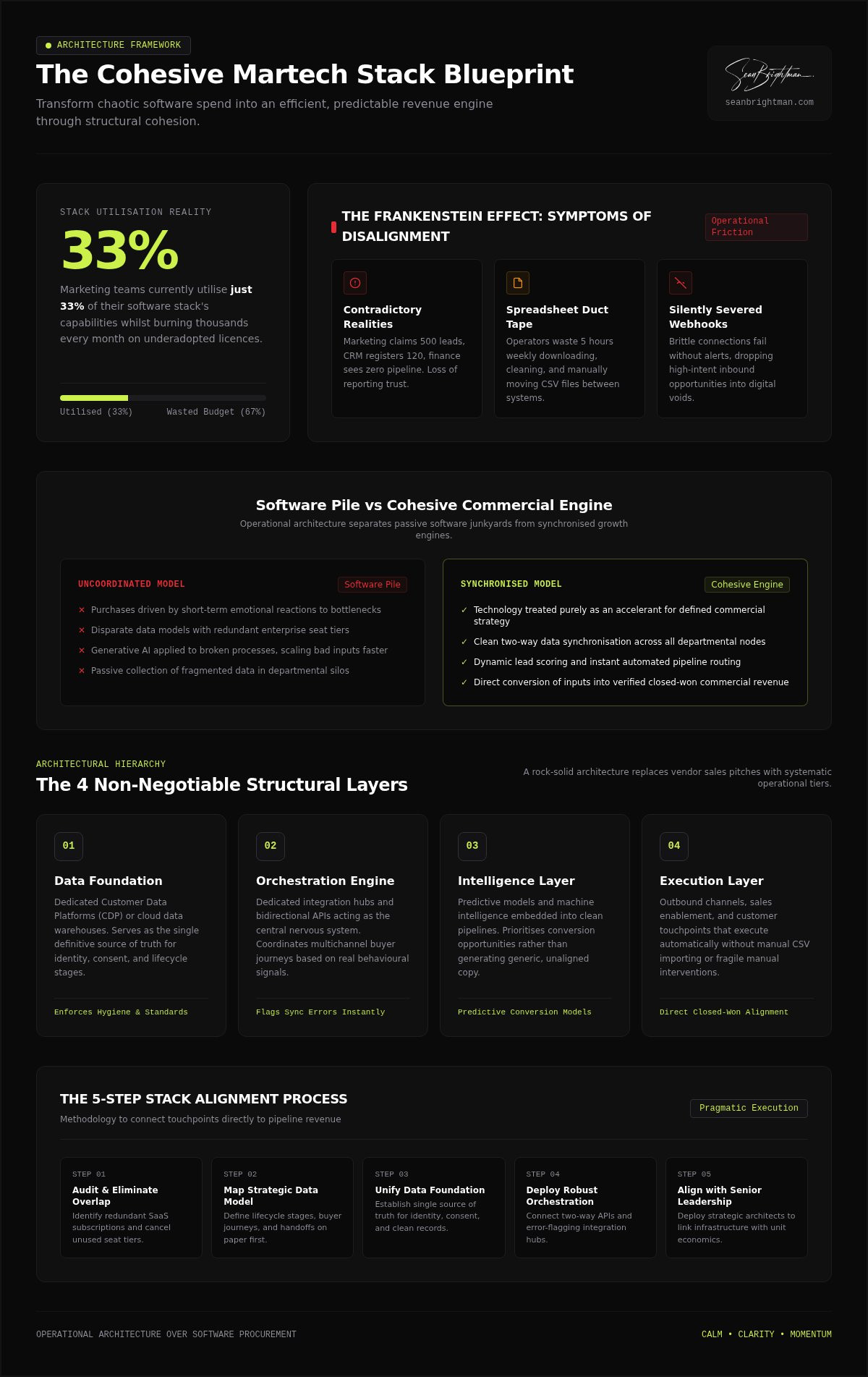
Marketing teams currently utilise just 33% of their software stack’s capabilities, whilst burning thousands of pounds every month on subscriptions nobody adopts. Stack cohesion isn’t a software procurement problem; it’s an operational architecture failure. You already feel the daily friction. Customer data remains trapped in isolated departmental silos, commercial forecasting is crippled by inaccurate attribution, and your team wastes valuable hours manually moving CSV files between disconnected platforms. Creating a cohesive martech stack demands operational discipline, not another software demo.
You don’t need more tools; you need a system that actually speaks to itself. In this guide, you’ll discover how to eliminate expensive bloat, unify customer data across every touchpoint, and architect a high-converting tech stack that drives measurable commercial revenue. We will map the operational blueprint for clean two-way data synchronisation, rigorous attribution from first engagement through to closed-won deals, and intelligent automations that execute without human intervention. Here is how you turn chaotic software spend into an efficient, predictable revenue engine.
Most commercial organisations do not possess a technology architecture. They possess a software junkyard. Creating a cohesive martech stack means building a synchronised commercial engine where data flows bidirectionally between systems to drive measurable revenue, not collecting point solutions to soothe short-term operational anxiety.
Modern marketing stacks break down because procurement is treated as an emotional reaction rather than an architectural discipline. A team member encounters a workflow bottleneck, submits an expense request for a point solution, and leaves the company twelve months later. The subscription renews automatically. Multiply this across five departments, and you are bleeding thousands of pounds on redundant licences, unused enterprise seat tiers, and unmanaged integrations that generate fatal data silos.
Worse, slapping generative AI platforms onto disjointed pipelines only accelerates the damage. AI does not fix broken foundational processes; it scales bad inputs faster. Without architectural cohesion, you are simply automating chaos at an enterprise scale.
When software is stitched together haphazardly, operational friction turns lethal to commercial growth. Look for these clear warning signals within your daily operations:
A software pile collects passive inputs. An engine converts inputs into closed-won revenue through tight operational synchronisation.
When you purchase point solutions in isolation, you inherit disparate data models, overlapping feature sets, and fragile integrations. Conversely, creating a cohesive martech stack relies on a unified data layer that powers foundational marketing automation, dynamic lead scoring, and instant pipeline routing. Technology is purely an accelerant for commercial strategy. If the strategic data model, buyer journey stages, and commercial handoffs are undefined on paper, purchasing another software licence will merely amplify your operational dysfunction.
Stop looking for a single silver-bullet tool. High-growth organisations build on operational architecture, not software vendor sales pitches. Creating a cohesive martech stack requires four distinct, non-negotiable structural layers: data foundation, orchestration, execution, and intelligence. When these components connect properly, customer data flows freely, attribution becomes undeniable, and pipeline converts predictably.
Your CRM is not the centre of the universe. The foundational layer belongs to a centralised data store, whether a dedicated Customer Data Platform (CDP) or a structured cloud data warehouse. This layer acts as the definitive single source of truth for customer identity, regulatory consent, and lifecycle stages. It strips out duplicate records, enforces property standards across systems, and ensures pristine data hygiene before records feed into downstream commercial tools. If this foundation is cracked, your entire stack crumbles.
Orchestration operates as the central nervous system of your business. It connects raw records to active customer-facing campaigns. High-performing architectures abandon brittle, consumer-grade zaps in favour of dedicated integration hubs and bidirectional APIs. This layer coordinates multichannel buyer journeys based on verified behavioural signals, manages data mapping protocols, and flags sync errors immediately. When an enterprise prospect requests pricing, sales enablement and email sequences trigger in lockstep, zero manual imports required.
Generic generative copy tools do not create commercial leverage. True competitive advantage comes from embedding predictive models directly into your clean operational data. This layer handles dynamic account scoring, real-time intent routing, and churn probability warnings before accounts churn.
Operationalising this intelligence requires methodical alignment. Senior commercial teams regularly deploy targeted ai consulting to build bespoke workflows that eliminate friction rather than introducing technical debt. Done right, creating a cohesive martech stack ensures your intelligence layer drives execution automatically. If your infrastructure lacks this cohesive coordination, partnering with an experienced strategic advisor at seanbrightman.com can help map the technical blueprint your commercial engine requires.
Fixing a fragmented commercial stack is not about buying fresh software. It is a systematic teardown and rebuild. Creating a cohesive martech stack demands operational discipline across five clear phases: auditing licences, mapping buyer journeys, pruning waste, enforcing taxonomy, and securing robust API integrations.
Start by auditing every software licence across the business. Pull credit card statements, review departmental expenses, and catalogue contract renewal dates alongside actual seat utilisation. Most leadership teams discover paid accounts untouched for months.
Next, trace the end-to-end journey of an inbound lead from initial anonymous visit through to payment processing. Document every digital handoff between platforms:
Mark every point of human intervention. Those friction points are where commercial pipeline leaks.
With your operational bottlenecks visible, cut the excess. Identify functional overlap across platforms. Your email automation tool, CRM, and customer success platform might all offer survey functionality or lead scoring. Choose one definitive system for each capability and cancel the redundant licences.
Once you strip away the bloat, establish ironclad data governance. Standardise UTM parameters, custom properties, and lifecycle status definitions across departments. Sales, marketing, and finance must agree on what constitutes a qualified lead and where that status updates. Without unified definitions, creating a cohesive martech stack is impossible.
Eliminate fragile third-party automations bridging critical commercial paths. Direct, bidirectional API integrations or enterprise middleware must handle primary data pipelines between your CDP, CRM, and marketing platforms.
Implement real-time error logging and automated failure alerts. If a sync fails between your lead capture forms and your sales queue, your operations team must know within minutes, not weeks later after missed quarterly targets. Finally, record every integration in an accessible data dictionary. When architectures are properly documented, institutional knowledge stays protected regardless of staff turnover.
Every commercial leader hits the same architectural fork in the road. Do you buy a single monolithic suite that promises to handle everything passably, or do you assemble a composable stack of specialised tools that excel at specific tasks? The answer dictates your operating margins, integration overhead, and agility for years. When creating a cohesive martech stack, neither choice is inherently superior. The decision comes down to your internal technical maturity and commercial growth velocity.
Monolithic platforms win on administrative simplicity. A single contract, unified user permissions, and native data models eliminate the integration headaches that plague fragmented environments. Data moves seamlessly between marketing campaigns and sales pipelines because it lives in the same relational database. The trade-off is functionality depth. Monolithic suites provide broad operational coverage, but their individual modules frequently offer shallower capabilities than dedicated point solutions. If your commercial execution demands sophisticated multichannel orchestration, an all-in-one suite will eventually feel like a straitjacket.
Composable architectures give you absolute tactical freedom. Your growth team can select the best analytics engine, the most capable email platform, and the sharpest enrichment software available. You avoid vendor lock-in because underperforming components can be swapped without ripping out your entire infrastructure.
Yet freedom carries a steep price. Composable stacks incur significant hidden maintenance costs:
The most elegant software architecture fails if your commercial team refuses to use it. Technology does not solve execution problems; human behaviour does. Leaders routinely spend six figures on platform subscriptions, only to watch sales reps revert to personal spreadsheets because the CRM requires twenty mandatory fields per contact record.
Operational discipline requires clear, documented standard operating procedures and simplified interfaces. Workflows must serve the revenue team, not the other way around. Engaging a battle-tested marketing operations consultant ensures your systems are engineered around frontline reality rather than theoretical ideals. If you are ready to evaluate your software architecture and align your tools with your commercial pipeline, explore strategic options at seanbrightman.com to eliminate waste and establish an engine built for measurable scale.
You cannot delegate enterprise architecture to junior operators or generalist marketing agencies. Tactical marketers know how to build email sequences and run paid campaigns. They do not know how to design data governance models, negotiate software enterprise tier caps, or audit webhook latency across five integrated platforms. Creating a cohesive martech stack requires architectural vision tied directly to unit economics and commercial growth.
Technology should mirror commercial reality, not shape it arbitrarily. When procurement is unguided, software decisions become reactive, leading to overlapping capabilities and runaway operational costs. Senior architectural leadership brings order to this friction. A seasoned strategist interrogates vendor proposals, strips out unused platform features before signing, and ensures that every software expenditure maps directly to accelerated pipeline velocity.
Stop reporting vanity metrics to your executive team. The board does not care about click-through rates, open percentages, or platform activity logs. They care about customer acquisition cost (CAC), pipeline velocity, net revenue retention, and customer lifetime value (LTV).
Operational maturity means building real-time dashboards that connect upstream campaign engagement directly to pipeline creation and closed revenue. Achieving this level of operational cohesion demands structured alignment before touching software settings. Exploring dedicated strategic brand roadmapping enables organisations to define commercial goals clearly so their marketing infrastructure reinforces overarching business objectives.
Hiring a permanent marketing director to fix technical operations creates significant financial drag. Between executive search fees, equity packages, and recruitment delays, you are committed before seeing a single process improve.
High-growth scale-ups bypass these bottlenecks by engaging an experienced fractional cmo. This plug-and-play model delivers decisive, battle-tested strategic oversight without the £120k+ overhead of a permanent hire. An experienced fractional leader audits current software, cuts redundant subscriptions, and restructures core integrations rapidly. When you establish veteran architectural oversight, creating a cohesive martech stack shifts from an ongoing headache into a distinct commercial advantage.
Software doesn’t generate commercial revenue; disciplined operational architecture does. Creating a cohesive martech stack requires shifting away from impulsive tool purchases toward a clean, synchronised infrastructure where customer data flows effortlessly from initial discovery to deal close.
Fixing fractured pipelines demands strategic clarity before another software licence renews. You need an unshakeable data foundation, strict integration governance, and operational buy-in across your commercial teams. Most importantly, you need experienced architectural leadership that bridges brand strategy, data integrity, and commercial execution.
You don’t have to carry the £120k+ overhead of a permanent executive hire to build a scalable foundation. Deploy battle-tested frameworks that eliminate tool fatigue, streamline pipeline velocity, and turn messy software into a predictable revenue system. Book a Strategic Roadmapping Session today to audit your current architecture, cut operational bloat, and engineer an integrated growth engine designed for sustained scale.
The first step is conducting an exhaustive systems and licence audit across your entire business. Review credit card statements, software contracts, and actual seat utilisation rather than relying on departmental assumptions. Identify what you pay for versus what your team actually logs into every week. Creating a cohesive martech stack begins by stripping out redundant subscriptions, not by purchasing another tool.
An effective stack contains only as many tools as your business model requires to generate commercial pipeline. Mid-market companies typically operate efficiently with 8 to 15 core platforms covering data, orchestration, execution, and analytics. Enterprise stacks often bloat beyond 40 tools, driving unnecessary operational friction. Prioritise deep adoption and clean integration across a handful of essential engines over sheer tool volume.
Neither architecture is universally superior; the right model depends on your internal technical capability. All-in-one platforms provide administrative simplicity, native data synchronization, and unified billing, making them ideal for lean teams. Best-of-breed composable stacks offer superior feature depth but require continuous engineering maintenance to avoid data corruption. Choose an all-in-one suite for simplicity, or composable tools for custom tactical execution.
Measure return on investment through commercial pipeline velocity and customer acquisition efficiency, never through vanity engagement metrics. Calculate your total cost of ownership, including software subscriptions, implementation fees, and internal maintenance hours. Balance that expense against pipeline creation, deal cycle speed, and manual labour saved through automated workflows. If a platform doesn’t demonstrably accelerate revenue, it represents pure overhead.
Integrations fail because of conflicting lifecycle definitions and mismatched property fields, not software bugs. When marketing and sales define an opportunity differently, or when custom data fields aren’t mapped identically, records duplicate and corrupt. Relying on brittle consumer zaps without automated failure alerts guarantees silent sync breakdowns. Durable integrations require standardised data taxonomy and disciplined cross-functional governance.
No. AI functions as an intelligence layer that accelerates existing infrastructure, not a standalone replacement for core operational systems. Predictive algorithms and generative tools still require clean relational databases to deliver accurate outputs. Layering AI on top of disconnected spreadsheets simply automates bad data faster. Use AI to improve segmentation and scoring, while keeping your foundational database and orchestration tools intact.
Stack governance belongs to senior commercial leadership, not disconnected IT departments or junior campaign operators. Creating a cohesive martech stack requires aligning technical architecture directly with commercial unit economics. A dedicated marketing operations leader or Fractional CMO must oversee software procurement, integration health, and data standards. Without centralised executive ownership, departmental software sprawl quickly returns.
Reading is good. A roadmap is better.