
You think hiring an agency is the safe, cost-effective way to scale. It isn’t. It’s often the fastest way to burn cash on “activity” that lacks a soul. Most UK scale-ups obsess over the monthly invoice whilst ignoring the strategic debt piling up in the background.
You’ve likely felt the frustration. You’re paying for “account managers” who need your constant oversight just to keep the lights on. You see reports filled with vanity metrics, but your bank balance doesn’t move. You want a growth engine; instead, you’re getting a list of tasks. When you weigh up the cost of fractional cmo vs agency, you shouldn’t just look at the bottom line of the quote. You need to look at who owns the outcome.
The true cost of marketing isn’t the fee you pay. It’s the wasted spend caused by poor strategy. This article breaks down the brutal reality of both models. I’ll show you why clarity beats capacity every time and how to build a scalable system that doesn’t require the CEO to play part-time marketing director. We’re moving from managing people to owning results.
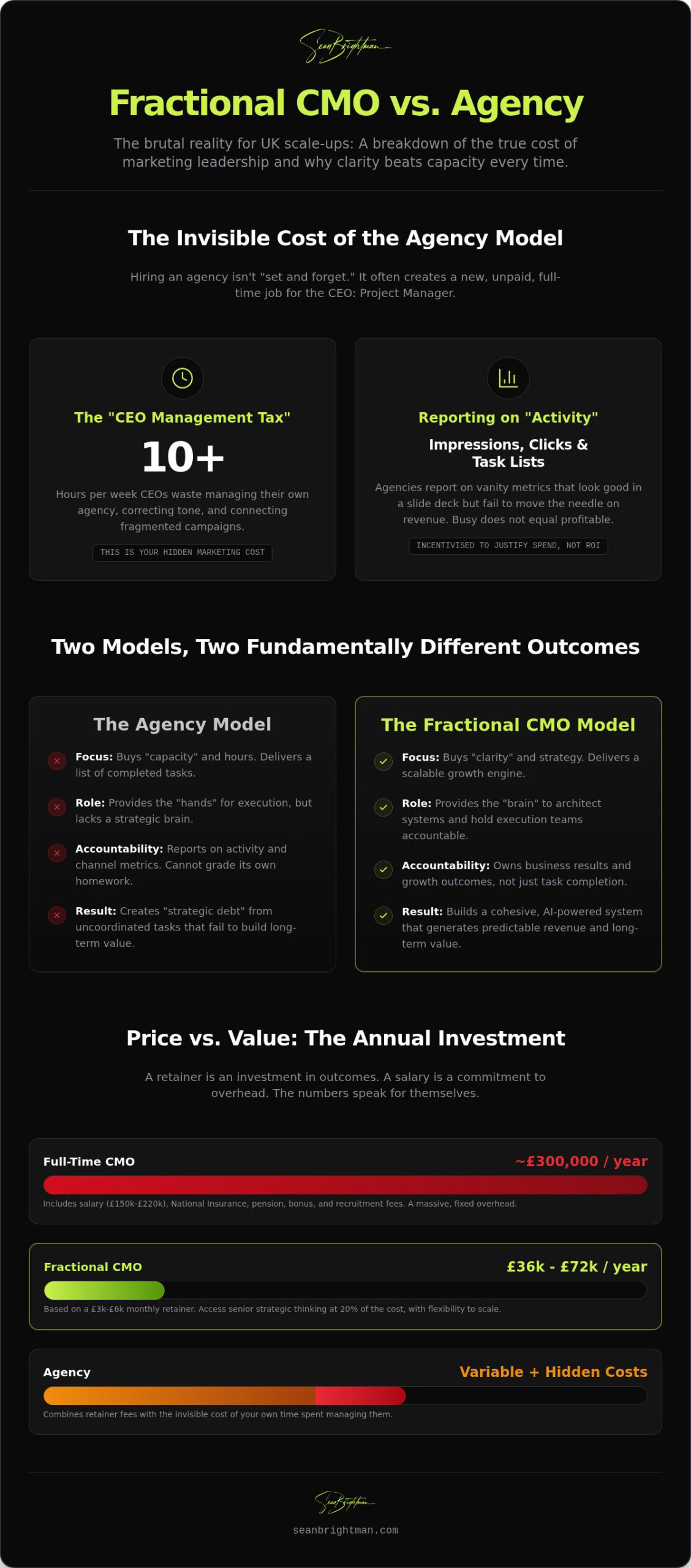
Scale-ups often treat agencies like a “set and forget” solution. It is a myth. You don’t just pay an agency; you pay to manage them. Most founders realise too late that hiring an agency to “fix” marketing usually results in a new full-time job for the CEO. This is the hidden friction that kills growth and drains your most valuable resource: your time.
Agencies sell capacity. They sell hours, clicks, and output. They are the hands of your marketing operation. But hands without a brain just flail. When you evaluate the cost of fractional cmo vs agency, you must account for the strategic vacuum left behind when you only hire “hands.” This vacuum creates strategic debt. It is the long-term cost of uncoordinated, tactical activity that fails to align with your business model.
If you’re spending 10 hours a week explaining your business model to an “account manager,” you’re failing. You’ve become a de facto Marketing Manager. This “outsourcing” actually increases your internal workload. You end up chasing deadlines, correcting tone, and trying to connect the dots between fragmented campaigns.
Calculate your hourly rate. Multiply it by 40 hours a month. That is the invisible surcharge on your agency invoice. You aren’t paying for growth; you’re paying to be a supervisor. This activity feels like progress, but it rarely moves the needle on revenue. It just keeps the wheels spinning whilst you do the heavy lifting of strategic planning.
An agency’s primary goal is to keep you spending. Their business model relies on retainers and ad spend percentages. This creates a fundamental conflict of interest. They cannot objectively audit their own performance because they are incentivised to justify their existence, not to keep your operation lean.
They report on vanity metrics because vanity metrics look good in a slide deck. You get reports filled with impressions that don’t lead to intent and clicks that don’t convert. These numbers mask a lack of strategic direction. They show you are busy, not that you are profitable.
You need a senior partner who owns the results, not just the tasks. The Fractional executive model places an architect in your business. This partner holds execution teams accountable. They don’t care about “activity.” They care about the growth engine. They ensure every pound spent is an investment, not just another cost of doing business. Agencies provide hands; a Fractional CMO provides the brain.
Scaling a business requires senior leadership. Most UK scale-ups think they only have two choices: hire a full-time heavyweight or dump the problem on an agency. Both are expensive mistakes. A full-time CMO in the UK carries a basic salary between £150,000 and £220,000. When you add National Insurance, private health, pension contributions, and bonuses, that seat costs you nearly £300,000 before they’ve even opened their laptop. That is a massive overhead for a business that needs to stay agile.
The cost of fractional cmo vs agency models becomes clear when you look at the middle ground. Typical UK market rates for a Fractional CMO sit between £3,000 and £6,000 per month. You get the same calibre of strategic thinking as a full-time hire but at 20% of the cost. It’s a plug-and-play solution. You aren’t paying for their career development or office politics. You’re paying for their years of battle-hardened experience to be applied directly to your growth engine.
A retainer is an investment in outcomes. A salary is a commitment to overhead. By choosing the fractional model, you strip away the hidden costs of employment. There are no recruitment fees, no notice periods that paralyse your strategy, and no equipment costs. You gain the ability to scale the engagement up or down based on your business velocity. If you need a heavy push for a product launch, they’re there. If you need to stabilise, you dial back. This flexibility is essential for any business navigating the debate of in-house vs. outsourced marketing. A fractional leader isn’t an “outsourced” vendor; they are an internal partner with an external perspective.
The modern CMO isn’t just a brand-builder. They are a systems architect. By working with a Marketing operations consultant, you’re building a scalable engine that uses AI to replace bloated agency teams. AI consulting reduces the need for expensive, manual execution. We use AI to build “automated accountability” into your marketing systems. This ensures every pound is tracked and every channel is optimised without needing a dozen junior agency staff to “manage” the process. A modern CMO must be an AI-integrator. If they aren’t looking at how to make your marketing leaner through technology, they aren’t doing their job. If you want to see how these systems fit together, you can explore my advisory retainer services to see how we build these engines.
Agencies are external vendors. A Fractional CMO is an internal partner. This isn’t just a semantic difference; it is a fundamental shift in how your business functions. When you examine the cost of fractional cmo vs agency, you are comparing the price of “doing” against the value of “directing.” One adds to your to-do list. The other removes items from it.
Agencies sell hours and output. They profit from the volume of work they perform. A Fractional CMO sells outcomes and strategy. They profit from the efficiency of your growth engine. If you want to understand why this shift is happening across the UK, read about why you should Stop Hiring Full-Time CMOs to see the full scope of the fractional revolution.
Agencies execute a brief. They are reactive by design. If your brief is poor, their results will be poor. They won’t challenge your assumptions because challenging the client puts the retainer at risk. A Fractional CMO writes the brief. They are proactive. They sit on your side of the table and ensure marketing strategy aligns with the CEO’s exit goals or long-term scaling plans.
An agency-led strategy often looks like “more of the same.” They recommend the channels they are comfortable managing, not necessarily the ones your business needs. A senior partner doesn’t care about channel loyalty. They care about the machinery of growth. They provide the “this, not that” clarity that keeps you from wasting budget on tactical dead ends.
The “messy middle” of marketing spend is where profit goes to die. Agencies often hide their margins in media buying mark-ups or software “recommendations” that provide them with kickbacks. These are hidden costs that never appear on your main invoice but drain your ROI. They make the system complex to remain indispensable.
A Fractional CMO provides total transparency. They audit the spend and cut the fat. They identify where an agency is overcharging for junior staff or marking up tools you could own directly. You get direct accountability. There is one throat to choke when things go wrong and one person responsible for ensuring every pound is working. You aren’t just buying capacity; you’re buying an insurance policy against marketing wastage.
Most scale-ups track the wrong numbers. They look at the monthly invoice and call it a day. That is lazy. To understand the true cost of fractional cmo vs agency models, you have to look at the leaks in your system. ROI isn’t just what you make; it’s what you stop losing. You need to calculate the total investment, not just the fees.
ROI starts with a Strategic brand roadmapping session. This isn’t a polite workshop. It is a tactical audit. We strip away the fluff. We kill the campaigns that feel good but do nothing. We set hard, non-negotiable KPIs. Your execution partners must meet these numbers to stay on the roster. We move from hoping it works to knowing it works.
Activity is a vanity metric. Efficiency is a business metric. I don’t care about a high volume of leads if your sales team thinks they are rubbish. We focus on pipeline quality. A Fractional CMO fixes the Sales-Marketing handoff. They build a clean, AI-powered marketing machine that prioritises conversion over clicks. This is how you build a scalable engine that doesn’t require constant CEO oversight. If you are ready to audit your current marketing engine, book a consultation to find your hidden ROI.
I don’t sell activity. I sell direction. Most UK scale-ups are drowning in “stuff” but starving for strategy. My approach is built on battle-hardened expertise, not agency-style fluff. We focus on the architecture of your growth engine, not just the paint job. If your engine is broken, no amount of shiny new ads will fix it. You need a partner who knows how to fix the machinery, not just someone who can change the oil.
We build for 2026, not 2016. That means deep AI integration. We use technology to automate the mundane and amplify the strategic. This isn’t about replacing people; it’s about making your team ten times more effective. When you evaluate the cost of fractional cmo vs agency, you have to consider the future-proofing of your business. An agency wants to keep you using their manual, billable processes. I want to build you a machine that runs without them. My Advisory Retainer provides the direction, accountability, and straight-talking partnership you need to move fast.
Tools aren’t a strategy. Having a CRM isn’t a strategy. Knowing how to organise those tools into a scalable, buyer-coveted engine is where the value lies. My methodology strips away corporate politeness. I provide blunt honesty about what is working and what is a waste of cash. We move from “messy marketing” to a clinical system. We organise your stack so that data flows, accountability is automated, and results are visible. We stop guessing and start measuring.
Your first hire shouldn’t be a £200k full-time CMO. It’s too risky and too slow. You don’t need a career-focused executive yet; you need a plug-and-play strategist who has seen your problems before. The path to scaling is simple. We start with a roadmap to identify the gaps. We then move to an advisory retainer for ongoing direction and accountability. This is the ultimate tool for CEOs who want to reclaim their time and stop being the bottleneck.
The cost of fractional cmo vs agency is ultimately measured in strategic velocity. You can keep paying for uncoordinated tasks, or you can invest in a partner who owns the outcome. Stop wasting spend on tactical noise. It’s time to build a system that scales. Contact me today to start building your growth engine.
The choice isn’t just about the invoice. It’s about who owns the number. Agencies provide the hands, but without a senior brain, you’re just paying for uncoordinated activity. By weighing up the cost of fractional cmo vs agency models, you’ve seen that the real expense is the strategic debt of “messy marketing.” You don’t need more reports. You need an engine that runs without you.
I specialise in building “buyer-coveted” growth engines for UK founders who value blunt honesty over corporate fluff. As the author of the definitive guide to AI-powered marketing strategy, I help you integrate the systems that make your business scalable and attractive for exit. Stop acting as a part-time marketing manager. It’s time to install a senior partner who builds machinery, not just campaigns.
Ready to find your hidden ROI? Book a Strategic Roadmapping Session with Sean Brightman to strip away the noise and start building a system that actually scales. Your growth engine is waiting for the right architect.
UK day rates for a Fractional CMO typically range from £700 to £2,500. Senior specialists in high-growth sectors like fintech often sit at the top of that range. Outside London, rates usually start around the £700 mark. You aren’t just paying for time. You’re paying for a decade of senior leadership delivered in a concentrated burst. This model removes the overhead of a £200k full-time salary whilst retaining the same strategic calibre.
It depends on what you lack. If you have no hands to do the work, you need an agency. If you have plenty of activity but no revenue growth, you need a Fractional CMO. A startup often burns cash on uncoordinated agency tasks. A fractional leader builds the strategy first. They ensure your agency is actually delivering. One provides capacity; the other provides clarity. You need a brain before you hire hands.
Yes. This is often the primary reason scale-ups hire one. A Fractional CMO acts as your internal leader. They hold execution partners accountable. They stop agencies from grading their own homework with vanity metrics. They ensure the agency’s output aligns with your business goals. You stop acting as the middleman. They take over the technical management so you can focus on leading the company. They are the architect; the agency is the builder.
Engagements usually last between six and eighteen months. It isn’t a permanent fixture. The goal is to build a scalable growth engine and then either hand it over to a full-time hire or an internal team. Some founders prefer long-term advisory retainers to maintain strategic oversight without the full-time cost. It is a flexible, results-oriented partnership that scales with your business velocity. You buy the impact, not the person.
Probably. A Marketing Manager executes. A CMO strategises. If your manager is overwhelmed or lacks the senior experience to build a board-level growth plan, they need a mentor. A Fractional CMO provides the senior architecture that a mid-level manager can then implement. This combination is often the most cost-effective way to scale. You get senior leadership without the senior salary. It turns a tactical role into a strategic asset.
The ROI of a Fractional CMO is measured in efficiency and strategic debt reduction. When calculating the cost of fractional cmo vs agency, look at the waste. A fractional leader can save over £150,000 annually compared to a full-time hire. They identify unattributed ad spend and kill underperforming campaigns. An agency’s ROI is tactical; a CMO’s ROI is structural. They fix the engine that generates the leads. They optimise the entire system.
An Advisory Retainer is a “light” version of the fractional role. It focuses on high-level direction and accountability rather than day-to-day management. You might meet monthly for strategic resets and have on-call support for critical decisions. It is ideal for CEOs who have a competent team but need a battle-hardened strategist to keep them on track. It is about strategic velocity, not tactical execution. It provides a straight-talking partner without the management overhead.
A modern one will. AI consulting is now a core part of the cost of fractional cmo vs agency debate. We use AI to build automated accountability and replace bloated manual processes. If your CMO isn’t an AI-integrator, they are obsolete. We build systems that use AI to handle the mundane tasks, allowing your team to focus on high-impact strategy. It makes your operation leaner, faster, and built for 2026.
Reading is good. A roadmap is better.