

Marketing without a strategy doesn’t just waste budget. It creates more activity without building a clear picture of what works. The consequences of no marketing strategy often creep in quietly: campaigns run, content goes out and suppliers stay busy, yet nobody can clearly connect the effort to business outcomes.
If that feels familiar, the problem may not be a particular channel or a team that isn’t trying hard enough. Without a shared direction, priorities drift, messages conflict and decisions get made on instinct. Spend and effort keep moving, but useful learning doesn’t accumulate. That makes growth harder to manage.
This article explains the commercial and operational consequences, from wasted effort and weakened focus to missed growth opportunities. You’ll learn how to find the underlying causes without defaulting to channel-blaming, then identify practical ways to regain direction. The aim isn’t a sprawling plan or more process. It’s a clearer link between business priorities, marketing choices and accountable action.
Marketing strategy is the set of choices that connects business goals to the people you need to reach, the position you want to own and the priorities that guide your effort. It answers four practical questions: who matters, why they should choose you, what deserves attention and how marketing supports the business. The Marketing Strategy overview provides useful background on the discipline. In practice, the test is whether those choices guide real decisions.
Strategy-free marketing is activity without a shared reason for choosing one audience, message or priority over another. That doesn’t mean every task needs a lengthy plan. It means people can explain how their work contributes to a common objective and what they expect to learn from it.
A missing strategy is different from an outdated one. If the business has clear choices but its audience, offer or market conditions have shifted, the strategy may need reviewing. If teams can’t agree on whom they’re trying to reach or what matters most, the gap is more fundamental. The consequences of no marketing strategy begin when decisions lack that common reference point.
Look at how choices get made. A business might join a social platform because a competitor is there, commission content because it’s been a while, then change the message after one quiet week. Each decision can sound reasonable in isolation. Together, they may reveal that there’s no consistent rationale.
Ask who each activity serves and which business priority it supports. If colleagues give different answers, or nobody can explain what the work should teach the business, visible busyness may be masking a lack of progress. Look at whether the intended audience responds, whether the message is understood and whether the activity supports a defined goal. Without a question to test, results are harder to interpret.
A tactic can distribute a message, but it can’t decide what the business should stand for or which audience deserves focus. If positioning is unclear, producing more posts or launching another campaign simply spreads the uncertainty across more places. Initiatives then compete for attention, budget and internal support instead of reinforcing one another.
That doesn’t make every disappointing result proof that strategy is absent. A single campaign may underperform because of its execution, timing or offer. The useful distinction is whether the business can explain what it was testing, what it learned and how that learning will shape the next decision. If priorities and audiences keep changing, comparisons become unreliable because too many variables have changed to show what influenced the result.
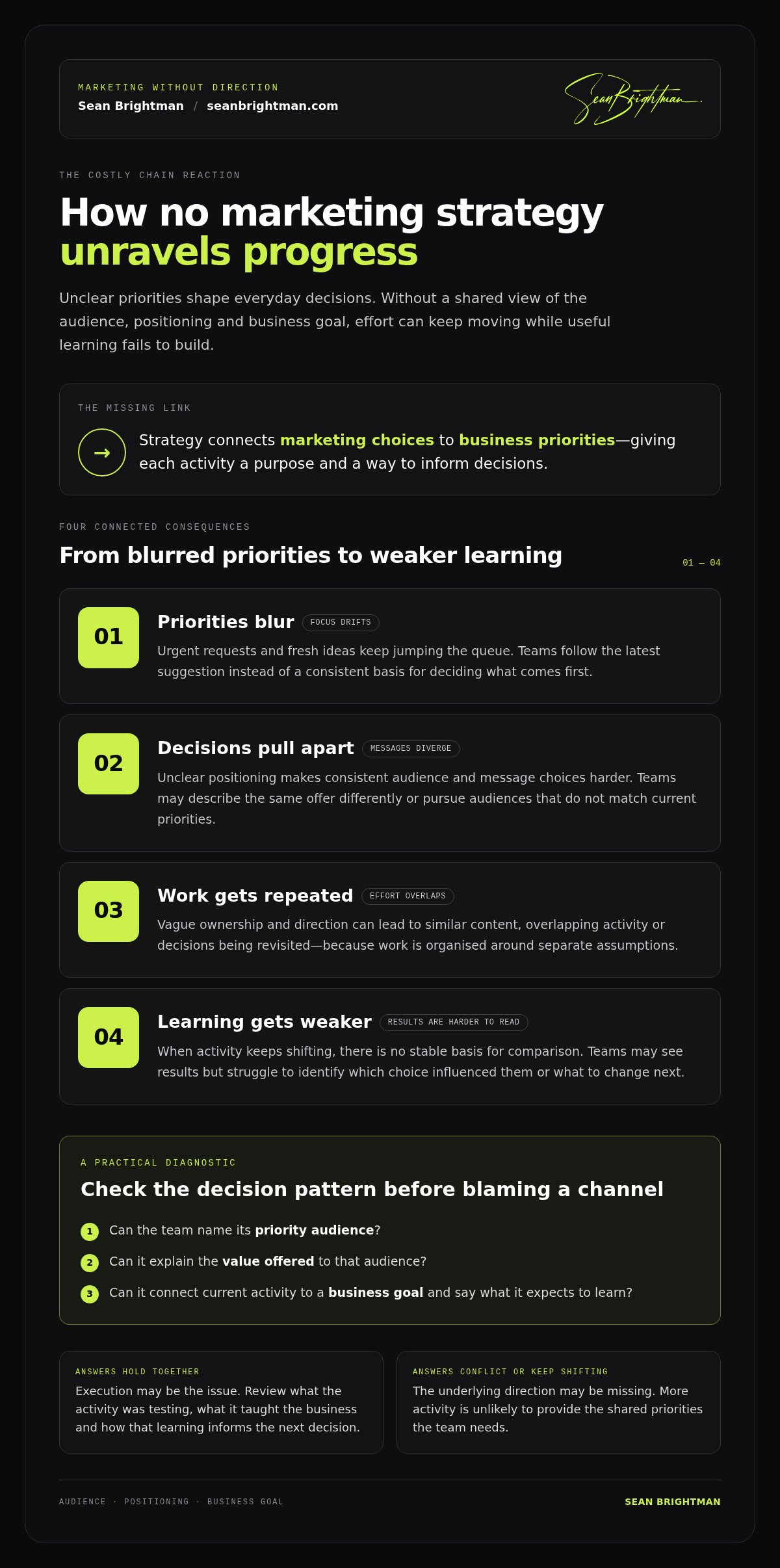
Start with the decision-making pattern, not the channel. Can the team name its priority audience, explain the value it offers them and connect current activity to a business goal? If those answers hold together, execution may be the issue. If they conflict or keep shifting, adding more activity is unlikely to provide the missing direction.
The damage rarely starts with one dramatic mistake. It builds as unclear priorities shape everyday decisions. Without a shared view of the audience, positioning and business goal, each team fills in the gaps differently. One initiative targets new prospects, another focuses on existing customers, and neither has a clear reason to take priority.
Strategy connects marketing choices to business priorities, so each activity has a clear purpose and can inform a decision. Without that link, teams may stay busy while the business struggles to tell whether its effort is moving in a useful direction.
Repeated starts, stops and channel changes absorb attention. A team might begin preparing one campaign, pause it when a new priority appears, then redirect the work elsewhere. Each change can have a sensible trigger, but without agreed criteria, the business spends time and coordination resetting its work.
Unclear ownership compounds the problem. Internal teams and suppliers can produce overlapping work because nobody has set the priority, defined responsibilities or aligned the brief. These are signs of friction, not a reliable basis for claiming a fixed financial loss. A practical first step is to clarify who decides, who delivers and what the activity must support.
Results need a question behind them. If a campaign has no clear objective, a rise in enquiries might look positive without showing whether they came from the intended audience or support a business priority. Data alone can’t supply the missing context.
Frequent changes make interpretation harder still. Change the audience, message and channel together, and a different result won’t tell you which change mattered. Keep a record of the goal, the choices made and the evidence reviewed. Then use that evidence to make a defined next decision, rather than treating every result as a verdict on the whole marketing effort.
If teams can’t agree on the priority or the next decision, strategic oversight can bring those choices into focus. Explore strategic marketing leadership to connect priorities with accountable action.
A marketing problem can start with the direction or with the delivery. Confuse the two and you risk fixing the wrong thing: adding channels won’t settle competing priorities, and rewriting strategy won’t resolve a stalled approval process. Treat the signs as clues, then check them against actual decisions, briefs and delivery.
These signals can overlap. A late campaign might reflect a slow approval process, or leaders who haven’t settled the audience and message. Don’t assign blame from one missed deadline or disappointing result. Look for patterns, and compare what was agreed with what actually happened.
Ask leaders separately to name the priority audience, the position the business wants to occupy and the outcome marketing should support. Then compare their answers. Different wording is normal; conflicting priorities are more telling. Check whether direction changes follow an agreed decision rule, such as new evidence or a shift in business priorities. If not, ask each team to explain why its current activity matters. Vague or contradictory answers point towards a strategy gap.
If leaders agree on direction, test the handover into delivery. Does each priority have an owner, a realistic timeframe and a clear route for decisions or approvals? Find where work stalls: unclear responsibility, delayed feedback or capacity constraints may be the bottleneck. Address that demonstrated problem before adding another channel or revisiting the strategy. The consequences of no marketing strategy differ from poor execution, and the remedy depends on the evidence.
Use a simple diagnostic: write down the agreed priority, the activity meant to support it, its owner and the next decision. If the priority itself is disputed, resolve the strategic question first. If the direction is settled but delivery breaks down, fix the handover. This keeps diagnosis grounded in evidence, not frustration with a particular person or channel.
Don’t respond to uncertainty by launching another campaign. First, pause long enough to see what the business is already doing, what it’s meant to achieve and where decisions are getting stuck. A reset should create direction, not a bigger planning exercise.
Work through these decisions in order:
A strategic brand roadmapping guide can help leaders structure these choices and connect them to a practical direction. The aim isn’t to document every possible tactic. It’s to make the important choices clear enough for teams to use.
Settle the business objective before choosing channels. Then agree who marketing needs to reach and what position or value proposition should guide the message. If leaders disagree, make that disagreement visible and resolve it with the best evidence available. Where evidence is thin, write down the assumption and decide how you’ll test it. This prevents opinion from quietly hardening into strategy.
Give each priority an owner, a next step and a review point. Define what evidence will inform the next decision, such as qualified enquiries or feedback from the intended audience, rather than relying on activity counts alone. Connected processes matter too. The marketing operations growth engine explores how clear processes can support coordinated delivery.
The consequences of no marketing strategy ease when choices become visible and reviewable, not when the plan grows longer. If you need senior strategic guidance to turn diagnosis into accountable action, explore strategic marketing support.
Once the business knows where direction is missing, senior strategic oversight can connect business priorities, positioning, audiences and the decisions that shape marketing activity. The value isn’t another layer of approval. It’s a clear point of accountability, so teams understand why priorities matter, who owns the next move and how evidence will inform what happens next.
The right level of support depends on the gap. A business that needs to set direction may not need ongoing leadership straight away. A team with an agreed plan but no consistent strategic ownership may benefit from support that continues beyond the planning stage.
Choose the format that matches the job to be done. These options address different needs, and none replaces the people responsible for delivering the work.
The distinction is practical: a roadmap sets the route, advisory support helps leaders stay on course, and fractional CMO leadership provides senior oversight as marketing decisions and delivery continue.
Look for better decisions, not instant results. Priorities should be easier to explain, ownership clearer and reviews more useful. Teams should be able to connect their activity to a business objective, then discuss what the evidence suggests without changing direction at the first sign of uncertainty.
These changes create a more disciplined way to manage marketing, but they don’t guarantee a fixed growth result or remove the need for execution. Strategy sets direction; teams still need to deliver, assess evidence and adapt when circumstances change. The consequences of no marketing strategy are less likely to persist when choices have owners, a clear rationale and a regular review.
If your business needs clearer direction and accountability, explore strategic marketing support and identify the level of leadership that fits the challenge.
The consequences of no marketing strategy aren’t fixed. You can interrupt them by stopping the assumption that every new idea is the answer and making deliberate choices about what deserves attention. The next step isn’t to plan everything. It’s to create enough direction for your business to act, learn and adjust with purpose.
That shift may call for a focused roadmap, ongoing advisory support or senior leadership through a Fractional CMO. The right support connects marketing decisions to business priorities and keeps accountability in view, without confusing strategic direction with outsourced advertising execution.
If guesswork is making it harder to decide what comes next, take a step towards clarity. Get clear on your marketing direction and move forward with greater focus.
A business can still attract customers, but its marketing decisions may become harder to coordinate and assess. For example, a strong month of referrals might prompt a sudden shift in attention, even if the business hasn’t established whether referrals can support its future goals. The consequences of no marketing strategy can include missed opportunities to build on useful learning, because activity isn’t guided by a stable set of choices.
Yes. A business can grow through referrals, repeat custom, strong demand or an effective individual campaign. The challenge is making growth more deliberate and repeatable. If success depends on one founder’s network or an unplanned surge in interest, it may be difficult to know what to invest in next. A strategy helps leaders decide which opportunities fit the business, rather than assuming every source of growth should be pursued.
Ask several people involved in marketing to explain, independently, which customers the business most wants to reach and why those customers should choose it. Then compare the answers. If they point to different audiences, offers or priorities, the gap may be strategic. Also check recent decisions: can the team explain why an activity was chosen, or does the answer rely mainly on habit, a competitor’s actions or someone’s preference?
No. A strategy sets the choices and rationale: whom the business wants to serve, what it wants to be known for and how marketing supports its goals. A plan turns that direction into organised work, such as campaigns, responsibilities, timings and resources. A detailed calendar can therefore exist without a coherent strategy. Check that planned activity reflects deliberate choices, not simply a list of tasks waiting to be completed.
No. A strategy can improve the quality and consistency of decisions, but it can’t guarantee sales. Results also depend on factors such as the offer, customer demand, delivery and competitors’ actions. Treat the strategy as a guide for making choices and learning, not a promise of a particular result. If sales don’t move as hoped, review the evidence and consider whether the assumptions, execution or wider business conditions need attention.
Set a regular review rhythm, then revisit the strategy sooner if a major change affects the business, such as a new offer, a shift in customer demand or a change in commercial priorities. A quarterly review can provide a useful routine for checking assumptions and progress, but it isn’t a rule for every organisation. Avoid changing direction in response to every short-term fluctuation; look for evidence that a key assumption or priority has genuinely shifted.
Reading is good. A roadmap is better.