
Your marketing budget isn’t a charitable donation to Silicon Valley. Most CEOs treat it like one. You’re likely watching thousands of pounds leak out of unproven ad sets whilst your team asks for yet another AI subscription. It’s exhausting. You’ve got tool fatigue, zero accountability, and a nagging suspicion that your growth has plateaued despite the spend.
I get it. You want a scalable engine, not a series of expensive experiments. Understanding how to avoid common marketing mistakes in 2026 requires more than a new checklist. It requires a structural overhaul. This is about strategy, not just more noise. We’re moving away from “hope as a strategy” and towards a clinical, results-oriented framework that actually works.
This guide provides the exact roadmap you need to identify and fix the failures stalling your business. We’ll strip away the corporate fluff and focus on building a growth engine that delivers a measurable ROI. You’ll discover how to diagnose your current failures and install a system that generates confidence. It’s time to stop guessing and start leading. Let’s get to work.
A marketing mistake isn’t a broken link or a misspelt subject line. Those are glitches. A real mistake is systemic. It’s building a house on sand. If you want to know how to avoid common marketing mistakes, you must stop looking at tactics and start looking at the architecture. Most businesses operate with a collection of disconnected tools and tired staff. They don’t have a department. They have a mess.
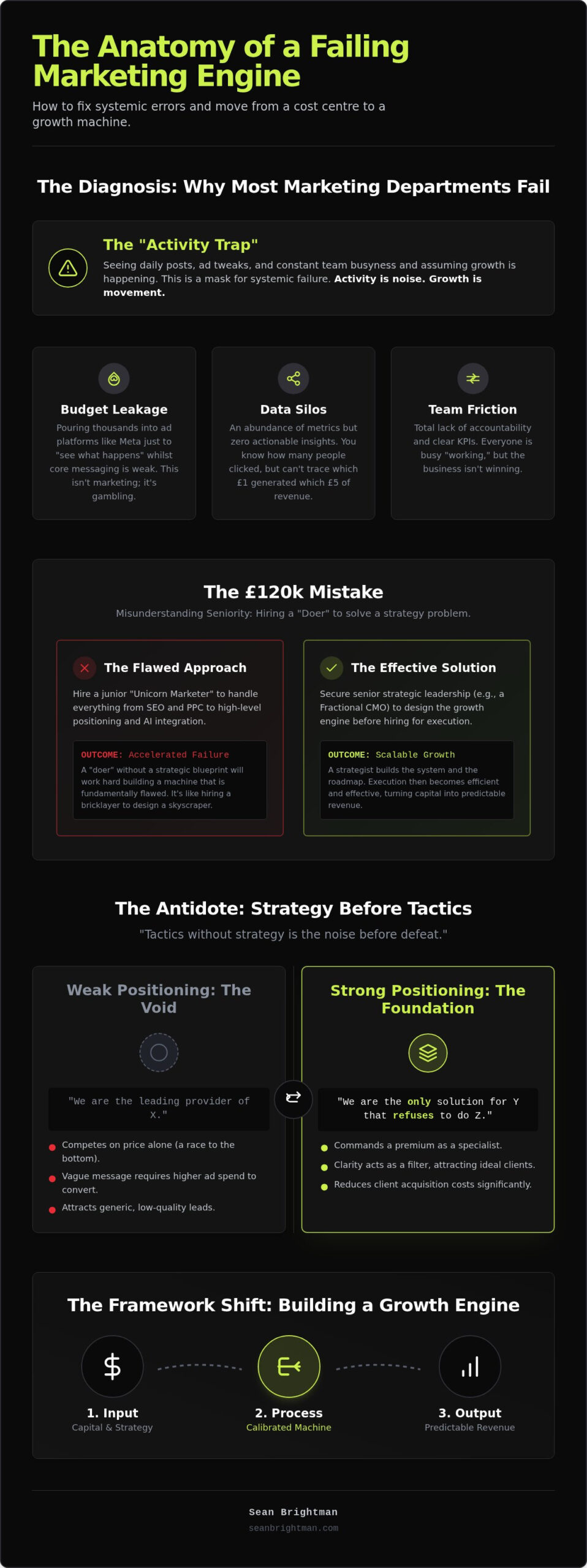
Many CEOs fall into the “Activity Trap.” They see their team posting daily on LinkedIn or tweaking ad copy and assume growth is happening. It isn’t. Activity is noise. Growth is movement. A marketing department is a cost centre that performs tasks. A growth engine is a calibrated machine that turns capital into predictable revenue. One is a drain on your balance sheet; the other is the heartbeat of your business.
The cost of “random acts of marketing” in the competitive 2026 landscape is terminal. You cannot afford to throw £5,000 at Meta ads just to “see what happens.” Without foundational marketing strategy concepts in place, you’re just subsidising Big Tech’s share price. You’re paying for clicks that land on a page that won’t convert because your positioning is weak. That isn’t marketing. It’s gambling.
Budget leakage is the first sign of a leadership vacuum. You’re spending on premium ad placements whilst your core messaging is still “we provide great service.” It’s a waste of money. Then come the data silos. You have plenty of metrics, but zero actionable insights. You know how many people clicked, but you can’t tell me which £1 generated which £5. Finally, there is team friction. Your staff are busy, but there is a total lack of accountability and clear KPIs amongst the ranks. Everyone is “working,” but nobody is winning.
Hiring a junior “doer” to solve a senior strategy problem is a recipe for disaster. It’s like hiring a bricklayer to design a skyscraper. They’ll work hard, but the building will eventually collapse. Many UK scale-ups fall for the fallacy of the “Unicorn Marketer.” They search for one person who can handle SEO, PPC, high-level positioning, and AI integration. This person doesn’t exist. When you hire for execution without providing strategic leadership, you aren’t fixing the problem. You’re just accelerating the failure. You need senior expertise to build the engine, but you don’t necessarily need the permanent overhead. Stop Hiring Full-Time CMOs and start looking for a strategist who can build the system instead of just managing the chaos.
Tactics without strategy is the noise before defeat. Most businesses are incredibly noisy. They’re busy posting, busy emailing, and busy burning through cash on PPC. But they’re standing still. If you want to know how to avoid common marketing mistakes, you have to stop obsessing over the “how” and start defining the “why.” Tactics are just tools. Strategy is the blueprint that tells you which tool to pick up and when to put it down.
You can spot a tactics-first mindset a mile off. It’s the agency that suggests a “TikTok strategy” before they’ve even asked about your profit margins. It’s the team member who wants to “try” a new AI tool because they saw it on LinkedIn. These aren’t growth initiatives. They’re distractions. Research into common marketing mistakes confirms that failing to define a clear value proposition is a primary driver of wasted spend. Without strategic brand roadmapping, you’re just throwing mud at a wall and hoping some of it turns into gold. Spoilers: it won’t.
If you sound like everyone else, you’re competing on price alone. That’s a race to the bottom. Poor positioning is the hidden tax on your lead generation. When your message is vague, your ads have to work twice as hard and cost twice as much to get a click. You need a binary “this, not that” value proposition. Don’t be “the leading provider of X.” Be the “only solution for Y that refuses to do Z.” This clarity acts as a filter. It attracts the right clients and repels the time-wasters. It’s about being a specialist in a world of mediocre generalists. If you’re ready to stop the generic noise, you might want to explore a more direct strategic approach.
A five-year plan is a fantasy in the AI era. You need a 12-month blueprint broken into 90-day sprints. This keeps the team agile whilst maintaining a fixed heading. I call this “Commander’s Intent.” You don’t tell the team exactly how to move every muscle; you tell them what the finished landscape looks like. Every tactical pound spent must align with your long-term exit or growth goal. If a campaign doesn’t move the needle toward that specific outcome, kill it. No sentimentality. No “brand awareness” excuses. Just clinical execution against a documented plan. That’s how you build an engine that actually scales.
Shiny Object Syndrome is the most expensive disease in modern marketing. You don’t need 50 AI subscriptions; you need one coherent system. Most CEOs are currently drowning in tool fatigue, paying for a bloated tech stack that their team barely understands. Learning how to avoid common marketing mistakes in the AI era means looking beyond the dashboard. It requires distinguishing between “AI for efficiency” and “AI for growth.” One saves you ten minutes on a blog post; the other fundamentally changes how you acquire customers.
The danger of automated mediocrity is real. AI-generated fluff is the new spam. If your brand starts sounding like a generic LLM, you’re trading long-term equity for a bit of short-term speed. It’s a bad trade. Customers in 2026 can smell unedited AI content a mile off, and they’ll punish you for it by ignoring your message. To build something that scales, you need AI Consulting in 2026 that focuses on mechanical integration rather than just buying more software.
Implementing ChatGPT without a prompt engineering framework is a waste of time. You’re just generating more noise. Most businesses fail because they don’t audit their existing workflows before adding AI “solutions.” They layer complex tech over broken processes. This creates the “Black Box” problem, where you lose control of your data and your customer journey. You shouldn’t be asking what AI can do; you should be asking what your business needs to achieve and whether AI is the right tool to accelerate that specific outcome. Stop chasing features and start fixing foundations.
A real growth engine uses AI to augment senior decision-making, not just to write tweets. You should be building custom GPTs that actually understand your unique business roadmap and brand voice. This isn’t about replacement; it’s about leverage. The necessity of human oversight remains absolute. The “human-in-the-loop” model is non-negotiable if you want to maintain brand authority and strategic focus. AI is the engine, but a seasoned strategist must remain the driver. Without that senior hand on the wheel, you’re just accelerating in the wrong direction. Focus on high-impact integration that supports your 90-day sprints, and ignore the rest of the noise.
Stop babysitting your team. Start managing the machinery. If you want to know how to avoid common marketing mistakes, you must stop managing people and start managing systems. People are unpredictable; systems are scalable. Your Marketing Operations act as the piping of your growth. If those pipes are blocked by inefficiency or lack of direction, it doesn’t matter how much budget you pour in. You’re just creating a bigger mess.
Marketing efficiency in 2026 isn’t about doing more things faster; it’s about doing fewer things with mechanical precision. You need a framework that provides senior-level accountability without the need for constant micro-management. This is about building a self-sustaining engine that delivers predictable outcomes whilst you focus on high-level business strategy.
Start with a brutal audit. Look at your current spend and identify “zombie” campaigns. These are the legacy ads or social strategies that have been running for months with zero ROI but “look busy.” Kill them. No sentimentality. Next, define your “Only-ness.” If you sound like your competitors, you’re a commodity. You must identify what only you can provide to the market. This binary clarity is the only way to win in a crowded field. Finally, design your first 90-day roadmap. This isn’t a vague wish list. It’s a technical blueprint with clear, binary success metrics. It either worked or it didn’t. There is no middle ground in a growth engine.
Build your tech stack to support the strategy, not the other way around. Most CEOs buy a tool and then look for a problem to solve. That’s a mistake. Your AI and automation tools should be the last things you install, once the process is proven. To keep a remote or fractional team on track, you need a “Weekly Pulse.” This is where an advisory retainer ensures the roadmap stays on track. It provides the external force needed to maintain momentum. Shift your focus from lagging sales data to Lead Indicators. Sales data is a post-mortem. Lead indicators, such as qualified enquiry volume or strategic content reach, are your forecast. If you’re ready to stop guessing and start building, book a strategic roadmapping session today to get your operations in order.
Most CEOs think the solution to a messy marketing department is a full-time hire. It isn’t. A full-time CMO in 2026 often costs north of £150,000 once you factor in benefits and equity. That’s a massive overhead for a role that often gets bogged down in internal politics. The Fractional CMO model is different. It’s senior leadership on tap. You get the strategy, the accountability, and the “get-your-hands-dirty” attitude without the executive bloat. Understanding how to avoid common marketing mistakes starts with acknowledging that you don’t need more employees; you need better systems.
A Fractional CMO acts as a straight-shooting strategist. They have no interest in your internal hierarchy or protecting their desk. Their only goal is to fix the engine. Sean Brightman provides this exact plug-and-play solution. As a battle-hardened expert and AI strategist, he steps in to diagnose the structural failures stalling your growth. This isn’t abstract consulting. It’s tactical precision. You’re paying for outcomes, not attendance.
There is immense value in an external perspective that isn’t afraid to be blunt. Internal teams often suffer from “groupthink” or a fear of challenging the status quo. An Advisory Retainer solves this. It’s the CEO’s best friend for marketing accountability. It moves the conversation from “I hope this works” to “I know this is the right direction.” You stop guessing. You start executing against a validated plan. It’s about having a seasoned professional who has seen these patterns before and knows exactly how to fix them. No fluff. No bureaucracy. Just results.
The transition from chaos to a structured growth engine doesn’t happen by accident. It starts with a strategic roadmapping session. This is where we strip back the noise and define your “Only-ness.” We identify the budget leaks and the tool fatigue that are draining your resources. By the end of the session, you won’t just have a list of tasks. You’ll have a 90-day blueprint with binary success metrics. If you’re tired of watching your marketing budget vanish into unproven ad sets, it’s time to act. Book a strategic roadmapping session today to stop the leak and start building a scalable engine. The machinery of your growth is waiting.
Marketing isn’t a dark art. It’s a mechanical system. If your growth has stalled, it’s because your engine has a structural failure, not because you haven’t bought enough AI tools. You’ve seen that strategy must always precede tactics and that a systemic leadership void is the root of most budget leakage. Moving from a messy department to a calibrated growth engine requires a decisive shift from managing tasks to managing systems.
Mastering how to avoid common marketing mistakes in 2026 isn’t about working harder; it’s about installing senior accountability. You don’t need a £150k full-time executive to fix these problems. You need a straight-shooting strategist who can build the roadmap and ensure the machine is humming. As the author of the definitive guide to brand and AI strategy, I’ve seen these failures before. I know exactly how to fix them.
It’s time to stop guessing. Book Your Strategic Roadmap Session with Sean Brightman to gain direct access to senior Fractional CMO expertise and a proven methodology for building scalable engines. Your business deserves a roadmap that actually delivers. Let’s get your marketing back on track.
The biggest mistake is hiring for execution before defining the strategy. Most CEOs hire a junior manager to “run the ads” without a blueprint. This is why learning how to avoid common marketing mistakes starts with senior leadership. You’re trying to build a house without an architect. You’ll end up with a pile of expensive bricks and no foundation. Fix the strategy first, then hire the hands.
You should typically allocate 10% to 20% of your total marketing budget to strategy and senior oversight. This investment protects the remaining 80% spent on execution. Spending £10,000 a month on ads without £1,500 of strategic direction is a gamble, not a growth plan. Think of strategy as the insurance policy for your execution spend. It ensures every tactical pound moves the needle toward your 90-day goals.
A Fractional CMO is generally better for fixing structural failures because they are platform-agnostic. An agency often wants to sell you more of what they do, whether it is SEO or PPC. A Fractional CMO doesn’t sell advertising; they build growth engines. They provide the blunt, external perspective needed to cut through internal politics and fix the machine whilst the agency just tries to fuel it.
Look for high activity but stagnant growth. If your team is “busy” but your revenue hasn’t moved in six months, your department is messy. Other signs include tool fatigue from too many AI apps and a total lack of accountability. If you cannot tell me exactly which channel is driving profit, you don’t have a growth engine. You have a collection of expensive hobbies.
AI is a force multiplier. It will accelerate your current direction. If your strategy is broken, AI will just help you make mistakes faster and at a larger scale. It creates “automated mediocrity” if you use it to churn out fluff. However, when integrated into a proven roadmap, AI consulting can drastically improve efficiency. Use it to augment senior decision-making, not to replace the need for a human-in-the-loop strategy.
Resistance is usually a symptom of a leadership void. When a team is used to “random acts of marketing,” a structured roadmap feels like a threat to their autonomy. You must shift the focus from managing people to managing systems. Establish “Commander’s Intent” and clear, binary success metrics. Once the team sees that a roadmap provides clarity and reduces chaos, the resistance usually evaporates.
You can diagnose the problem in a single strategic roadmapping session. Fixing the actual engine usually takes one to two 90-day sprints. The first 30 days are about the audit and positioning. The next 60 days focus on systemising the tech stack and establishing the “Weekly Pulse” for accountability. It’s a clinical process, not a multi-year transformation. You want maximum impact in a concentrated timeframe.
Reading is good. A roadmap is better.