
Most companies treat AI like a shiny new toy, but in 2026, a toy won’t save your margins. You’ve likely fallen into the trap of tool fatigue, paying for a dozen subscriptions whilst your marketing department remains a fragmented, uncoordinated mess. Hiring an ai marketing strategy consultant isn’t about adding another line to your software budget. It’s about fixing the chaos. You see the potential for growth, yet the path to a scalable system feels blocked by technical noise and the fear of falling behind competitors who seem to have cracked the code.
We’re moving beyond tactical experiments to create integrated systems that drive measurable brand value and business valuation. It’s not about “using” AI; it’s about building an engine. You don’t need more software. You need a roadmap and senior-level direction that provides accountability without the bloated overhead of a full-time executive. This article outlines how to transition from messy implementation to a high-impact growth engine that actually delivers. We’ll strip away the corporate fluff and focus on the mechanics of strategic AI integration that builds real business value.
An ai marketing strategy consultant is a senior-level architect who designs the systems required to turn raw data into scalable revenue. They aren’t software resellers or prompt engineers. They are strategists who build the machinery that makes marketing work. Most businesses today are drowning in software whilst starving for a cohesive plan. They possess the components but lack the blueprint. This role bridges the gap between high-level brand objectives and the technical execution of Artificial Intelligence in Marketing.
The distinction is simple: strategy, not software. Architecture, not activity. A consultant doesn’t care about your favourite tool; they care about your business valuation. They focus on the integration of systems that drive measurable growth. If your marketing feels like a collection of disjointed experiments, you’re likely suffering from the ‘messy’ department syndrome. This is the number one enemy of AI ROI. Without a central nervous system, AI just creates more noise at a faster rate. You don’t need more activity. You need a growth engine.
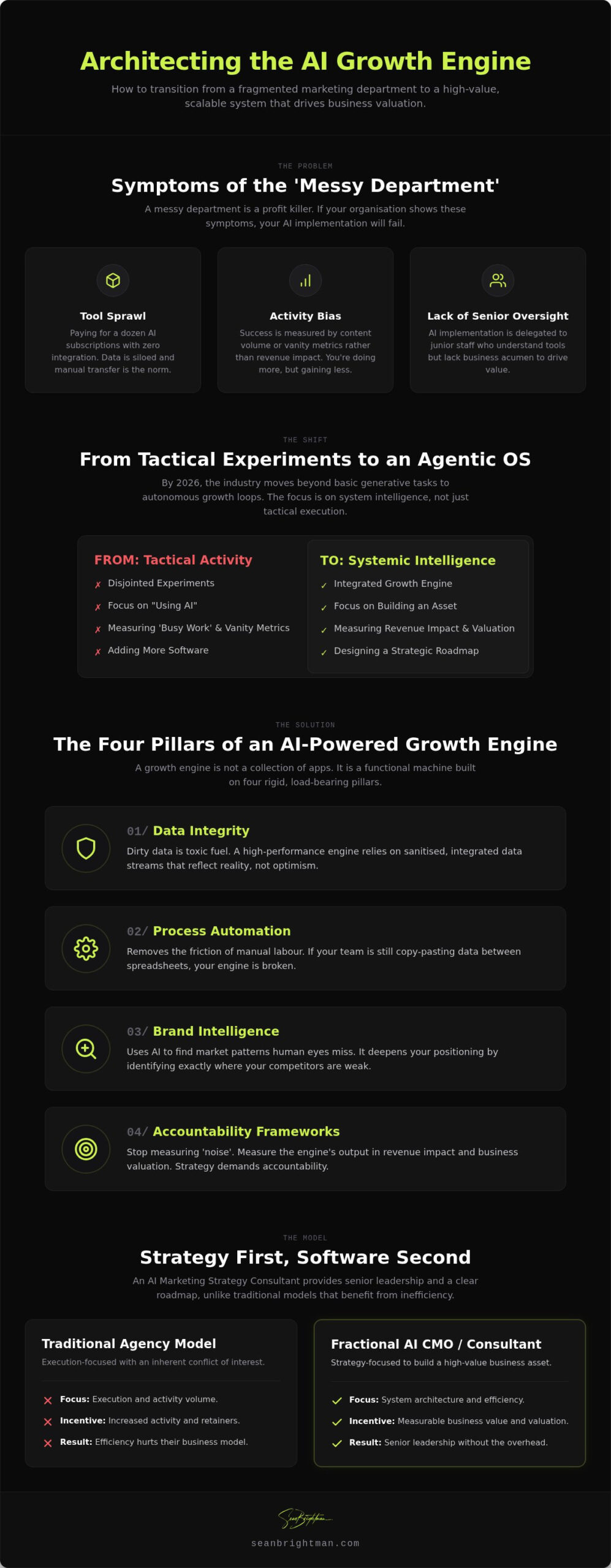
By 2026, the industry has moved beyond basic generative tasks. We’ve entered the era of the ‘Agentic OS’. Marketing operations no longer rely on human-triggered prompts for every action. Instead, they run on autonomous growth loops. This shift represents a move from tactical execution to systemic intelligence. It’s the difference between asking an LLM to write a blog post and building a system that identifies market trends, produces content, and optimises distribution automatically. The ai marketing strategy consultant serves as the lead architect of this modern marketing machine.
A messy department is a profit killer. It hides behind ‘busy work’ and avoids accountability. You don’t need more tools; you need to sanitise your process. If your organisation shows these symptoms, your AI implementation will fail:
You need a fractional CMO or a dedicated consultant to bring order to this chaos. They provide the senior-level direction required to turn messy activity into a scalable growth engine. Stop playing with tools. Start building an engine.
A growth engine is not a collection of apps. It is a functional machine built on four rigid pillars. Without these, your AI efforts are just expensive hobbies. First, you need data integrity. Dirty data is toxic fuel. It causes the engine to seize and produces hallucinations that lead to bad business decisions. A high-performance AI-Powered Marketing Plan relies on sanitised, integrated data streams that reflect reality, not optimism.
Second, process automation removes the friction of manual labour. If your team is still copy-pasting data between spreadsheets, your engine is broken. Third, brand intelligence uses AI to find market patterns that human eyes miss. It deepens your positioning by identifying exactly where your competitors are weak. Finally, you need accountability frameworks. Stop measuring “noise” like impressions or AI-generated content volume. Measure the engine’s output in revenue impact and business valuation. An ai marketing strategy consultant ensures these pillars are load-bearing, not decorative.
A tech stack is a pile of software receipts. A marketing systems architecture is a blueprint for profit. One is a cost centre; the other is an asset. The consultant’s job is to design a system that scales without increasing headcount. This involves mapping every tool to a specific strategic outcome. We build for scale so the business works whilst you sleep. This isn’t about “using AI” to do the same old things. It is about re-engineering the entire operation to favour efficiency over activity. If your current setup requires constant manual intervention, it isn’t a system. It’s a job.
AI is a force multiplier, not a replacement for senior leadership. The machine ends where the strategist begins. You have a binary choice: use AI to copy your competitors faster, or use AI to out-think them. The machine handles the logic, the pattern recognition, and the heavy lifting. The human brings the battle-hardened perspective that no LLM can replicate. This is the “plug-and-play” value of an ai marketing strategy consultant. They provide the steering wheel for the engine. They know when to push the machine and when to rely on gut instinct forged in the field. If you want to move from messy implementation to a structured roadmap, an advisory retainer provides the senior oversight you’re currently missing.
Agencies are built to scale headcount. AI is built to scale output whilst reducing headcount. This is a fundamental conflict of interest that most businesses ignore until it’s too late. Agencies sell execution because that’s where the margin lives. They want to bill you for the “doing.” A strategic ai marketing strategy consultant sells efficiency because that’s where the value lives. They want to build the “being.” If your agency is pitching AI, ask yourself: are they trying to make themselves more profitable, or are they trying to make you more independent?
Most agencies offer “black box” solutions. They hide the prompts, the data flows, and the logic behind a proprietary curtain. This is a strategic risk. If you don’t own the logic, you don’t own the engine. You are simply renting a temporary advantage. Real growth requires ownership. You must own the systems, the data, and the intellectual property that your AI generates. A consultant ensures that the architecture is yours, providing the roadmap whilst leaving the “hands” to whoever is best suited for the task.
Outsourcing your entire AI strategy to a traditional agency is a move towards obsolescence. In 2026, marketing is a technical discipline. If you don’t build internal capability, you are building a house on rented land. True AI consulting isn’t about doing the work for you; it’s about empowering your internal team to run the machine. It involves a transfer of knowledge, not a permanent dependency. You need a partner who helps you sanitise your processes and integrate tools into a unified system that your staff actually understands.
A consultant provides the neutral oversight that agencies cannot. They don’t have a creative department to keep busy or a preferred software vendor providing kickbacks. Their only metric is your business valuation. This objectivity allows you to design an AI marketing strategy that prioritises long-term exit value over short-term campaign noise. Senior leadership must own this roadmap. Delegating your strategic core to a third party is an abdication of duty. You need a battle-hardened advisor who tells you what you need to hear, not what keeps the retainer active. This is about building a functional component for your business, not just another marketing campaign.
Transformation isn’t a vague aspiration; it’s a scheduled delivery. A 90-day roadmap turns a messy marketing department into a precision-engineered growth engine. This isn’t a slow-burn evolution. It is a rapid-fire overhaul in four distinct phases. Phase 1 starts with the efficiency audit, where we find the hidden profit trapped in redundant processes. Phase 2 moves into architecture design. Here, an ai marketing strategy consultant maps specific tools to your overarching business strategy. We don’t buy software because it’s clever; we buy it because it fits the blueprint.
Phase 3 is the pilot implementation. We prove the engine works using your real-world data in a controlled environment. We don’t gamble with your brand; we validate the mechanics. Finally, Phase 4 is the scale-up. We integrate these validated AI systems across the entire department. This transition replaces manual friction with automated flow. By day 90, you aren’t “trying AI.” You are running a machine that generates measurable business value and increases your overall valuation.
Most marketing departments are bleeding cash through “zombie” software subscriptions and redundant roles. An audit reveals exactly where AI should have replaced manual labour months ago. We look for the £120k mistakes: the salaries spent on tasks a machine does better and the tools you pay for but never use. This process exposes the brutal gap between activity and impact. If a task doesn’t move the needle on revenue, it’s waste. We cut the waste to fund the engine.
A roadmap without clear KPIs is just a wish list. Our approach aligns every AI integration with your long-term business exit strategy. We build for the future buyer, not just the current quarter. This requires a shift from tactical fixes to systemic excellence. An ai marketing strategy consultant establishes the Advisory Retainer to ensure ongoing accountability. This isn’t a “set and forget” project. It’s a continuous refinement of your competitive advantage. You need senior-level oversight to ensure the engine doesn’t drift back into chaos. If you’re ready to stop the bleed and start the build, it’s time to book your AI roadmapping session.
Hiring a full-time CMO in 2026 is a legacy solution to a modern problem. For most scale-ups, it is a strategic error. You end up paying for forty hours of “presence” when you actually require four hours of high-impact, senior-level direction. This is why the fractional CMO model is the superior choice for the AI era. It offers the senior authority you need at a fraction of the cost. You get the plug-and-play expertise of an ai marketing strategy consultant who focuses on building your engine rather than managing internal bureaucracy. It is about strategic output, not corporate politeness.
The Advisory Retainer is the vehicle for this ongoing direction. It provides a steady hand on the tiller whilst your internal team executes the roadmap we’ve built together. You aren’t hiring a manager to sit in meetings; you’re hiring a strategist to oversee the machine’s performance. This distinction is critical. One adds layers of complexity; the other adds layers of efficiency. By choosing a fractional leader, you gain access to a battle-hardened expert who has seen your specific chaos before and knows the exact mechanics required to fix it. This approach keeps your organisation lean and your growth scalable.
Founders don’t have time for corporate politicians. They need a straight-shooting strategist who gets their hands dirty in the data. The fractional leader operates with a sense of urgency that full-time hires often lose over time. We focus on building a smarter marketing system that doesn’t rely on a massive headcount to function. In 2026, business success is defined by the intelligence of your systems, not the number of desks in your marketing department. We prioritise high-leverage actions that move the needle on revenue immediately. This is about maximum impact in a concentrated timeframe. It is lean, efficient, and designed to deliver results without the friction of traditional management structures.
An AI-powered growth engine is more than a marketing tool. It is a significant business asset that directly impacts your valuation. When you prepare for a business exit, potential buyers look for turn-key operations that don’t fall apart when the founder leaves. They want a marketing department that runs on logic, automated processes, and clean data. A robust AI architecture increases buyer interest by de-risking the entire marketing function. It transforms your marketing from a messy cost centre into a predictable revenue asset. This makes your business far more attractive to investors and acquirers. If you are ready to stop managing a messy department and start building a high-value machine, book a strategy session to build your growth engine and secure your future valuation.
Marketing in 2026 is a binary choice. You either own a precision-engineered machine or you remain a victim of tool fatigue. We’ve seen why agencies fail. We’ve seen how a 90-day roadmap replaces chaos with accountability. Moving from a messy department to a scalable growth engine requires senior-level intervention. It prioritises your business valuation over software subscriptions. It’s about building an asset, not just running ads.
An ai marketing strategy consultant provides the objective architecture your internal team needs to thrive. As a published author on marketing strategy and a senior Fractional CMO for UK scale-ups, I deliver no-fluff advisory retainers that focus on results. This isn’t about adding more activity. It’s about building a turn-key system that increases buyer interest. Stop renting your competitive advantage. It’s time to sanitise your data, automate your friction, and lead your market with a machine that works whilst you sleep.
Build your scalable growth engine with Sean Brightman and take control of your trajectory.
An ai marketing strategy consultant acts as the lead architect for your marketing machine. They design integrated systems that automate manual friction and turn raw data into scalable revenue. Unlike a tool specialist, they focus on your business valuation and long-term roadmap. Their role involves conducting efficiency audits, designing system architecture, and providing senior-level accountability through an advisory retainer. They ensure your AI implementation aligns with your brand positioning and growth targets.
The difference lies in the conflict of interest between efficiency and execution. Agencies often sell “doing” because they rely on billing for manual tasks and high headcounts. A consultant sells “being” by building autonomous systems that reduce the need for external hands. While agencies provide the execution, a consultant provides the objective roadmap. They act as a neutral advisor, ensuring you own your data and systems instead of renting them from a third party.
Scale-ups benefit most when their internal operations begin to feel fragmented. You don’t need a massive headcount, but you do need enough complexity to justify automation. If you’re paying for multiple software subscriptions or have a messy department, you’re ready. The goal is to build a growth engine that scales without a proportional increase in costs. AI strategy is about preparing your infrastructure for the next stage of business valuation.
ROI is measured through increased operational efficiency and business valuation rather than just campaign clicks. By removing manual friction, you recapture wasted salary spend and eliminate redundant software costs. A structured roadmap identifies the “£120k mistakes” where human labour is being misapplied. The long-term return comes from building a turn-key asset that is attractive to future buyers. It’s about moving from a cost centre to a predictable revenue machine.
Yes, the primary goal is to empower your internal team to run the machine. A consultant doesn’t replace your staff; they provide the senior-level direction and technical blueprint they lack. Through a transfer of knowledge, your team learns how to manage AI-powered growth loops effectively. This reduces dependency on expensive external agencies whilst increasing the high-value output of your existing employees. It turns your team from “doers” into “directors.”
A Fractional CMO provides senior leadership at a fraction of the cost of a full-time executive. In the UK, this is typically delivered via a day rate or a monthly advisory retainer. You avoid the bloated overhead of a high salary whilst gaining battle-hardened expertise. This model allows scale-ups to access high-level strategy without the long-term commitment of a permanent hire. It is a plug-and-play solution for businesses that value impact over presence.
A messy department is the perfect starting point for an efficiency audit. We begin by ruthlessly identifying “zombie” software and redundant processes that drain your budget. The 90-day transformation roadmap is designed to bring order to this complexity by sanitising your data fuel and integrating your tools. We strip away the corporate fluff and activity bias. The result is a clean, automated system that provides clear accountability and measurable brand growth.
You’re ready when tool fatigue sets in and your marketing feels uncoordinated. If you’re paying for AI subscriptions but haven’t seen a shift in your margins, your architecture is broken. Readiness is defined by a desire to move beyond tactical experiments toward a systemic growth engine. If you’re looking for senior-level direction and a clear roadmap to increase your business valuation, you’re ready for an ai marketing strategy consultant.
Reading is good. A roadmap is better.