

91% of marketers are currently burning budget on AI, yet only 41% can prove a single penny of ROI. That is a massive, expensive gap. Using ai for competitive advantage in marketing is not about collecting software subscriptions. It is about building a system. Most leaders are drowning in tool fatigue whilst their competitors claim to be moving faster. You feel the pressure to innovate, but you lack the senior strategic direction to make it stick. You want results, not more research projects.
It is time to stop playing with prompts and start building a growth engine. You need a defensible edge, not a longer list of logins. Strategy, not software. This guide moves beyond the hype to deliver a pragmatic framework for AI integration that actually scales. We will explore how to transition from tool-led chaos to a strategic, intelligence-led marketing system that secures your market position for 2026 and beyond. This is about tactical precision, not abstract theory.
AI for competitive advantage in marketing is not a collection of ChatGPT prompts. It is the use of machine intelligence to build a defensible, non-commodity market position whilst stripping away operational friction. Most businesses treat AI as a bolt-on. They are wrong. In 2026, the era of experimental AI is dead. We have entered the age of strategic AI. If your AI usage doesn’t create a gap between you and your rivals that they cannot easily close, you are just spending money to stay in the same place.
Strategic differentiation is the goal. Tactical automation saves time; strategic differentiation wins markets. Artificial intelligence in marketing has evolved from simple algorithms to complex systems that shift the centre of gravity from creative execution to strategic oversight. You aren’t just making content faster. You are making better decisions. With 91% of marketers now using AI, the “early adopter” advantage is gone. Now, the winner is the one with the best architecture.
Successful systems rely on three specific mechanics that turn raw technology into a market edge:
A messy marketing department cannot be fixed with more software. Adding AI to a broken process only results in faster failure. Many leaders suffer from “shiny object syndrome,” buying every new app that promises a silver bullet. This is a tactical error that leads to fragmented data and wasted budget.
Advantage comes from systems architecture, not individual app subscriptions. You need an engine, not a pile of parts. Stop looking for the next tool. Start looking for the strategic framework that integrates intelligence into your core operations. This is about building a growth engine that is hard to copy and impossible to ignore. It requires senior oversight to ensure your tech stack serves your strategy, not the other way around.
Your marketing strategy is the operating system. AI is just the hardware. If your OS is buggy, the hardware is useless. To build a 2026 growth engine, you must stop treating AI as a series of disconnected apps. You need a unified architecture. This starts with a data foundation that AI can actually use to generate value. Most businesses have data siloes that make machine learning models hallucinate or fail. You need clean, structured inputs. Without them, you are just guessing at high speed. Strategy first, tech second.
Integration must span the entire customer journey. From the moment of discovery to long-term retention, AI should be the connective tissue. It manages the hand-off between awareness and conversion. It predicts churn before it happens. This is how you use the future of AI in marketing to create a seamless, high-velocity experience. Your team must organise around these intelligence-led workflows. Shift their focus from manual execution to strategic oversight. They shouldn’t be writing every individual email; they should be training the engine that writes them.
Start by mapping your current engine. Identify the friction points where human effort is high but value is low. These are your AI-ready targets. Build a “plug-and-play” infrastructure that allows you to swap out specific AI models as the technology evolves without breaking your entire system. Consistency is non-negotiable. Use generative tools to scale, but keep your brand voice under tight human control. If you need a blueprint for this transition, an AI roadmapping session can provide the tactical clarity you lack.
AI excels at finding “white space” in crowded markets. It can process thousands of competitor reviews and social signals to find the gaps your rivals missed. Use these insights to refine your Strategic brand roadmapping. This isn’t about gut feeling; it is about data-backed positioning. Validating your value proposition through AI-driven sentiment analysis ensures your message hits the mark every time. This is the core of leveraging ai for competitive advantage in marketing. You aren’t just shouting louder; you are speaking more precisely to a market that is already looking for your solution. Precision is the new scale.
AI is a mirror, not a miracle worker. If your marketing data is messy, AI simply multiplies that mess at a speed your team cannot manage. This is the “Garbage In, Garbage Out” reality that most leaders ignore. They expect a tool to fix a broken process. It won’t. In fact, by September 2026, the gap between AI activity and actual accountability has widened, with only 41% of marketers able to prove the ROI of their initiatives. You don’t need more software; you need a better engine.
Hiring an agency to “do AI” for you is a tactical mistake. Agencies are built for execution, not for re-architecting your business model. When you outsource your AI strategy, you outsource your core intelligence. This leads directly to the commoditisation trap. If you use the same tools as your competitors to produce the same type of content, you end up looking exactly like them. You become a commodity. To use ai for competitive advantage in marketing, you must own the roadmap and the senior accountability that comes with it. Someone in the boardroom must own the machine.
Tools are tactical; strategy is direction. A tool tells you how to automate a task, but strategy tells you why that task matters to your bottom line. Buying a ChatGPT Plus subscription is an expense, but building an AI marketing roadmap is an investment in a defensible asset. Stop focusing on becoming a “content factory” that churns out 42% more volume just because the technology allows it. Focus on building a growth engine that uses intelligence to find higher-quality leads and convert them faster. Strategy is the operating system; the tools are just the peripherals.
Many businesses over-invest in execution tools before they have defined their strategic goals. This is a recipe for tool fatigue and wasted budget. Avoid these common errors:
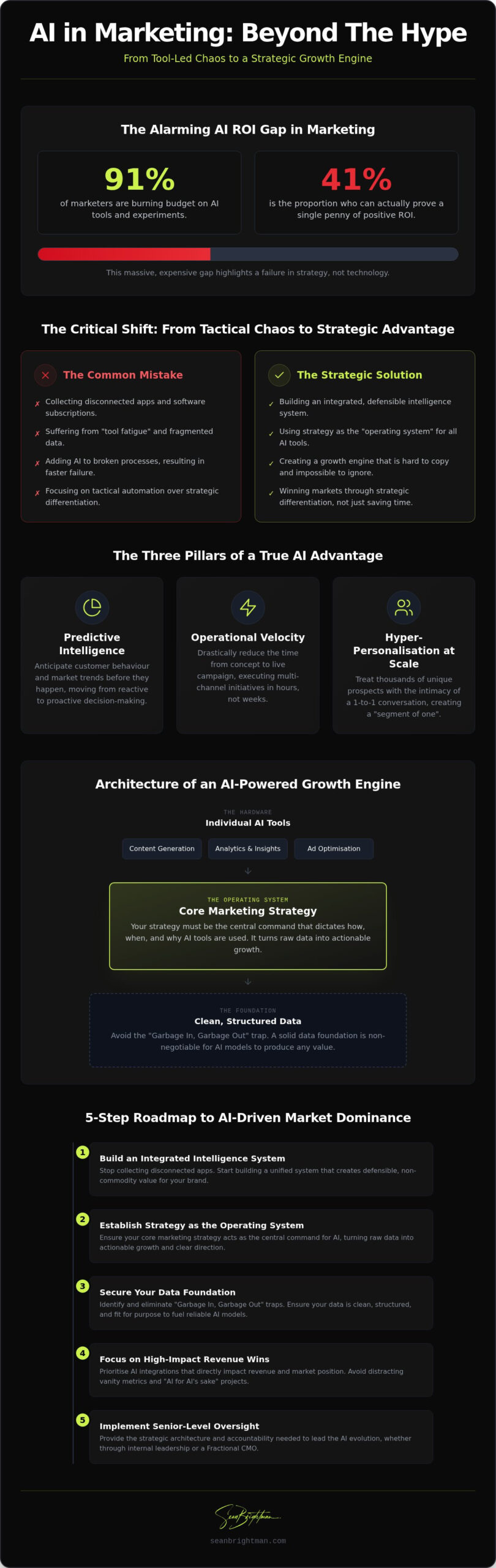
Market leadership is not accidental. It is engineered. To achieve ai for competitive advantage in marketing, you need a battle-hardened framework that moves from theory to revenue. Most organisations stall because they treat AI as a series of disconnected experiments. You must treat it as a factory. This roadmap is designed to strip away the fluff and build a system that delivers a genuine market edge whilst your competitors are still struggling with their logins.
You cannot build on a swamp. You need a marketing operations consultant style audit of your existing tech stack and workflows. Identify exactly where human effort is being wasted on low-value repetition. Benchmark your current efficiency against 2026 industry standards. This isn’t about finding tools you like; it is about identifying the friction points where AI can reduce costs or increase output immediately. If a tool doesn’t move the needle, it doesn’t stay.
Do not try to automate everything at once. Select two or three core use cases that will drive a measurable gap between you and your rivals. Create a clear ROI framework for each initiative. Every AI project must align with your overall business exit or growth targets. If you are aiming for the 22% higher ROI typical of AI-driven campaigns, your engine must be specifically tuned for that outcome. This is about revenue, not vanity metrics. Precision beats volume every single time.
Execution is where most plans die. You must roll out your AI tools whilst maintaining strict brand guidelines to avoid the trust erosion seen across the market. Use an Advisory Retainer to ensure the roadmap stays on track and your team remains accountable. Accountability is the lubricant that keeps your growth engine running. It ensures that “moving fast” doesn’t mean “moving recklessly.”
The final stages of the roadmap involve scaling your validated workflows across the entire organisation and continuously optimising for strategic velocity. This is how you move from a pilot project to a total market takeover. You don’t just use AI; you become an AI-first marketing operation. Ready to stop guessing and start winning? Book an AI roadmapping session to build your defensible growth engine today.
AI is a force multiplier, but it requires a hand on the throttle. You don’t need a technician to lead your transformation; you need a strategist who understands the machinery of growth. To achieve ai for competitive advantage in marketing, senior-level direction is mandatory. However, most scale-ups cannot justify the £150k+ overhead of a full-time hire who spends half their day in internal meetings. You need high-impact intervention, not a permanent seat in the office. A Fractional CMO acts as the architect of your intelligence system, building a legacy of structured data and automated workflows that increases your business valuation.
The “Fractional Revolution” is here because it delivers senior-level AI consulting at a fraction of the cost. Hiring a fractional CMO gives you access to a battle-hardened expert who has seen these systems fail and knows exactly how to make them succeed. This is the role of the “straight-shooting strategist.” Whilst internal teams are often bogged down by legacy processes and a fear of being replaced by algorithms, an external strategist cuts through the noise. They provide the accountability that internal teams often lack. They don’t care about internal politics; they care about the velocity of the growth engine. It is about tactical precision, not corporate politeness.
A clinical growth machine is built in ninety days, not nine months. In the first three months of an AI-led strategy, the focus shifts from experimental chaos to operational order. You move from a messy marketing department to a streamlined operation where every intelligence tool serves a documented, revenue-driving purpose. This transformation directly impacts your business valuation. In 2026, investors and buyers don’t just look at your current revenue; they look at the defensibility of your systems. A business powered by a proprietary, intelligence-led architecture is worth significantly more than one relying on manual, non-scalable labour. You are building a defensible asset, not just a marketing department. This is how you prepare for a high-value exit whilst securing ai for competitive advantage in marketing today. Structure creates value. Speed creates dominance.
The gap between the leaders and the laggards is widening. Using ai for competitive advantage in marketing isn’t about the size of your tech stack; it’s about the precision of your architecture. You’ve seen the roadmap. You understand that strategy must be the operating system for your intelligence. Now, you have a choice. You can continue drowning in tool fatigue, or you can build a defensible system that rivals cannot copy. Success requires movement.
Advantage comes from senior accountability and a clinical focus on revenue. Stop treating AI as a side project and start treating it as your core infrastructure. Through direct strategic advisory and battle-hardened expertise, you can strip away the corporate fluff and move from experimental chaos to a high-velocity growth machine. The technology is ready. The question is whether your leadership is prepared to execute.
Stop playing with tools and start building your growth engine—book an AI roadmapping session today.
The market waits for no one. Start building your future now.
AI creates a gap by automating the mundane and supercharging the strategic. It allows for hyper-personalisation at a scale that manual teams cannot match. By using ai for competitive advantage in marketing, you move from reactive tactics to predictive intelligence. You aren’t just shouting louder; you are speaking more precisely. This creates a defensible position that rivals, who are likely just using AI for basic content generation, cannot replicate.
The primary risk is the “Garbage In, Garbage Out” trap. If your data foundation is messy, your AI outputs will be flawed. There are also significant legal risks in 2026, such as FTC penalties of up to $53,088 per violation for undisclosed AI content and new EU transparency rules. Relying on tools without senior strategic oversight leads to brand commoditisation. You end up sounding like everyone else whilst potentially alienating customers.
No, you need a strategy, not a massive war chest. Many high-impact AI tools operate on hybrid or usage-based pricing models that scale with your business. The real cost isn’t the software; it’s the wasted time spent on tools that don’t serve a clear purpose. A focused roadmapping session can identify the 20% of AI initiatives that will drive 80% of your revenue growth. Start small, validate the ROI, and then scale.
A Fractional CMO acts as the architect of your growth engine. They provide the senior leadership and accountability required to integrate AI into your core operations without the £150k+ overhead of a full-time hire. They cut through the hype to identify which technologies actually drive market share. By focusing on strategic advisory, they ensure your team stays focused on high-value tasks whilst the machine handles the heavy lifting and repetition.
Automation is about doing things faster; strategy is about doing the right things. Automation might help you publish 42% more content each month, but without strategy, that content might not convert. Strategy defines the “why” and the “how” of your system. It ensures that every tool in your stack is working toward a specific business goal. Automation is the engine, but strategy is the GPS that ensures you don’t drive off a cliff.
Absolutely. AI excels at processing vast amounts of competitor data and customer sentiment to find “white space” in the market. It can validate your value proposition against thousands of social signals in minutes. This data-backed approach removes the guesswork from your strategic brand roadmapping. You can refine your messaging to hit exactly what the market is missing, giving you a sharp, defensible edge that gut feeling alone cannot produce.
Expect to see operational shifts within the first 30 days and measurable revenue impact within 90 days. A clinical 90-day transformation moves your department from tool-led chaos to a structured growth machine. Initial wins usually come from stripping away friction in your content and lead-generation workflows. Once these systems are validated, the compounding effect of scaled intelligence begins to drive significant market dominance and increased business valuation.
SMEs actually have the most to gain from ai for competitive advantage in marketing. Large enterprises are often bogged down by bureaucracy and legacy tech that makes AI integration slow and painful. SMEs are agile. They can implement a strategic roadmap and pivot their workflows in weeks. Machine intelligence levels the playing field, allowing smaller teams to produce the output and impact of a much larger organisation without the massive headcount.
Reading is good. A roadmap is better.