
Eighty per cent of AI projects fail. This isn’t a technical glitch; it’s a leadership failure. Most CEOs are currently building “toy boxes” full of shiny apps rather than actual growth engines. You’ve likely felt the tool fatigue already. Your marketing department is a mess of disconnected prompts and your budget is leaking into experiments that don’t scale. You’re paying for ai consulting services that deliver abstract theories instead of functional machinery.
It’s time to stop playing with tools and start building a scalable, AI-powered system that delivers actual ROI. You need a strategist, not a coder. This guide provides the blueprint to move from chaotic experiments to a clinical, automated growth engine that runs without you. We will break down the 2026 roadmap for fractional leadership, the shift towards agentic AI workflows, and how to slash overheads whilst your competitors are still stuck in the “prompt engineering” phase. We’re building a system, not a hobby.
In 2026, the UK market is flooded with “AI experts” who are little more than prompt engineers in expensive suits. Real ai consulting services aren’t about teaching your team how to use a chatbot. They are about the strategic integration of intelligence into every gear of your business machinery. Think of it as the difference between buying a bag of random car parts and commissioning a high-performance engine. One is a technical capability; the other is a commercial outcome.
Effective ai consulting services replace chaotic experimentation with clinical systems. Most CEOs are currently suffering from “toy box” syndrome. They have a collection of shiny apps that don’t talk to each other and don’t drive revenue. A strategy-first approach ignores the hype and focuses on the architecture. It treats Artificial intelligence as a functional component of your growth engine, not a magic wand. Ultimately, AI consulting is the bridge between raw technology and business profit.
The phase of “let’s see what this does” is over. For serious UK businesses, experimentation has been replaced by the need for scalable growth engines. In 2021, you might have automated a few emails. In 2026, you’re using predictive engines to anticipate market shifts before they happen. This requires senior leadership. If the CEO isn’t steering the AI, the technology is just accelerating your existing inefficiencies. The “AI toy box” is a distraction; a growth engine is an asset.
Professional advisory isn’t a vague chat over coffee. It is a clinical process designed to find the hidden profit in your current mess. It involves stripping away the fluff and installing components that actually move the needle. A modern framework focuses on three pillars:
This isn’t about adding more work to your plate. It’s about building a system that runs with less manual intervention and higher precision. You aren’t hiring a coder to build an app; you’re hiring a strategist to build a business that scales without you.
Between 70% and 90% of enterprise AI projects fail to deliver their intended value. This isn’t a technical glitch or a coding error. It is a leadership vacuum. When you outsource your intelligence to a junior team or an external agency without a clear directive, you get a “toy box” of expensive gadgets rather than a commercial result. Professional ai consulting services recognise that technology is only 20% of the solution; the rest is senior strategic ownership. If the CEO isn’t steering the machine, the machine is just wasting money at a faster rate.
CEOs are currently drowning in tool fatigue. Your marketing department is likely a bloated mess of disconnected subscriptions that don’t communicate with each other. This is the “plug-and-play” myth in action. True integration is mechanical. It requires stripping the engine down and rebuilding it around a central logic. An agency will happily bill you for “content creation” prompts. A consultant will tell you why your current process is broken and how to fix the underlying architecture. Agencies sell hours; consultants sell outcomes.
Many UK businesses waste thousands of pounds every month on uncoordinated AI subscriptions. They have one tool for copy, another for images, and a third for data analysis, yet nothing is integrated. This is a hobby, not a business strategy. To survive 2026, you must stop playing with apps and start building a scalable growth engine. Whilst global initiatives like the National Artificial Intelligence Initiative focus on macro-level strategy, your focus must be on the micro-level architecture of your marketing operations. Professional ai consulting services move you from tactical prompts to strategic systems that protect your margins.
Your staff are likely terrified. They see AI as a replacement for their livelihoods rather than an augmentation of their skills. This fear creates friction that can stall even the best implementation. You cannot install a high-performance system if your team is quietly sabotaging the gears. Overcoming this requires a culture of AI-powered accountability. They need to see that the machine handles the drudgery so they can handle the strategy. Before you buy a single new tool, you must establish a Marketing Strategy Roadmap. This provides the clarity your team needs to stop worrying about displacement and start focusing on high-value output.
If you are tired of the fluff and ready for a clinical audit of your operations, it might be time for a Fractional CMO roadmapping session to identify your specific gaps.
Most “AI consultants” are simply tech enthusiasts with a subscription and a LinkedIn premium account. They lead with tools because they don’t understand business. Choosing the right ai consulting services requires you to look past the technical jargon and focus on commercial experience. If a consultant cannot explain how their implementation protects your gross margin or shortens your sales cycle, they are a hobbyist, not a strategist. You need someone who understands Building an AI Business Strategy, not just someone who can write a clever prompt.
A massive red flag is the “AI-first” agency with zero marketing background. These firms often suggest “60+ use cases” for AI in your business. This is a recipe for chaos. A battle-hardened expert knows that 57 of those use cases are distractions. You only need the three that drive revenue and lower overheads. This is why a Fractional CMO who owns the AI strategy is often more valuable than a dedicated technical firm. They prioritise brand positioning and customer behaviour whilst using AI as the mechanical lever to scale those efforts.
The “Big Four” firms offer safety and massive reports, but they move at a glacial pace. You’ll pay for a 200-page slide deck that is obsolete by the time it’s delivered. Boutique ai consulting services provide direct access to senior minds and rapid, clinical implementation. For a UK scale-up, the choice is clear. You don’t need a corporate safety net; you need a strategic partner who isn’t afraid to be blunt about your current inefficiencies and fix them in weeks, not years.
When interviewing potential partners, ignore their tech stack. Focus on their operational logic. Ask these questions to separate the theorists from the practitioners:
The wrong first question is “What tools do you use?” The right question is “How will this change our unit economics?” If they start talking about specific apps before they’ve audited your workflow, end the meeting. They are trying to sell you a tool, not a solution. You are looking for a architect who can design the machinery of your future growth.
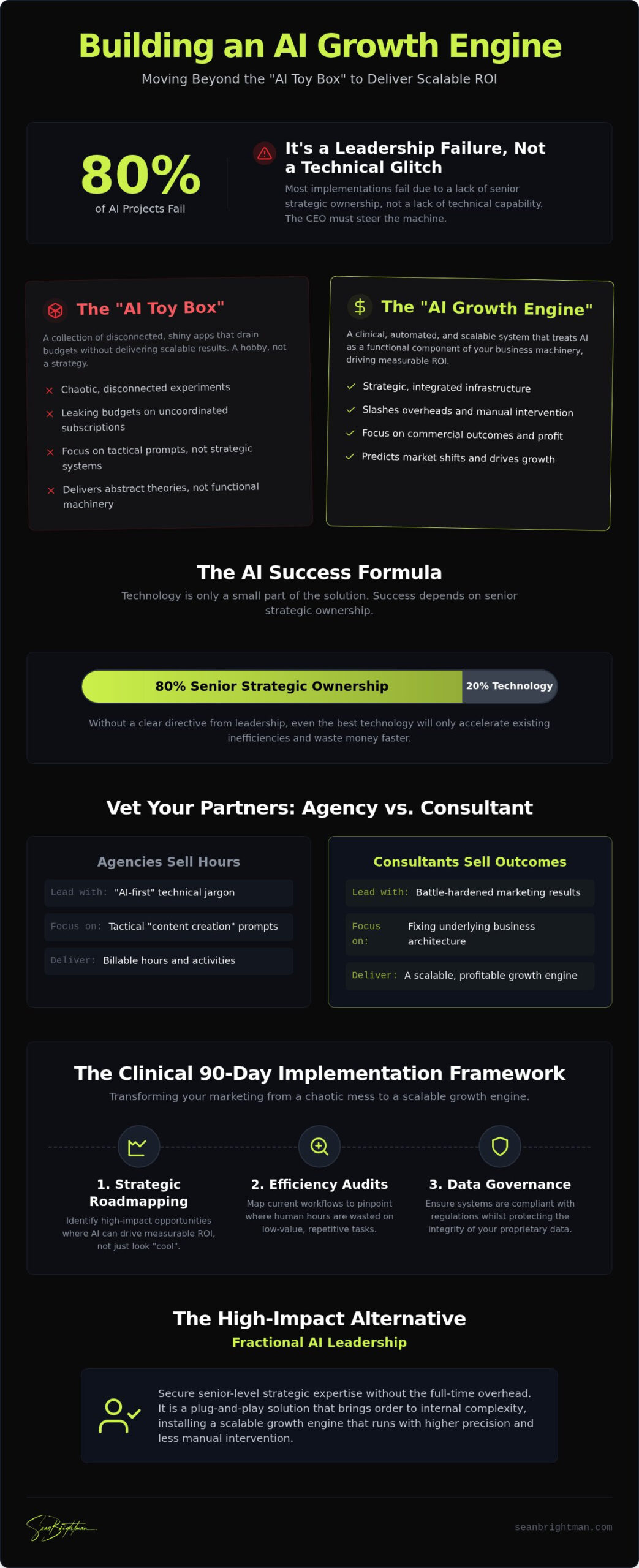
Strategic transformation doesn’t happen by accident. It happens through clinical execution. Most ai consulting services fail because they lack a structured delivery model. You don’t need a year-long project plan; you need a 90-day sprint to replace manual friction with automated precision. This framework is designed to strip away the “toy box” mentality and install a functional growth engine that delivers measurable ROI. We move from audit to advisory in three distinct phases.
The first month is about finding the hidden profit in your current mess. We map every marketing workflow to identify where your team is wasting hours on low-value drudgery. This isn’t a vague observation; it’s a mechanical teardown of your operations. We evaluate your existing tech stack for redundancy, often finding that businesses are paying for multiple subscriptions that perform the same task. By setting a baseline for AI-driven ROI early, we ensure every subsequent move is commercially justified. You aren’t just buying tech; you’re buying back time.
Once the audit is complete, we move into the AI implementation for marketing phase. This is the architectural design of your future growth. We integrate Large Language Models (LLMs) into your lead generation and customer journeys to create a seamless, automated experience. This involves developing custom GPTs or internal intelligence hubs that store your brand’s unique logic. Crucially, every output must align with strategic brand roadmapping. If the AI doesn’t sound like your brand, it’s a liability, not an asset.
The final phases focus on tactical execution and ongoing advisory. We deploy high-impact tools with clear KPIs, ensuring your team knows exactly what success looks like in a post-AI landscape. This isn’t a “set and forget” solution. It requires iterative growth and senior-level accountability to ensure the system remains efficient as the market shifts. You need a partner who stays in the trenches with you, adjusting the gears as your business scales and the technology evolves. We don’t just hand over a manual; we manage the machine.
If you’re ready to stop the budget leak and start building, book a Fractional CMO roadmapping session to begin your 30-day audit.
Hiring a full-time AI Director in 2026 is a commercial mistake for most UK scale-ups. You will likely pay upwards of £150,000 per year plus benefits for a role that might be obsolete in twenty-four months. This is the old way of thinking. High-impact ai consulting services now operate on a fractional basis. It is a plug-and-play model. You get senior-level strategic authority without the deadweight of a permanent executive salary. It is about precision, not presence. You are buying an outcome, not an employee.
A fractional consultant acts as an external force for internal order. Your team is busy with the daily grind and lacks the headspace to re-engineer their own workflows. They need a strategist to step in, identify the bottlenecks, and enforce the new architecture. The Advisory Retainer is the ultimate accountability tool. It ensures the strategy doesn’t just sit in a slide deck. It ensures the engine actually gets built and remains efficient as the technology shifts.
Speed is the only currency that matters in a post-AI market. Fractional leadership allows you to fix the engine whilst it is running. You aren’t waiting for a six-month recruitment cycle or a three-month notice period. You get immediate access to battle-hardened expertise. This model focuses on strategic direction and team accountability. It is about moving the needle now, not eventually. You pay for results, not hours spent in meetings. It is a lean, clinical approach to business growth that scales with your needs.
Transformation doesn’t require a leap of faith. It starts with a one-off Roadmapping session. This is a low-risk entry point designed to audit your current mess and provide a clinical plan for ai consulting services. From there, the advisory retainer ensures the strategy actually sticks. You get direct, blunt honesty. I will tell you what you need to hear, not what you want to hear. If your current marketing operations are a bloated liability, we strip them back. If your team is resisting the shift, we address it. Order from chaos. Precision over fluff. Let’s build your growth engine.
The “toy box” phase of AI is over. Successful UK scale-ups in 2026 don’t win by having the most apps; they win by having the most efficient machinery. You’ve seen why senior-level strategy is the only variable that prevents implementation failure. You know that a 90-day roadmap is the difference between a budget leak and a scalable asset. Professional ai consulting services should deliver order, not just more options.
It’s time to move from tactical prompts to a clinical growth engine that runs without your daily input. As a Fractional CMO and author of “The Book” on marketing strategy, I specialise in building profit-driven systems for leaders who have no patience for bureaucracy. We strip away the fluff and install the components that actually drive revenue. We build engines, not hobbies.
Don’t let your marketing operations remain a chaotic liability whilst your competitors automate their advantage. Book your AI Roadmapping session with Sean Brightman today and start building a system that scales. The future belongs to the architects, not the experimenters. Let’s get to work.
ai consulting services for SMEs focus on identifying high-impact automation opportunities and building custom internal intelligence hubs. It includes a clinical audit of your current marketing tech stack to eliminate redundancy. Instead of just suggesting tools, a consultant designs a bespoke architecture that connects your CRM, content production, and lead generation into a single, automated growth engine. It is about building functional machinery, not just offering advice.
UK scale-ups can expect a wide range of pricing depending on the firm’s seniority. Boutique firms often charge between £150 and £300 per hour, whilst comprehensive diagnostic assessments can range from £8,000 to £20,000. Monthly retainers for fractional leadership usually fall between £2,000 and £7,000 depending on the complexity of the implementation. You are paying for strategic velocity and the avoidance of expensive project failures.
You should expect to see measurable efficiency gains within the first 30 to 60 days. This typically manifests as a significant reduction in manual human hours spent on drudgery like data entry or first-draft content creation. Full commercial ROI, including lower customer acquisition costs and higher lead conversion rates, usually takes 90 to 180 days as the system gathers data and the automated growth engine begins to reach peak performance.
No, you don’t need to hire a full-time specialist if your consultant builds the system correctly. The goal of professional ai consulting services is to create a “plug-and-play” infrastructure that your current marketing team can operate. A consultant provides the senior-level architecture and oversight, whilst your internal staff focus on high-value strategic output. This prevents the £150,000+ overhead of a permanent AI Director.
AI consulting is a powerful tool for brand positioning. Beyond simple automation, consultants use predictive engines and sentiment analysis to identify exactly where your brand sits in the market. This data allows you to refine your messaging with clinical precision. Automation then ensures that this refined positioning is deployed consistently across every touchpoint in the customer journey, from initial ad copy to long-form nurturing sequences.
An AI agency usually sells execution and billable hours for specific tasks like prompt engineering or video generation. An AI consultant sells strategy, architecture, and commercial outcomes. Agencies focus on doing the work; consultants focus on building the system so the work happens automatically. You hire an agency when you need a pair of hands; you hire a consultant when you need a brain to design the machine.
You get immediate clarity from the moment the roadmapping session concludes. You will have a clinical list of exactly what is broken and how to fix it. Physical results, such as automated lead nurturing or predictive analytics, typically take 90 days to fully integrate and test. This timeframe ensures the system is robust, compliant with UK regulations, and aligned with your proprietary brand voice before it goes live.
It is arguably more critical for B2B firms with long sales cycles. AI consulting helps these businesses implement sophisticated lead scoring and automated “always-on” nurturing sequences that stay in front of prospects for months without human intervention. This ensures no lead is dropped during a six-month decision process. It turns a manual, leaky sales funnel into a precise, automated pipeline that prioritises high-value accounts.
Reading is good. A roadmap is better.